IPSS Score: What Your Number Means and What Comes Next
Two men can hand me the same IPSS score of 18 and need opposite treatment. Here is what your number actually decides, what it cannot see, and how far it has to fall before you would notice a difference.

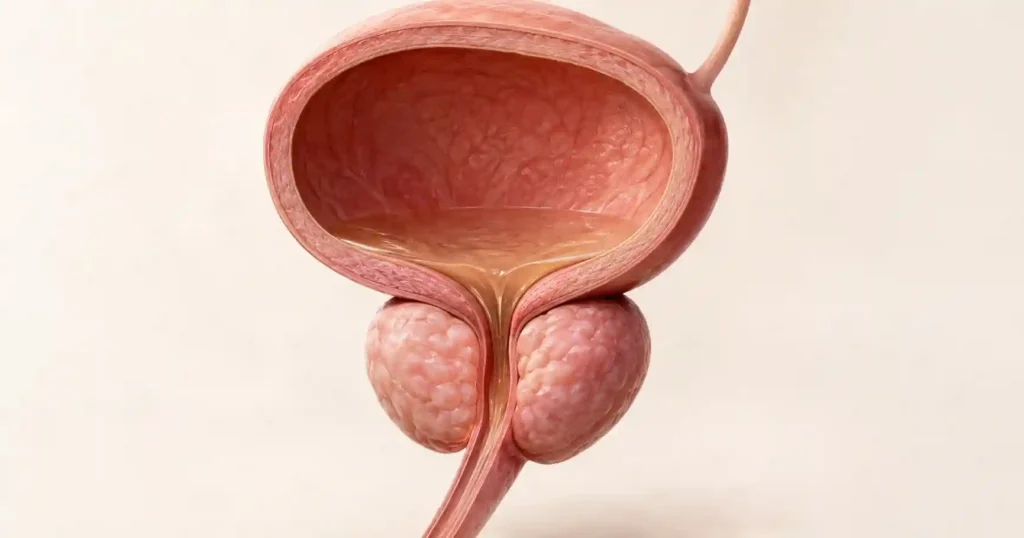
An IPSS score of 18 lands on my desk most weeks, and the first thing I do is set it aside. Not because the number is worthless — the International Prostate Symptom Score is the most-used patient questionnaire in urology, and the 2026 American Urological Association guideline still asks for one at the first visit. But two men can hand me an identical 18 and need opposite things. One needs reassurance and a change to when he drinks his last coffee. The other needs a flow test and an honest conversation about surgery. The score tells me how loud the symptoms are. It does not tell me what is making the noise. Below: what each of the seven questions is really measuring, what the mild, moderate and severe bands change about treatment, how far your score has to fall before you would actually feel it, and the four things the questionnaire systematically fails to see. For the wider picture of prostate disease, start at the Prostate Health Hub.
Key Takeaways
- The IPSS is seven questions scored 0 to 5 each, giving a total of 0 to 35: mild 0-7, moderate 8-19, severe 20-35.
- The eighth question — quality of life, scored 0 to 6 — is scored separately and is often what decides whether you are treated at all.
- A meaningful improvement is not 1 or 2 points. Published thresholds run from 3 points (1995) to 5.26 points (2025), and men who start severe need roughly 8 points before they notice a difference.
- The score cannot tell an obstructing prostate from an overactive bladder. If your symptoms are storage-dominant or your problem is night waking alone, the 2026 AUA guideline sends you to a frequency-volume chart, not straight to a prostate drug.
What the IPSS Score Actually Measures
The questionnaire was built and validated by the AUA Measurement Committee in 1992 across 210 men with benign prostatic hyperplasia and 108 controls [1]. It performed well as an instrument: internally consistent, with test-retest reliability of 0.92, and responsive to real change — mean scores in that validation cohort fell from 17.6 before prostatectomy to 7.1 four weeks after.
You will see it called two things. The AUA Symptom Index and the International Prostate Symptom Score contain the same seven severity questions summed to 0 to 35. The IPSS adds a bother question that is scored on its own and never folded into the total [2]. The literature uses the two names interchangeably, which is why your score may appear on a hospital letter under either heading.
Each question asks how often over the past month, scored 0 (not at all) to 5 (almost always). The nocturia question is the exception — it counts actual episodes per night, 0 through 5 or more. What matters clinically is that the seven items are not measuring one thing. They split into storage symptoms (the bladder misbehaving) and voiding symptoms (the outlet resisting), and those two groups point at different organs.
| Question | What it asks | What it points to |
|---|---|---|
| Incomplete emptying | Feeling the bladder is not empty after you finish | Residual urine — either outlet resistance or a detrusor no longer generating enough pressure to finish the job |
| Frequency | Needing to go again within two hours | Reduced functional capacity. This is a storage problem and is not prostate-specific |
| Intermittency | The stream stopping and restarting | The bladder muscle fatiguing part-way through a void against resistance |
| Urgency | Difficulty postponing the urge | Detrusor overactivity — the bladder contracting before you asked it to |
| Weak stream | Reduced force of flow | The most obstruction-specific of the seven, and the one that tracks best with a low measured flow rate |
| Straining | Having to push to start | Recruiting abdominal pressure because detrusor contraction alone cannot overcome the outlet |
| Nocturia | Times you get up at night to pass urine | The least prostate-specific item of all. Overlaps with evening fluid timing, sleep apnea, heart failure and diabetes |
IPSS Score Ranges: Mild, Moderate, and Severe
Three bands, unchanged since 1992. What has changed is how much weight a urologist puts on them. In 2026 the band sets the starting point of the conversation, not the destination.
| Total score | Band | What it usually triggers | What it does not mean |
|---|---|---|---|
| 0-7 | Mild | Watchful waiting, fluid timing, bladder retraining. Drug treatment only if the bother score is disproportionately high. | That your prostate is small, or that nothing is obstructing. |
| 8-19 | Moderate | Shared decision-making. Options span an alpha blocker, a 5-alpha-reductase inhibitor if the gland is large, or a minimally invasive procedure. | That surgery is the next step, or that medication is mandatory. |
| 20-35 | Severe | Objective testing — post-void residual, uroflowmetry — and an earlier procedural conversation. | That the bladder is already damaged, or that medication cannot work. |
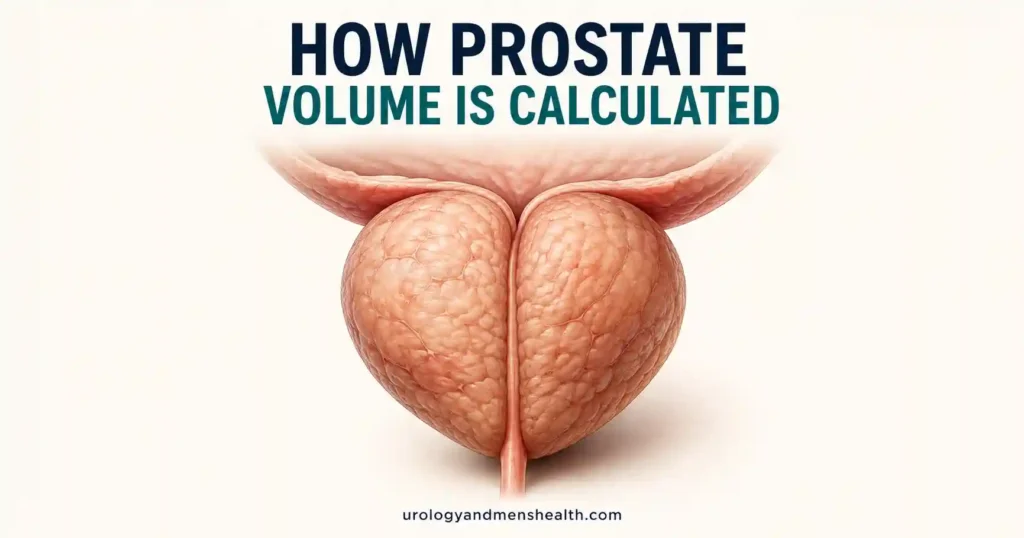
Notice what is missing from that table: prostate size. A moderate IPSS score tells you nothing about whether your gland is 30 mL or 100 mL, and that distinction changes which drug works. A 5-alpha-reductase inhibitor earns its place in glands above roughly 30 to 40 mL and is close to useless below that. This is why the size question gets answered separately, by examination or imaging, and why the treatment ladder in my full guide to enlarged prostate and when surgery is warranted is built around gland volume rather than symptom score.
If you have not scored yourself yet, the IPSS calculator runs the seven questions and the bother item and prints a summary you can hand across the desk.
Why Your IPSS Score Doesn’t Decide Your Treatment
The 2026 AUA guideline is explicit that a symptom score is one input among several at the first visit [2]. Alongside it: a full history including prior procedures and current medications, a physical examination with digital rectal examination, and a urinalysis looking specifically for glucose, protein, blood and infection. Post-void residual measurement and uroflowmetry are optional additions rather than mandatory ones, and the guideline notes there is no universally agreed threshold for a clinically significant residual volume — the trend over time matters more than any single reading.
Three instructions from Part I of that guideline change what happens next more than your total does. First, urinary incontinence, post-void dribbling and pain are assessed separately — none of them appear in the seven questions. Second, you should be asked which single symptom bothers you most. Third, if your symptoms are predominantly storage-type, or if isolated night waking is the whole complaint, the recommended next step is a frequency-volume chart, not a prostate prescription.
That last point catches men out constantly. Nocturia contributes up to 5 points to a total that runs to 35, but as a standalone complaint it is more often a fluid-timing, sleep or cardiac problem than a prostate one. I have set out the full differential in why you wake at night to urinate, because prescribing tamsulosin to a man whose real problem is untreated sleep apnea wastes six months.
In My Practice
The score I trust least is a 9. A man circles “less than half the time” straight down the column because it feels like the reasonable middle answer, hands the form back, and his actual problem — that he cannot sit through a meeting or a flight without planning around a bathroom — appears nowhere on the paper. So I now ask one question before I read the total: of these seven things, which one would you pay to have gone by Friday? The answer redirects my plan more often than the number does.
The total ranks severity; the most bothersome symptom ranks priority, and only the second of those two tells me what to prescribe.
Track your IPSS over time: the BPH symptom log I give patients
Enter your email below to receive Dr. Khalid’s complete BPH & Enlarged Prostate Guide as a free, printable PDF.
How Much Does Your IPSS Score Have to Change Before You Notice?
This is the question almost nobody answers for patients, and it is the one that determines whether you should stay on a drug or stop it.
The original threshold came from Barry and colleagues in 1995, who put the smallest perceptible change at 3 points [4]. That figure has been quoted for thirty years. It is probably too low. A Dutch primary care cohort published in 2019 put the minimal important difference at 5.2 points [6], and a 2025 analysis of the BEST randomized trial landed at 5.26 points with a confidence interval of 4.38 to 6.13 [5].
The more useful finding in that 2025 analysis is what happens when you split by baseline severity. Men who started in the moderate band needed a mean fall of 4.00 points to describe themselves as even minimally improved. Men who started severe needed 8.23 points. Men carrying both a BPH and an overactive bladder diagnosis needed the most of all, at 6.22 points.
Set that against what medication realistically delivers. The 2026 AUA guideline reports that uroselective alpha blockers — tamsulosin, alfuzosin, silodosin — typically reduce IPSS by 30 to 40% and raise maximum flow rate by 20 to 25%, which translates to an improvement of roughly 2 to 4 points over placebo [3].
Read those two paragraphs together and the arithmetic is uncomfortable. If you started at 26 and an alpha blocker moves you to 22, that is a statistically real drug effect and a change you will probably not feel. It is not evidence the drug failed. It is evidence that a 4-point gain is not enough at your starting point — and the sensible next conversation is about combination therapy or a procedure, not about a different alpha blocker.
- Re-score at 8 to 12 weeks, not at 2 weeks. Alpha blockers act within days, but 5-alpha-reductase inhibitors need months.
- Use the same questionnaire and the same time of day. Filling it in on a Monday morning after a quiet weekend and comparing it to one filled in after a long-haul flight compares nothing.
- Write your baseline down with the date. Recalled scores drift downward, which manufactures improvement that was never there.
Where the IPSS Score Gets It Wrong
Four failure modes, in the order I encounter them.
It cannot separate an obstructing prostate from an overactive bladder
Frequency and urgency score identically whether the driver is a 90 mL gland squeezing the outlet or a bladder muscle contracting at 150 mL for reasons that have nothing to do with the prostate. Christopher Chapple’s assessment after twenty-five years of the instrument was blunt: the bladder is an unreliable witness [7]. Symptoms report the consequence, not the cause. Distinguishing the two needs a frequency-volume chart, a residual measurement, and sometimes urodynamics.
It says nothing about prostate size or cancer risk
There is no score at which the questionnaire starts screening for malignancy. A man with an IPSS of 3 and a rising PSA needs investigation; a man with an IPSS of 30 and a normal PSA and examination usually does not. Symptom severity and cancer risk are independent axes, and treating them as one is the most common misreading I correct.
The nocturia item is overloaded
One question carrying up to 5 of 35 points, answering to at least six unrelated mechanisms. A man drinking two beers after 9 p.m. and a man in early heart failure can produce the same digit.
How it is administered changes the answer
Barry’s group tested self-completion against interviewer administration and could not cleanly rule out a mode effect [8]. In practice, men under-report to a form and over-report to a person, or the reverse, depending on temperament. If your score was read aloud to you by a nurse at one visit and filled in on an iPad at the next, part of any change you see is method, not medicine.
One more group is systematically misread by this questionnaire: men in their thirties and forties with high scores and pelvic discomfort. The IPSS was validated in older men with BPH, and it will happily generate a score of 22 in a 34-year-old whose actual diagnosis is chronic pelvic pain syndrome. I have set out how that presentation differs in the guide to chronic prostatitis and CPPS.
How to Use Your IPSS Score at Your Next Appointment
Five specific things, each with a timeframe.
- Bring the completed form with the date written on it. A dated baseline is what makes every future score interpretable.
- Name your single most bothersome symptom before your total is discussed. The 2026 guideline asks your clinician to elicit this; arriving with the answer ready saves the appointment.
- Bring your full medication list, including anything bought over the counter. Decongestants, some antihistamines and certain antidepressants tighten the bladder neck and can add several points on their own.
- If night waking is your main complaint, ask for a three-day frequency-volume chart before any prescription. It separates a small bladder from overnight overproduction, and no questionnaire can do that.
- Agree a re-score date of 8 to 12 weeks at the same visit. Ask specifically: what fall in points would count as this working? If nobody has named a target, nobody can call the treatment a failure later.
Red Flags: Symptoms That Skip the Questionnaire
These need direct assessment regardless of your total. Do not wait for a scheduled review.
- Visible blood in the urine — at any age, with any score. This warrants a urology referral, not a symptom form.
- Complete inability to pass urine with a painful, distended lower abdomen — this is acute retention. Go to the emergency room the same day; the bladder cannot wait it out.
- Fever, shaking chills or back pain alongside urinary symptoms — suggests infection above the bladder.
- Symptoms that worsen sharply over days rather than months — the natural history of BPH is slow. Rapid change means something else is happening.
- New bone pain, unexplained weight loss or leg swelling with urinary change — needs assessment within days, not at the next routine appointment.
Frequently Asked Questions
What is a normal IPSS score for a man over 60?
There is no age-adjusted normal. The bands are identical at 45 and at 80: mild is 0 to 7, moderate 8 to 19, severe 20 to 35. Symptom prevalence rises with age, but that does not make a score of 14 acceptable at 70. What decides whether a moderate score gets treated is the separately scored bother question, not your birth year. The IPSS calculator scores both.
Does a high IPSS score mean I need prostate surgery?
No. A severe score triggers objective testing — residual volume, flow rate — and an earlier discussion about procedures, but many men in the 20 to 35 band respond adequately to combination medication. Between drugs and formal surgery sits a middle tier of minimally invasive options, which I compare in the guide to UroLift and Rezum. Score sets the urgency of the conversation, not its conclusion.
Can my IPSS score be high if my prostate is a normal size?
Yes, and this is common. The questionnaire measures symptoms, not anatomy. Frequency, urgency and night waking all score highly in overactive bladder, where the prostate is unremarkable and the detrusor muscle is contracting without permission. The treatment is entirely different — bladder retraining and anticholinergic or beta-3 agonist medication rather than alpha blockade. I cover the distinction in overactive bladder in men.
I am 35 with an IPSS of 20. Is that benign prostatic hyperplasia?
Almost certainly not. BPH is uncommon as a symptomatic diagnosis before the mid-forties, and the questionnaire was validated in older men. A high score in a man in his thirties with pelvic, perineal or post-ejaculatory discomfort points much more often toward chronic pelvic pain syndrome. The evaluation is different, and alpha blockers alone rarely resolve it — see chronic prostatitis and CPPS.
How often should I repeat the IPSS?
Repeat it 8 to 12 weeks after starting or changing any treatment, then annually while stable. Use the same format each time and write the date on it. Comparing a score you filled in yourself against one a nurse read aloud to you introduces error large enough to hide a real drug effect. If you are weighing which medication to discuss first, the BPH treatment finder maps options against gland size and symptom pattern.
References
- Barry MJ, Fowler FJ Jr, O’Leary MP, et al. The American Urological Association symptom index for benign prostatic hyperplasia. J Urol. 1992;148(5):1549-1557. PubMed
- Goueli R, Badlani GH, Welliver C, et al. Management of Lower Urinary Tract Symptoms Attributed to Benign Prostatic Hyperplasia: AUA Guideline (2026) Part I: Presentation and Evaluation. J Urol. 2026. Journal of Urology
- Management of Lower Urinary Tract Symptoms Attributed to Benign Prostatic Hyperplasia: AUA Guideline (2026) Part II: Medical Management. J Urol. 2026. Journal of Urology
- Barry MJ, Williford WO, Chang Y, et al. Benign prostatic hyperplasia specific health status measures in clinical research: how much change in the American Urological Association Symptom Index and the Benign Prostatic Hyperplasia Impact Index is perceptible to patients? J Urol. 1995;154(5):1770-1774. PubMed
- Wiemer L, Lehmacher W, Schonburg S, et al. Defining the Minimal Important Difference in International Prostate Symptom Score for Men with Lower Urinary Tract Symptoms Using a Patient-centered Anchor Measure. Eur Urol Open Sci. 2025;81:44-49. PubMed
- Blanker MH, Alma HJ, Devji TS, et al. Determining the minimal important differences in the International Prostate Symptom Score and Overactive Bladder Questionnaire: results from an observational cohort study in Dutch primary care. BMJ Open. 2019;9(12):e032795. PubMed
- Chapple CR. 25 Years of Experience with the AUA Symptom Index: Increasing Recognition that the Bladder is an Unreliable Witness. J Urol. 2017;197(2S):S198-S199. PubMed
- Barry MJ, Fowler FJ, Chang Y, et al. The American Urological Association symptom index: does mode of administration affect its psychometric properties? J Urol. 1995;154(3):1056-1059. PubMed
Dr. Muhammad Khalid
MBBS · FCPS (Urology) · MCPS (General Surgery) · CHPE · CRSM · IMC #539472
Specialist urologist with 11+ years of clinical experience across tertiary teaching hospitals. Trained at Lady Reading Hospital and Khyber Teaching Hospital, Peshawar. Author or co-author of five peer-reviewed international publications, including in Cureus and the World Journal of Surgery. Procedural expertise: URS, PCNL, RIRS, TURP, TURBT, and major open urological surgery. Full profile →
This article is for educational purposes only and does not constitute medical advice. Always consult your physician or urologist for diagnosis and treatment decisions specific to your condition.