
IIEF-5 Erectile Function Assessment
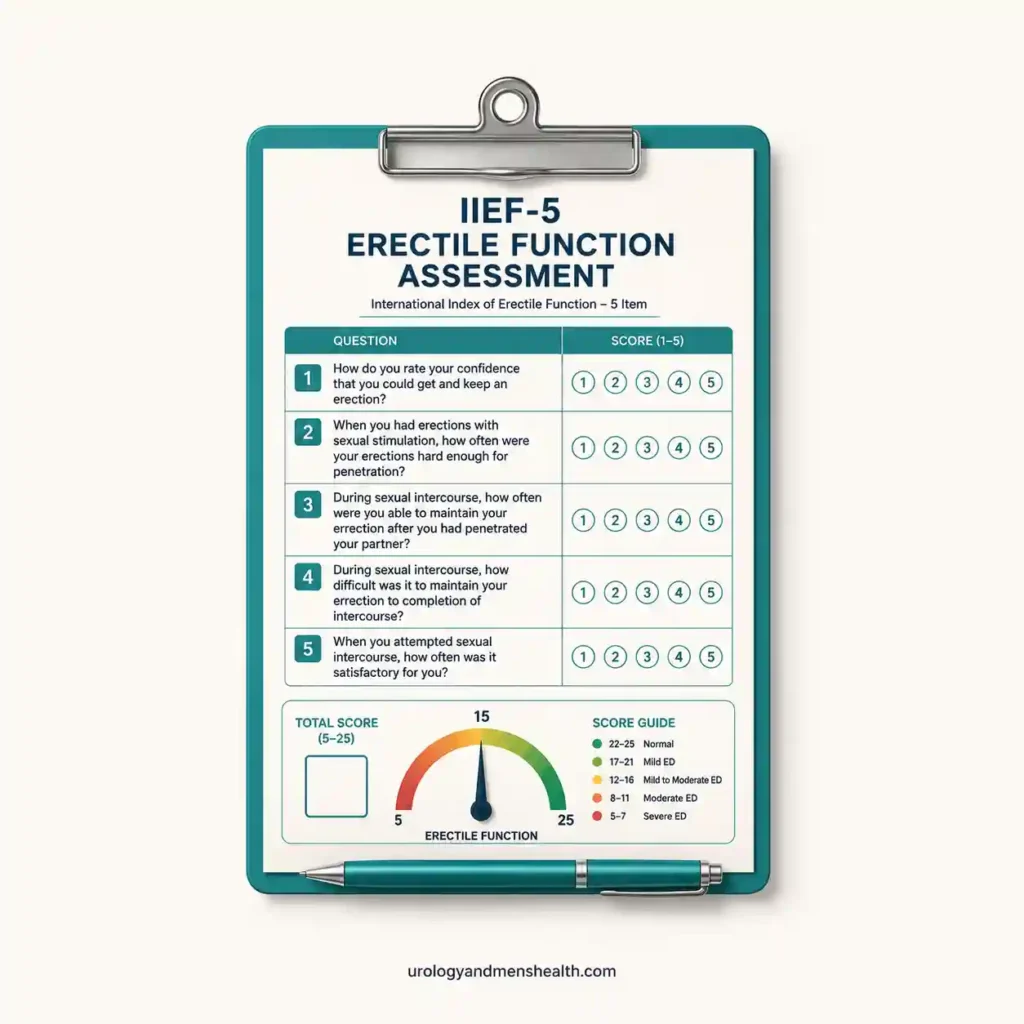
The IIEF-5 erectile function assessment is the five-question score urologists use to grade erectile dysfunction, from none through severe. Answer for the past 6 months and you get a total out of 25, the band it falls in, what it means, and the questions worth taking to your doctor. Nothing is stored or sent anywhere. For the wider picture, start at my sexual health hub.

The Tool
Related Sexual Health Tools
Full Clinical Guide
In This Guide:
- The IIEF-5 scores five items out of 25. 22-25 is no ED, 17-21 mild, 12-16 mild-to-moderate, 8-11 moderate, 5-7 severe.
- The cut-off that matters is 21. In the original validation, 21 separated men with ED from men without it with a sensitivity of 0.98.
- It cannot score a man who has not been sexually active. A total pulled down by “did not attempt intercourse” answers is not a severity grade.
- The score is also a vascular signal. Penile arteries are the narrowest of the major arteries, which is why they complain first.
What the IIEF-5 Erectile Function Assessment Measures
The IIEF-5 erectile function assessment is the five-item short form of the International Index of Erectile Function, published by Rosen and colleagues in 1999 and known in most clinics as the Sexual Health Inventory for Men, or SHIM [1]. Four of the five items ask about the erection itself — your confidence, whether it was firm enough to penetrate, whether you kept it after penetration, and how hard it was to hold until the end. The fifth asks something different: whether intercourse was actually satisfying. In the development work, 1,152 men (1,036 with erectile dysfunction and 116 controls) were scored, and a cut-off of 21 out of 25 discriminated best, with a sensitivity of 0.98 and a specificity of 0.88 [1]. The AUA recommends validated questionnaires for exactly this job — grading severity, measuring whether a treatment worked, and guiding what comes next [2].
The Physiology Behind Your Score
An erection is a plumbing event with a chemical trigger. Sexual stimulation releases nitric oxide from nerve endings and from the endothelium — the single-cell lining of the blood vessels — which raises cGMP inside the smooth muscle of the corpora cavernosa. That muscle relaxes, arterial blood floods in, and the expanding tissue pinches the draining veins shut against the tunica albuginea. That last step is the veno-occlusive mechanism: inflow makes an erection start, trapping makes it last. An enzyme called PDE5 breaks cGMP down, which is why a PDE5 inhibitor amplifies an existing signal rather than manufacturing one — no stimulation, no signal, no erection. Damage the endothelium with high blood pressure, high glucose or tobacco and inflow fails first. The penile arteries measure roughly 1-2 mm across, against 3-4 mm for the coronaries and 5-7 mm for the carotids [3] — the same plaque burden narrows the small pipe to symptoms long before the large one. That is why erections are a vascular gauge, and why the ED Vascular Risk Screener is a reasonable companion to this score.
How to Interpret Your Result
Two men can both say “my erections are not what they were” and walk out of my clinic with completely different plans. The man who scores 23 has no ED by the instrument’s own definition; my job is to record the number and ask what he scored two years ago, because a slide from 25 to 23 tells me more than the 23 does. The man who scores 9 is in the moderate band — he leaves with a blood form for a morning testosterone, HbA1c and lipids, a PDE5 inhibitor prescription, and a date to come back and rescore. The man who scores 6 is severe, and his appointment is only half about erections: at that level I want his cardiovascular risk looked at properly, because ED symptoms typically appear 2 to 3 years before coronary symptoms and 3 to 5 years before a cardiovascular event [4]. The bands are 22-25 none, 17-21 mild, 12-16 mild-to-moderate, 8-11 moderate, 5-7 severe [1]. One caveat overrides all of them: the questionnaire cannot produce a valid score for a man who has not been sexually active [2].
What to Do With Your Result
If you scored 17 or above, do nothing medical and everything preventive: get blood pressure, fasting glucose or HbA1c and a lipid panel checked, and keep the number so the next one means something. If you scored 8 to 16, this is the band where treatment reliably works — ask for a morning total testosterone (below 300 ng/dL, about 10.4 nmol/L, with symptoms is the threshold your doctor will use), glucose and lipids, and ask whether an oral PDE5 inhibitor is safe with your medications, in particular any nitrate [2]. If low testosterone is a live question, the Low Testosterone Symptom Quiz is the faster way to work out whether the test is worth requesting. If you scored 7 or below, ask for a urologist rather than a repeat prescription — penile duplex ultrasound, a vacuum device, injection therapy and an implant are all real options, and current European and American guidance treats none of them as a punishment for failing tablets [5]. If you are unsure about your result, the PDF report this tool generates gives you a ready-made framework to bring to your next appointment.
In My Practice
The most useful thing I do with this score is ask a man to fill it in twice. The first time, it is a number he is ashamed of. Twelve weeks later, after we have titrated a tablet properly and his HbA1c has actually been looked at, it is a number that has moved — and the moving is what convinces him that this was a blood vessel problem and not a verdict on him. Men who never rescore tend to give up on treatment in the first month; men who rescore almost never do.
One IIEF-5 is a snapshot. Two, twelve weeks apart, is a measurement — and it is the second one that changes decisions.
References
- Rosen RC, Cappelleri JC, Smith MD, Lipsky J, Pena BM. Development and evaluation of an abridged, 5-item version of the International Index of Erectile Function (IIEF-5) as a diagnostic tool for erectile dysfunction. Int J Impot Res. 1999;11(6):319-26. PubMed. The original validation: 1,152 men, cut-off 21, five severity bands.
- Burnett AL, Nehra A, Breau RH, et al. Erectile Dysfunction: AUA Guideline. J Urol. 2018;200(3):633-41. American Urological Association. Source for validated-questionnaire use, the SHIM bands, the non-sexually-active caveat, morning testosterone and PDE5 inhibitor guidance.
- Montorsi P, Ravagnani PM, Galli S, et al. The artery size hypothesis: a macrovascular link between erectile dysfunction and coronary artery disease. Am J Cardiol. 2005;96(12B):19M-23M. American Journal of Cardiology. Source for the 1-2 mm penile vs 3-4 mm coronary vs 5-7 mm carotid comparison.
- Vlachopoulos C, Jackson G, Stefanadis C, Montorsi P. Erectile dysfunction and coronary artery disease prediction: evidence-based guidance and consensus. Int J Clin Pract. 2010;64(7):848-57. PubMed. Source for the 2-3 year and 3-5 year lead-time intervals (Level 2, Grade B).
- Salonia A, Bettocchi C, Capogrosso P, et al. EAU Guidelines on Sexual and Reproductive Health, 2025 update. European Association of Urology. Second-body guidance on ED diagnosis, treatment order and follow-up.
- Utomo E, Blok BF, Pastoor H, Bangma CH, Korfage IJ. The measurement properties of the five-item International Index of Erectile Function (IIEF-5): a Dutch validation study. Andrology. 2015;3(6):1154-9. Andrology. Independent validation, and the floor-effect problem in men not attempting intercourse.
Frequently Asked Questions
What is a normal IIEF-5 score?
A total of 22 to 25 out of 25 is the band the original validation defined as no erectile dysfunction. Below that, 17 to 21 is mild, 12 to 16 mild-to-moderate, 8 to 11 moderate, and 5 to 7 severe. The single most useful cut-off is 21: at or below it, erectile dysfunction is likely and worth a conversation. If your score has fallen several points from a previous one, that matters even inside the normal band — the ED Vascular Risk Screener is the sensible next step.
Is the IIEF-5 the same as the SHIM score?
Yes, in practice they are the same five questions with the same scoring. IIEF-5 is the research name, taken from the abridged five-item version of the fifteen-item International Index of Erectile Function. SHIM, the Sexual Health Inventory for Men, is the name most clinics print on the form. The one thing to watch is that the full IIEF’s erectile function domain uses different score ranges, so a number from one is not interchangeable with a number from the other.
Can I use this if I have not had sex recently?
Not reliably, and that is not a limitation of this page but of the instrument. Four of the five questions ask what happened when you attempted intercourse. If you answer “did not attempt intercourse” on most of them, the total drops for a reason that has nothing to do with how firm your erections are, and the severe band becomes meaningless. If that is your situation, skip the number and go straight to the conversation — the ED Treatment Pathway is more useful to you than a score.
How accurate is this tool, and can I rely on it?
The IIEF-5 is one of the best-validated instruments in urology: in the original study of 1,152 men, a cut-off of 21 identified erectile dysfunction with a sensitivity of 0.98 and a specificity of 0.88. But it grades severity, it does not diagnose a cause. It cannot tell you whether the problem is arterial, hormonal, neurological, drug-related or psychological, and it cannot examine you. Treat the number as a well-calibrated starting point for a medical conversation, not as a diagnosis.
How do I use this result at my doctor’s appointment?
Press Download My Report. You get a two-page PDF: your five answers and your total on page one, and on page two my interpretation of your band, the tests worth requesting, and specific questions to ask, with your score already filled in. Hand it over at the start of the appointment. It saves you having to say the difficult part out loud, and it gives your doctor a scored baseline rather than a vague account of a bad few months.
Dr. Muhammad Khalid
MBBS · FCPS (Urology) · MCPS (General Surgery) · CHPE · CRSM · IMC #539472
Specialist urologist with 11+ years of clinical experience across tertiary teaching hospitals. Trained at Lady Reading Hospital and Khyber Teaching Hospital, Peshawar. Author or co-author of five peer-reviewed international publications, including in Cureus and the World Journal of Surgery. Procedural expertise: URS, PCNL, RIRS, TURP, TURBT, and major open urological surgery. Full profile →
This article is for educational purposes only and does not constitute medical advice. Always consult your physician or urologist for diagnosis and treatment decisions specific to your condition.