
Semen Analysis Interpreter and Total Motile Count Calculator
This semen analysis interpreter reads your report against the WHO 2021 (sixth edition) reference limits and works out your total motile sperm count - the single figure I lean on most when I counsel a couple. Enter volume, concentration and progressive motility; add morphology and total motility if your lab printed them. Nothing is stored, and you get a PDF to take to your appointment. The wider picture sits in my sexual health hub.

The Tool
Related Sexual Health Tools
Full Clinical Guide
In This Guide:
- The WHO 2021 limits are the fifth percentile of fertile men, not a pass mark – one line below the line is a reason to repeat the test, not a diagnosis.
- Your total motile sperm count (volume x concentration x progressive motility) predicts natural conception better than the individual labels on your report.
- Three prognostic bands matter: under 5 million, 5 to 20 million, and over 20 million.
- A semen analysis reflects sperm made about three months ago, which is why the repeat test is timed the way it is.
What This Semen Analysis Interpreter Measures
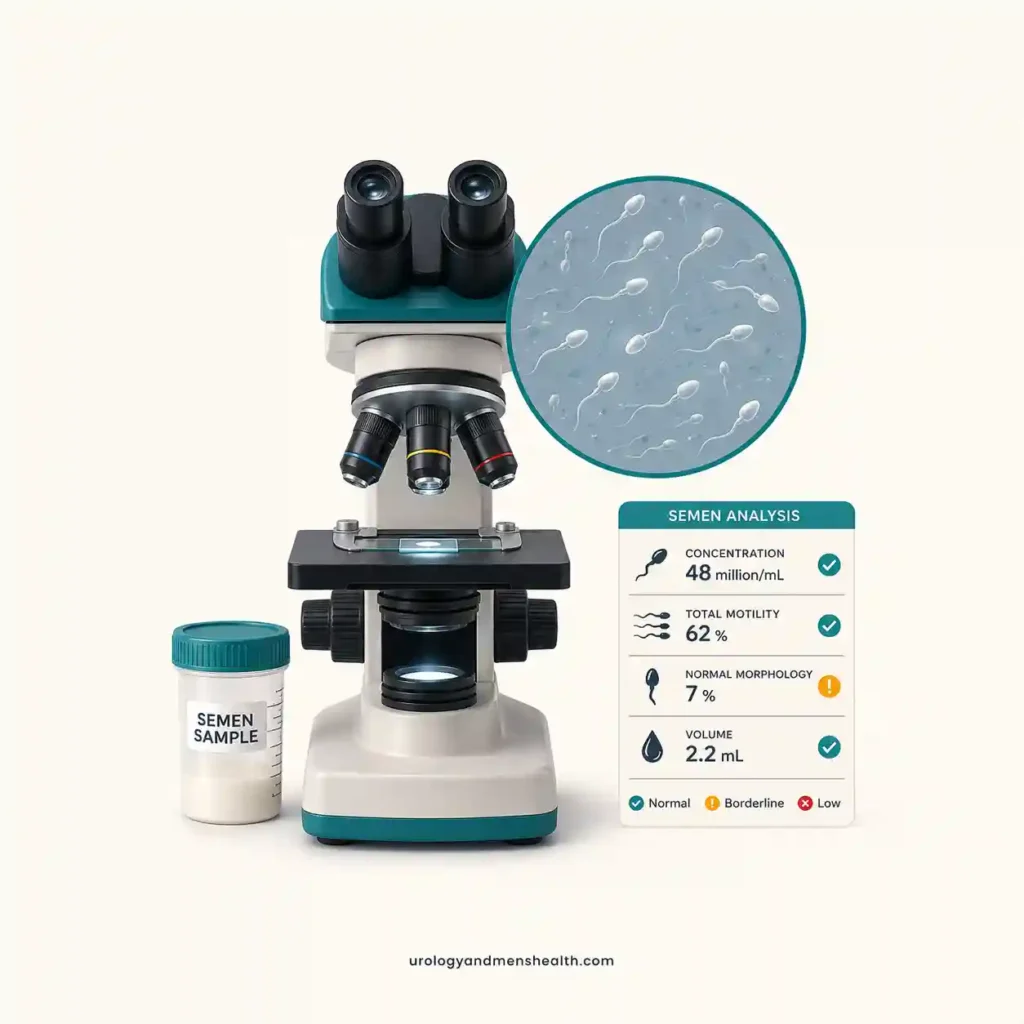
This semen analysis interpreter reads your report against two separate yardsticks. The first is the WHO laboratory manual for the examination and processing of human semen, sixth edition, published in 2021 [1] – the document nearly every andrology lab in the world runs on. Its lower reference limits are volume 1.4 mL (about a quarter of a teaspoon), concentration 16 million per mL, total sperm number 39 million, total motility 42 percent, progressive motility 30 percent, vitality 54 percent and normal forms 4 percent [1][2]. Those figures are not a pass mark. They are the fifth percentile of men whose partners conceived naturally inside a year, so a fertile father can sit below any one of them, and the sixth edition says plainly that they are decision guides rather than thresholds [2]. The second yardstick is the total motile sperm count, and that is the one carrying your prognosis. For how a semen analysis fits the wider assessment, read my longer piece on male infertility.
Why the Total Motile Count Beats the Individual Lines
Total motile sperm count multiplies volume by concentration by the percentage of sperm swimming forwards. Percentages on their own mislead: 30 percent progressive motility in a 4 mL sample loaded with sperm is a different clinical situation from 30 percent in a 1 mL sample that barely registers. In a Dutch cohort of 1,177 infertile couples, this single number tracked spontaneous ongoing pregnancy better than the WHO labels (oligozoospermia, asthenozoospermia and the rest), and it separated cleanly into three prognostic groups: under 5 million, 5 to 20 million, and above 20 million [3]. The other half of the physiology is timing. Sperm take roughly 74 days to produce, with newer isotope work suggesting the whole run to ejaculate may be shorter, plus a further couple of weeks maturing in the epididymis [6]. So your report is a photograph of what your testicles were doing last season, not this week – a point that matters enormously if you were on testosterone, which shuts production down while it is running. If that is you, my low testosterone symptom quiz is the companion piece.
How to Interpret Your Result
Take two men who both walk in convinced their report is bad. The first has 3 mL, 40 million per mL and 50 percent progressive motility: a total motile count of 60 million. His morphology is 2 percent and printed in red, and he is terrified of it. I tell him the sperm is not the problem and we spend the appointment on timing and on his partner’s assessment. The second has 2 mL, 8 million per mL and 25 percent progressive motility: 4 million. Same worry, completely different consultation – exam for a varicocele, morning testosterone with FSH and LH, and an honest conversation about what he has been taking. Above 20 million, sperm rarely limits a couple. Between 5 and 20 million, sperm is one factor among several and a cause is often findable and fixable. Below 5 million, the cause becomes the whole question, and a zero concentration (azoospermia) leaves this tool behind entirely.
Read: Semen Analysis Results Explained, Line by LineWhat to Do With Your Result
If your total motile count is above 20 million, keep the report as a baseline and repeat it only if something changes. In the 5 to 20 million band, ask for a repeat analysis about three months out, at the same lab, with 2 to 7 days of abstinence [1], plus a scrotal exam and a hormone panel – the EAU and AUA/ASRM guidelines both build the male workup around history, examination and semen analysis rather than around a single number [4][5]. Below 5 million, see a urologist rather than repeating the test alone; FSH and testosterone start splitting a production problem from a blockage on the first visit, and genetic testing (karyotype, Y-chromosome microdeletion) enters the conversation at very low counts [4]. Whatever the band, stop testosterone or anabolic steroids and say so out loud – it is one of the few causes with a direct route back. If a prior vasectomy is the cause, the vasectomy reversal success calculator is the better starting point. If you are unsure about your result, the PDF report this tool generates gives you a ready-made framework to bring to your next appointment.
Read: Varicocele and Male Fertility – When Surgery HelpsIn My Practice
The two questions I ask before I order anything are what was happening three months ago, and what are you taking. A gym cycle that finished in the spring, a testosterone gel started for tiredness, a week of fever – each one explains a report that otherwise looks alarming, and none of them shows up on the lab sheet.
The lab measures the output. The history explains it. A semen analysis read without one is half a test.
References
- World Health Organization. WHO laboratory manual for the examination and processing of human semen, 6th edition, 2021. World Health Organization. Source of the lower reference limits and the 2-to-7-day abstinence window.
- Boitrelle F, Shah R, Saleh R, et al. The Sixth Edition of the WHO Manual for Human Semen Analysis: A Critical Review and SWOT Analysis. Life (Basel). 2021;11(12):1368. PubMed. Tabulates the 2010 versus 2021 limits and stresses they are decision guides, not thresholds.
- Hamilton JAM, Cissen M, Brandes M, et al. Total motile sperm count: a better indicator for the severity of male factor infertility than the WHO sperm classification system. Hum Reprod. 2015;30(5):1110-1121. PubMed. The 1,177-couple cohort behind the under-5 / 5-20 / over-20 million bands used by this tool.
- Brannigan RE, Hermanson L, Kaczmarek J, et al. Updates to Male Infertility: AUA/ASRM Guideline (2024). J Urol. Journal of Urology. Evaluation of the male partner, semen analysis, and genetic testing thresholds.
- European Association of Urology. EAU Guidelines on Sexual and Reproductive Health – male infertility. Uroweb. Parallel assessment of the female partner and counselling on associated health risks.
- Amann RP. The cycle of the seminiferous epithelium in humans: a need to revisit? J Androl. 2008;29(5):469-487. Journal of Andrology. Supports citing human spermatogenesis as approximately 74 days, with the caveat that estimates vary.
Frequently Asked Questions
What counts as a normal semen analysis under WHO 2021?
A result is called normal when every value sits at or above the WHO 2021 lower limits: volume 1.4 mL, concentration 16 million per mL, total sperm 39 million, total motility 42 percent, progressive motility 30 percent, vitality 54 percent and normal forms 4 percent. Those limits are the fifth percentile of recently fertile men, not a pass mark, so one line slightly below is a reason to repeat the test rather than a diagnosis. My article on semen analysis results explained walks through each line.
Why do my results change so much between tests?
Because a semen analysis is a snapshot of a production run that started about three months earlier, and because every step of it varies. Abstinence outside the 2 to 7 day window, an illness with fever, a hot bath habit, even how complete the collection was all move the numbers. That is why I judge a trend across two samples taken about three months apart rather than a single report.
Can GLP-1 weight-loss drugs change my sperm count?
Weight loss itself tends to help male fertility, and the effect of GLP-1 drugs on sperm specifically is still being studied rather than settled. What I watch for is the man who starts one, loses weight fast, and starts testosterone at the same clinic – the testosterone, not the GLP-1, is what suppresses his sperm production. My piece on GLP-1 drugs and male fertility covers what the evidence currently supports.
How accurate is this tool, and can I rely on it?
It applies the published WHO 2021 reference limits and the total motile count formula to the numbers you type in, so the arithmetic is exact – but it is a screening aid, not a diagnosis. It cannot see your examination, your hormones, your history, or your partner’s fertility, and it cannot interpret a zero count. Treat the output as a structured way to read your report, and let a urologist confirm what it means for you.
How do I use this result at my doctor’s appointment?
Press Download My Report. You get a two-page PDF: your entered values and total motile count on page one, then my interpretation, your next steps, and questions to ask – already filled in with your own number – on page two. Hand it over at the start of the appointment. It saves the first ten minutes of re-reading the lab sheet and moves the conversation straight to what happens next.
Dr. Muhammad Khalid
MBBS · FCPS (Urology) · MCPS (General Surgery) · CHPE · CRSM · IMC #539472
Specialist urologist with 11+ years of clinical experience across tertiary teaching hospitals. Trained at Lady Reading Hospital and Khyber Teaching Hospital, Peshawar. Author or co-author of five peer-reviewed international publications, including in Cureus and the World Journal of Surgery. Procedural expertise: URS, PCNL, RIRS, TURP, TURBT, and major open urological surgery. Full profile →
This article is for educational purposes only and does not constitute medical advice. Always consult your physician or urologist for diagnosis and treatment decisions specific to your condition.