
CKD Stage Calculator (eGFR)
This CKD stage calculator turns your creatinine blood test into an estimated glomerular filtration rate (eGFR) using the race-free CKD-EPI 2021 equation - the standard the National Kidney Foundation and KDIGO now recommend. Enter your age, sex, and latest creatinine to see your eGFR, your CKD stage from G1 to G5, and a clear next-step plan. Read more across our kidney health hub.

The Tool
Related Kidney & BP Tools
Full Clinical Guide
In This Guide:
- Your eGFR estimates the percentage of normal kidney filtering capacity still working – 60 or above is the normal range.
- An eGFR under 60 for at least three months, or any lasting sign of kidney damage, is what defines chronic kidney disease.
- The same eGFR can be reassuring or urgent depending on your age, urine albumin, and other risk factors.
- A single low reading is not a diagnosis – dehydration, some medicines, or a hard workout can lower it briefly, so a repeat test confirms.
What the CKD Stage Calculator Measures
This CKD stage calculator estimates your glomerular filtration rate (eGFR) – the volume of blood your kidneys filter each minute, scaled to a standard body size of 1.73 m2. It uses the CKD-EPI 2021 creatinine equation developed by the Chronic Kidney Disease Epidemiology Collaboration and published in the New England Journal of Medicine [1]. This is the version the National Kidney Foundation recommends laboratories use, and it deliberately removes the race coefficient that older formulas applied [2]. Your eGFR is the single best routine measure of overall kidney function, which is why it – not the raw creatinine number – defines your chronic kidney disease (CKD) stage. To read it, the tool needs only three things you already have: your age, your sex, and your most recent serum creatinine result.
The Physiology Behind Your eGFR
Each kidney holds about a million tiny filters called nephrons. Blood passes through them under pressure, and waste, excess salt, and water are pulled out to form urine while proteins and blood cells stay in. Creatinine is a steady waste product of muscle activity; when filtration slows, creatinine backs up in the blood. That is the link the equation uses – it reads the creatinine level and, correcting for the muscle differences tied to age and sex, estimates how fast the filters are working [4]. Think of eGFR as the percentage of normal filtering capacity still online: an eGFR of 50 means the kidneys are clearing waste at roughly half the expected rate for a healthy young adult. Because hydration shifts creatinine too, a urine check adds context – our Urine Color Decoder shows what your color is signalling.
How to Interpret Your Result
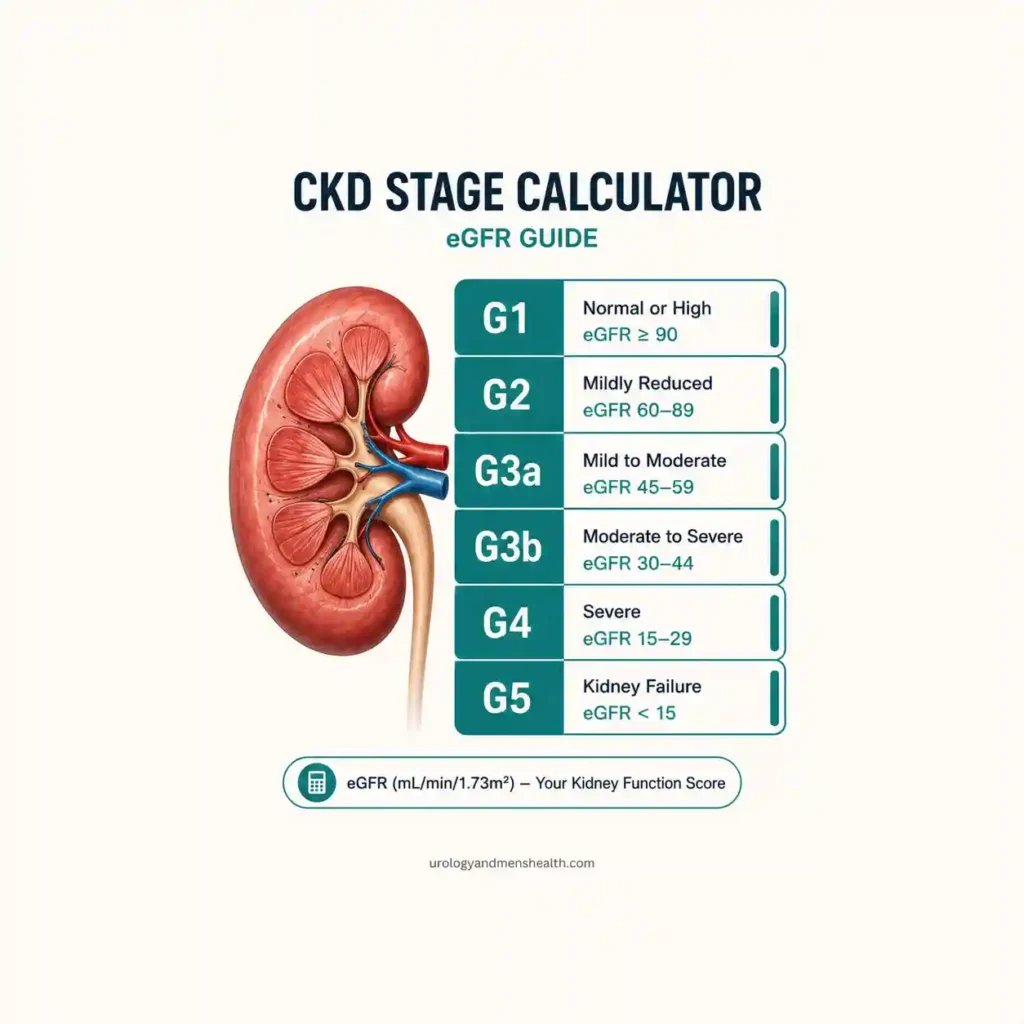
eGFR is graded into KDIGO stages. G1 (90 or above) and G2 (60-89) mean normal or only mildly reduced filtration – and on their own do not count as kidney disease unless a urine or imaging test also shows damage lasting at least three months. G3a (45-59) and G3b (30-44) make up Stage 3, where active protection matters. G4 (15-29) and G5 (under 15) signal advanced disease that needs a specialist [3]. The same number means very different things to different people: a 25-year-old runner with an eGFR of 88 needs nothing more than a note in the chart, while a 70-year-old with diabetes and an eGFR of 41 needs a urine albumin test, a blood-pressure plan, and a kidney-protective medication started now. The stage sets the urgency; your other risk factors set the detail.
What to Do With Your Result
If your eGFR is 60 or above, treat this as a baseline: ask for a one-time urine albumin-to-creatinine ratio to catch silent early damage, and recheck yearly if you have diabetes or high blood pressure. In Stage 3, the goal is to slow decline – tight blood-pressure control (a systolic target near 120 mmHg under KDIGO 2024 guidance), sodium under 2,000 mg (about 5 g of salt) a day, and a kidney-protective drug such as an ACE inhibitor, ARB, or SGLT2 inhibitor where appropriate [3]. The Sodium Intake Tracker makes that daily limit easier to hit. Below 30, the priority is an early, calm nephrology referral so complications and future options can be planned rather than rushed. If you are unsure about your result, the PDF report this tool generates gives you a ready-made framework to bring to your next appointment.
In My Practice
The number patients arrive worried about is almost always the creatinine, because it is the one flagged on the lab report. But two people with an identical creatinine of 1.3 mg/dL can sit a full CKD stage apart once age and sex are factored in – a fit 40-year-old man may have a normal eGFR, while a slighter 75-year-old woman with the same value is already in Stage 3. A good part of these consultations is spent moving the focus off the raw creatinine and onto the eGFR, which is the number that actually tells us how the kidneys are doing.
If you remember only one figure from your blood test, make it your eGFR, not your creatinine.
References
- Inker LA, Eneanya ND, Coresh J, et al. New Creatinine- and Cystatin C-Based Equations to Estimate GFR without Race. N Engl J Med. 2021;385(19):1737-1749. PubMed. Validation of the CKD-EPI 2021 creatinine equation.
- National Kidney Foundation. CKD-EPI Creatinine Equation (2021). kidney.org. Recommends the 2021 race-free equation for reporting eGFR.
- KDIGO 2024 Clinical Practice Guideline for the Evaluation and Management of Chronic Kidney Disease. Kidney Int. 2024. KDIGO. GFR stage thresholds, the 3-month criterion, BP target, and ACE/ARB/SGLT2 therapy.
- NIDDK. Glomerular Filtration Rate (GFR) Equations for Adults. NIDDK. US government summary of the 2021 CKD-EPI eGFRcr equation and its limits.
Frequently Asked Questions
What is a normal eGFR, and what counts as low?
An eGFR of 90 or above is normal, and 60-89 is only mildly reduced – neither is kidney disease on its own. Below 60 is where chronic kidney disease begins: 45-59 is Stage 3a, 30-44 is Stage 3b, 15-29 is Stage 4, and under 15 is kidney failure. Our full CKD staging guide explains what each stage means for you.
Does one low eGFR automatically mean I have kidney disease?
No. Chronic kidney disease means an eGFR under 60, or another sign of kidney damage, that has lasted at least three months. A single low reading can come from dehydration, a recent hard workout, or certain medications, so a repeat test is needed to confirm. Reading your creatinine alongside eGFR helps – see our guide to high creatinine levels.
Can I raise my eGFR back up?
If your eGFR dropped temporarily from dehydration or a medication, it can recover. Established chronic damage is usually not reversible, so the goal is to slow further decline rather than cure it – through blood-pressure control, blood-sugar management if you are diabetic, a low-sodium diet, and kidney-protective medicines. Our Sodium Intake Tracker helps you manage one of the biggest levers.
How accurate is this tool, and can I rely on it?
This calculator uses the CKD-EPI 2021 equation, the same formula clinical laboratories use, so the eGFR it produces matches what your lab would report from the same creatinine value. For most people the estimate lands within about 30% of true measured GFR, but it is a screening aid, not a diagnosis – it cannot account for unusual muscle mass, acute illness, or pregnancy. Always confirm results with your doctor, who can add a urine color check and an albumin test alongside it.
How do I use this result at my doctor’s appointment?
Use the Download My Report button to save a two-page PDF with your eGFR, your CKD stage, and a short list of questions tailored to your result. Bring it to your appointment – it gives your doctor your filtration estimate and a ready-made starting point, and helps you ask about urine albumin testing, blood-pressure targets, and whether any medication needs adjusting. For background first, read our guide to blood pressure and kidney damage.
Dr. Muhammad Khalid
MBBS · FCPS (Urology) · MCPS (General Surgery) · CHPE · CRSM · IMC #539472
Specialist urologist with 11+ years of clinical experience across tertiary teaching hospitals. Trained at Lady Reading Hospital and Khyber Teaching Hospital, Peshawar. Author or co-author of five peer-reviewed international publications, including in Cureus and the World Journal of Surgery. Procedural expertise: URS, PCNL, RIRS, TURP, TURBT, and major open urological surgery. Full profile →
This article is for educational purposes only and does not constitute medical advice. Always consult your physician or urologist for diagnosis and treatment decisions specific to your condition.