
Urology Surgery Comparison Tool
This urology surgery comparison tool guides you to the right operation in three questions - whether you are facing an enlarged prostate, a kidney stone, or a bladder investigation. I will match your answers to the surgery most likely to apply to your situation, then explain what the procedure involves, how long recovery takes, and what to ask your surgeon. Part of the Urological Surgery Recovery hub.

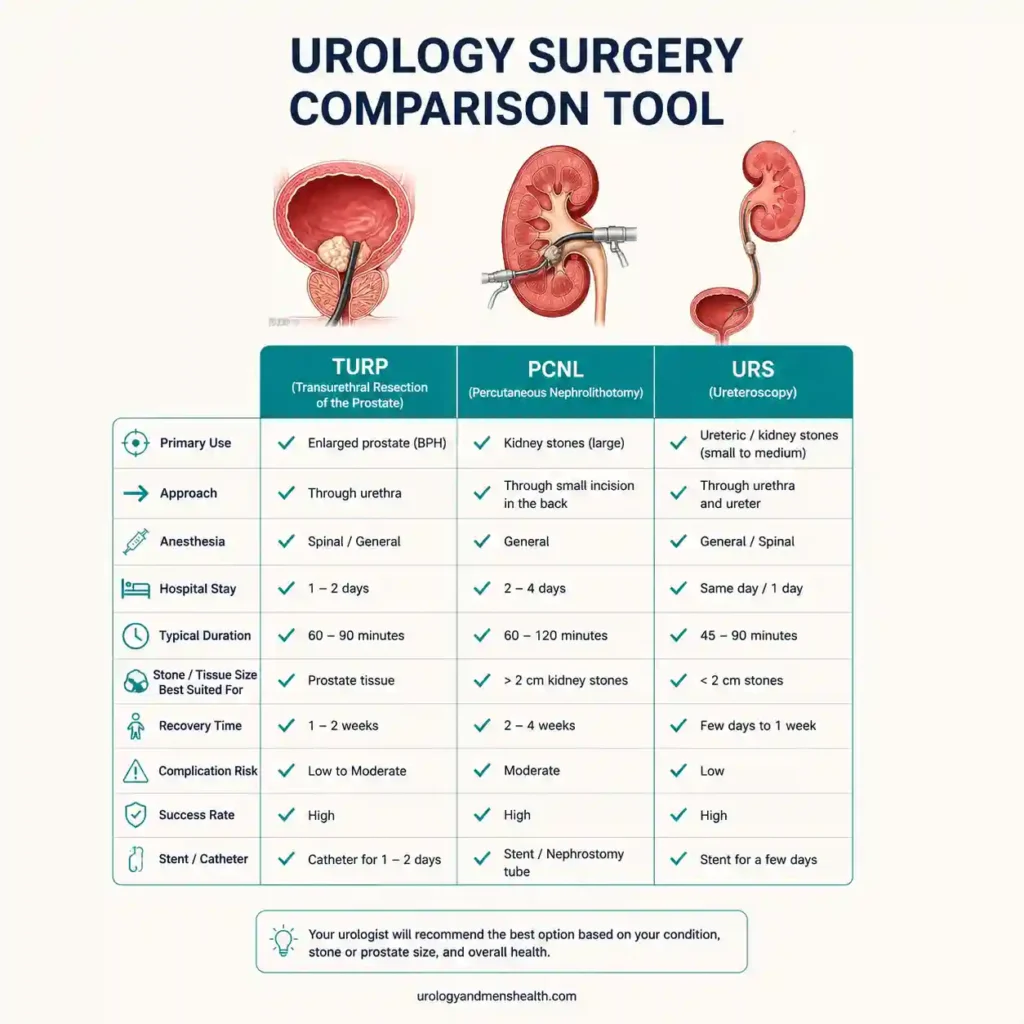
The Tool
Related Surgery Tools
Full Clinical Guide
In This Guide:
- The right operation is determined by your condition first (prostate, stone, or bladder), then by anatomy – size, location, and clinical goals within that category.
- A minimally invasive result means same-day or overnight care and recovery in days. A standard procedure means one to two nights and four to six weeks. A major procedure delivers the most complete result where a smaller operation would not be enough.
- For BPH, preserving ejaculation is the fork in the road – UroLift and Rezum can do it; TURP typically cannot.
- For kidney stones, 2 cm is the key threshold – above it, PCNL consistently delivers a higher stone-free rate than ureteroscopy alone.
What This Tool Covers
This urology surgery comparison tool maps six of the most common urology operations onto the conditions for which each is the right first choice, using the AUA 2025 Surgical Management of Stones guideline [1] and the EAU Guidelines on Non-neurogenic Male LUTS [2] as its clinical backbone. The six procedures are: TURP (transurethral resection of the prostate), HoLEP (holmium laser enucleation of the prostate), ureteroscopy (URS or flexible RIRS), PCNL (percutaneous nephrolithotomy), TURBT (transurethral resection of a bladder tumour), and flexible cystoscopy. These cover the vast majority of planned urology surgical episodes – and the most common point of confusion for men preparing for one of them. Most men arrive knowing the procedure name; fewer arrive understanding why that specific operation was chosen over its alternatives. This tool bridges that gap.
The Physiology Behind the Choice
The right operation for a blocked prostate is not the right operation for a kidney stone, because the problem is different at its root. BPH causes obstruction by tissue bulk – the adenoma compresses the prostatic channel from the inside, so surgery must remove or lift the tissue away. Kidney stones obstruct the draining system by sitting in the ureter or collecting system; surgery must reach the stone through the body’s existing channel where possible, which is why the ureteroscope travels up through the urethra and bladder without any external cut. Bladder problems represent a third category entirely – investigation first via cystoscopy, then treatment via TURBT if a tumour is confirmed, because the two steps are clinically sequential and sometimes performed in the same sitting. Understanding which of these three problems is yours is the first decision; choosing the specific operation within that category is the second. For men whose problem is BPH and who want to understand what makes TURP and laser enucleation different, the article on TURP surgery – what to expect before, during, and after is a useful starting point.
How to Interpret Your Result
The tool returns one of three tiers. A minimally invasive result – covering cystoscopy, ureteroscopy for smaller stones, and office-based prostate procedures – means a day-case or overnight setting, a short operative time, low bleeding risk, and recovery measured in days. A standard procedure result – TURP, TURBT, or a staged stone approach – means general or spinal anaesthesia, one to two nights in hospital, and a recovery of four to six weeks before urinary function fully settles. A major procedure result – HoLEP for a large prostate or PCNL for a large kidney stone – means the most complete outcome available for that indication, with a recovery of two to four weeks that reflects a more extensive operation rather than a more dangerous one. Two men with the same tier can have entirely different surgeries depending on their underlying condition; the recommendation headline tells you which surgery, not just which tier.
What to Do With Your Result
Whatever tier your result lands in, the immediate priority is the same: take the recommendation to your urology appointment and use it to ask more specific questions. A man who comes in knowing he is looking at a TURP and a man who comes in knowing he is looking at HoLEP are asking completely different questions about sexual function, catheter time, and long-term durability – and both conversations are better for that preparation. If your result indicates a minimally invasive option, ask specifically whether you can avoid an overnight catheter. If it says major procedure, ask about your surgeon’s annual case volume for that specific operation, not just the specialty in general. If your result introduces an option you had not heard of before – UroLift, Rezum, or mini-PCNL – that is exactly what the tool was built to do. Men who have a ureteral stent already in place as a bridge procedure before their main stone surgery can track their symptoms with the Ureteral Stent Symptom Tracker. If you are unsure about your result, the PDF report this tool generates gives you a ready-made framework to bring to your next appointment.
In My Practice
The men who struggle most in the surgical consultation are the ones who arrive with a procedure name but not an understanding of why that specific operation was chosen for them. A man who knows that HoLEP was selected because his prostate is too large for TURP to clear properly walks into that conversation asking entirely different questions than one who simply accepted the booking without context.
A surgery comparison is most useful not as a shortlist of what to choose, but as a framework for having a more specific and more productive conversation with the surgeon who actually knows your anatomy.
References
- American Urological Association. Surgical Management of Kidney and Ureteral Stones (2025 Guideline). AUA Guidelines. Accessed July 2026.
- European Association of Urology. Guidelines on Non-neurogenic Male Lower Urinary Tract Symptoms. Uroweb.org. Accessed July 2026.
- Bayraktar N, Baseskioglu AB. HoLEP vs TURP in Elderly Patients (aged ≥75 years): Insights Into Recovery, Complications, and Risk Factors. Cureus. 2024;16(12):e76384. PMC11761158. DOI: 10.7759/cureus.76384.
- Stember DS. Best Practices for Ejaculation Preservation in BPH Surgery: Making Forward Progress on Retrograde Ejaculation. AUA News. October 2021. AUA News. Accessed July 2026.
Frequently Asked Questions
What is the difference between TURP and HoLEP for an enlarged prostate?
TURP uses an electrical current to trim away prostate tissue in pieces; HoLEP uses a holmium laser to shell out the entire inner prostate in one pass, which is then morcellated and removed. Both relieve urinary obstruction, but HoLEP removes more tissue and suits larger prostates better. A 2024 study found HoLEP typically meant a shorter hospital stay than TURP, though short-term incontinence is more common after HoLEP. Read the HoLEP vs TURP comparison for a detailed breakdown.
Will I need a catheter after my urology surgery?
Most urology operations require a catheter for at least 24 to 48 hours. A TURP typically involves one to two days; HoLEP often just overnight. Ureteroscopy for a simple stone may need no overnight catheter, though many surgeons leave a ureteral stent for several weeks after. PCNL usually involves a nephrostomy tube overnight and a urethral catheter for a day or two. The Catheter Size and Type Selector walks you through what to expect from each type.
How long does recovery take after kidney stone surgery?
Ureteroscopy typically means going home the same day and resuming light activity within days, though a ureteral stent – if placed – remains for one to four weeks. PCNL requires a one-to-three day hospital stay and around two to four weeks before full activities resume. The Post-Operative Recovery Timeline tool gives a step-by-step guide to what to expect after stone surgery.
How accurate is this tool, and can I rely on it?
This tool follows AUA and EAU surgical guidelines to match your condition to the most appropriate surgery category. It does not replace a consultation with a urologist, who knows your specific anatomy, imaging, and medical history. The result gives you a framework for that conversation – it is a preparation aid, not a clinical decision. Use it alongside your surgeon’s recommendation, not instead of it.
How do I use this result at my doctor’s appointment?
After running the tool, use the Download My Report button to save a two-page PDF. Page one shows your answers and recommendation; page two lists the doctor questions with space to note the responses. Take this to your pre-operative appointment or your urology consultation. The pre-filled questions help you get specific answers about your surgery rather than generic reassurance.
Dr. Muhammad Khalid
MBBS · FCPS (Urology) · MCPS (General Surgery) · CHPE · CRSM · IMC #539472
Specialist urologist with 11+ years of clinical experience across tertiary teaching hospitals. Trained at Lady Reading Hospital and Khyber Teaching Hospital, Peshawar. Author or co-author of five peer-reviewed international publications, including in Cureus and the World Journal of Surgery. Procedural expertise: URS, PCNL, RIRS, TURP, TURBT, and major open urological surgery. Full profile →
This article is for educational purposes only and does not constitute medical advice. Always consult your physician or urologist for diagnosis and treatment decisions specific to your condition.