
UTI vs STI Symptom Checker for Men
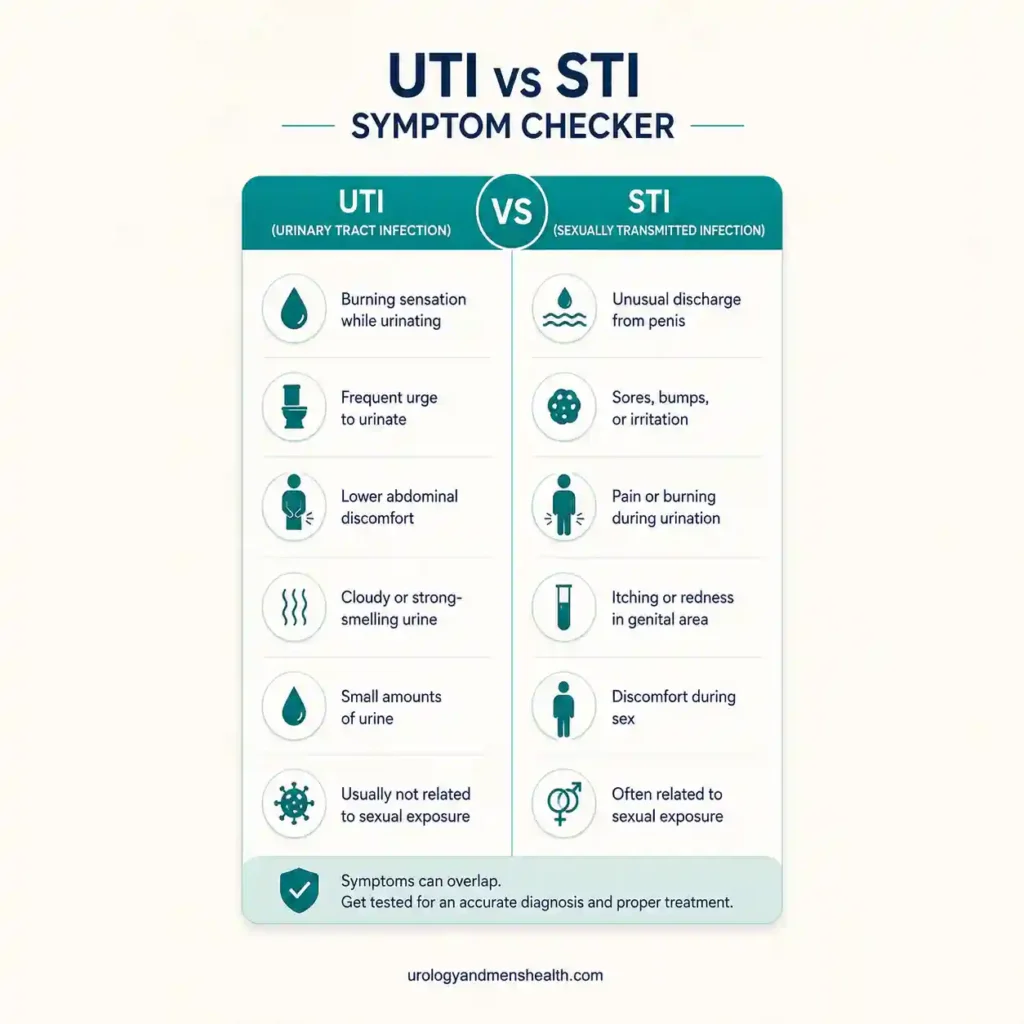
This UTI vs STI symptom checker for men helps you tell a urinary tract infection apart from a sexually transmitted infection when the main symptom - burning when you pee - is the same for both. Answer a few questions about discharge, your symptom pattern, and recent contact, and you will get a clear next step: which test to ask for, or when to be seen the same day. It is a screening aid, not a diagnosis. For more, see the UTIs and infections hub.

The Tool
Related UTI & Infection Tools
Full Clinical Guide
In This Guide:
- A UTI and an STI can cause the exact same burning when you pee – the difference is found by testing, not by how it feels.
- Discharge is the strongest clue: thick yellow-green points toward gonorrhea, clear or milky toward the non-gonococcal causes – but both still need a test.
- In men, a bladder infection is always treated as complicated, so a urine culture matters even when the pattern looks simple.
- Fever, flank pain, or sudden testicle pain are not “wait and test” symptoms – they need same-day care.
What This Tool Checks
This UTI vs STI symptom checker for men sorts your symptoms into the pattern most likely behind them – a urinary tract infection in the bladder, urethritis from a sexually transmitted infection, or a warning picture that needs same-day care. It is built on the way specialists actually separate these conditions: the CDC 2021 STI Treatment Guidelines for urethritis, and the EAU guidance on urinary tract infections in men. The reason a checker helps here is that the headline symptom – a burning pain when you pass urine, called dysuria – is shared by both a UTI and an STI, so the symptom alone cannot tell you which you have. What separates them is the supporting detail: whether there is discharge, where the trouble sits, and your recent sexual history. The tool does not diagnose you; it points you to the correct test, because only a urine culture or a nucleic acid amplification test (NAAT) can name the cause.
Why the Same Symptom Has Two Very Different Causes
Think of the male urinary tract as a single pipe with two very different neighborhoods. The bladder sits at the top; the urethra is the long tube running out through the penis. A urinary tract infection is bacteria – usually E. coli from your own gut – multiplying in the bladder, which irritates the bladder wall and produces frequency, urgency, cloudy urine, and lower-belly pressure. Urethritis is inflammation of the tube itself, most often from an organism passed during sex: chlamydia, gonorrhea, or Mycoplasma genitalium. Both inflame the same nerve endings near the tip of the penis, which is why both burn when urine passes over them. The tell is the discharge: gonorrhea classically produces a thick, yellow or green, pus-like discharge, while the non-gonococcal causes tend to produce a clear or milky, watery one. A bladder infection produces no urethral discharge at all. If the burning comes with a swollen, painful testicle instead, the inflammation has usually spread to the epididymis – epididymitis – which shifts the whole plan toward urgent assessment.
How to Read Your Result
The checker sorts you into one of three results, and the gap between them is wide. A man who gets “your pattern fits a bladder infection” and a man who gets “get STI testing” are being sent to two different tests and, often, two different treatments – which is exactly why guessing is risky. A lower-tract pattern (frequency, cloudy urine, no discharge, no recent new partner) points to a UTI, and the next step is a urine dip and culture. A testing-needed result means either discharge or a urethral-plus-risk picture has raised the chance of urethritis, so a NAAT for chlamydia and gonorrhea is the priority – and if the story is mixed, both tests together. A seek-urgent-care result means you flagged a fever, flank pain, or testicle pain, which moves this out of the checker’s hands entirely. If ongoing urinary symptoms make you wonder whether your bladder is emptying fully, the post-void residual estimator is a useful companion, and persistent pelvic or perineal pain is better scored with the NIH-CPSI prostatitis index.
What to Do With Your Result
Match the action to the result. For a bladder-infection pattern, ask your primary care doctor or urologist for a urine dipstick and culture before any antibiotic – in men a UTI is treated as complicated, so the culture guides both the drug and its length. For a testing-needed result, ask specifically for a NAAT on a urine sample or urethral swab; the CDC recommends presumptively treating diagnosed urethritis with doxycycline 100 mg twice daily for 7 days, and treating gonorrhea with a single 500 mg ceftriaxone injection – so getting the right test is what unlocks the right treatment. For a fever, flank pain, or testicle-pain result, be seen the same day: a febrile UTI in a man can mean the kidney or prostate is involved, which usually needs around two weeks of an antibiotic that reaches the prostate, and sudden testicle pain needs an emergency ultrasound to rule out torsion. Whatever your result, remember both conditions are treatable once the test names them, and an untreated partner is the single most common reason an STI comes straight back. A useful next read on the urinary side is the diagnostic workup for recurrent UTIs in men. If you are unsure about your result, the PDF report this tool generates gives you a ready-made framework to bring to your next appointment.
In My Practice
The most common mistake I see is not a patient’s – it is a UTI diagnosed on symptoms alone in a man who actually had urethritis. His burning eases for a few days on the wrong antibiotic, everyone assumes it worked, and three weeks later he is back with the same problem and a partner who was never told to get tested.
The fix is unglamorous and reliable: in a man with urinary burning, I test before I label. A urine culture and a NAAT cost little and rule out the expensive error of treating the wrong organism in the wrong place. A checker cannot replace those tests – but it can get you to ask for the right one on the first visit.
References
- Workowski KA, Bachmann LH, Chan PA, et al. Sexually Transmitted Infections Treatment Guidelines, 2021. MMWR Recomm Rep. CDC MMWR 2021. Urethritis: gonococcal vs non-gonococcal presentation and NAAT-based diagnosis.
- CDC. Urethritis and Cervicitis – STI Treatment Guidelines, 2021. CDC STI Guidelines. Doxycycline 100 mg BID x7d for NGU; presumptive treatment.
- European Association of Urology. Guidelines on Urological Infections, 2024. EAU Uroweb. Male UTI as complicated; ~2-week fluoroquinolone for febrile UTI / prostatic involvement.
- Urinary Tract Infection (UTI) in Males: Differential Diagnoses. Medscape / eMedicine. Medscape. Urethritis is a more common cause of male dysuria than UTI; absence of bacteriuria suggests urethritis.
Frequently Asked Questions
Can a UTI and an STI cause the exact same symptoms?
Yes – and that is the whole problem. Burning when you pee (dysuria) is the shared headline symptom for both a bladder infection and urethritis from a sexually transmitted infection. The difference is in the supporting detail: discharge, where the discomfort sits, and recent sexual contact. Because the overlap is real, in men the safe move is to test rather than guess, which is why the UTI risk assessment and a NAAT often go together.
I have discharge but no pain. Is it still an STI?
Possibly – discharge on its own, even without much burning, is a classic sign of urethritis and warrants testing. Thick yellow or green discharge leans toward gonorrhea; clear or milky discharge leans toward chlamydia or Mycoplasma genitalium. None of these can be confirmed by appearance alone, so a NAAT is the next step regardless of how mild it feels. Do not wait for pain to appear before getting tested.
Can men get UTIs without any sexual cause at all?
Yes. A urinary tract infection in a man is usually bacteria from the gut reaching the bladder, and it has nothing to do with sex. What matters is that a male UTI is treated as a complicated infection because the prostate and a longer urethra are involved, so it deserves a urine culture rather than a symptom-only diagnosis. If UTIs keep returning, the recurrent UTI workup explains what a specialist looks for.
How accurate is this tool, and can I rely on it?
This checker organizes your symptoms the way a specialist would to decide which test comes first, but it does not diagnose you. A urinary tract infection and a sexually transmitted infection can only be confirmed by a urine culture or a NAAT, and the two can even occur together. Treat the result as a guide to the right next test and conversation, not as a verdict – and always act on the warning signs it flags.
How do I use this result at my doctor’s appointment?
Tap “Download My Report (PDF)” after you get your result. It summarizes your answers, the suggested next test, and a short list of questions to ask, all attributed to Dr. Khalid. Handing that to your primary care doctor or urologist gets you to the right test faster and makes it easier to ask for both a urine culture and STI testing in a single visit rather than two.
Dr. Muhammad Khalid
MBBS · FCPS (Urology) · MCPS (General Surgery) · CHPE · CRSM · IMC #539472
Specialist urologist with 11+ years of clinical experience across tertiary teaching hospitals. Trained at Lady Reading Hospital and Khyber Teaching Hospital, Peshawar. Author or co-author of five peer-reviewed international publications, including in Cureus and the World Journal of Surgery. Procedural expertise: URS, PCNL, RIRS, TURP, TURBT, and major open urological surgery. Full profile →
This article is for educational purposes only and does not constitute medical advice. Always consult your physician or urologist for diagnosis and treatment decisions specific to your condition.