
PSA Age-Adjusted Interpreter
Your age-adjusted PSA is read against an age-specific ceiling, not a flat 4.0 ng/mL cut-off that treats a 45-year-old and a 75-year-old the same. Enter your age and total PSA — add free PSA percentage if you have it — and the tool tells you which band you fall into: within range, borderline, or elevated. It is a screening read, not a diagnosis. For related guides, see the full Prostate Health Hub.

The Tool
Related Prostate Tools
Full Clinical Guide
In This Guide:
- Age-adjusted PSA compares your result to the ceiling for your age, not a flat 4.0 ng/mL line.
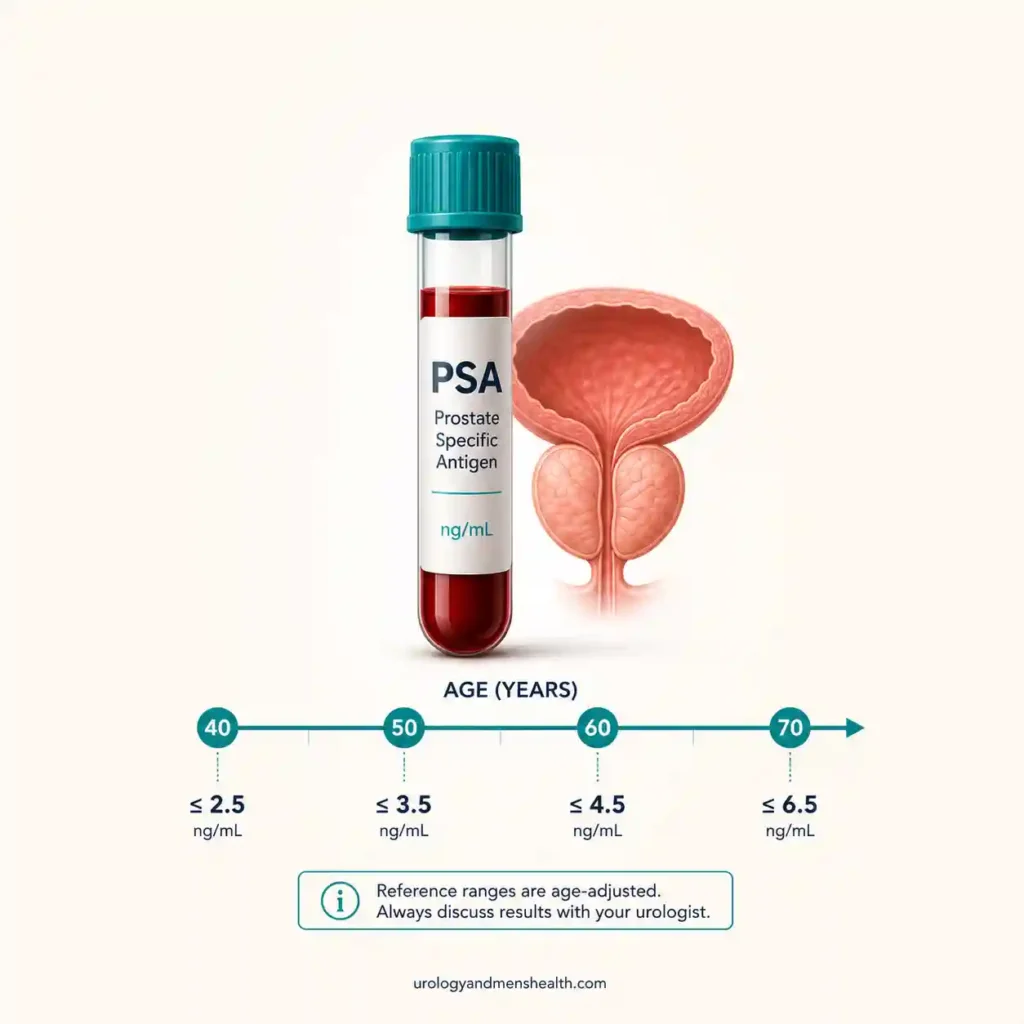
- The reference ceiling rises each decade — roughly 2.5, 3.5, 4.5 and 6.5 ng/mL.
- Most raised results have a benign cause: an enlarged prostate, infection, or recent ejaculation.
- The trend across several tests tells you more than any single number.
What This Tool Measures
This tool reports your age-adjusted PSA: your total prostate-specific antigen (PSA) value compared against the reference ceiling expected for your age group, rather than a single fixed threshold. The age-specific approach was established by Oesterling and colleagues, whose community-based study set the reference ranges still used in clinical practice today [1]. PSA is a protein made by the prostate and measured in a routine blood draw. Because the gland enlarges with age, the upper limit of “normal” rises too, which is why a result that is reassuring at 70 would be worth a closer look at 45. The calculator applies the age band ceilings (2.5, 3.5, 4.5 and 6.5 ng/mL across the decades) and, where you provide it, factors in your free-to-total PSA ratio to refine the band.
The Physiology Behind the Score
PSA leaks into the bloodstream from prostate tissue. The more prostate tissue there is, the more PSA you would expect to see, which is why benign prostatic enlargement raises the number without any cancer being present. Think of PSA as the volume on a speaker: a bigger speaker plays louder at the same setting. That is why size matters to interpretation, and why pairing a PSA with gland volume (PSA density) often resolves a borderline reading. If you have had a prostate volume measured on ultrasound or MRI, the Prostate Volume Calculator turns it into a PSA density figure that puts your number in proportion. Inflammation (prostatitis), a recent urinary infection, cycling, and ejaculation in the prior 48 hours can all push PSA up temporarily, which is why timing and repeat testing matter as much as the value itself.
How to Interpret Your Result
A within range result means your PSA is at or below the ceiling for your age; the priority becomes tracking the trend over time rather than reacting to one figure. A borderline result sits modestly above the ceiling, the band where benign enlargement and inflammation are the most common explanations and where a repeat test and free-PSA ratio usually clarify things. An elevated result is well above the age ceiling and warrants specialist assessment, though even here a large benign prostate or a missed infection accounts for a meaningful share of cases. In every band, the modern pathway favors imaging before any needle.
What to Do With Your Result
If you are within range, log the value as a baseline and recheck on the interval your doctor sets. If you are borderline, ask for a repeat PSA in about six weeks with a free-to-total ratio, having avoided cycling, ejaculation and any infection beforehand. If you are elevated, request a urology appointment within two to four weeks and ask whether a multiparametric MRI should precede any biopsy. Because benign enlargement is the most frequent cause of a raised PSA, it helps to understand how an enlarged prostate behaves and when it needs treatment.
Read: Enlarged Prostate (BPH) — When Surgery Becomes the AnswerIf your result and your concern are driven by family history or other risk factors, the Prostate Cancer Risk Calculator folds PSA into a fuller risk picture. For the wider set of guides on screening, biopsy and treatment, see the full Prostate Health Hub. If you are unsure about your result, the PDF report this tool generates gives you a ready-made framework to bring to your next appointment.
In My Practice
The most useful thing a man can do before a PSA appointment costs nothing: bring the dates and values of his last two or three results on a single piece of paper. I see far more anxiety created by a PSA quoted with no history than by the number itself. A 4.2 in isolation reads as alarming; a 4.2 that has crept up from 4.0 and 4.1 over three years reads as stable and benign, and the consultation changes completely once that line is visible.
When a man cannot tell me what his previous PSA was, the first thing I do is order a repeat and ask him to track it from now on. The trend is the information.
References
- Oesterling JE, Jacobsen SJ, Chute CG, et al. Serum prostate-specific antigen in a community-based population of healthy men: establishment of age-specific reference ranges. JAMA. 1993;270(7):860-864. PubMed
- American Urological Association / Society of Urologic Oncology. Early Detection of Prostate Cancer: AUA/SUO Guideline. 2023. AUA Guideline
- European Association of Urology. Guidelines on Prostate Cancer. EAU; 2025. EAU Guideline
- Catalona WJ, Partin AW, Slawin KM, et al. Use of the percentage of free prostate-specific antigen to enhance differentiation of prostate cancer from benign prostatic disease. JAMA. 1998;279(19):1542-1547. PubMed
Frequently Asked Questions
What is a normal age-adjusted PSA level?
Age-specific reference ceilings are roughly 2.5 ng/mL under age 50, 3.5 ng/mL in your 50s, 4.5 ng/mL in your 60s, and 6.5 ng/mL in your 70s, based on the Oesterling reference ranges. A value at or below your age ceiling is within range. These are screening thresholds, not diagnostic lines, and a result just over the ceiling is usually benign. If your reading falls in the uncertain 4 to 10 ng/mL window, the PSA grey zone guide explains what happens next.
Why does PSA rise as I get older?
The prostate slowly enlarges with age, a process called benign prostatic hyperplasia. More prostate tissue produces more PSA, so the blood level drifts upward over decades without any cancer being involved. This is the entire reason a flat 4.0 ng/mL cut-off misleads older men into worry and younger men into false comfort. Because a single value rarely tells the story, tracking how your number changes year to year with the PSA Velocity Tracker is more informative than any one reading.
Can something other than cancer raise my PSA?
Yes, and benign causes are the most common. An enlarged prostate, prostatitis, a recent urinary tract infection, cycling, catheterization, and ejaculation within 48 hours of the test can all elevate PSA temporarily. This is why a borderline result is usually repeated about six weeks later under controlled conditions before any further step. Ruling out these reversible causes reclassifies a large share of mildly raised results back to normal.
How accurate is this tool, and can I rely on it?
This interpreter applies published age-specific PSA reference ranges and an optional free-PSA adjustment, the same framework urologists use. It is a screening aid that helps you understand your result and frame the right questions; it does not diagnose cancer or replace clinical judgment. PSA must always be read alongside your history, examination, and sometimes imaging. Use it to prepare for a conversation with your doctor, not to substitute for one.
How do I use this result at my doctor’s appointment?
Use the Download My Report button to generate a one-page PDF with your age-adjusted result, what it means, the suggested next steps, and tailored questions to ask. Bring it to your appointment along with the dates and values of any previous PSA tests. Having your trend on paper lets your doctor judge how fast your PSA has moved, which is often more telling than a single number.
Dr. Muhammad Khalid
MBBS · FCPS (Urology) · MCPS (General Surgery) · CHPE · CRSM · IMC #539472
Specialist urologist with 11+ years of clinical experience across tertiary teaching hospitals. Trained at Lady Reading Hospital and Khyber Teaching Hospital, Peshawar. Author or co-author of five peer-reviewed international publications, including in Cureus and the World Journal of Surgery. Procedural expertise: URS, PCNL, RIRS, TURP, TURBT, and major open urological surgery. Full profile →
This article is for educational purposes only and does not constitute medical advice. Always consult your physician or urologist for diagnosis and treatment decisions specific to your condition.