
BPH Procedure Selector: UroLift, Rezum, TURP, Aquablation or HoLEP
This BPH procedure selector helps you see which enlarged-prostate operation - UroLift, Rezum, TURP, Aquablation or HoLEP - best fits your prostate size, your symptoms, and how much you want to protect sexual function. Answer four short questions for a guideline-based steer to take to your urologist. It does not replace a specialist's assessment. Start with the wider picture on our prostate health hub.

The Tool
Related Prostate Tools
Full Clinical Guide
In This Guide:
- Prostate size is the master switch: under about 80 mL (2.7 fl oz) opens the office options (UroLift, Rezum); over 80 mL points to HoLEP, Aquablation or open surgery.
- If keeping ejaculation matters most, UroLift, Rezum and Aquablation protect it; TURP and HoLEP cause dry (retrograde) ejaculation in most men.
- Office procedures trade a little durability for that comfort – UroLift sits near 13.6% surgical retreatment over 5 years, Rezum near 4.4%.
- Complications – retention, repeat infections, bladder stones, kidney strain – move you from “if” to “when,” and surgery should not be delayed.
What This BPH Procedure Selector Does
This BPH procedure selector turns the surgical decision for an enlarged prostate into four plain questions and maps your answers onto the AUA (2020, amended 2023) and EAU surgical recommendations for benign prostatic hyperplasia [1][2]. Benign prostatic hyperplasia is non-cancerous prostate growth that squeezes the urethra and blocks the flow of urine. The tool weighs the same three things a urologist weighs: how large the prostate is, how badly it is obstructing you, and how much you want to protect ejaculation. It is a starting map, not a verdict – the named procedure is the conversation to open, after a urologist confirms your anatomy. For the fuller clinical picture, see our guide on when an enlarged prostate needs surgery, and if you have a recent scan you can estimate your prostate volume first.
How the Procedures Actually Differ
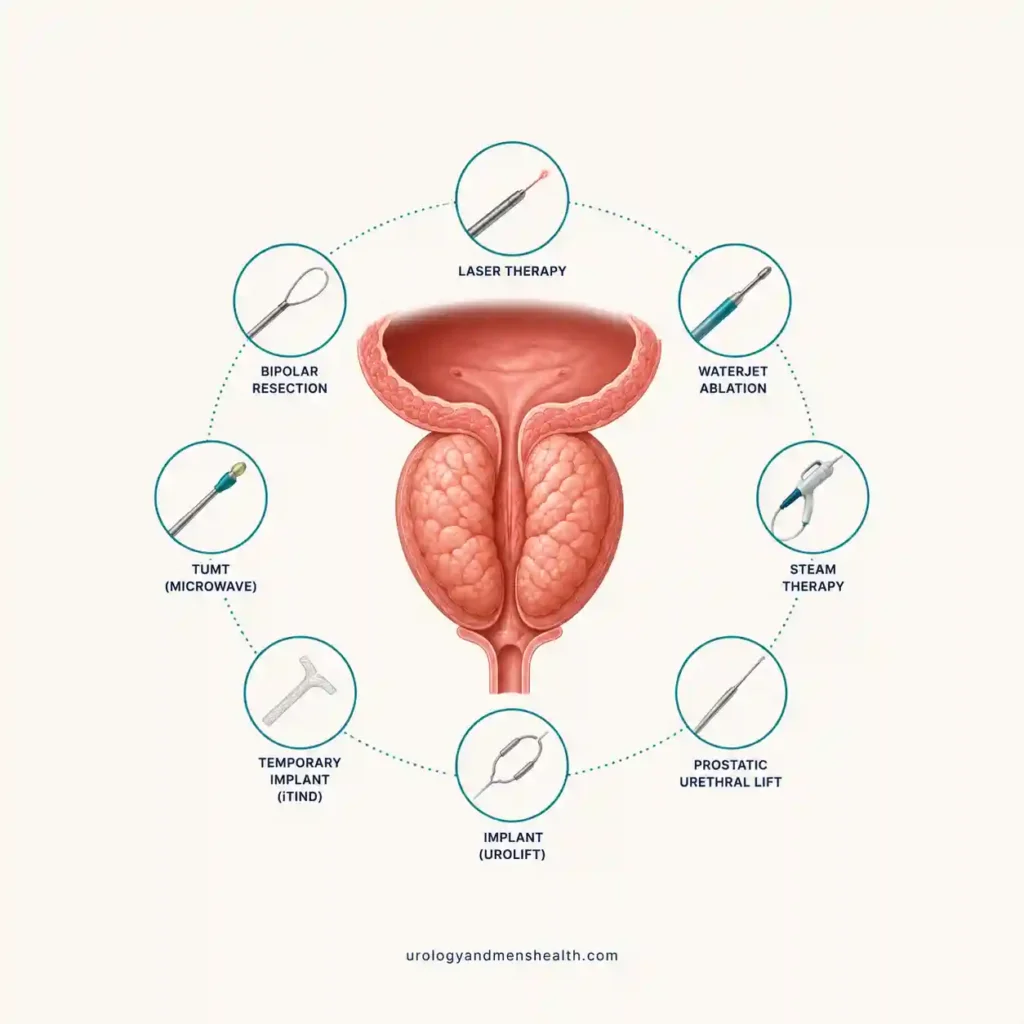
Every BPH operation reopens the same channel, but they do it in different ways, and that is what creates the trade-offs. The office-based minimally invasive procedures move tissue aside rather than cutting it out: UroLift places tiny permanent implants that pull the prostate lobes open, and Rezum injects water vapor (steam) that makes obstructing tissue shrink over weeks. Because neither disturbs the bladder neck the way a resection does, both protect ejaculation [3]. The operating-room procedures remove or enucleate tissue: TURP shaves it from inside, and HoLEP peels the whole inner gland away with a laser, which is why HoLEP works regardless of prostate volume [5]. Aquablation sits in between – a robot-guided waterjet that ablates tissue under image control and tends to spare ejaculation more often than TURP [1].
How to Read Your Result
The same set of symptoms can land on completely different advice. A man with a 45 mL prostate who wants to keep ejaculation is steered toward UroLift or Rezum; a man with a 120 mL gland who is already in urinary retention is steered toward HoLEP or open surgery, soon – and that gap is the whole point of sizing first. The tool sorts you into one of three routes. The least-invasive route covers a proper medication trial and the function-sparing office procedures. The operating-room route covers the more durable resective and enucleative options, where prostate size decides which one and TURP remains the standard up to about 80 mL (2.7 fl oz) [1]. The complicated route means a complication is already present and the timeline tightens. The durability numbers are real: office procedures carry a higher chance of needing a second procedure within 5 years than a one-time resection.
What to Do With Your Result
If you landed on the least-invasive route and have not yet given medication a fair trial, start there – an alpha-blocker such as tamsulosin can ease the stream within days, and a 5-alpha-reductase inhibitor such as finasteride or dutasteride shrinks the gland over 3 to 6 months. If tablets have failed, ask specifically about UroLift and Rezum, and have your size and median-lobe status confirmed on ultrasound or MRI. If you landed in operating-room territory, the first job is a measured prostate volume, because that single number decides whether TURP, Aquablation (offered at 30 to 80 g and studied up to 150 cc) or HoLEP is on the table [5]. If a complication was flagged, treat it as a deadline and book a urologist promptly. Whichever route you are on, you can also work through the medication options and check where your symptoms sit on the IPSS symptom score before your visit. If you are unsure about your result, the PDF report this tool generates gives you a ready-made framework to bring to your next appointment.
In My Practice
The factor men most often over-weight is the word “minimally invasive,” and the one they under-weight is their own prostate volume. I have sat with men set on an office procedure for a gland the size of an orange, and the kindest thing I can do is show them that for that size the realistic comparison is not big surgery versus small surgery – it is one durable operation versus likely needing a second lighter one. Once the number is on the table, the decision almost makes itself.
Size and your feelings about ejaculation do most of the deciding in BPH surgery. Get the volume measured early, and the shortlist of sensible options shrinks to one or two.
References
References
- American Urological Association. Management of LUTS Attributed to BPH: Guideline Part II – Surgical Evaluation and Treatment (2020, amended 2023). Journal of Urology. Prostate-size thresholds and procedure eligibility (UroLift and Rezum <80 g; Aquablation 30-80 g).
- European Association of Urology. Guidelines on the Management of Non-neurogenic Male LUTS, including benign prostatic obstruction. Uroweb. Surgical treatment of BPO.
- Rukstalis D, et al. The UroLift implant: mechanism behind rapid and durable relief from prostatic obstruction. Prostate Cancer and Prostatic Diseases. 5-year surgical retreatment 13.6%; no new sustained ejaculatory or erectile dysfunction.
- Mahmood F, et al. A narrative review of water vapor thermal therapy (Rezum) for BPH. J Clin Med (PMC). Rezum 5-year surgical retreatment 4.4%; TURP retrograde ejaculation approximately 50-70%.
- Berjaoui MB, et al. WATER versus WATER II 5-year update: Aquablation in 30-80 cm3 vs 80-150 cm3 prostates. BJUI Compass. Aquablation across size ranges; enucleation effective regardless of volume.
Frequently Asked Questions
UroLift, Rezum, TURP, Aquablation or HoLEP – which BPH procedure is best?
Will I lose the ability to ejaculate after BPH surgery?
How long is recovery and catheter time after each procedure?
How accurate is this tool, and can I rely on it?
How do I use this result at my doctor’s appointment?
Dr. Muhammad Khalid
MBBS · FCPS (Urology) · MCPS (General Surgery) · CHPE · CRSM · IMC #539472
Specialist urologist with 11+ years of clinical experience across tertiary teaching hospitals. Trained at Lady Reading Hospital and Khyber Teaching Hospital, Peshawar. Author or co-author of five peer-reviewed international publications, including in Cureus and the World Journal of Surgery. Procedural expertise: URS, PCNL, RIRS, TURP, TURBT, and major open urological surgery. Full profile →
This article is for educational purposes only and does not constitute medical advice. Always consult your physician or urologist for diagnosis and treatment decisions specific to your condition.