
DASH Diet Daily Compliance Scorer
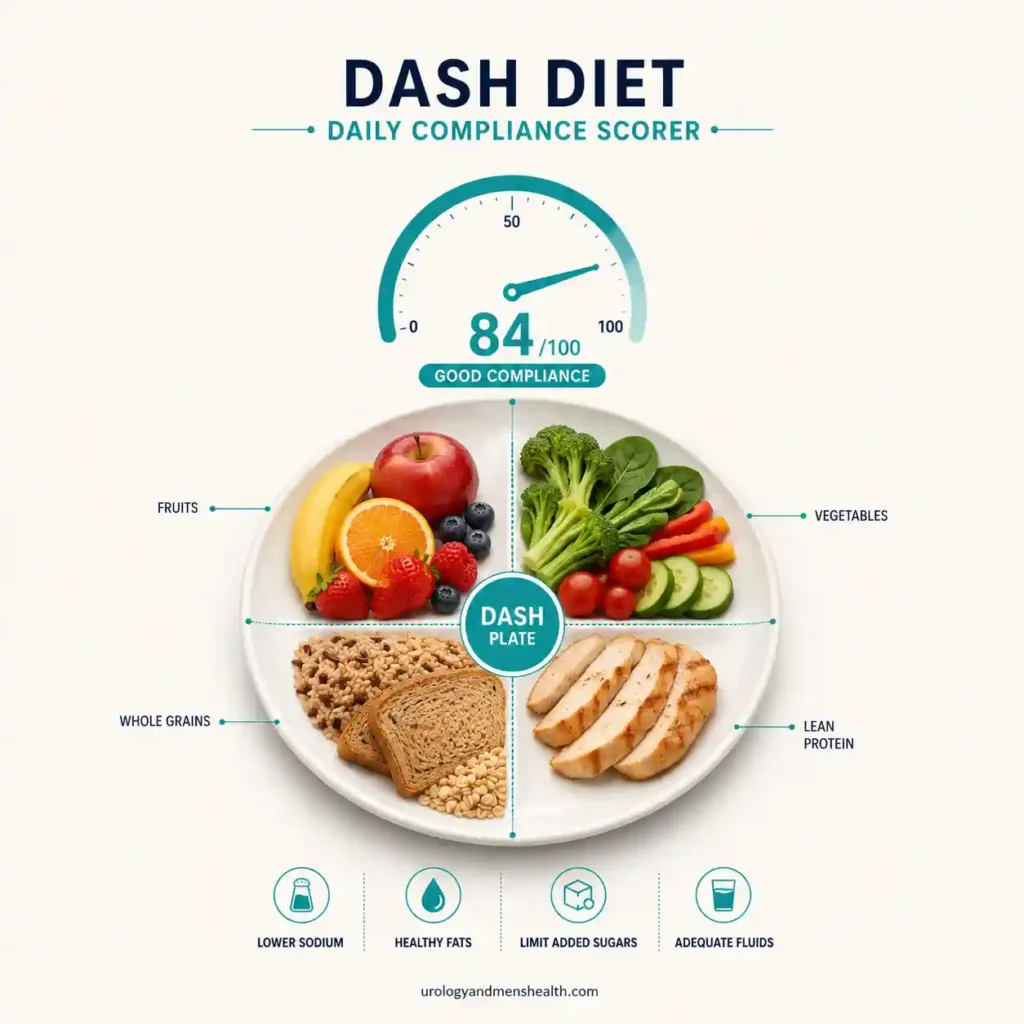
This DASH diet compliance scorer checks how closely a single day of eating matches the DASH plan proven to lower blood pressure. Enter your servings of vegetables, fruit, grains, dairy, protein, nuts, and sweets, plus how salty the day was, and you get a compliance percentage, the food groups you are on track for, and the one to focus on next. See more tools on the blood pressure hub.

The Tool
Related Blood Pressure Tools
Full Clinical Guide
In This Guide:
- DASH lowers blood pressure through the whole pattern – potassium-rich produce and dairy plus low sodium – not any single food.
- Meeting the DASH minimums (4 vegetables, 4 fruit, 6 grains, 2 dairy, sodium under target) scores 100%; you do not need to overshoot.
- The effect is dose-dependent, so fixing the one flagged group is worth more than a total overhaul.
- Re-score daily – your weekly average, tracked against home BP readings, is what actually matters.
What This Tool Measures
This DASH diet compliance scorer measures how closely one day of eating matches the DASH eating plan – the Dietary Approaches to Stop Hypertension pattern developed by the US National Heart, Lung, and Blood Institute (NHLBI) and endorsed by the American Heart Association to lower blood pressure [1][5]. It scores eight components against the NHLBI targets for a 2,000-calorie day: 4 to 5 servings of vegetables, 4 to 5 of fruit, 6 to 8 of grains, 2 to 3 of low-fat dairy, 6 ounces or fewer of lean meat, poultry, or fish, regular nuts and legumes, few added sugars, and a sodium level under 2,300 mg – ideally 1,500 mg [1]. Your result is a single compliance percentage, the groups you are on track for, and the one to fix next.
The Physiology Behind the Score
DASH lowers blood pressure through the nutrients its food groups carry rather than any single ingredient. Vegetables, fruit, and low-fat dairy load the diet with potassium, calcium, and magnesium, which help blood vessels relax and counter the pressure-raising effect of sodium [1]. Cutting sodium works from the other direction: less salt means less fluid held in the circulation, so the vessels face lower resistance. Think of it as easing off the accelerator and the brake at once – adding the minerals that relax vessels while removing the salt that stiffens them. Because the effect is dose-dependent, every serving you shift toward target counts, which is why sodium is weighted heavily here. If salt is your weak point, the Sodium Intake Daily Tracker breaks down exactly where it hides.
How to Interpret Your Result
A day at 85% and a day at 40% call for completely different advice. At strong adherence (75% or above) the DASH pattern is mostly in place, and the work is holding it across the week, since the trial benefit came from the pattern repeated day after day, not one perfect plate. Partial adherence (50 to 74%) usually means one or two groups are dragging the score – the tool names the weakest one so you fix that first rather than everything at once. A low score (under 50%) means the main levers – sodium, vegetables, fruit – are mostly missing, which sounds discouraging but leaves the most room to gain: the original DASH trials saw the largest blood-pressure drops in the people who started furthest from target [2]. Read the “Focus next” line, not just the number.
What to Do With Your Result
Whatever your score, change one thing and re-measure. If sodium was flagged, aim under 2,300 mg a day and read labels on bread, sauces, and processed meat, where most hidden salt sits; a lower-sodium day often moves blood pressure within about two weeks [3]. If produce was the gap, add one vegetable and one fruit serving per meal before chasing the full 4-to-5 target. Track your DASH score alongside a morning home blood-pressure reading so you can watch the two move together over a fortnight. Salt hides in more places than most people expect – the Hidden Sodium Calculator shows the worst offenders in a typical day.
If you are unsure about your result, the PDF report this tool generates gives you a ready-made framework to bring to your next appointment.
In My Practice
The single most common reason a motivated patient’s DASH score stalls is not willpower – it is sodium they never see. A man eating vegetables and fruit all day can still blow past the salt limit on one deli sandwich and a bowl of canned soup, and be genuinely surprised when I add it up with him.
Before overhauling a whole diet, I look for the two or three high-salt items doing most of the damage – because removing those often moves the number more than any amount of extra vegetables.
References
- National Heart, Lung, and Blood Institute. DASH Eating Plan (serving targets and sodium limits). NHLBI.
- Appel LJ, Moore TJ, Obarzanek E, et al. A Clinical Trial of the Effects of Dietary Patterns on Blood Pressure. N Engl J Med. 1997;336:1117-1124. The DASH diet lowered systolic and diastolic BP by 5.5 and 3.0 mmHg more than the control diet. NEJM.
- Sacks FM, Svetkey LP, Vollmer WM, et al. Effects on Blood Pressure of Reduced Dietary Sodium and the DASH Diet (DASH-Sodium). N Engl J Med. 2001;344:3-10. Lowering sodium reduced BP further on top of DASH. NEJM.
- Conlin PR, et al. The effect of dietary patterns on blood pressure control in hypertensive patients: results from the DASH trial. In people with hypertension, 70% reached normal BP on the combination diet vs 23% on control, with changes evident within about 2 weeks. PubMed.
- American Heart Association. Managing Blood Pressure with a Heart-Healthy Diet (DASH eating plan). American Heart Association.
Frequently Asked Questions
What counts as one serving when I use this DASH scorer?
Do I need to hit every DASH target to get a good score?
I do not know my sodium in milligrams – how does the tool handle that?
How accurate is this tool, and can I rely on it?
How do I use this result at my doctor’s appointment?
Dr. Muhammad Khalid
MBBS · FCPS (Urology) · MCPS (General Surgery) · CHPE · CRSM · IMC #539472
Specialist urologist with 11+ years of clinical experience across tertiary teaching hospitals. Trained at Lady Reading Hospital and Khyber Teaching Hospital, Peshawar. Author or co-author of five peer-reviewed international publications, including in Cureus and the World Journal of Surgery. Procedural expertise: URS, PCNL, RIRS, TURP, TURBT, and major open urological surgery. Full profile →
This article is for educational purposes only and does not constitute medical advice. Always consult your physician or urologist for diagnosis and treatment decisions specific to your condition.