
UTI Recurrence Risk Profiler
Your UTI recurrence risk in men is rarely down to bad luck — a repeating infection usually points to a cause worth finding. This profiler walks through your history and symptoms, then flags the most likely driver behind the pattern and the single next step that fits it. It takes about a minute and nothing is stored. For the full picture, see the UTIs and infections hub.

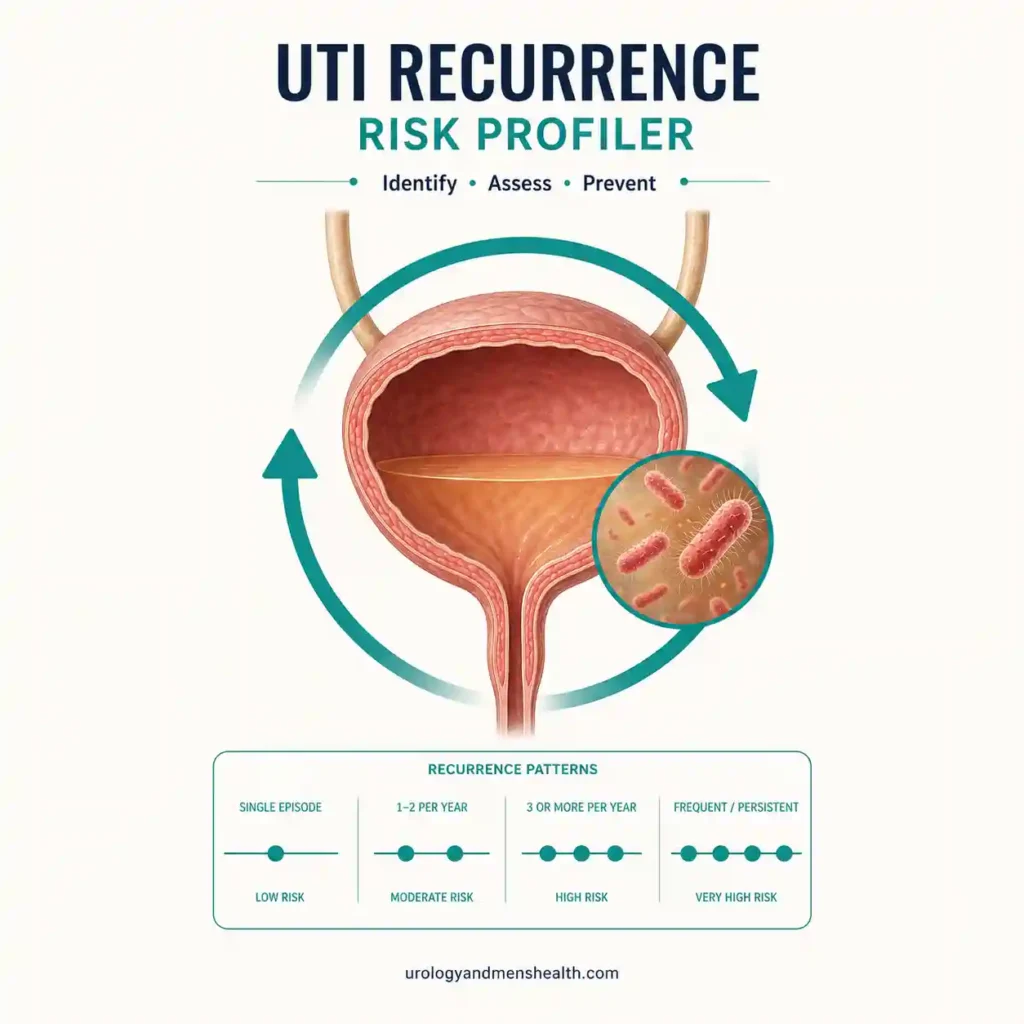
The Tool
Related UTI Tools
Full Clinical Guide
In This Guide:
- In men, recurring UTIs are usually a symptom of an underlying cause, not bad luck.
- The commonest drivers are incomplete bladder emptying and the prostate acting as a reservoir.
- A urine culture before each antibiotic — plus imaging when needed — matters more than the drug choice.
- Red-flag symptoms (fever, flank pain, visible blood, unable to pass urine) need same-day care.
What This Tool Measures
Recurrent UTIs in men are far less common than in women, and that difference is exactly why they matter. This UTI recurrence risk profiler is built on the recurrence criteria used by the American Urological Association and the European Association of Urology — two or more infections in six months, or three or more in a year [1] — and then goes a step further to sort the likely reason behind the pattern. Rather than scoring severity, it walks your history and symptoms down a short decision path and lands on the single most useful next step for your situation. It does not diagnose the cause; it points you and your doctor at the right question. For the full diagnostic picture, read the workup for recurrent UTIs in men.
Why a Man’s UTIs Come Back
In women, most UTIs are simple and self-contained. In men, a repeating infection is different: UTIs stay uncommon until around age 60 and then climb, and most men who get one have some underlying factor driving it [4]. The commonest is incomplete emptying. When the bladder does not fully empty — often because an enlarging prostate narrows the outlet — a pool of urine is left behind after each void, and that standing pool is where bacteria multiply between infections [5]. Think of it as a pond that never fully drains. The prostate itself can also act as a hidden reservoir: bacteria shelter inside it, survive a standard antibiotic course, and reseed the bladder days after treatment ends [2]. Stones and catheters give bacteria a surface to cling to. To see how much urine you may be leaving behind, the post-void residual estimator is the companion tool.
How to Read Your Result
Your result is a recommendation, not a number. A lower-complexity result means your answers show no warning features or structural driver — the focus is confirming the infection with a culture and simple prevention. A treatable-driver result means the pattern points at something specific and fixable: incomplete emptying, a prostatic reservoir, or blood sugar feeding the bacteria — each with its own test. A higher-complexity result means either red-flag symptoms that need same-day care, or a structural feature — a stone, a catheter, prior surgery, or blood between infections — that marks a complicated infection needing a prompt urologist [3]. The confidence label tells you how strongly your answers pointed one way. Because male recurrent UTI is so often structural, no result here should end with simply another antibiotic prescription; it should end with the right test.
Read: Why repeat antibiotics stop working — and what to doWhat to Do With Your Result
Whatever your result, three moves apply. First, insist on a urine culture before the next antibiotic — matching the drug to the organism is what breaks a cycle of half-treated infections, and it is the single most useful thing most men are missing. Second, if there is any sign of poor emptying, ask for a post-void residual scan and a flow test before anyone talks about long-term preventive antibiotics. Third, if infections return within a week or two of finishing treatment, ask directly whether the prostate is the source; a prostate-focused infection needs a longer, culture-directed course than a bladder infection, and the chronic prostatitis symptom index can help frame that conversation.
If you are unsure about your result, the PDF report this tool generates gives you a ready-made framework to bring to your next appointment.
In My Practice
The pattern that stays with me is the man in his sixties on his fifth antibiotic course in a year, frustrated that nothing sticks. The infections were real, but every visit treated the episode and none asked the question underneath it. One bladder scan and one properly timed culture reframed the whole problem — and the course of the next year.
A recurring infection in a man is a prompt to investigate, not just to prescribe — the cause, once found, is usually more treatable than the endless cycle suggests.
References
- American Urological Association / CUA / SUFU. Recurrent Uncomplicated Urinary Tract Infections in Women: Guideline (definition of recurrent UTI). AUA guideline.
- European Association of Urology. Guidelines on Urological Infections, 2025/2026 (management of underlying complicating factors; male accessory gland infections). Uroweb.
- Infectious Diseases Society of America. Complicated Urinary Tract Infections Guideline, 2025 (features defining a complicated UTI). IDSA.
- Male Urinary Tract Infection: Guidelines Update. US Pharmacist, 2025 (male UTI uncommon until age 60; most have an underlying urologic factor). US Pharmacist.
- Recurrent Urinary Tract Infections. StatPearls, NCBI Bookshelf (recurrence definition; incomplete emptying as a reservoir). StatPearls.
Frequently Asked Questions
Why do I keep getting UTIs as a man?
UTIs are uncommon in men, so a repeating pattern usually signals an underlying cause rather than bad luck. The most frequent drivers are incomplete bladder emptying, often from an enlarged prostate, and the prostate acting as a bacterial reservoir. Stones, catheters, and poorly controlled diabetes also feature. That is why the sensible next step is finding the driver — see the diagnostic workup for recurrent UTIs in men — not just another antibiotic.
How many UTIs count as “recurrent”?
Guidelines define recurrent UTI as two or more infections within six months, or three or more within a year, each confirmed by symptoms and a urine test. In men, even a single confirmed UTI is worth checking, because male UTIs are uncommon. If you are unsure where you fall, the UTI risk assessment for men helps you gauge your risk before infections stack up.
Does a recurring UTI mean I have something serious like cancer?
Usually not. The great majority of recurring infections in men trace back to a treatable cause such as incomplete emptying or the prostate. That said, blood you can see in your urine between infections should always be checked, as it occasionally points to something that needs imaging or a look inside the bladder. If in doubt about your symptoms, review UTI in men — when to worry.
How accurate is this tool, and can I rely on it?
This profiler is an educational screening aid, not a diagnosis. It is built on the recurrence criteria from the AUA and EAU and on well-established clinical drivers, but it cannot examine you, culture your urine, or scan your bladder — the things that actually confirm a cause. Use it to understand your likely pattern and to prepare, then confirm everything with a clinician. For a related check, try the UTI vs STI symptom checker.
How do I use this result at my doctor’s appointment?
Use the Download My Report button to save a two-page PDF with your answers, your recommendation, and a short list of questions to ask. Bringing it keeps the visit focused on the driver behind your infections rather than only the current episode, and it prompts the tests that matter — a culture and, where relevant, a bladder scan. For background before you go, read the recurrent UTI workup guide.
Dr. Muhammad Khalid
MBBS · FCPS (Urology) · MCPS (General Surgery) · CHPE · CRSM · IMC #539472
Specialist urologist with 11+ years of clinical experience across tertiary teaching hospitals. Trained at Lady Reading Hospital and Khyber Teaching Hospital, Peshawar. Author or co-author of five peer-reviewed international publications, including in Cureus and the World Journal of Surgery. Procedural expertise: URS, PCNL, RIRS, TURP, TURBT, and major open urological surgery. Full profile →
This article is for educational purposes only and does not constitute medical advice. Always consult your physician or urologist for diagnosis and treatment decisions specific to your condition.