Antibiotic Resistance UTI: Why Treatment Keeps Failing
An antibiotic resistance UTI usually isn't an untreatable infection. More often the wrong drug was chosen blind, or the bacteria are sitting somewhere that drug can't reach. Here's how I tell the two apart.

An antibiotic resistance UTI is the most common explanation men are given when a urinary infection keeps coming back — and it is also the most commonly misunderstood one. Most men who tell me their antibiotics “stopped working” have not acquired some untreatable superbug. They were given a drug chosen blind, before anyone knew what was actually growing, and a meaningful share of those guesses are wrong from the first dose. The rest of the time something structural is happening: the bacteria are living inside the prostate, inside a stone, or behind a bladder that never fully empties, where no oral antibiotic reaches a killing concentration. Those two problems look identical from the outside. You take the tablets, feel better for a week, and the burning comes back. They need completely different fixes. For the wider picture of how urinary infections behave in men, our UTIs and Infections Hub covers the pillar in full.
Key Takeaways
- In the largest US recurrent-UTI dataset, 21.8% of urinary E. coli isolates were already resistant to trimethoprim-sulfamethoxazole and 14.2% to fluoroquinolones — which is why blind prescribing fails so often.
- An ESBL result rarely costs you one antibiotic. Among US outpatient ESBL-producing E. coli, 72.4% were also resistant to fluoroquinolones and 56.7% to trimethoprim-sulfamethoxazole.
- A culture reporting “sensitive” can still fail in men, because nitrofurantoin and fosfomycin achieve high urine concentrations but poor prostatic tissue concentrations.
- For afebrile men, a 2021 JAMA randomized trial found 7 days of ciprofloxacin or trimethoprim-sulfamethoxazole was noninferior to 14 days — longer courses added resistance pressure without adding cure.
What antibiotic resistance actually means in a recurring UTI
Resistance is a property of the bacteria, not of you. Your body does not become resistant to antibiotics. A particular strain of E. coli either carries a mechanism that defeats a particular drug, or it does not.
There are three mechanisms that account for nearly everything you will see on a urine report. The first is an enzyme — beta-lactamases chop the chemical ring that penicillins and cephalosporins depend on, so the drug arrives inactivated. The second is an efflux pump, a molecular bailing bucket in the bacterial membrane that throws the antibiotic back out faster than it accumulates. The third is a modified target: the enzyme the drug was designed to jam has changed shape slightly, and the drug no longer binds it.
The reason this matters for recurrent infection is that these mechanisms are selected for by exposure. Every antibiotic course you take kills the susceptible bacteria in your gut and on your perineum and leaves the resistant ones behind to repopulate. In a US cohort of outpatients with E. coli urinary infection, receiving a fluoroquinolone or any oral antibiotic within the previous 90 days independently predicted a fluoroquinolone-non-susceptible and multidrug-resistant isolate at the next infection [3].
That effect shows up clearly when you compare people who get infections repeatedly against people who get one. In a retrospective US cohort of more than 80,000 outpatients, isolates from the recurrent group were resistant to trimethoprim-sulfamethoxazole in 21.8% of cases versus 18.7% in the non-recurrent group, and to fluoroquinolones in 14.2% versus 8.6%. ESBL production was found in 5.9% versus 4.1%, and the odds of resistance across three or more drug classes were 1.70 times higher [1].
One honest caveat, because you will not find it stated on most pages covering this topic: that dataset, and almost every large outpatient resistance dataset in circulation, is drawn from female patients. There is no equivalent large-scale male outpatient surveillance. Men’s isolates are generally expected to be equally or more resistant, because catheters, instrumentation, and prostatic reservoirs all add exposure — but that is an inference, not a measurement, and I am not going to present it as one.
Check which prior antibiotic exposures raise your resistance risk →Why an antibiotic resistant UTI in men is a different problem
For two decades, every urinary infection in a man was classified as “complicated” by definition, regardless of how mild it looked. The 2025 EAU Urological Infections guidelines moved away from that framing, replacing the uncomplicated/complicated split with a classification based on whether the infection is localised to the bladder or systemic, in either sex [6]. Under the new scheme a man with straightforward cystitis, no fever, and no prostatic involvement can be treated as a localised infection — which means a narrower drug and a shorter course, and less resistance pressure.
But the reason the old classification existed has not gone away. It is the prostate.
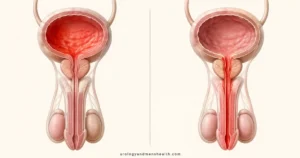
Think of the prostate as a walled compound sitting immediately downstream of the bladder. The glandular tissue is protected by lipid membranes and sits at a pH different from plasma, and only a small number of antibiotics cross into it at concentrations high enough to kill bacteria. Fluoroquinolones and trimethoprim-sulfamethoxazole do. Nitrofurantoin and fosfomycin largely do not — they are concentrated in urine, which is exactly what makes them excellent for cystitis and useless for anything sitting in prostatic tissue.
This produces the single most confusing scenario in men’s urology: a laboratory report that says the organism is sensitive to the drug you took, and an infection that came back anyway. The report was not wrong. It predicted what would happen in urine. It said nothing about what would happen three millimetres away in glandular tissue. That is a pharmacokinetic failure, not a resistance failure, and treating it as resistance — by escalating to a broader antibiotic — makes the resistance problem worse while leaving the reservoir untouched.
Duration is the other place men get treated on reflex rather than evidence. A 2021 randomized, double-blind trial published in JAMA enrolled 272 afebrile men with symptomatic urinary infection and found that 7 days of ciprofloxacin or trimethoprim-sulfamethoxazole was noninferior to 14 days for symptom resolution, with no increase in recurrence [4]. If you have no fever and no evidence of prostatic involvement, a fortnight of antibiotics is not extra safety. It is extra selection pressure. The starting point for any of this is understanding what a urinary infection in a man actually signals in the first place, because in men it is far more often a symptom of something structural than a standalone event.
In My Practice
A 58-year-old man was referred to me after four courses of antibiotics in seven months. Each culture had grown E. coli reported as sensitive to nitrofurantoin, each course cleared his symptoms within three days, and each time the burning returned around week three. Nobody had measured his post-void residual. It was 240 mL. He was not failing because of resistance — he was failing because he was carrying a third of a litre of stagnant urine in a bladder his enlarged prostate would not let him empty, and nitrofurantoin was never going to reach the prostate anyway.
When a sensitive organism keeps returning on schedule, stop escalating the antibiotic and start looking for the reservoir.
The four resistance patterns that show up most often
Four patterns account for most of what a urologist sees on a sensitivity report.
Trimethoprim-sulfamethoxazole
The highest baseline resistance of the common oral agents, at 21.8% in recurrent-infection isolates [1]. The conventional prescribing threshold is that empiric use should be abandoned once local resistance exceeds roughly 20%. In much of the United States that line has already been crossed, which means prescribing it blind is a coin flip with unfavourable odds.
Fluoroquinolones (ciprofloxacin, levofloxacin)
Non-susceptibility reached 14.2% in recurrent isolates [1]. These drugs still matter in men because they penetrate prostatic tissue, but the FDA has issued repeated safety warnings covering tendon rupture, aortic aneurysm, peripheral neuropathy, and central nervous system effects. They are a considered choice for tissue infection, not a first reflex for simple cystitis.
Nitrofurantoin
Still reliably active against E. coli and the reason it remains a first-line cystitis agent. Its limitations are organism-specific rather than resistance-driven: Proteus is intrinsically resistant, Klebsiella frequently is, and it does not treat tissue infection at any dose.
ESBL production
Extended-spectrum beta-lactamase enzymes destroy penicillins and most cephalosporins. Found in 5.9% of recurrent-infection isolates [1] — and this is where the arithmetic turns against you. In a US analysis of more than 1.5 million outpatient E. coli urine isolates, among those that were ESBL-producing or non-susceptible to third-generation cephalosporins, 72.4% were also resistant to fluoroquinolones, 56.7% to trimethoprim-sulfamethoxazole, and 46.6% to both [2]. An ESBL result does not remove one antibiotic from the list. It typically removes three.
Those figures come from female outpatient cohorts [1][2]. Use them as the shape of the problem rather than as your personal probability.
Get the Recurrent UTI Eradication Protocol — what to ask for at each stage
Enter your email below to receive Dr. Khalid’s complete Recurrent UTI Eradication Protocol as a free, printable PDF.
How to read your urine culture and sensitivity report
Most men are told “the culture confirmed an infection” and nothing else. Ask for the actual report. There are four things on it worth understanding.
- The organism. E. coli behaves differently from Proteus, which alkalinises urine and forms struvite stones, which behaves differently again from Enterococcus. The name changes which drugs are even candidates.
- The colony count. Reported in colony-forming units per millilitre. High counts with symptoms support infection. Low counts, or mixed growth of several organisms, usually mean contamination during collection rather than a resistant strain.
- The S / I / R grid. S means susceptible at standard dosing. R means resistant. The middle category, increasingly reported as “susceptible-dose dependent,” means the drug can still work if given at a higher dose or more frequently — it is not a soft no.
- The MIC. The minimum inhibitory concentration, in micrograms per millilitre. A lower number is not automatically better across different drugs; it only means anything compared against that specific drug’s breakpoint. Nitrofurantoin and fosfomycin are reported against urine-specific breakpoints, which is precisely why an S beside them does not promise anything about tissue.
What to do with this: ask that a urine culture with sensitivities be sent before the first dose of any antibiotic, and ask for a copy of the finished report rather than a verbal summary. If you have already started treatment, still send it — a partially suppressed culture is more useful than none. Keep every report. A man who arrives at my clinic with three dated sensitivity reports gets a better decision than one who arrives with a memory of “some antibiotic that did not work.” If this is your second or third episode, the underlying question is no longer which antibiotic, but what the diagnostic workup for recurrent infection in men should actually include.
What treatment looks like when the first-line drugs fail
The first principle is that the next prescription should be culture-directed, not another guess. A second empiric course after a failed first empiric course is how men end up on their fourth antibiotic in a year with a more resistant organism than they started with.
For infection confined to the bladder, oral options remain reasonable even with a difficult organism: nitrofurantoin where the organism is susceptible, fosfomycin as a single or repeated dose, an oral cephalosporin, or amoxicillin-clavulanate depending on the report. Where the infection involves prostatic tissue, the field narrows to agents that penetrate — a fluoroquinolone or trimethoprim-sulfamethoxazole if susceptible — and the duration extends substantially, often to four to six weeks for chronic bacterial prostatitis.
For a febrile ESBL infection, oral therapy is usually not adequate and a short intravenous course, commonly with a carbapenem such as ertapenem, is the standard route. That is a hospital or ambulatory-infusion decision, not something to be managed on repeat prescriptions.
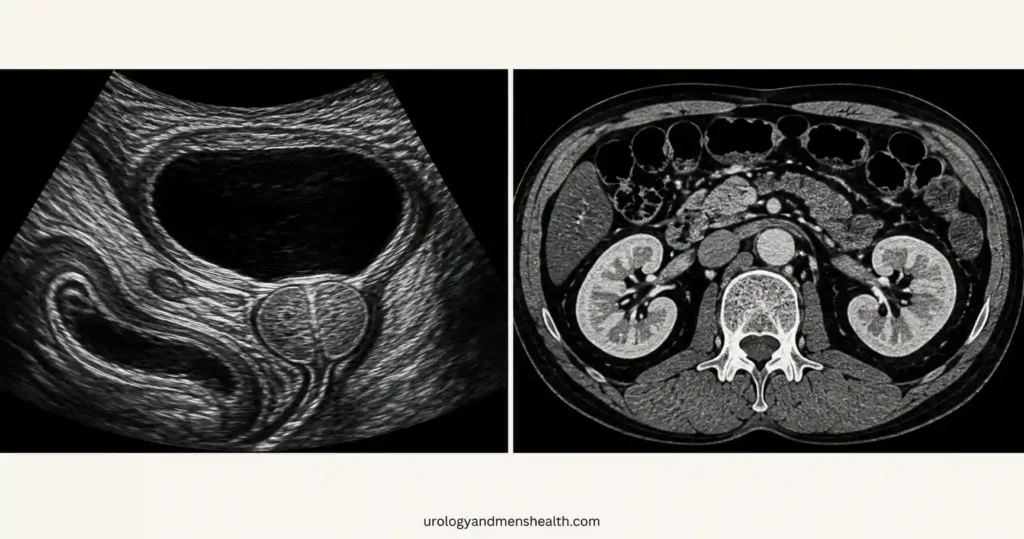
Running alongside the antibiotic decision, there should be a structural one. Post-void residual measurement by bladder scan takes two minutes and identifies incomplete emptying. Non-contrast CT of the kidneys, ureters and bladder identifies stones. This matters because certain stones are not merely associated with infection — they are built by it. Struvite stones form when urease-producing bacteria alkalinise the urine, and once formed they house bacteria inside a mineral shell no antibiotic penetrates, reseeding the bladder every time treatment stops. The relationship runs in both directions, which is covered in detail in how kidney stones and urinary infections drive each other.
When to Go to the ER
Antibiotic resistance becomes an emergency when the infection stops being confined to the bladder. Go to the emergency room the same day, not to a repeat prescription, if you develop:
- Fever above 38°C (100.4°F) or shaking chills, particularly with pain in the flank or back
- Nausea and vomiting that stops you keeping oral antibiotics down
- Confusion, drowsiness, a racing pulse, or feeling faint on standing — these can be early sepsis, and in older men confusion may be the only sign
- Complete inability to pass urine despite a full bladder
- Symptoms that are worsening rather than plateauing after 48 hours on an antibiotic
How to stop driving resistance in your own bladder
Resistance is not something that happens to you from the outside. It is cultivated, one course at a time, in your own gut and urinary tract. Four decisions carry most of the weight.
Do not treat bacteria without symptoms. Asymptomatic bacteriuria — bacteria present on culture with no burning, frequency, urgency, or fever — should not be treated in most men. The exceptions are narrow: before a urological procedure that will breach the urinary tract mucosa, and in pregnancy. The 2025 AUA/CUA/SUFU amendment to the recurrent urinary infection guideline made this shift explicit, redefining treatment success as symptom resolution rather than microbial eradication and reemphasising that not all bacteriuria warrants antibiotics [5]. That guideline addresses women, but the principle transfers directly, and in men the temptation to chase a positive culture is if anything stronger.
Never use leftover or borrowed antibiotics. A half-finished pack from a previous episode delivers a subtherapeutic dose of a drug the current organism may already resist. It is the most efficient way to select resistance available to a patient.
Ask about non-antibiotic prevention. The ALTAR randomized trial compared methenamine hippurate 1 g twice daily against daily low-dose antibiotic prophylaxis over 12 months and found methenamine noninferior for preventing symptomatic infections, with a lower proportion of participants developing resistant E. coli on treatment — 56% versus 72% in the antibiotic arm [7]. That trial enrolled 240 women, so the male evidence is weaker by extrapolation, but methenamine is a reasonable conversation to have with your urologist before committing to a year of daily antibiotics.
Fix the driver, not the episode. In men this is the one that changes outcomes. Bladder outlet obstruction from an enlarged prostate, an untreated stone, a stricture, or an indwelling catheter will keep generating infections no matter how elegantly each one is treated. Ask specifically for a post-void residual measurement and, if you have had two or more infections in six months, for imaging — and set a timeframe: if you have had a second culture-confirmed infection, that workup should be arranged within four weeks rather than after the next episode.
Profile your own recurrence risk before your next appointment →Frequently Asked Questions
Does an antibiotic resistant UTI mean I have a superbug?
In most cases, no. Resistance describes one bacterial strain against one drug class, not a globally untreatable organism. An E. coli resistant to trimethoprim-sulfamethoxazole is frequently still fully sensitive to nitrofurantoin or fosfomycin. The practical question is which agents remain active on your specific report. The antibiotic resistance risk matrix shows which prior exposures make a resistant isolate more likely at your next episode.
Why did my UTI come back when the culture said the antibiotic was sensitive?
A sensitivity result predicts what happens in urine, not in tissue. If bacteria are sheltering inside the prostate, inside a stone, or in residual urine that never drains, a drug can sterilise the urine and leave the reservoir intact. Struvite stones are the clearest example, since they are constructed by bacteria and reseed the bladder — the mechanism is covered in how stones and urinary infections feed each other.
How long should a man take antibiotics for a UTI?
For afebrile men with lower urinary symptoms, a 2021 JAMA randomized trial found 7 days of ciprofloxacin or trimethoprim-sulfamethoxazole was noninferior to 14 days. Febrile infection, suspected bacterial prostatitis, or bloodstream involvement needs longer, often 14 days to 6 weeks. Ask which of those you are being treated for before accepting a duration, and read what a UTI in a man actually signals.
What is an ESBL UTI and how is it treated?
ESBL means the bacteria produce an extended-spectrum beta-lactamase, an enzyme that destroys penicillins and most cephalosporins. Because ESBL strains are frequently co-resistant to fluoroquinolones and trimethoprim-sulfamethoxazole, oral options narrow sharply. Bladder-confined infection may still respond to fosfomycin or nitrofurantoin; febrile infection usually needs intravenous therapy such as ertapenem. A structured recurrent infection workup identifies why the strain colonised you.
Can I prevent recurrent UTIs without taking antibiotics every day?
Often, yes. The ALTAR randomized trial found methenamine hippurate noninferior to daily low-dose antibiotic prophylaxis for preventing recurrences, with less resistance emerging during treatment. That trial studied women, so male evidence is weaker, but in men the higher-yield move is correcting the driver — retention, stones, or prostate disease. Start by mapping your own pattern with the UTI recurrence risk profiler.
References
- Fromer DL, Cheng WY, Gao C, et al. Likelihood of Antimicrobial Resistance in Urinary E. coli Isolates Among US Female Patients with Recurrent Versus Non-Recurrent uUTI. Urology. 2024;190:1-10. PubMed
- Kaye KS, Gupta V, Mulgirigama A, et al. Co-resistance Among Escherichia coli and Klebsiella pneumoniae Urine Isolates from Female Outpatients with Presumed UTI: A Retrospective US Cohort Study. Infect Dis Ther. 2024;13(7):1715-1722. PubMed
- Mitrani-Gold FS, Kaye KS, Gupta V, et al. Older patient age and prior antimicrobial use strongly predict antimicrobial resistance in Escherichia coli isolates recovered from urinary tract infections among female outpatients. PLoS One. 2023;18(5):e0285427. PubMed
- Drekonja DM, Trautner B, Amundson C, Kuskowski M, Johnson JR. Effect of 7 vs 14 Days of Antibiotic Therapy on Resolution of Symptoms Among Afebrile Men With Urinary Tract Infection: A Randomized Clinical Trial. JAMA. 2021;326(4):324-331. PubMed
- Ackerman AL, Bradley M, D’Anci KE, et al. Updates to Recurrent Uncomplicated Urinary Tract Infections in Women: AUA/CUA/SUFU Guideline (2025). American Urological Association. AUA
- Bonkat G, Kranz J, Cai T, et al. EAU Guidelines on Urological Infections. European Association of Urology, 2025. EAU
- Harding C, Chadwick T, Homer T, et al. Methenamine hippurate compared with antibiotic prophylaxis to prevent recurrent urinary tract infections in women: the ALTAR non-inferiority RCT. Health Technol Assess. 2022;26(23):1-172. PubMed
Dr. Muhammad Khalid
MBBS · FCPS (Urology) · MCPS (General Surgery) · CHPE · CRSM · IMC #539472
Specialist urologist with 11+ years of clinical experience across tertiary teaching hospitals. Trained at Lady Reading Hospital and Khyber Teaching Hospital, Peshawar. Author or co-author of five peer-reviewed international publications, including in Cureus and the World Journal of Surgery. Procedural expertise: URS, PCNL, RIRS, TURP, TURBT, and major open urological surgery. Full profile →
This article is for educational purposes only and does not constitute medical advice. Always consult your physician or urologist for diagnosis and treatment decisions specific to your condition.