Can Kidney Stones Cause UTIs? A Urologist Explains
Kidney stones and urinary infections aren't separate problems — each one can cause the other. The combination I watch most closely is a stone that's both blocking and infected, because that can turn into sepsis within hours.

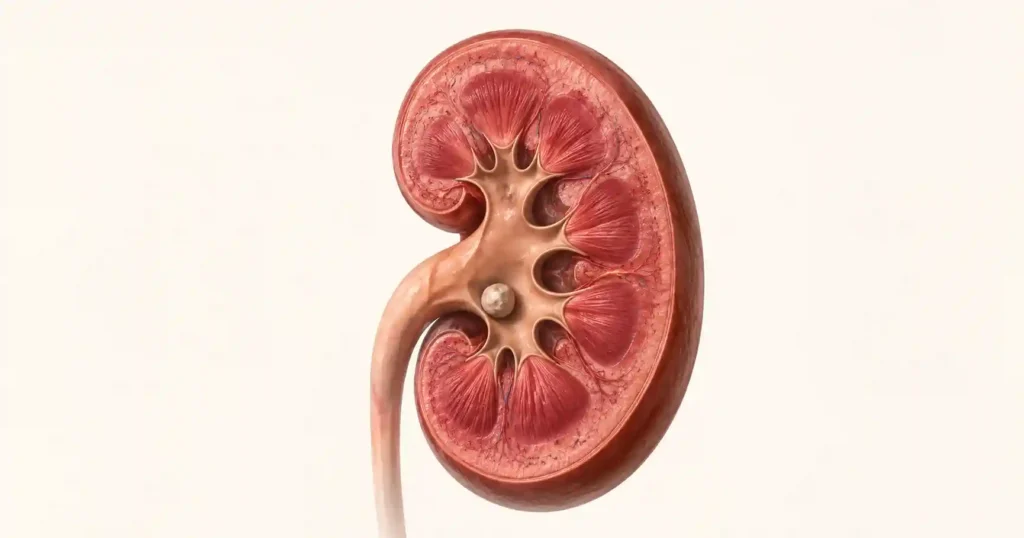
Can kidney stones cause UTIs? Yes — and in my clinic the two problems show up together far more often than patients expect. A stone and a urinary tract infection are not separate events that happen to coincide; each one can directly cause the other, and the relationship runs in both directions. A stone blocks the flow of urine and gives bacteria a sheltered place to multiply. Certain infections, in turn, build a specific type of stone from the inside out. The reason this matters is not academic. The most dangerous combination I treat is a stone that is both blocking the kidney and infected at the same time — a situation that can move from uncomfortable to life-threatening in a matter of hours. For the full picture of how stones form and behave, our Kidney Stones Hub covers the basics. This article answers one specific question: how stones and infections feed each other, when that combination becomes an emergency, and what actually breaks the cycle.
Key Takeaways
- A stone that blocks urine flow leaves stagnant urine behind it — and stagnant urine is where bacteria multiply. This is the main way stones cause infections.
- Struvite (infection) stones work the other way: urease-producing bacteria turn urine alkaline, which precipitates the minerals that build large, fast-growing staghorn stones.
- Fever or chills with a known kidney stone is a red flag. An infected, obstructed kidney can progress to sepsis within hours and needs emergency drainage, not just antibiotics.
- Antibiotics alone rarely clear an infection sitting on or behind a stone, because the stone shelters bacteria — so the stone itself usually has to be treated to stop infections coming back.
How Kidney Stones Cause UTIs: The Obstruction Problem
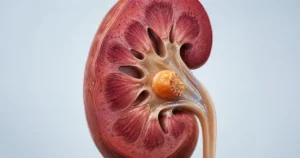
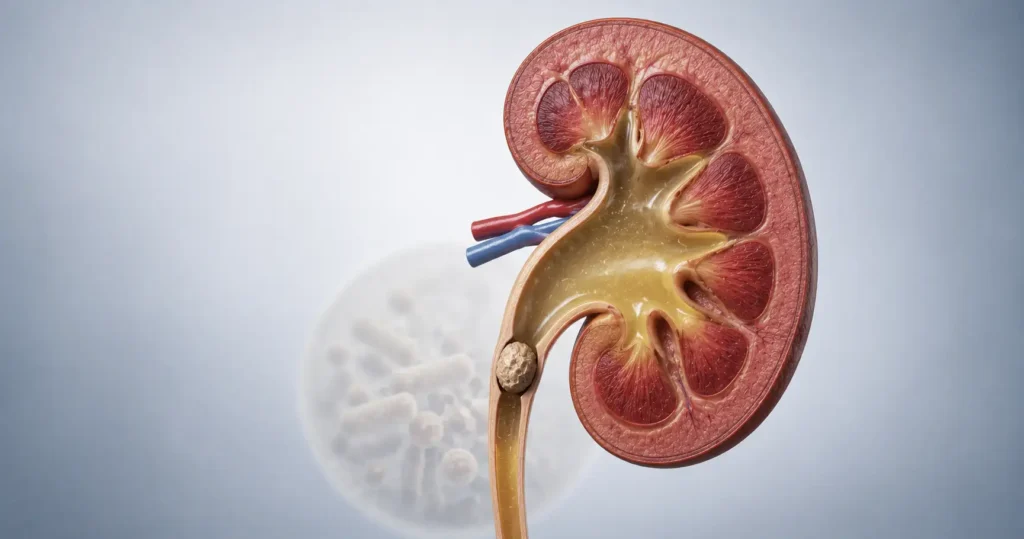
Urine is meant to move in one direction and keep moving. That constant flow is one of the body’s best defenses against infection — bacteria get flushed out before they can establish a foothold. A stone interrupts that. When a stone partly or fully blocks a ureter, urine pools behind it, and stagnant urine is an ideal environment for bacteria to multiply.
There is a second mechanism that does not need any blockage at all. The surface of a stone gives bacteria something to attach to and hide within, partly shielded from both the flushing action of urine and from antibiotics in the bloodstream. This is why some men get the same infection back again and again, no matter how many antibiotic courses they finish — the stone is acting as a reservoir that reseeds the infection each time. If that pattern sounds familiar, our complete guide to kidney stone symptoms and treatment explains how stones are diagnosed and removed.
Struvite Stones: When the Infection Comes First
The relationship also runs the other way: an infection can build the stone. These are called struvite stones, or infection stones, and they form through a specific chemical chain. Certain bacteria — classically Proteus, but also Klebsiella and Pseudomonas — produce an enzyme called urease that splits urea in the urine into ammonia. The ammonia turns the urine alkaline, and in that alkaline environment, magnesium ammonium phosphate and carbonate apatite crystallize out and harden into stones [2].
Struvite stones behave differently from the more common calcium stones. They grow quickly, and they can branch out to fill the entire collecting system of the kidney — the so-called staghorn stone. They account for between 2% and 15% of all stones analyzed, and every patient who forms one is considered high-risk for it happening again [2]. Once this cycle starts, it becomes self-sustaining: the infection builds the stone, and the stone then harbors the infection. Understanding which stone type you make matters here — see how struvite differs from calcium and uric acid stones in our guide to the different types of kidney stones.
Find out which stone type you may be forming → Kidney Stone Composition IdentifierWorried about a stone coming back? Download Dr. Khalid’s 7-Day Kidney Stone Prevention Meal Plan.
Enter your email below to receive Dr. Khalid’s complete 7-Day Kidney Stone Prevention Meal Plan as a free, printable PDF.
The Dangerous Combination: An Infected, Blocked Stone
In My Practice
The cases that stay with me are the ones that came in looking deceptively stable. A man in his forties arrived with a few days of flank pain he had blamed on a pulled muscle, a low-grade fever he had blamed on a cold, and a single obstructing stone we found on his CT scan. Within hours of admission his blood pressure dropped and he was septic. The stone had turned the kidney behind it into a closed, infected pocket, and his body had been quietly losing the fight for two days.
Fever with a known or suspected kidney stone is never something to watch overnight at home — an obstructed, infected kidney is one of the few true emergencies in stone disease.
When a stone blocks the kidney and the urine behind it is infected, you have a closed, infected space under pressure. Bacteria and the toxins they release have nowhere to drain, so they are forced back into the bloodstream. This is how a stone that felt like ordinary pain in the morning becomes urosepsis by the evening. Major urology bodies treat a concurrent obstructing stone and urinary infection as a genuine emergency [1][2].
The single most important thing to understand is that antibiotics alone are not enough here. An infected, obstructed kidney has to be physically drained — urgently — with either a small tube passed up to the kidney (a ureteral stent) or a drain placed through the skin (a nephrostomy). The antibiotics cannot reach infected urine that has nowhere to go. Only after the kidney is decompressed and the infection cleared is the stone itself treated [1][2]. The reason the timing is treated so seriously: delaying decompression of an obstructing, infected stone is associated with a measurably higher risk of death [3].
Red Flags: Go to the ER the Same Day
If you have a known or suspected kidney stone, these signs point to a possible infected, obstructed kidney. Do not wait — this needs emergency assessment, not a clinic appointment next week. (More on infection symptoms in men is in our guide to UTIs in men and when to worry.)
- Fever above 38°C (100.4°F) or shaking chills
- Flank or back pain together with cloudy, foul-smelling urine
- Feeling confused, very weak, or lightheaded
- A racing heartbeat, fast breathing, or passing much less urine than usual
- Pain that keeps worsening despite pain medication
Breaking the Cycle: Testing, Treatment, and Prevention
Stones and the infections they cause account for over one million emergency department visits in the US each year, so this is a well-worn path for urologists [1]. The work-up is straightforward: a urine culture to identify the bacteria, a non-contrast CT scan (CT KUB) to find and measure the stone, and — once the stone is out — a formal stone analysis to confirm whether it is a struvite infection stone.
Treatment depends on which way the cycle is running. For an infection stone, the goal is to remove every fragment of stone material as completely as possible, because any piece left behind reseeds both the stone and the infection; targeted antibiotics are given alongside [2]. For infections driven by a non-infection stone causing blockage, clearing the stone removes the reservoir the bacteria were living in. To lower your risk going forward, two specific actions matter most: aim for a urine output that keeps you well-hydrated — for most men that means drinking enough to reach roughly 2.5 to 3 liters of fluid a day (about 85 to 100 fl oz) — and have any urinary infection cultured and properly treated rather than half-treated [4].
If you have had repeated urinary infections, ask your doctor a pointed question at your next visit: has imaging actually ruled out a stone I don’t know about? And if you are a known stone former, ask your urologist for a stone analysis on your next stone so you know whether infection is part of your picture.
Check your infection risk → UTI Risk Assessment for MenFrequently Asked Questions
Can a kidney stone cause a UTI if the stone isn’t blocking anything?
Yes. Even a stone that isn’t obstructing the kidney can act as a surface where bacteria attach and shelter, protected from the urine’s natural flushing and partly from antibiotics. That is why some men get the same urinary tract infection back repeatedly until the stone itself is treated. If infections keep returning, ask your doctor whether a CT scan has ruled out a stone you don’t yet know about.
How do I know if my kidney stone is infected?
The warning signs are fever, shaking chills, cloudy or foul-smelling urine, and feeling unwell beyond the pain itself. A stone causing pain alone is usually not an emergency, but pain plus fever suggests the kidney behind the stone may be both blocked and infected. You can gauge your risk with our UTI risk assessment for men, but treat any fever with a stone as a same-day emergency.
What is a struvite stone, and why does it keep coming back?
A struvite stone is an infection stone built by bacteria that split urea and turn the urine alkaline, which lets minerals crystallize into large, fast-growing stones. They return unless every fragment is removed and the underlying infection is cleared, because any leftover piece reseeds both the stone and the infection. Our guide to the different types of kidney stones explains how struvite differs from calcium stones.
Will antibiotics alone clear a UTI caused by a kidney stone?
Often they won’t. Antibiotics can settle the symptoms for a while, but bacteria sheltered inside or behind a stone are hard to reach, so the infection tends to relapse once the course ends. Lasting relief usually means treating the stone as well as the infection. A stone composition check helps confirm whether an infection stone is driving the cycle.
Can passing a kidney stone leave you with a UTI afterward?
It can. The irritation a stone causes as it moves, along with any stent placed during treatment, can make the urinary tract more vulnerable to bacteria for a short time. Most of these infections are straightforward to treat. For the bigger picture on how stones behave from start to finish, see our complete guide to kidney stones.
References
- American Urological Association / Endourological Society. Surgical Management of Kidney and Ureteral Stones: AUA Guideline. 2024–2025. AUA
- European Association of Urology. Guidelines on Urolithiasis. 2025. EAU
- Delayed Decompression of Obstructing Stones with Urinary Tract Infection Is Associated with Increased Odds of Death. Journal of Urology. 2020;204(6):1256-1262. Journal of Urology
- National Institute of Diabetes and Digestive and Kidney Diseases. Kidney Stones. NIDDK
Dr. Muhammad Khalid
MBBS · FCPS (Urology) · MCPS (General Surgery) · CHPE · CRSM · IMC #539472
Specialist urologist with 11+ years of clinical experience across tertiary teaching hospitals. Trained at Lady Reading Hospital and Khyber Teaching Hospital, Peshawar. Author or co-author of five peer-reviewed international publications, including in Cureus and the World Journal of Surgery. Procedural expertise: URS, PCNL, RIRS, TURP, TURBT, and major open urological surgery. Full profile →
This article is for educational purposes only and does not constitute medical advice. Always consult your physician or urologist for diagnosis and treatment decisions specific to your condition.