
Kidney Stone Prevention Compliance Tracker
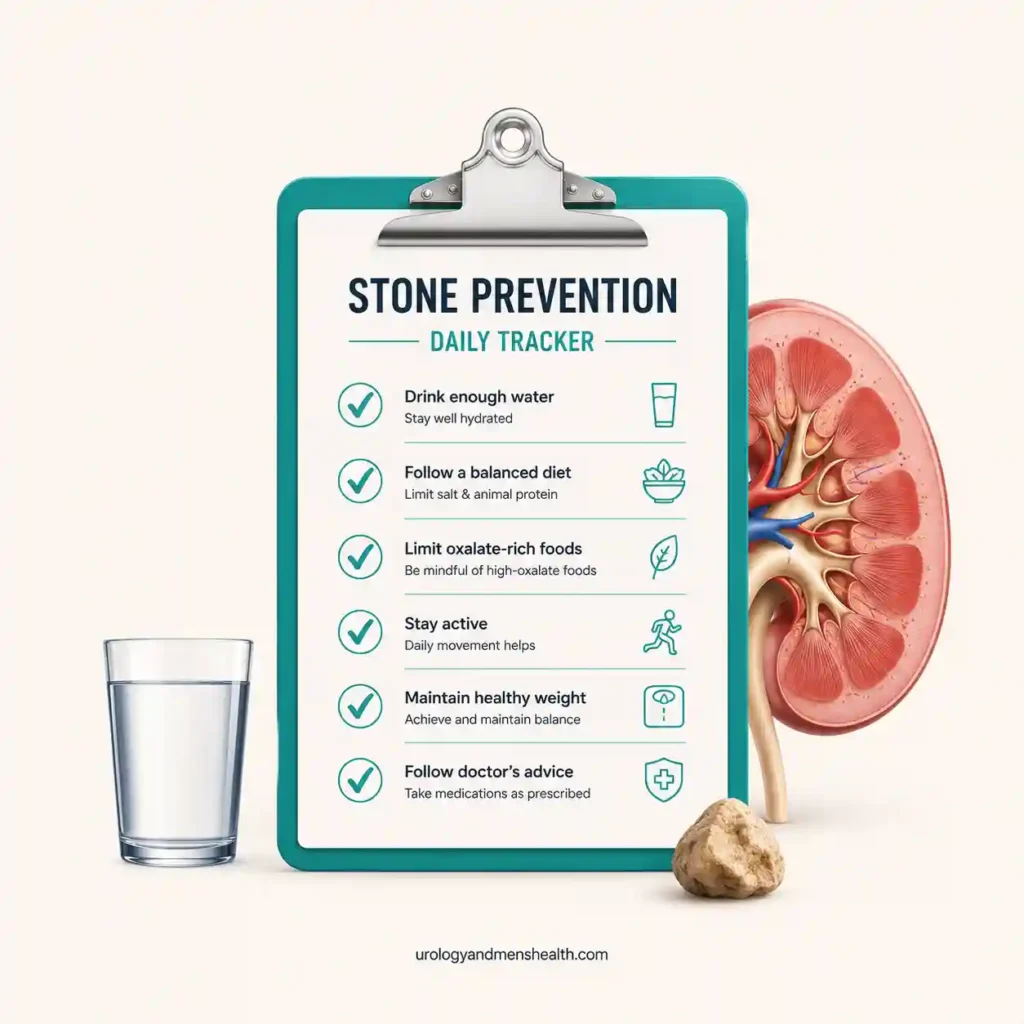
This kidney stone prevention compliance tracker scores how closely your daily habits match the seven evidence-based defenses urologists use to stop stones returning. In about two minutes it checks your fluid, sodium, calcium, oxalate, protein, citrate, and weight, then shows exactly which habits are protecting you and which are leaving a gap. Start with the kidney stones hub for the full prevention picture.

The Tool
Related Kidney Tools
Full Clinical Guide
In This Guide:
- The score is a compliance audit, not a diagnosis — it counts how many of seven evidence-based prevention habits you currently meet.
- Fluid is the highest-yield habit: enough to pass at least 2.5 liters of urine a day dilutes every stone-forming salt at once.
- Do not cut dietary calcium — a normal 1,000–1,200 mg a day binds oxalate in your gut and lowers, not raises, your risk.
- Forming stones despite good habits points to chemistry, not behavior — that is exactly what a 24-hour urine test checks for.
What This Tracker Measures
This kidney stone prevention compliance tracker turns the American Urological Association’s stone-prevention advice into a single, honest score. Rather than guess whether your routine is “good enough,” it checks your habits against seven specific recommendations that carry a Grade B evidence rating in the AUA Medical Management of Kidney Stones Guideline [1]: fluid intake, sodium restriction, normal dietary calcium, oxalate handling, animal-protein moderation, citrate intake, and body weight. Each habit you meet scores one point, for a total out of seven. It is important to be clear about what this is not: it is not a metabolic test and not a recurrence predictor. It is a structured way to see, at a glance, which of your defenses are solid and which are leaving an opening for the next stone.
The Physiology Behind the Habits
Stones form when the salts in your urine become concentrated enough to crystallize. Every habit on this list either dilutes those salts or keeps them dissolved. Fluid is the master lever — a urine volume of at least 2.5 liters a day thins out calcium, oxalate, and uric acid together [2]. Sodium matters because the kidney handles salt and calcium on the same pathway, so a high-salt diet drags calcium into the urine. The calcium habit is the one people get backwards: eating normal calcium with meals lets it bind oxalate in the gut so the pair leaves in your stool, not your urine. Cutting dairy does the opposite. Citrate is the natural inhibitor that coats crystals and stops them growing. If you want to see the calcium-oxalate pairing in a real plate of food, the Calcium-Oxalate Meal Balancer walks through it.
How to Read Your Compliance Score
The number is read as defense strength, and the colored band beside it shows how much gap remains. A score of 6 or 7 is a Strong Defense: your routine is doing most of the work, and a stone at this level usually means the cause is metabolic rather than dietary. A score of 3 to 5 is a Partial Defense — protected on some fronts, exposed on others — and this is where most stone formers land. A score of 0 to 2 is a High Gap, where concentrated urine is doing the damage. The point of the score is that it is specific: a man who meets six habits and a man who meets two are told completely different things. The first needs a urine test; the second needs to start drinking. The per-habit breakdown beside your score names exactly which defenses to shore up first.
What to Do With Your Result
Resist the urge to fix all seven habits at once. If you scored high but still formed a stone, the next move is a 24-hour urine collection to look for an abnormality in volume, calcium, oxalate, or citrate — there is little diet left to change. If you scored in the middle, change only the one or two habits marked as a gap and hold them for six weeks before adding more; narrow and consistent beats broad and brief. If you scored low, start with fluid alone, because urine volume lowers the concentration of every stone-forming salt at once and gives you a quick, motivating win. Whichever band you are in, dialing in your daily target with the Hydration Calculator is a sensible first step. If you are unsure about your result, the PDF report this tool generates gives you a ready-made framework to bring to your next appointment.
In My Practice
The conversation I have most often about stone prevention is not about adding something, but about undoing one wrong move. A patient who has formed a calcium oxalate stone hears “calcium” and immediately drops dairy, convinced they are helping. Months later they return with another stone and are baffled, because they did the one thing they thought mattered most.
Normal dietary calcium is protective, not harmful, for the vast majority of calcium oxalate stone formers — it binds oxalate in the gut before it can reach the urine. If your tracker flags calcium as a gap because you have been avoiding dairy, that is often the single most valuable habit to reverse, and it is one your urologist can confirm against your stone type in minutes.
References
- American Urological Association. Medical Management of Kidney Stones: AUA Guideline (2014, amended 2019). AUA Guideline. Source of the seven Grade B prevention recommendations.
- Pearle MS, Goldfarb DS, Assimos DG, et al. Medical Management of Kidney Stones: AUA Guideline. J Urol. 2014. DOI: 10.1016/j.juro.2014.05.006. Fluid target of ≥2.5 L urine/day and the dietary calcium 1,000–1,200 mg statement.
- European Association of Urology. EAU Guidelines on Urolithiasis. EAU Urolithiasis Guideline. Second-body confirmation of fluid, diet, and metabolic-workup recommendations.
- National Institute of Diabetes and Digestive and Kidney Diseases. Eating, Diet, & Nutrition for Kidney Stones. NIDDK. Patient-facing dietary guidance.
Frequently Asked Questions
Why shouldn’t I restrict calcium if I have calcium oxalate stones?
It is the most common self-inflicted mistake in stone prevention. If you cut dietary calcium, the oxalate in your food has nothing to bind to in your gut, so it is absorbed into your blood and dumped into your urine, where it finds calcium and forms stones. Eating a normal 1,000 to 1,200 mg of calcium with meals lets the pair leave in your stool instead. See which foods actually drive stone formation.
Which single habit matters most for preventing stones?
Fluid, by a clear margin. Urine volume is the one variable that dilutes calcium, oxalate, and uric acid at the same time, which is why the AUA targets at least 2.5 liters of urine a day. If you can only change one thing this week, make it fluid; for most people that means drinking around 2.5 to 3 liters. Every other habit refines the chemistry that fluid sets the stage for.
How is this compliance score different from my actual stone risk?
This score measures your behavior – how well your habits match guideline advice. Your actual recurrence risk also depends on your stone history, anatomy, and urine chemistry, which behavior alone cannot capture. A high compliance score lowers risk but does not erase it, especially if you have an underlying metabolic abnormality. For a history-based risk estimate, the Stone Risk Profiler uses the validated ROKS nomogram.
How accurate is this tool, and can I rely on it?
The habits scored here come directly from the AUA Medical Management of Kidney Stones Guideline, so the targets are evidence-based. What the tool cannot do is measure your urine chemistry or know your stone type, so it is a structured prompt, not a substitute for a 24-hour urine test or your urologist’s judgment. Treat a low score as a reason to act and a clear agenda for your appointment, not as a diagnosis.
How do I use this result at my doctor’s appointment?
Tap “Download My Report” to generate a two-page PDF with your compliance score, your per-habit breakdown, and a short list of questions tailored to your result. Bringing it turns a vague “I want to prevent stones” into a focused conversation about your specific gaps and whether a 24-hour urine collection or preventive medication is warranted for your stone type.
Dr. Muhammad Khalid
MBBS · FCPS (Urology) · MCPS (General Surgery) · CHPE · CRSM · IMC #539472
Specialist urologist with 11+ years of clinical experience across tertiary teaching hospitals. Trained at Lady Reading Hospital and Khyber Teaching Hospital, Peshawar. Author or co-author of five peer-reviewed international publications, including in Cureus and the World Journal of Surgery. Procedural expertise: URS, PCNL, RIRS, TURP, TURBT, and major open urological surgery. Full profile →
This article is for educational purposes only and does not constitute medical advice. Always consult your physician or urologist for diagnosis and treatment decisions specific to your condition.