
NIH-CPSI Chronic Prostatitis Symptom Score Calculator
The NIH-CPSI chronic prostatitis symptom score turns weeks of vague pelvic pain and urinary trouble into one number you and your doctor can act on. This validated nine-question index scores pain, urinary symptoms, and quality of life, then sorts your result into a mild, moderate, or severe band with a plain-English plan for each. It takes about two minutes. For more, see the UTIs and infections hub.

The Tool
Related UTI & Prostatitis Tools
Full Clinical Guide
In This Guide:
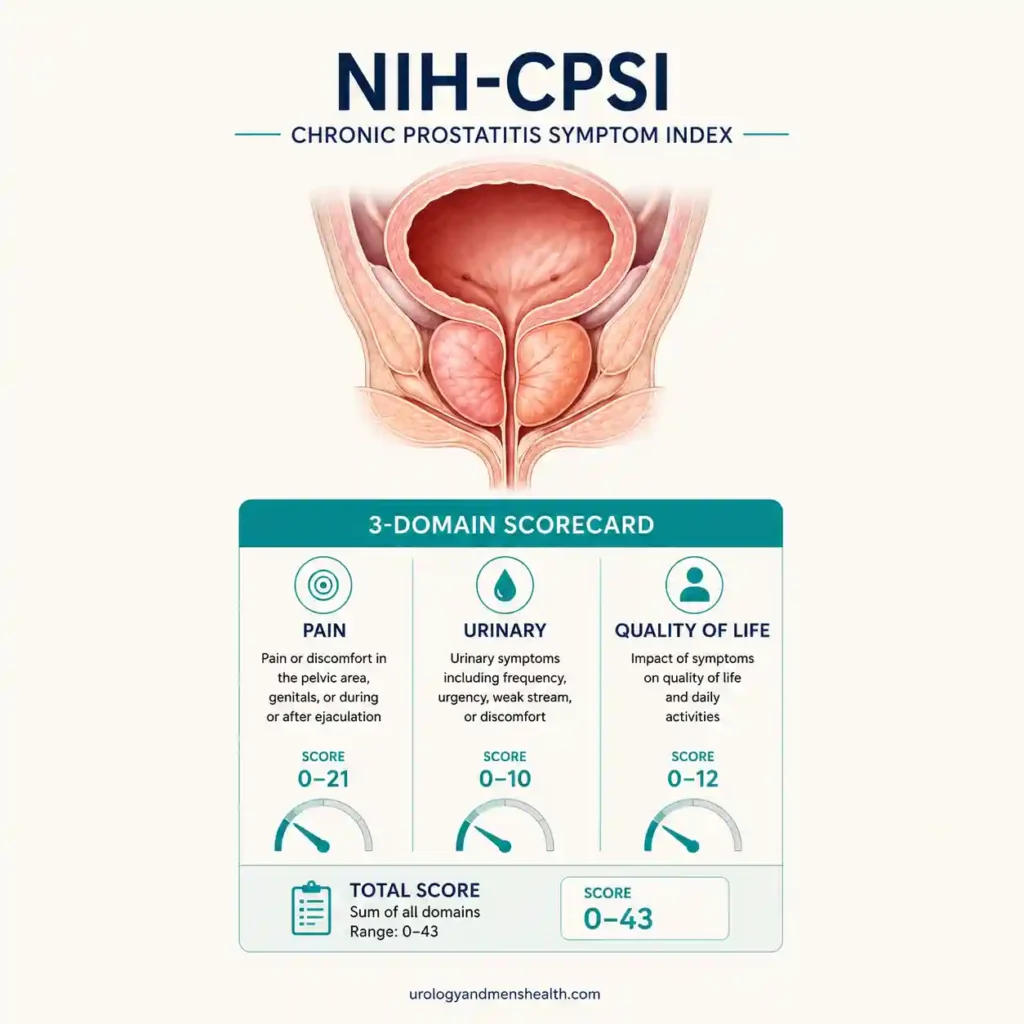
- The NIH-CPSI is a validated 9-question index scoring pain, urinary symptoms, and quality of life, for a total of 0 to 43.
- Bands are mild 0-14, moderate 15-26, and severe 27-43 – your domain breakdown matters as much as the total.
- A high score reflects symptom burden, not danger: chronic pelvic pain syndrome does not damage the prostate or shorten life.
- A fall of about 6 points on a repeat score is a meaningful sign that treatment is working.
What This Tool Measures
The NIH-CPSI chronic prostatitis symptom score is the standard way to measure how much chronic prostatitis and chronic pelvic pain syndrome (CP/CPPS) are affecting you. It is a nine-question index developed and validated by Litwin and colleagues through the National Institutes of Health Chronic Prostatitis Collaborative Research Network, tested against men with benign prostatic enlargement and healthy controls [1]. The questionnaire produces a single total from 0 to 43, built from three separate domains: pain (0 to 21), urinary symptoms (0 to 10), and quality of life (0 to 12) [2]. It measures how you have felt over the past week, so it captures the day-to-day reality of the condition rather than a one-off bad moment.
The Physiology Behind the Score
Most men who score on this index have what the NIH consensus calls category III prostatitis – chronic pelvic pain syndrome with no active bacterial infection to treat [3]. Think of the pelvic floor as a set of muscles that can go into a low, constant spasm, much like a shoulder that stays knotted after months of tension. That tightness irritates the nerves running through the perineum and refers pain to the testicles, the tip of the penis, and the bladder area. The same tension can drive urinary symptoms – a stop-start stream or a feeling of not emptying fully – which is why the index scores urinary complaints alongside pain. If your urinary points are high, the Post-Void Residual Estimator can help gauge whether your bladder is actually emptying. The score does not diagnose the cause; it measures the burden so the right cause can be pursued.
How to Interpret Your Result
Total scores are grouped as mild (0 to 14), moderate (15 to 26), and severe (27 to 43), thresholds drawn from a multinational study of more than 1,500 men [2]. But the total is only half the story. A man who scores 8 because of mild, occasional aching and a man who scores 8 because of severe pain on just a few days need very different plans – which is why the pain, urinary, and quality-of-life breakdown sits beside your total. Reading your result means asking two questions: how high is the total, and which domain is driving it? A score built almost entirely from pain points toward the pelvic floor and nerves; one built from urinary points toward the bladder and outflow. For what treatment actually looks like once you know your band, this guide walks through the options.
What to Do With Your Result
A mild score usually calls for conservative steps first: cutting triggers such as prolonged cycling, caffeine, and alcohol, warm sitz baths, and 5 to 10 minutes of daily pelvic floor relaxation, then a repeat score in 4 to 6 weeks. A moderate or severe score is where the domain split changes the plan. Pain-predominant results point toward pelvic floor physiotherapy and a low-dose neuromodulator such as amitriptyline; urinary-predominant results point toward an alpha-blocker like tamsulosin and bladder retraining. The reason this matters is that sequential single-drug trials – the classic run of one antibiotic after another – fail most men, because category III disease has no infection to clear. Guideline-backed care instead treats two or three targets at once, matched to your phenotype [4]. The UPOINT Phenotype Classifier maps exactly which domains are active for you, and pelvic floor dysfunction is one of the most treatable of them.
If you are unsure about your result, the PDF report this tool generates gives you a ready-made framework to bring to your next appointment.
In My Practice
The single most common thing I see with this condition is the fear that it is cancer. A man in his thirties with months of a perineal ache and a completely normal examination has often spent weeks convinced something is being missed. The relief when the CPSI reframes it as a pain syndrome, not a tumor, is a treatment in itself.
Naming the condition accurately – chronic pelvic pain syndrome, not an infection and not cancer – is often the first real step toward getting the symptoms down.
References
- Litwin MS, McNaughton-Collins M, Fowler FJ Jr, et al. The National Institutes of Health Chronic Prostatitis Symptom Index: development and validation of a new outcome measure. J Urol. 1999;162(2):369-375. PubMed.
- Wagenlehner FME, van Till JWO, Magri V, et al. NIH-CPSI symptom evaluation in multinational cohorts of patients with chronic prostatitis/chronic pelvic pain syndrome (n=1563); total-score severity categories mild 0-14, moderate 15-26, severe 27-43. Eur Urol. 2013;63(5):953-959. PubMed.
- Krieger JN, Nyberg L Jr, Nickel JC. NIH consensus definition and classification of prostatitis. JAMA. 1999;282(3):236-237. JAMA.
- European Association of Urology. Guidelines on Chronic Pelvic Pain (prostate pain syndrome; UPOINT phenotype-directed multimodal therapy). EAU Guidelines.
- Propert KJ, Litwin MS, Wang Y, et al. Responsiveness of the NIH Chronic Prostatitis Symptom Index (NIH-CPSI); an approximately 6-point change is clinically meaningful. Qual Life Res. 2006;15(2):299-305. PubMed.
- Nickel JC, Downey J, Hunter D, Clark J. Prevalence of prostatitis-like symptoms in a population-based study using the NIH Chronic Prostatitis Symptom Index. J Urol. 2001;165(3):842-845. PubMed.
Frequently Asked Questions
What is a normal NIH-CPSI score, and what counts as severe?
Does a high CPSI score mean I have an infection or prostate cancer?
How is the NIH-CPSI different from the IPSS?
How accurate is this tool, and can I rely on it?
How do I use this result at my doctor’s appointment?
Dr. Muhammad Khalid
MBBS · FCPS (Urology) · MCPS (General Surgery) · CHPE · CRSM · IMC #539472
Specialist urologist with 11+ years of clinical experience across tertiary teaching hospitals. Trained at Lady Reading Hospital and Khyber Teaching Hospital, Peshawar. Author or co-author of five peer-reviewed international publications, including in Cureus and the World Journal of Surgery. Procedural expertise: URS, PCNL, RIRS, TURP, TURBT, and major open urological surgery. Full profile →
This article is for educational purposes only and does not constitute medical advice. Always consult your physician or urologist for diagnosis and treatment decisions specific to your condition.