
Hidden Sodium Calculator
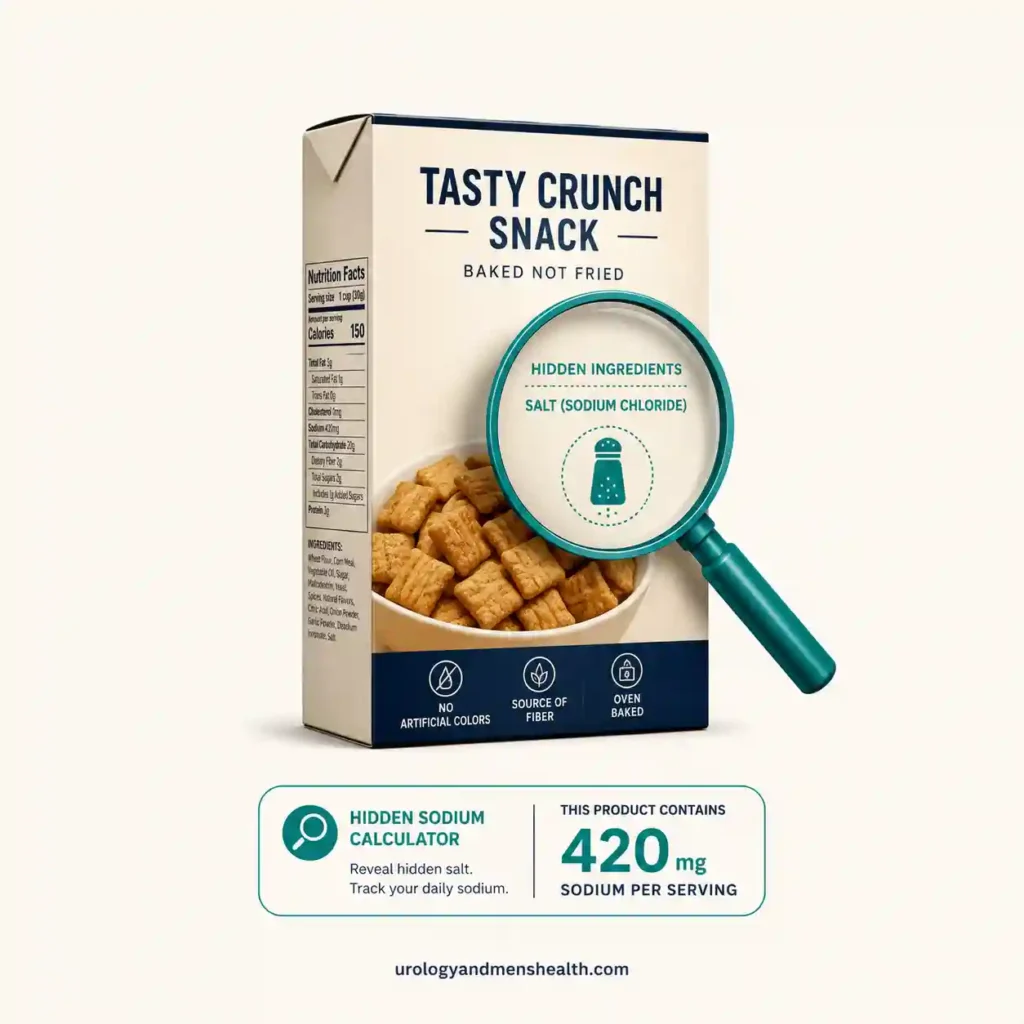
This hidden sodium calculator estimates how much salt you really eat in a day, and shows how much is hidden inside packaged and restaurant food rather than the salt shaker. Answer eight quick questions about a typical day, and you will see your estimated daily sodium, how it compares to the recommended limit, and which foods drive the total. For more on managing your numbers, see the blood pressure hub.

The Tool
Related Blood Pressure Tools
Full Clinical Guide
In This Guide:
- For the average person, more than 70% of sodium is hidden in packaged and restaurant food, not the salt shaker.
- The recommended ceiling is 2,300 mg a day, with 1,500 mg the ideal for anyone with high blood pressure.
- The average adult eats around 3,400 mg a day, usually without realizing it.
- Cutting your single biggest hidden source moves your total more than a dozen small tweaks.
What This Hidden Sodium Calculator Measures
This hidden sodium calculator estimates your total daily sodium from the everyday foods that carry the most of it, then splits that total into the part you add yourself and the part that is hidden inside packaged and restaurant food. It is scored against the sodium targets set by the Dietary Guidelines for Americans and the American Heart Association: no more than 2,300 mg a day for most adults, and an ideal of 1,500 mg for anyone with high blood pressure or heart risk [1][2]. The World Health Organization sets an even tighter international target of under 2,000 mg. The tool is not a lab test; it is a fast way to see roughly where you stand and, more usefully, where your sodium is actually coming from. If salt and high blood pressure have come up together at your appointments, the link is real and worth understanding: read more on how salt affects both blood pressure and stones.
Why Hidden Sodium Raises Blood Pressure
Sodium raises blood pressure through a simple mechanism: extra sodium in the bloodstream pulls water in with it, which increases the volume of blood your vessels have to carry, and higher volume means higher pressure. Some people are more salt-sensitive than others, which is why the same intake nudges one man’s readings and barely moves another’s. The awkward part is that the salt shaker is a bystander here. On average, only about 10 to 15% of dietary sodium comes from salt added while cooking or at the table, and roughly 5 to 10% occurs naturally in food; the remaining 70%-plus is hidden inside processed, packaged, and restaurant meals [1][3]. That is the number this tool exists to surface. If you want to see how sustained pressure translates into organ risk, the BP and kidney damage risk tool connects the two.
How to Read Your Estimate
Your result lands in one of three bands. On target (at or under about 2,300 mg) means you are inside the recommended range and the job is holding it there. Above target (roughly 2,300 to 3,400 mg) is the most common result and the most fixable: you are over the limit but below the national average, and a swap or two usually closes the gap. Well above target (at or above the national average of around 3,400 mg) is where sodium becomes a realistic driver of raised blood pressure, and where the payoff from change is largest. The breakdown underneath your score matters more than the number itself: the “hidden” percentage tells you how much of your total is coming from food you did not consciously salt. A single restaurant meal can carry close to a full day’s limit on its own, which is why that one line often explains an otherwise puzzling result.
What to Do With Your Result
Whatever your band, the highest-value move is the same: find your single biggest hidden source and change that one thing first. If bread is driving your total, compare loaves and pick the lowest-sodium one; a product under about 140 mg of sodium per serving counts as low. If it is processed meat or restaurant meals, halving those two alone often removes more than 1,000 mg a day – and cutting roughly 1,000 mg a day is enough to improve blood pressure for most people [2][4]. Log what you actually eat for a few days with the sodium intake tracker to confirm which foods dominate, and score a full day against the wider pattern with the DASH compliance scorer. If your estimate is well above target, pair the diet change with an actual blood pressure reading rather than acting on food alone.
If you are unsure about your result, the PDF report this tool generates gives you a ready-made framework to bring to your next appointment.
In My Practice
The food that pushes a man over his sodium target is almost never the one that tastes saltiest. I have had patients swear off crisps and salted peanuts while eating six slices of bread, two bowls of breakfast cereal, and a tin of soup a day – none of which taste salty, all of which are quietly loaded. Sodium hides best in food that tastes bland.
Do not judge sodium by taste. The Nutrition Facts label is the only reliable guide, and anything under 140 mg of sodium per serving counts as low.
References
- U.S. Food and Drug Administration. Sodium in Your Diet: Use the Nutrition Facts Label and Reduce Your Intake. FDA. Confirms over 70% of dietary sodium comes from packaged and prepared foods, not table salt.
- Van Horn L, et al. Recommended Dietary Pattern to Achieve Adherence to the AHA/ACC Guidelines: A Scientific Statement From the American Heart Association. Circulation. 2016. AHA/ACC. Sodium reduction to under 2,300 mg/day, or 1,500 mg/day for greater BP lowering, graded Level A.
- Centers for Disease Control and Prevention. Sodium Intake Among Persons Aged ≥2 Years – United States, 2013-2014. MMWR. 2017. CDC MMWR. Average intake 3,409 mg/day; 70% from 25 food types; restaurant food the most sodium-dense.
- MedlinePlus (U.S. National Library of Medicine). Sodium in diet. MedlinePlus. Table salt is about 40% sodium; one teaspoon holds 2,300 mg; under 140 mg per serving is low-sodium.
Frequently Asked Questions
Why is my sodium so high when I barely use the salt shaker?
What foods should I cut first to lower my sodium fastest?
Is sea salt or pink Himalayan salt lower in sodium?
How accurate is this tool, and can I rely on it?
How do I use this result at my doctor’s appointment?
Dr. Muhammad Khalid
MBBS · FCPS (Urology) · MCPS (General Surgery) · CHPE · CRSM · IMC #539472
Specialist urologist with 11+ years of clinical experience across tertiary teaching hospitals. Trained at Lady Reading Hospital and Khyber Teaching Hospital, Peshawar. Author or co-author of five peer-reviewed international publications, including in Cureus and the World Journal of Surgery. Procedural expertise: URS, PCNL, RIRS, TURP, TURBT, and major open urological surgery. Full profile →
This article is for educational purposes only and does not constitute medical advice. Always consult your physician or urologist for diagnosis and treatment decisions specific to your condition.