
Catheter Size & Type Selector
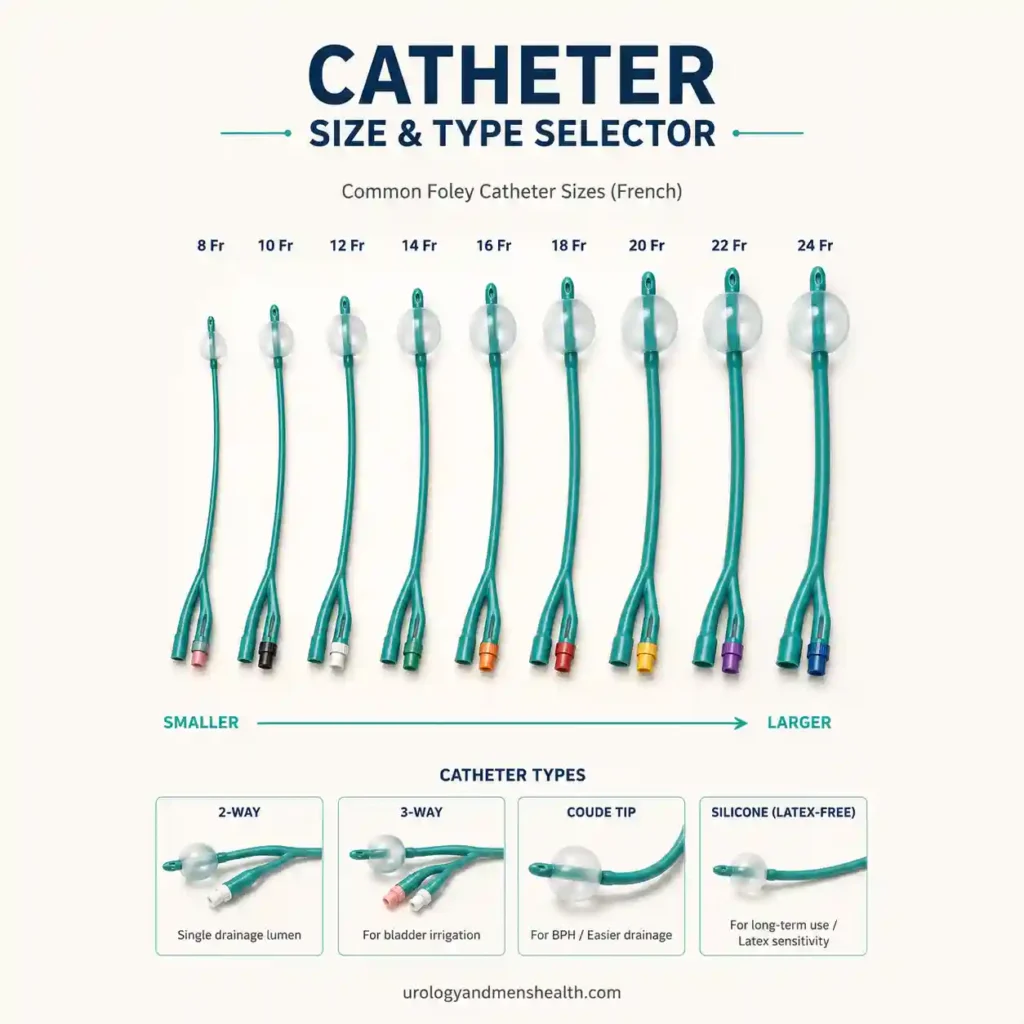
This catheter size and type selector walks you through the same questions a urologist works through: who the catheter is for, the kind of drainage needed, whether there is blood in the urine, and how long it will stay in. It explains the French sizing scale in plain English and shows what size and type usually fit - so you know what to expect and what to ask, not what to insert yourself. For more, visit the urological surgery and recovery hub.

The Tool
Related Surgery Tools
Full Clinical Guide
In This Guide:
- Catheters are sized on the French (Fr) scale, where 1 Fr = 0.33 mm, so a 14 Fr catheter is about 4.6 mm across.
- The rule is the smallest bore that drains well – a 14-16 Fr Foley is standard for adults; bigger is not better.
- Visible blood or clots need a large-bore (20-24 Fr) three-way catheter for irrigation, set by the surgical team.
- Suprapubic and pediatric catheters are clinician-chosen – this tool educates, it does not prescribe a size.
What This Catheter Size and Type Selector Does
This catheter size and type selector maps a described situation onto the sizing logic that urologists and urology nurses use every day, drawn from the European Association of Urology Nurses (EAUN) indwelling catheterisation guideline and the CDC’s catheter-infection guidance [1]. It is an educational routing tool, not a prescription: catheter size, material, and type are always confirmed by the clinician placing the device. What the tool gives you is a clear picture of what usually fits and why, so you can ask precise questions instead of guessing. The three variables that drive almost every decision are the person’s anatomy, the type of drainage, and whether the urine carries blood or clots.
The French Scale, in Plain English
Catheter width is measured on the French scale (written Fr, or Ch for Charrière, its 19th-century inventor). One French unit equals 0.33 mm of outer diameter, so you divide the Fr number by three to get millimeters: a 12 Fr catheter is about 4 mm (0.16 inch) across, a 16 Fr is about 5.3 mm (0.21 inch), and a 24 Fr is about 8 mm (0.31 inch) [2]. A higher number means a wider tube – the opposite of the needle gauge system, which trips people up. The scale measures the outside of the catheter, not the drainage channel inside. For everyday drainage this matters because the urethra grips the tube once it is in, so a wider catheter is not a “stronger” one – it simply presses harder on the urethral lining.
How to Read Your Result
The tool sorts situations into three bands. A standard drainage result covers clear urine with routine needs: intermittent catheters for adults are commonly 12-14 Fr, and a short-term indwelling Foley is usually 14-16 Fr with a 10 mL retention balloon [3]. A special sizing result appears when there is visible blood or expected clots, which call for a large-bore 20-24 Fr catheter, often a three-way type that irrigates the bladder, or when longer-term use favors a smallest-effective silicone catheter. A clinician-set only result appears for suprapubic and pediatric catheters, where sizing depends on a hands-on assessment the tool cannot make. A man drained after a TURP and a woman needing a short intermittent catheter are two completely different sizing problems, and the tool separates them on the questions that actually change the answer. Read more in the home catheter care guide.
What to Do With Your Result
For a standard result, the single most useful action is to have the exact French size and balloon volume written down by the nurse or urologist arranging the catheter before you buy or accept any supplies. For a special-sizing result, track your urine color daily – the shift from red toward clear is the signal your team uses to step down to a smaller, more comfortable catheter. For a clinician-set result, do not size or swap a suprapubic or pediatric catheter at home; a suprapubic tract can begin closing within hours if the catheter comes out. Across every band, remember that the biggest infection driver is not the size but the dwell time: the risk of bacteria appearing in the urine runs at roughly 3-7% for each day a catheter stays in, which is why every plan should include a date to review or remove it [1]. You can also compare procedures with the urology surgery comparison tool.
If you are unsure about your result, the PDF report this tool generates gives you a ready-made framework to bring to your next appointment.
In My Practice
When I hand a patient a catheter after surgery, the question I hear most is not about infection or comfort – it is “why is mine so much bigger than my father’s was?” Almost always the answer is that theirs is a three-way irrigation catheter placed to flush out clots, and his was a simple two-way for routine drainage. They are solving different problems.
The width you are given reflects the job the catheter has to do that week, not how serious your condition is. Once the urine clears, the plan is nearly always to step down to something smaller or to remove it entirely.
References
- Gould CV, Umscheid CA, Agarwal RK, et al. Guideline for Prevention of Catheter-Associated Urinary Tract Infections. CDC / HICPAC. Bacteriuria risk 3-7% per catheter-day; minimize dwell time.
- French catheter scale: 1 Fr = 0.33 mm outer diameter (D mm = Fr / 3). Charriere / French gauge reference. Conversion and directionality of the scale.
- Geng V, Cobussen-Boekhorst H, Farrell J, et al. EAUN Evidence-based Guidelines for Best Practice in Urological Health Care: Indwelling Catheterisation in Adults. EAUN 2024. 12-14 Ch urethral, 16 Ch+ suprapubic, smallest-effective bore.
- Urinary catheter types, sizes, and selection. MedlinePlus (NIH). Patient-facing overview of catheter types and use.
Frequently Asked Questions
What size catheter is normal for an adult?
For routine drainage in adults, a 14-16 Fr indwelling Foley catheter with a 10 mL balloon is the usual standard, and intermittent catheters are often 12-14 Fr. The guiding principle is the smallest bore that drains well, since a wider tube presses harder on the urethra without draining any better. Your actual size is confirmed by the clinician placing it. See the home catheter care guide for day-to-day handling.
Why is a bigger catheter used after prostate or bladder surgery?
After procedures like a TURP, urine often carries blood and clots that can block a normal catheter. A large-bore 20-24 Fr three-way catheter has an extra channel to irrigate the bladder and wash clots out before they cause a blockage. The wider tube is doing a temporary job while the surgical surface heals, and the team steps down to a smaller catheter once the urine runs clear. The recovery timeline tool shows what to expect.
What is the difference between an intermittent and an indwelling catheter?
An intermittent catheter is inserted to drain the bladder and then removed straight away, so nothing stays in the body between uses. An indwelling (Foley) catheter stays in place, held by a small balloon inflated inside the bladder, and drains continuously into a bag. Intermittent catheterization carries a lower infection risk because there is no permanent tube, which is why it is often preferred when it is practical. Check your infection risk factors with the UTI risk assessment.
How accurate is this tool, and can I rely on it?
This tool reflects EAUN and CDC catheter guidelines, but it is an educational aid, not a prescription. Catheter size, type, material, and balloon volume are always chosen and confirmed by the clinician placing the device, who can account for your anatomy and history in ways a questionnaire cannot. Use it to understand what usually fits and to ask sharper questions, not to buy or change a catheter on your own. For anything beyond routine sizing, speak with your urology team.
How do I use this result at my doctor’s appointment?
Press Download My Report to save a one-page PDF summarizing the situation you described, the sizing band it points to, and a short list of questions for your clinician. Bringing it means you can ask directly about the exact French size, whether a two-way or three-way catheter is planned, and the balloon volume, rather than trying to recall the details later. It also gives your team a quick snapshot of what you were told to expect. Pair it with the home care guide.
Dr. Muhammad Khalid
MBBS · FCPS (Urology) · MCPS (General Surgery) · CHPE · CRSM · IMC #539472
Specialist urologist with 11+ years of clinical experience across tertiary teaching hospitals. Trained at Lady Reading Hospital and Khyber Teaching Hospital, Peshawar. Author or co-author of five peer-reviewed international publications, including in Cureus and the World Journal of Surgery. Procedural expertise: URS, PCNL, RIRS, TURP, TURBT, and major open urological surgery. Full profile →
This article is for educational purposes only and does not constitute medical advice. Always consult your physician or urologist for diagnosis and treatment decisions specific to your condition.