
Gleason Score Risk Interpreter
This Gleason score risk interpreter turns the two pattern numbers on your prostate biopsy report into a plain-language Grade Group and a clear risk band, then maps the typical next steps. Add your PSA and clinical stage for a fuller D'Amico picture, or run it on the Gleason numbers alone. It takes under 90 seconds and gives you a solid starting point before your appointment. Part of our prostate health hub.

The Tool
Related Prostate Tools
Full Clinical Guide
In This Guide:
- Your Gleason score is the two pattern numbers added together – and a 3+4 is not the same as a 4+3.
- The modern system reports five Grade Groups (1 to 5), which separate favourable from unfavourable disease far more clearly than “Gleason 7” alone.
- Your risk band comes from combining the Grade Group with your PSA and clinical stage – not from the Gleason number on its own.
- A Grade Group 1 cancer is usually watched, not treated; high-grade disease needs staging before any treatment choice.
What This Tool Measures
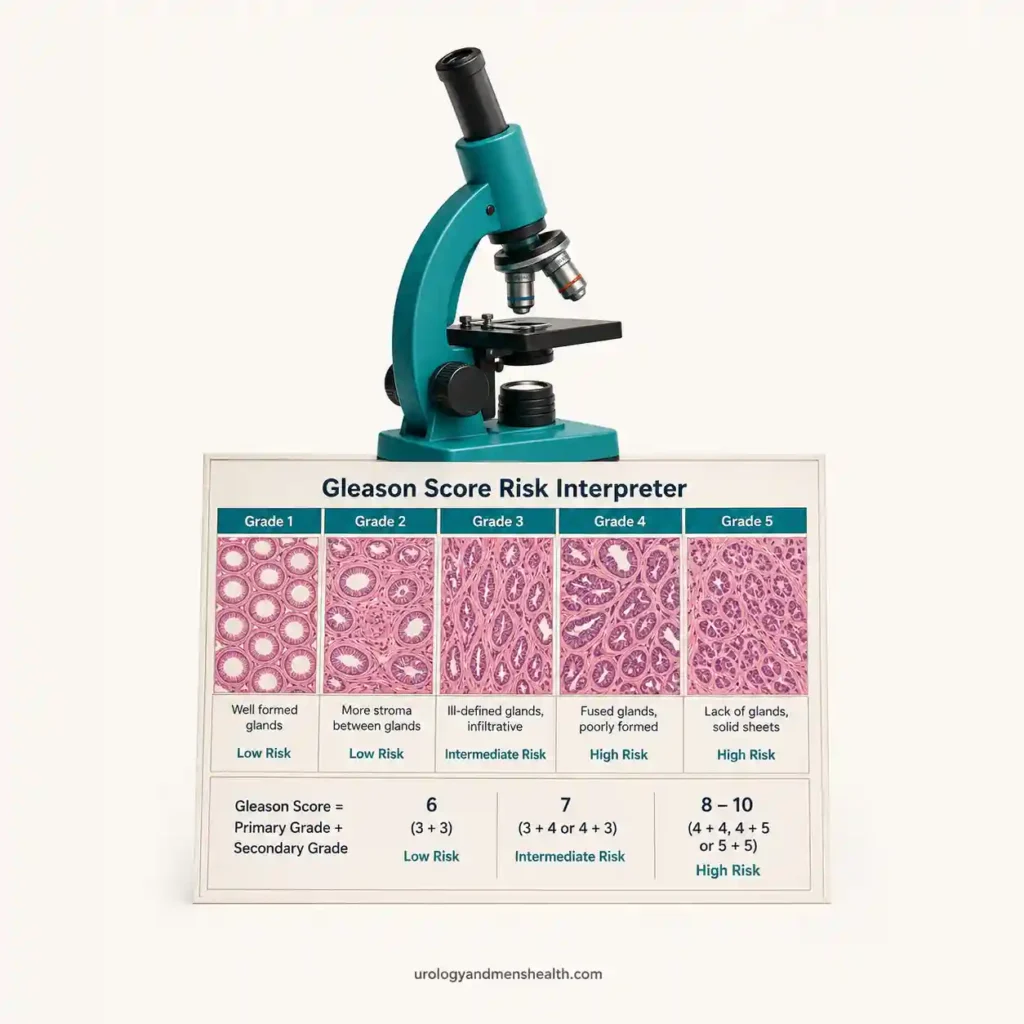
This Gleason score risk interpreter takes the grading a pathologist assigns to your prostate biopsy and translates it into the information that actually drives decisions: your ISUP Grade Group and your overall risk band. The Gleason system, refined by the International Society of Urological Pathology in 2014, scores how far prostate cancer cells have drifted from normal gland architecture, using patterns 3, 4 and 5. The two most common patterns in your cores are added together, so scores run from 6 to 10. Because “Gleason 7” hid two very different cancers, the 2014 consensus folded the scores into five Grade Groups (1 to 5) that predict outcome far more cleanly [1][2].
The Physiology Behind the Score
Under the microscope, a healthy prostate looks like neat, well-spaced glands. As cancer becomes more aggressive, that order breaks down. Pattern 3 cells still form separate, recognisable glands. Pattern 4 cells fuse into ragged, poorly formed glands. Pattern 5 cells barely form glands at all. The pathologist names the most common pattern first and the next most common second – which is why the order carries meaning. A 3+4 = 7 is mostly orderly pattern 3 with a smaller aggressive component, while a 4+3 = 7 is led by the aggressive pattern. Both add to 7, but they behave differently, and your PSA level (the protein your PSA blood test measures) and clinical stage then layer on top to set the full risk picture.
How to Interpret Your Result
The tool sorts your inputs into three bands using the long-established D’Amico framework [3]. Low risk means a Grade Group 1 cancer (Gleason 6) with PSA under 10 ng/mL and stage T1-T2a. Intermediate risk is triggered by a Gleason 7, a PSA of 10-20 ng/mL, or stage T2b. High risk follows from a Gleason 8-10, a PSA above 20 ng/mL, or stage T2c-T3. The bands are deliberately different in what they recommend: a man who scores 3+3 with a normal PSA and a man who scores 4+5 with a PSA of 30 receive completely different advice – the first is usually offered monitoring, the second needs staging scans and active treatment. That is the whole point of stratifying rather than fixating on a single number.
If your MRI or biopsy details are still unclear, it is worth understanding how imaging fits the pathway, because an MRI is increasingly done before biopsy and can change how confident your team is in the grade.
What to Do With Your Result
For low risk, the modern standard of care is active surveillance – regular PSA, MRI and repeat biopsy rather than immediate surgery or radiation – which both the AUA/ASTRO and EAU guidelines endorse as the preferred option for low-risk disease [4][5]. For intermediate risk, the favourable (3+4) and unfavourable (4+3) split decides whether surveillance stays on the table or treatment is recommended. For high risk, the next move is accurate staging before any treatment is chosen. Whatever your band, take the specific result into a planned conversation rather than a worried one, and if numbers are missing, the prostate cancer risk calculator can add context. A meaningful share of men on surveillance are later reclassified to a higher grade on a repeat biopsy, which is exactly why repeat sampling and MRI are built into monitoring rather than bolted on.
If you are unsure about your result, the PDF report this tool generates gives you a ready-made framework to bring to your next appointment.
In My Practice
The number men bring me is almost always just the Gleason sum – a 6, a 7, an 8. What they rarely arrive knowing is how many of their cores were positive, what their PSA density is, or whether an MRI was done. Yet those are often the details that decide whether I recommend watching or treating. I have reassured men with a “scary” 7 because only a single core was involved, and steered others with the “same” 7 toward treatment because half their cores were.
The Gleason number opens the conversation; the volume of disease, PSA density and imaging are what finish it.
References
- Epstein JI, Zelefsky MJ, Sjoberg DD, et al. A contemporary prostate cancer grading system: a validated alternative to the Gleason score. Eur Urol. 2016;69:428-435. Validation of the five Grade Groups.
- Epstein JI, Egevad L, Amin MB, et al. The 2014 ISUP Consensus Conference on Gleason grading of prostatic carcinoma. ISUP consensus, 2016. Defines Grade Groups 1-5.
- D’Amico AV, Whittington R, Malkowicz SB, et al. Biochemical outcome after radical prostatectomy, external beam radiation therapy, or interstitial radiation therapy for clinically localized prostate cancer. JAMA. 1998;280:969-974. Low/intermediate/high risk thresholds.
- Eastham JA, et al. Clinically Localized Prostate Cancer: AUA/ASTRO Guideline (2022). American Urological Association. Active surveillance preferred for low-risk disease.
- EAU Guidelines on Prostate Cancer – Treatment. European Association of Urology. Risk-based management and surveillance criteria.
Frequently Asked Questions
What does the Gleason score actually measure?
A pathologist examines your biopsy tissue under a microscope and assigns a pattern number (3, 4, or 5) based on how far the cells have lost normal gland architecture. The two most common patterns are added together to give the Gleason score. So 3+4=7 means the dominant pattern is relatively orderly (pattern 3) with a smaller, more aggressive component (pattern 4). See our complete Gleason score guide.
Why does the pattern order matter (3+4 vs 4+3)?
Both add to 7, but 4+3 carries higher risk because the dominant pattern is the more aggressive one. The modern system separates them: 3+4 is Grade Group 2 (favourable) and 4+3 is Grade Group 3 (unfavourable). That single distinction genuinely changes whether treatment or monitoring is recommended. If you are still waiting on details, our prostate biopsy guide explains what your report contains.
Is a Gleason 6 really cancer?
Technically yes, but Grade Group 1 (Gleason 6) behaves so quietly that many experts argue it barely warrants the label. It almost never spreads while confined to the prostate. Most men are managed with active surveillance rather than immediate treatment, sparing them surgery and radiation side effects while keeping close watch. That is evidence-based care, not neglect.
How accurate is this tool, and can I rely on it?
It applies the same ISUP Grade Group logic and D’Amico risk thresholds urologists use every day, so the band it gives you is sound. But it works only with the numbers you enter, and it cannot see your MRI, your core counts, or your individual health. It is a clear conversation starter, not a diagnosis or a treatment decision – those belong with your urologist.
How do I use this result at my doctor’s appointment?
Tap “Download My Report” after you get your result. It produces a two-page PDF with your Grade Group, risk band, the suggested next steps, and a short list of questions to ask – all attributed to Dr. Khalid. Bringing that to your appointment keeps the conversation focused on decisions rather than on decoding the report, and makes sure nothing important gets missed.
Dr. Muhammad Khalid
MBBS · FCPS (Urology) · MCPS (General Surgery) · CHPE · CRSM · IMC #539472
Specialist urologist with 11+ years of clinical experience across tertiary teaching hospitals. Trained at Lady Reading Hospital and Khyber Teaching Hospital, Peshawar. Author or co-author of five peer-reviewed international publications, including in Cureus and the World Journal of Surgery. Procedural expertise: URS, PCNL, RIRS, TURP, TURBT, and major open urological surgery. Full profile →
This article is for educational purposes only and does not constitute medical advice. Always consult your physician or urologist for diagnosis and treatment decisions specific to your condition.