
Oxalate Food List: 120+ Foods Ranked for Kidney Stone Prevention
This oxalate food list ranks 120+ everyday foods by oxalate content per serving and color-codes each one for kidney stone safety. The clinical reality is simpler than most lists suggest: only a handful of foods need real restriction, and most of your diet stays exactly as it is. Search any food, see its milligrams per serving, and find a tested safe swap where one is needed. Start with the full kidney stones hub.

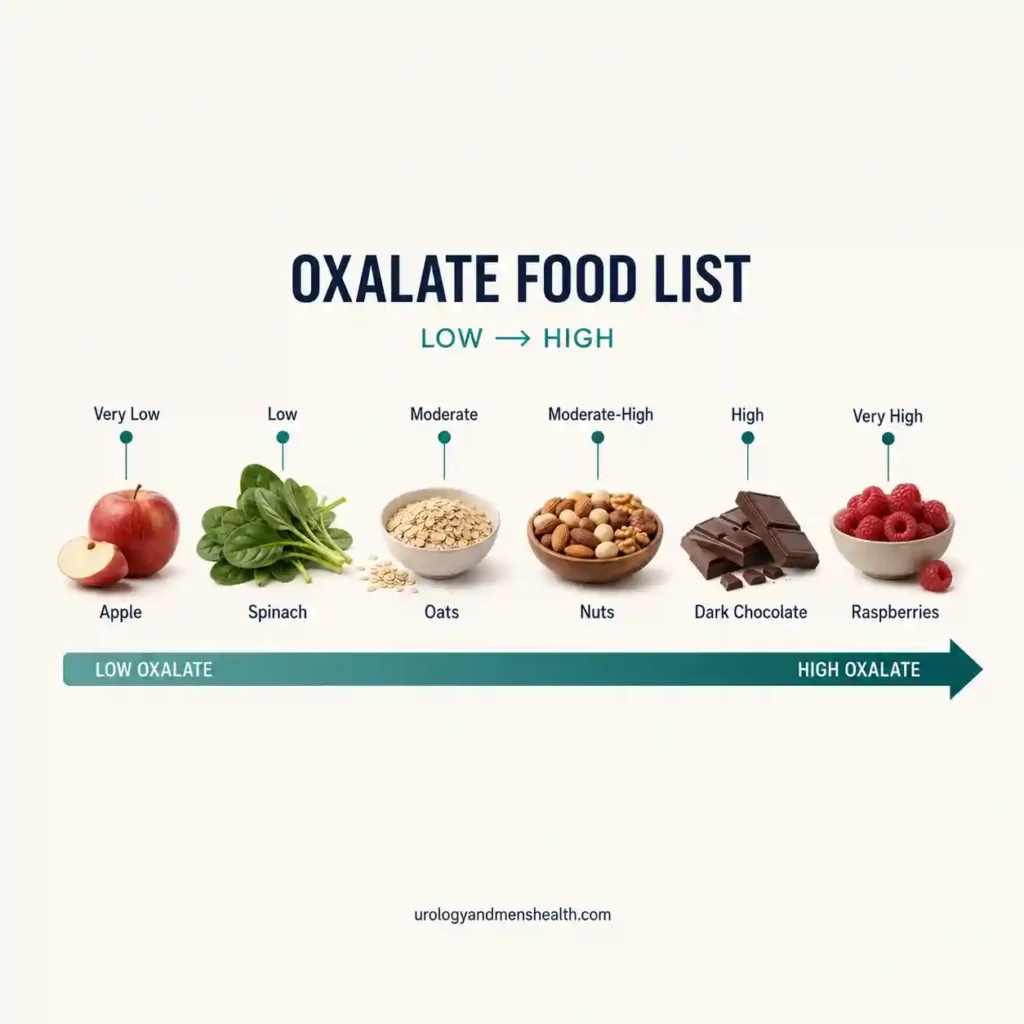
The Tool
In My Practice
The most damaging misconception I see in clinic is the patient who arrives with a printed online oxalate list and tells me they have eliminated every vegetable from their diet. This is unnecessary, counterproductive, and often does more harm to their stone risk than the original problem. Vegetables provide potassium, magnesium, and dietary alkali — all of which actively raise urinary citrate and protect against stone formation. The only vegetables I ask recurrent calcium oxalate stone formers to eliminate outright are spinach, rhubarb, beet greens, and Swiss chard. Everything else continues in normal portions. A spinach omelette is a problem; a kale omelette with cheese is a complete answer.
For my South Asian patients in particular, the single most clinically significant food on this list is palak — spinach curry. Palak paneer, palak dal, and saag are extremely common in the regional diet and are usually the largest oxalate load most of these patients consume. I do not ask them to abandon their cuisine. I ask them to swap to tarka dal, chana masala, or aloo-based dishes — equally satisfying and essentially safe. Cultural accommodation produces far better long-term compliance than blanket prohibition. For my US patients, the items I most often catch missed during dietary counseling are chia seeds, wheat bran, and concentrated soy protein powders — all popular “health foods” that quietly load oxalate above what a spinach side would deliver.
Copied to clipboard
Bookmark this page for your weekly grocery shop and return whenever you add a new food to your routine.
No data is stored or transmitted. All filtering runs entirely in your browser.
Related Kidney Tools
Full Clinical Guide
In This Guide:
- Oxalate is a natural plant compound that binds calcium in urine to form the most common kidney stone type.
- Only 8-10 high-oxalate foods need real restriction — spinach, rhubarb, almonds, beets, and dark chocolate lead the list.
- Pairing moderate-oxalate foods with a calcium source at the same meal binds the oxalate in your gut before it reaches your kidneys.
- Do not cut dietary calcium — low-calcium diets raise urinary oxalate and increase stone risk.
What This Oxalate Food List Measures and Why It Matters
This oxalate food list measures one specific number for each food: the total oxalate content per realistic serving, expressed in milligrams. Oxalate is a small organic compound found naturally in many plant foods. In the gut, oxalate either binds with calcium and is excreted in stool, or — if dietary calcium is insufficient at the same meal — passes into the bloodstream and is filtered by the kidneys into the urine. Once in the urine, oxalate combines with calcium to form calcium oxalate crystals, which aggregate into stones. The American Urological Association’s stone management guideline identifies dietary oxalate restriction as a preventive intervention specifically for patients with documented calcium oxalate stones and elevated urinary oxalate on 24-hour urine testing.[1]
The values in this database draw on two reference sources widely used in clinical urology and renal nutrition: the University of Massachusetts Medical School Oxalate Food List, which laboratory-tested several hundred foods using high-performance liquid chromatography,[2] and Harvard Medical School’s clinical guidance for stone prevention. The tool combines these into one searchable, filterable interface, with safe-substitute recommendations layered onto each restricted item — a feature absent from the source databases themselves. For the full prevention strategy this list supports, start with the kidney stone diet clinical protocol.
The Physiology of Oxalate, Calcium, and Stone Formation
The biology behind every number on this list comes down to a single competitive race in your gut. When you eat a food containing oxalate, the oxalate molecules look for something to bind with. If there is calcium present in that meal — from milk, cheese, yogurt, or a calcium-fortified food — the oxalate binds with the calcium in the gut, forms an insoluble crystal called calcium oxalate, and is excreted in stool. That oxalate never reaches your kidneys. If calcium is not available at the same meal, the oxalate is absorbed across the gut wall, enters the bloodstream, and is filtered into the urine. Once in concentrated urine, oxalate combines with the calcium that is always present in urine and forms the crystals that grow into stones.
This is why the single most counterintuitive instruction in stone prevention is “do not restrict dietary calcium.” Stone formers used to be told to avoid dairy. Modern evidence showed the opposite: low-calcium diets increase urinary oxalate excretion and raise stone risk, because without gut calcium to bind it, more dietary oxalate is absorbed.[3] The clinical instruction now is to eat oxalate-containing foods with a calcium-containing food at the same meal. Cooking matters too: boiling and discarding the cooking water removes roughly 30 to 87 percent of oxalate from leafy vegetables, depending on the vegetable and the duration of boiling.[4] But even after that loss, a normal serving of spinach stays high enough to matter — cooking helps with moderate-oxalate vegetables, but it does not move spinach into the safe range.
How to Read Your Result: Tier Bands and Real-World Limits
Each food on this list falls into one of three tiers, and the tier determines what you do with it. HIGH (100 mg or more per serving): this is the eliminate-or-strictly-restrict band. Around a dozen foods in normal Western and South Asian diets fall here, and they account for the majority of dietary oxalate load in stone formers. A single half-cup serving of cooked spinach (roughly 90 g) carries about 750 mg of oxalate — more than an entire day’s target intake in one side dish.[2] MODERATE (10 to 99 mg per serving): this is the eat-with-calcium band. Foods like oatmeal, raspberries, sweet potato, quinoa, and cashews live here. They are not problems in normal portions when paired with milk, yogurt, or cheese at the same meal. LOW (under 10 mg per serving): this is the eat-freely band. The vast majority of common foods — including most fruits, white and brown rice, dairy, eggs, all meat and fish, most vegetables, and most breads — are in this tier.
The European Association of Urology guideline treats a urinary oxalate above roughly 45 to 50 mg per day (0.5 mmol) as hyperoxaluria in recurrent calcium oxalate stone formers.[5] To stay under that threshold, most clinicians aim to keep dietary oxalate intake in the region of 100 mg per day. That is reachable, even comfortable, once you eliminate the high-tier foods and pair the moderate ones with calcium. It becomes impossible if you keep eating spinach, almonds, and chia seeds at the rates an average health-conscious adult does without thinking.
Read next: Types of Kidney Stones — Which One Do You Have?What to Do With Your Oxalate Food List
Three specific actions, in order. First — within the next two weeks, identify which high-tier foods are currently in your diet and remove them. Use the search box above. The most common ones I find in patient food diaries are spinach (in salads, smoothies, palak), almonds (snacking, almond flour, almond butter), peanut butter, chia seeds, dark chocolate, and bran cereals. Replace each with the safe alternative listed on its card. Second — at every meal from this week onward, pair any moderate-tier food with a calcium source eaten at the same time. A bowl of oatmeal with milk is fine. A bowl of oatmeal with black coffee is not. Yogurt with raspberries is fine. Raspberries on their own, daily, is not. Third — at your next urology appointment, request a 24-hour urine collection if you have not had one in the last 12 months. Dietary oxalate restriction is most effective when guided by a measured urinary oxalate level. Before the test, do not change your diet — your urologist needs to see your real intake, not an aspirational version.
For the full diet protocol that this list supports, the kidney stone diet clinical protocol covers oxalate alongside the other three pillars: hydration, sodium, and animal protein. If you are unsure about your result, the personalized PDF this tool generates gives you a ready-made framework to bring to your next appointment.
Read next: Foods That Cause Kidney Stones — Oxalate & Sodium GuideIn My Practice
The conversation that comes up most often in clinic when patients sit down with this list is the one about spinach. A patient — usually middle-aged, usually health-conscious, usually someone who eats a daily green smoothie — looks at the spinach value and asks me whether the spinach in their smoothie really is the problem, when they have eaten that smoothie for ten years without symptoms. The honest answer is yes, it almost certainly is. Calcium oxalate stones form silently for years before the first painful obstruction. The smoothie that produced no symptoms in year five is the same smoothie that produced the 6 mm stone in year ten. Stopping the spinach now does not undo the stone they have, but it changes the trajectory of the next one.
The clinical takeaway is that asymptomatic decades do not equal safety in stone disease — the chemistry runs whether you feel it or not, and the only feedback signal you get is the stone itself.
Trusted Patient Resources
For the full clinical context behind this oxalate food list and a structured prevention strategy, these resources are clinically reliable starting points:
- The Kidney Stone Diet: Clinical Protocol for Prevention — the complete dietary strategy this list supports
- Types of Kidney Stones — Which One Do You Have? — oxalate restriction is primarily for calcium oxalate stone formers
- Foods That Cause Kidney Stones — sodium and animal protein alongside oxalate
- External: National Kidney Foundation — Calcium Oxalate Stones
- External: Urology Care Foundation — Kidney Stone Patient Guide
Worried about a stone coming back? Download Dr. Khalid’s 7-Day Kidney Stone Prevention Meal Plan.
Enter your email below to receive Dr. Khalid’s complete 7-Day Kidney Stone Prevention Meal Plan as a free, printable PDF.
References
- Pearle MS, Goldfarb DS, Assimos DG, et al. Medical Management of Kidney Stones: AUA Guideline. Journal of Urology. 2014;192(2):316-324 (amended 2019). AUA Guideline.
- Massey LK, Roman-Smith H, Sutton RAL. Effect of dietary oxalate and calcium on urinary oxalate and risk of formation of calcium oxalate kidney stones. Journal of the American Dietetic Association. 1993;93(8):901-906. PubMed. Per-serving values cross-checked against the UMass Medical School Oxalate Food List.
- Curhan GC, Willett WC, Speizer FE, et al. Comparison of dietary calcium with supplemental calcium and other nutrients as factors affecting the risk for kidney stones in women. Annals of Internal Medicine. 1997;126(7):497-504. PubMed.
- Chai W, Liebman M. Effect of different cooking methods on vegetable oxalate content. Journal of Agricultural and Food Chemistry. 2005;53(8):3027-3030. PubMed.
- Skolarikos A, Neisius A, Petrik A, et al. EAU Guidelines on Urolithiasis. European Association of Urology. 2025 edition. EAU Guidelines.
Frequently Asked Questions
What foods are highest on the oxalate food list and most important to restrict for kidney stones?
The foods that need serious restriction — those above 100 mg of oxalate per normal serving — are spinach, rhubarb, beet greens, Swiss chard, almonds, peanuts and peanut butter, pistachios, chia seeds, wheat bran, cocoa powder, and star fruit. Of these, spinach is the single most clinically significant, because it is eaten in large quantities in both South Asian and Western salad-culture diets and a single cooked serving carries far more oxalate than any other common food. Eliminating or drastically reducing these specific foods, while continuing to eat everything else normally, is the evidence-based approach. The kidney stone diet protocol covers exactly which foods to restrict and why.
How much oxalate per day is safe for a calcium oxalate stone former?
The European Association of Urology defines hyperoxaluria as a urinary oxalate above roughly 45 to 50 mg per day (0.5 mmol) in recurrent calcium oxalate stone formers. To stay under that, most clinicians aim to keep dietary oxalate intake around 100 mg per day. The key word is dietary — because a large share of urinary oxalate comes from the body’s own metabolism regardless of what you eat. The dietary target is achievable if you avoid the top 8 to 10 highest-oxalate foods and pair moderate-oxalate foods with calcium at the same meal. For the full framework, see the guide to foods that cause kidney stones.
Does cooking reduce oxalate content in vegetables?
Yes, but not enough to make high-oxalate vegetables safe if you have recurrent calcium oxalate stones. Boiling vegetables and discarding the cooking water removes roughly 30 to 87 percent of the oxalate, depending on the vegetable and the duration. But even at the top of that range, a normal serving of spinach stays in the high-oxalate band. Steaming retains more oxalate than boiling. The practical takeaway: cooking helps for moderate-oxalate vegetables like okra or leeks, but it does not rescue spinach, rhubarb, beet greens, or Swiss chard for stone formers.
Can I eat spinach with kidney stones if I pair it with calcium — does that neutralize the oxalate?
Partially, but not completely — and for spinach specifically, the oxalate load is so high that pairing alone is not enough. Calcium eaten with oxalate in the same meal binds to that oxalate in the gut, which is why dietary calcium is protective for most calcium oxalate stone formers. But spinach delivers so much oxalate per serving that even with a full dairy serving, a meaningful amount still reaches the kidneys. For moderate-oxalate foods like oatmeal, raspberries, or quinoa, pairing with dairy lowers stone-forming risk to a clinically negligible level. For spinach, substitution is the recommended approach, not calcium co-administration.
Are peanuts and peanut butter high on the oxalate food list? What about almond milk?
Peanuts and peanut butter are among the highest-oxalate common foods — roughly 95 to 120 mg per standard portion. That is significant for a stone former and should be limited to occasional small portions, or eliminated entirely for those with frequent recurrence. Almond milk, by contrast, contains only about 10 to 15 mg per cup, because the oxalate of whole almonds is heavily diluted by water during processing. It is a reasonable dairy alternative if it is fortified with calcium — though fortified plant milks do not deliver the same gut oxalate-binding calcium as dairy, because the added calcium often settles and is less bioavailable.
How accurate is this oxalate food list, and can I rely on it?
The oxalate values draw on the University of Massachusetts Medical School Oxalate Food List and Harvard Medical School clinical guidance. The oxalate content of any individual food sample varies by roughly 10 to 30 percent based on growing conditions, season, and preparation, so the values are best read as tier indicators, not exact prescriptions. The HIGH/MODERATE/LOW bands are the clinically meaningful unit — a food at 95 mg and one at 105 mg behave essentially the same in your kidneys. The tool is a structured starting point for your dietary review, not a substitute for personalized clinical assessment. For your stone type specifically, the types of kidney stones guide explains who oxalate restriction actually helps.
How do I use this oxalate food list at my doctor’s appointment?
Download the personalized PDF using the Download My Personalized Food List button, or copy the foods-to-avoid summary, and bring either to your urology or primary care appointment. Use it as the opening frame of the consultation: say you have been using this oxalate food list, name the high-tier foods currently in your diet, and ask whether you should be eliminating them and whether a 24-hour urine collection would show if your urinary oxalate is actually elevated. That single question moves the appointment from a generic dietary chat to a structured, measurable plan. The PDF includes four specific questions covering stone composition, urinary oxalate testing, your daily oxalate target, and pairing strategy. See the kidney stone diet protocol for the wider plan.
Dr. Muhammad Khalid
MBBS · FCPS (Urology) · MCPS (General Surgery) · CHPE · CRSM · IMC #539472
Specialist urologist with 11+ years of clinical experience across tertiary teaching hospitals. Trained at Lady Reading Hospital and Khyber Teaching Hospital, Peshawar. Author or co-author of five peer-reviewed international publications, including in Cureus and the World Journal of Surgery. Procedural expertise: URS, PCNL, RIRS, TURP, TURBT, and major open urological surgery. Full profile →
This article is for educational purposes only and does not constitute medical advice. Always consult your physician or urologist for diagnosis and treatment decisions specific to your condition.