
Men's Health Screening Checklist Generator
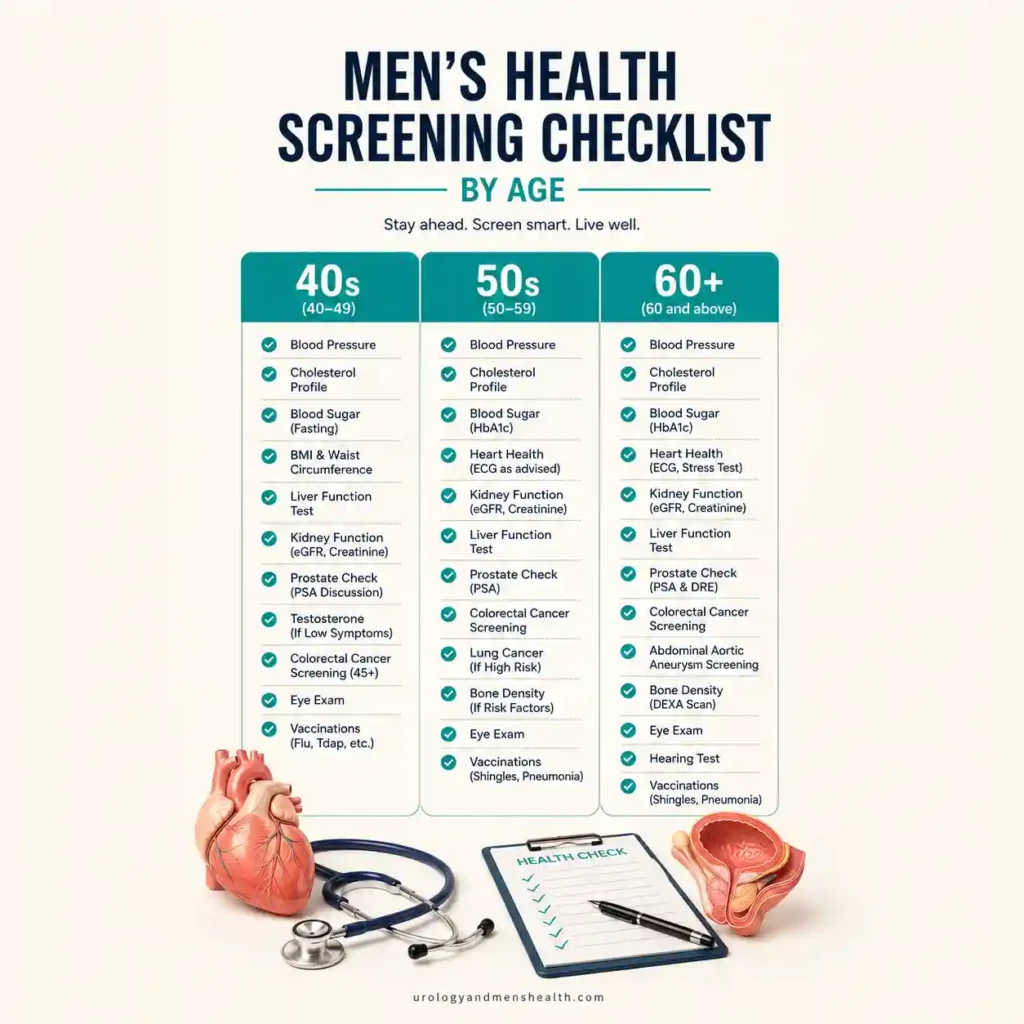
This men's health screening checklist generator turns your age and personal risk into a short, specific list of the tests worth booking now - the ones guidelines actually recommend for someone like you, not a generic panel. Answer four quick questions about your age, family history, general health and any current symptoms. You will get a clear priority, the tests that fit you, and questions to raise with your doctor. Start with the Men's Wellness hub for the full picture.

The Tool
Related Wellness Tools
Full Clinical Guide
In This Guide:
- Screening is for men without symptoms; a current symptom needs assessment now, not a test schedule.
- Age and risk drive the list: blood pressure yearly from 40, colorectal screening from 45, a PSA conversation from 50 (earlier if higher risk).
- One appointment can stack several checks at once – blood pressure, glucose, cholesterol and the right cancer conversations.
- Re-run this at each birthday; the recommendation changes as you cross age bands or gain a risk factor.
What This Men’s Health Screening Checklist Is Built On
This men’s health screening checklist generator is not a single test but a synthesis of what national bodies actually recommend for men, sorted by the two things that decide almost everything: your age and your personal risk. The recommendations here follow the US Preventive Services Task Force (USPSTF), the American Urological Association and Society of Urologic Oncology (AUA/SUO), and the American Heart Association and American College of Cardiology (ACC/AHA) [1][2][6]. There is no single validated instrument for general screening the way IPSS scores prostate symptoms; instead, each guideline switches on at a specific age or risk threshold, and this tool assembles the ones that apply to you into one list. That is the difference between vague advice to “get checked” and a checklist tied to your situation.
Why Age and Risk Decide Everything
Screening means testing people who feel well, to catch disease before it causes symptoms. Its value is never fixed: it depends on how common the disease is in someone like you and how much earlier treatment helps. That is why the same PSA test is a reasonable discussion at 55 and discouraged at 75. Think of it like a smoke alarm – useful where fires are plausible, mostly noise where they are not. Age raises the odds for almost every condition here; specific factors raise them further. Erection changes are a good example: because the penile arteries are narrow, they often show vascular trouble before the heart does, which is why an erectile-function vascular screen can double as an early cardiovascular check. Prediabetes, high blood pressure and early cancers are all silent at the stage when treatment is easiest.
How to Read Your Result
Your result lands in one of three places. On Track means you are well and lower-risk, and the guideline-backed list is genuinely short – a blood pressure reading and steady habits. Screening Due means you have crossed an age or risk line where specific tests start preventing more harm than they cause: blood pressure yearly from 40 (stage 1 high blood pressure begins at 130/80 mmHg) [8], a glucose check from 35 if you carry extra weight [5], colorectal screening from 45 [3], a PSA conversation from 50 – or 40 to 45 if you are higher risk [2] – and a one-time aortic ultrasound for men 65 to 75 who have ever smoked [4]. See a Doctor means you reported a current symptom, and a symptom is not a screening question. Routine testicular self-exams are not advised for men without symptoms, because the cancer is rare and highly curable even when found later [7]; a new lump, though, is a symptom and needs a prompt look. The headline names your single highest-value next move.
What to Do With Your Checklist
If you are On Track, put one blood pressure number on file this year and re-run this on your birthday. If you are Screening Due, book a single appointment and stack the basics – a blood pressure reading, bloods for glucose and cholesterol, and the age-appropriate cancer conversations – rather than spreading them across visits. A rising blood pressure is the quietest of these, so pairing this with a blood-pressure and kidney-risk check is worthwhile. If your result is See a Doctor, treat the checklist as your appointment prep, not a diagnosis, and go. Whatever your tier, the aim is to convert a vague sense of “I should get checked” into specific, booked actions.
If you are unsure about your result, the PDF report this tool generates gives you a ready-made framework to bring to your next appointment.
In My Practice
A patient in his late forties once told me he was “up to date” because his employer ran an annual blood panel. When we went through it, the panel had never once included a blood pressure trend, a glucose check, or – despite a father with prostate cancer – any conversation about PSA. He was doing something, but not the things his age and history actually called for.
That gap is what a screening checklist closes. Generic “get checked” advice is easy to feel covered by; a list tied to your specific age and risk is what makes sure the right test actually gets ordered.
References
- USPSTF. Prostate Cancer: Screening (2018). US Preventive Services Task Force. Shared decision on PSA for ages 55-69; recommends against routine screening at 70+.
- Wei JT, et al. Early Detection of Prostate Cancer: AUA/SUO Guideline (2023). Journal of Urology. Baseline PSA at 45-50; begin 40-45 for higher risk; every 2-4 years for 50-69.
- USPSTF. Colorectal Cancer: Screening (2021). US Preventive Services Task Force. Screening now starts at age 45.
- USPSTF. Abdominal Aortic Aneurysm: Screening (2019). US Preventive Services Task Force. One-time ultrasound for men 65-75 who have ever smoked.
- USPSTF. Prediabetes and Type 2 Diabetes: Screening (2021). US Preventive Services Task Force. Screen adults 35-70 with overweight or obesity.
- USPSTF. Hypertension in Adults: Screening (2021). US Preventive Services Task Force. Annual screening from age 40; confirm elevated readings out of office.
- USPSTF. Testicular Cancer: Screening (2011, grade D). US Preventive Services Task Force. Recommends against routine screening in asymptomatic males.
- 2025 AHA/ACC High Blood Pressure Guideline. American Heart Association. Stage 1 hypertension defined as 130-139/80-89 mmHg; threshold 130/80 reaffirmed.
Frequently Asked Questions
What health screenings do men actually need, and when?
The core set is driven by age and risk. From your 40s: blood pressure every year, plus glucose and cholesterol if you carry extra weight. From 45: colorectal cancer screening. Ages 50 to 69: a shared decision about PSA testing, brought forward to 40 to 45 if you are higher risk. This tool builds the list that fits you, and the 40-plus men’s health checklist covers the detail.
I feel completely healthy. Do I still need any screening?
Often yes, because the whole point of screening is to catch disease before you feel it. High blood pressure, prediabetes and early prostate or bowel cancer are silent at the stage where treatment works best. How much applies to you depends on age and risk; under 40 and low-risk, the honest answer is very little beyond a blood pressure check.
Should I be doing a monthly testicular self-exam?
National screening bodies do not recommend routine testicular self-exams for men without symptoms, because testicular cancer is uncommon and highly curable even when found later. That is different from ignoring your body: a new lump, a change in size or heaviness, or a heavy ache is a symptom, and that does warrant a prompt check. The warning-signs guide explains what deserves a same-week appointment.
How accurate is this tool, and can I rely on it?
This tool is a screening aid, not a diagnosis. It sorts you using published guidelines from the USPSTF, AUA/SUO and ACC/AHA, but it cannot examine you, see your bloods, or weigh your full history the way your doctor can. Use it to build a specific, guideline-based list and to decide what to raise first, then let a clinician confirm what actually applies to you.
How do I use this result at my doctor’s appointment?
Tap Download My Report to generate a two-page PDF with your result, the tests it suggests for your age and risk, and questions to ask. Take it in and hand it over, or read from it. It turns a vague “I think I should get some things checked” into a specific list your doctor can act on in one visit, which makes the appointment far more efficient.
Dr. Muhammad Khalid
MBBS · FCPS (Urology) · MCPS (General Surgery) · CHPE · CRSM · IMC #539472
Specialist urologist with 11+ years of clinical experience across tertiary teaching hospitals. Trained at Lady Reading Hospital and Khyber Teaching Hospital, Peshawar. Author or co-author of five peer-reviewed international publications, including in Cureus and the World Journal of Surgery. Procedural expertise: URS, PCNL, RIRS, TURP, TURBT, and major open urological surgery. Full profile →
This article is for educational purposes only and does not constitute medical advice. Always consult your physician or urologist for diagnosis and treatment decisions specific to your condition.