
PSA Density Calculator
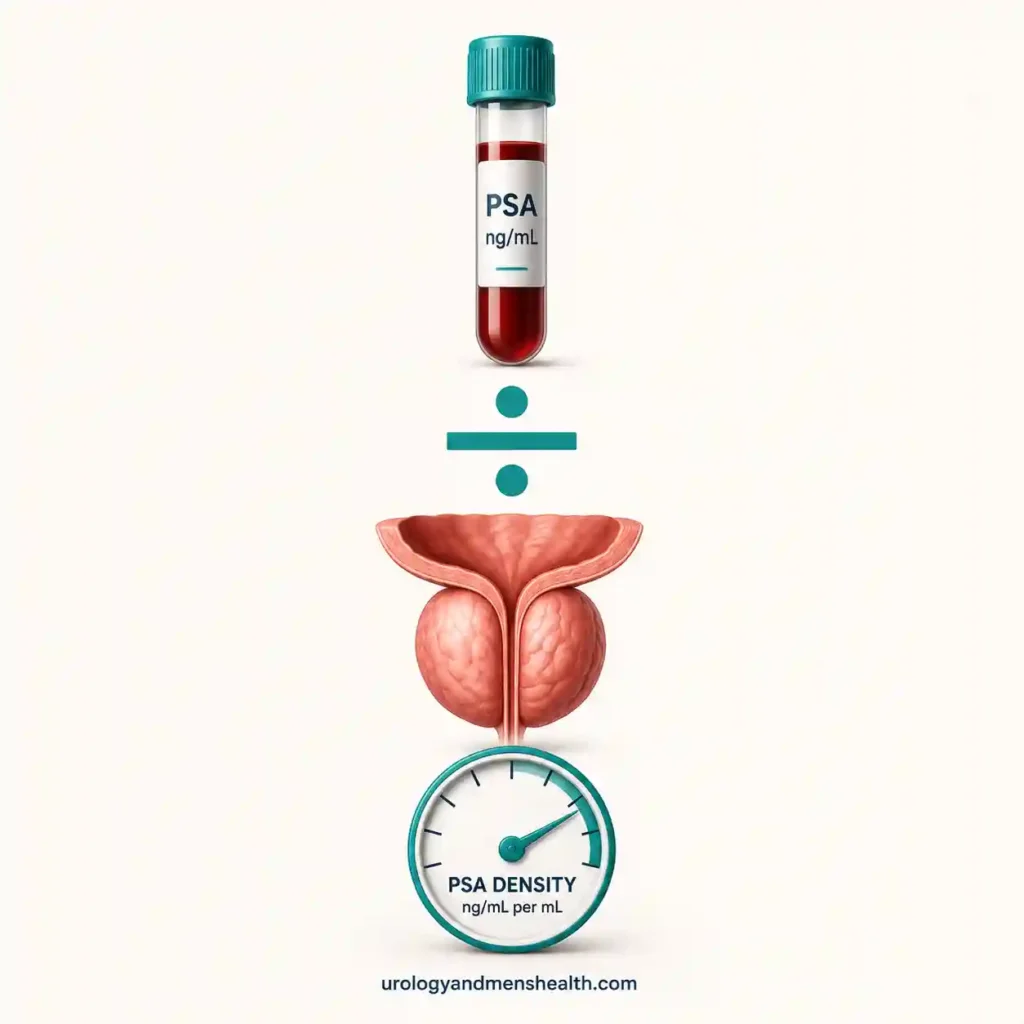
This PSA density calculator turns your PSA and prostate volume into a single number - PSA density - that shows how much of your PSA your prostate size alone can explain. It is the figure urologists use to decide whether a raised PSA needs a biopsy or just monitoring. Enter two values, see your result against the 0.15 threshold, and take a clear summary to your prostate health hub discussion.

The Tool
Related Prostate Tools
Full Clinical Guide
In This Guide:
- PSA density is your PSA divided by your prostate volume – it removes the effect of gland size from your number.
- A density at or above 0.15 ng/mL/cc is the level most guidelines use to justify a biopsy discussion.
- Below about 0.10, the chance of significant cancer is low – especially alongside a negative MRI.
- Density is most useful for a borderline PSA or an indeterminate PI-RADS 3 scan, where it tips a close call.
What the PSA Density Calculator Measures
This PSA density calculator works out your PSA density (PSAD) – your total PSA divided by your prostate volume in cc (cubic centimeters, the same as milliliters). PSA density was introduced by Benson and colleagues in 1992 to sharpen PSA in the 4 to 10 ng/mL “gray zone”, where the raw number alone is a weak guide to who actually has cancer [1]. The idea is simple: a big prostate makes more PSA, so dividing by size tells you whether your PSA is high for your gland or just high because the gland is large.
The Physiology Behind the Number
Every cell of prostate tissue leaks a small amount of PSA into the blood. With benign prostatic enlargement (BPH), the gland simply has more tissue, so total PSA drifts up even though nothing dangerous is happening. Cancer, by contrast, disrupts the normal gland architecture and pushes PSA up out of proportion to size. Dividing PSA by volume is a way of asking which of those two things is more likely. If you do not have a measured volume, the Prostate Volume Calculator estimates it from three dimensions on your ultrasound or MRI using the standard ellipsoid formula.
How to Interpret Your Result
Below 0.10 ng/mL/cc, the odds of clinically significant cancer are low – in one large biopsy series, men below roughly 0.09 had only about a 4% chance of significant disease [4]. Between 0.10 and 0.15 is a genuine gray zone where an MRI usually decides the next move. At or above 0.15 ng/mL/cc, your PSA is higher than gland size alone explains, and this is the level at which both AUA and EAU guidance leans toward a biopsy discussion [3]. Density earns its keep most in the borderline band and in indeterminate scans – it is far less useful once an MRI already shows a suspicious lesion, where the risk of significant cancer runs high regardless.
What to Do With Your Result
A low density usually means monitoring, not biopsy: log it as a baseline and recalculate whenever your PSA or prostate size is re-measured. A borderline density is a prompt to get, or act on, a multiparametric MRI before any biopsy – and if you already have one, your age-adjusted PSA and PI-RADS score together often settle the question. An elevated density warrants a urology appointment within a few weeks and, in almost all cases, an MRI-first pathway rather than going straight to biopsy. For men weighing an indeterminate scan against their density, the dedicated decision tool below combines both into one recommendation.
If you are unsure about your result, the PDF report this tool generates gives you a ready-made framework to bring to your next appointment.
In My Practice
The number that changes the room is the volume. I have watched a man’s shoulders drop the moment we recalculate a frightening PSA against a large gland and the density lands in the reassuring range – and I have watched the opposite, where a modest PSA of 5 in a small 25 cc prostate produces a density near 0.20 that we cannot ignore.
Density is the single figure that reframes a PSA from a bare number into a size-adjusted risk – which is exactly why I calculate it before I ever talk about biopsy.
References
- Benson MC, Whang IS, Olsson CA, et al. The use of prostate specific antigen density to enhance the predictive value of intermediate levels of serum PSA. J Urol. 1992;147:817-821. PubMed. The paper that introduced PSA density for the gray zone.
- European Association of Urology. Prostate Cancer Guidelines – Diagnostic Evaluation (biopsy indication, PSA density, PI-RADS). Uroweb. Uses PSA density in risk stratification; PI-RADS 3 with density <0.10 may forgo biopsy.
- American Urological Association / SUO. Early Detection of Prostate Cancer Guideline (2023, amended 2025). AUAnet. A negative MRI with low PSA density supports a shared decision to omit biopsy.
- Press B, et al. The use of prostate specific antigen density to predict clinically significant prostate cancer. Sci Rep. 2020;10:20015. Scientific Reports. PSA density outperformed PSA alone; very low density carried a low chance of significant cancer.
Frequently Asked Questions
What is a normal PSA density?
My PSA density is above 0.15 – do I definitely have cancer?
How do I get my prostate volume for this calculation?
How accurate is this tool, and can I rely on it?
How do I use this result at my doctor’s appointment?
Dr. Muhammad Khalid
MBBS · FCPS (Urology) · MCPS (General Surgery) · CHPE · CRSM · IMC #539472
Specialist urologist with 11+ years of clinical experience across tertiary teaching hospitals. Trained at Lady Reading Hospital and Khyber Teaching Hospital, Peshawar. Author or co-author of five peer-reviewed international publications, including in Cureus and the World Journal of Surgery. Procedural expertise: URS, PCNL, RIRS, TURP, TURBT, and major open urological surgery. Full profile →
This article is for educational purposes only and does not constitute medical advice. Always consult your physician or urologist for diagnosis and treatment decisions specific to your condition.