
PSA Doubling Time Calculator
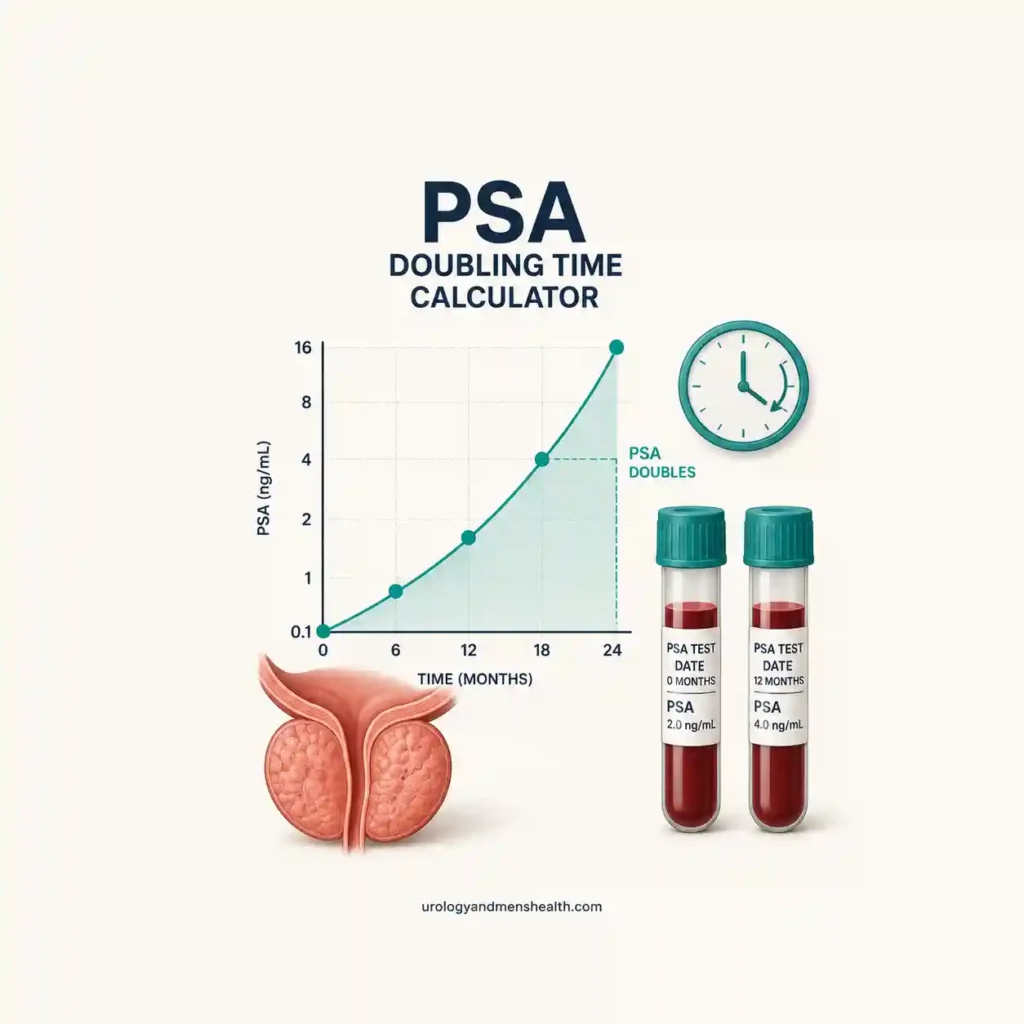
This PSA doubling time calculator estimates how many months it takes your PSA to double, from two readings and the time between them. It is built for men tracking a rising PSA after prostatectomy, radiation, or during monitoring, where the speed of the rise matters more than any single number. You will get a doubling time in months, a plain-language risk band, and the questions to raise with your urologist. Start with the prostate health hub for the full picture.

The Tool
Related Prostate Tools
Full Clinical Guide
In This Guide:
- PSA doubling time is the number of months it takes your PSA to double – the speed of the rise, not its size.
- A doubling time under 3 months is the most concerning pattern; over 12 months is the reassuring one.
- Both the AUA and EAU treat a doubling time of 9 months or less as higher-risk recurrence after treatment.
- Two readings give a rough estimate; three or more values over the past year make it reliable.
What the PSA Doubling Time Calculator Measures
The PSA doubling time calculator tells you how many months it takes your prostate-specific antigen (PSA) to double in value. It is a measure of speed, not size: two men can both sit at a PSA of 1.0 ng/mL, but the one whose level reached 1.0 in three months is in a very different position from the one who took three years to get there. The calculation assumes PSA rises exponentially when disease is active, so it takes the natural logarithm of your two readings and divides the natural log of 2 by the slope between them – the same log-linear method used in the widely cited Memorial Sloan Kettering calculator [1]. It is most useful for men with a rising PSA after surgery or radiation, where doubling time guides what happens next. If you want the related rate measure in ng/mL per year, the PSA Velocity Tracker covers that.
The Physiology: Why Speed Beats the Single Number
Prostate cancer cells, when present and active, tend to grow at a roughly constant rate – which means the PSA they shed climbs along an exponential curve rather than a straight line. Think of it like compound interest: a balance growing at a high rate doubles quickly and keeps accelerating, while a low rate barely moves over years. Doubling time captures that growth rate in a single, intuitive figure. A short doubling time means the underlying biology is moving fast; a long one means it is moving slowly, regardless of how high or low the actual PSA happens to be today. This is why a urologist will often care more about how your PSA is changing than about any one result. After treatment, this distinction separates men who can be safely watched from those who need imaging and a faster decision.
How to Interpret Your Result
The tool sorts your result into three bands. A doubling time under 3 months is the pattern most strongly tied to prostate-cancer-specific death after biochemical recurrence, and it calls for prompt specialist review [2]. A doubling time of 3 to 12 months is the intermediate band that guidelines watch closely – both the American Urological Association and the European Association of Urology classify a doubling time of 9 months or less as higher-risk recurrence [3]. A doubling time over 12 months is the reassuring band: the EAU regards this (with a favorable Gleason grade) as low-risk recurrence where observation is reasonable [4]. Doubling time is read alongside your Gleason grade, not in isolation, so it is worth viewing it next to your Gleason risk group.
What to Do With Your Result
The single most important step is to recalculate with more data before acting on a fast result. Two readings can mislead – a stray high value, a different lab, or a recent infection can fake a short doubling time. The consensus methodology asks for at least three PSA values spread over three months or more, taken at least four weeks apart and from the same assay [5]. If your result lands in the rapid band, ask your urologist about a PSMA PET scan and a faster appointment. In the intermediate band, the conversation is about closer monitoring and whether imaging is warranted now. In the slow band, the question is simply how often to repeat the test. Doubling time was historically used as an active-surveillance trigger, but current practice leans on repeat biopsy and MRI instead – if surveillance is your situation, the active surveillance guide explains the modern approach, and the PSA Interpreter helps place each individual reading in context. If you are unsure about your result, the PDF report this tool generates gives you a ready-made framework to bring to your next appointment.
In My Practice
I see two recurring mistakes with doubling time. The first is acting on two readings alone – a man arrives convinced his cancer is racing back because two numbers doubled in two months, when a third value from his own records flattens the curve completely. The second is the opposite: dismissing a slow but steady climb because no single reading looks alarming. Both errors come from looking at numbers instead of the rate.
Bring every PSA result you have, with dates. The doubling time is only as good as the history you feed it, and your own old lab slips are often the most valuable thing in the room.
References
References
- Memorial Sloan Kettering Cancer Center. PSA Doubling Time nomogram (log-linear calculation method). MSKCC. The calculation standard this tool follows.
- Freedland SJ, Humphreys EB, Mangold LA, et al. Risk of prostate cancer-specific mortality following biochemical recurrence after radical prostatectomy. JAMA. 2005;294(4):433-439. DOI. A PSADT under 3 months carried the highest cancer-specific mortality.
- American Urological Association / SUO. Advanced Prostate Cancer Guideline (PSADT of 9 months or less defines higher-risk biochemical recurrence). AUA.
- European Association of Urology. Guidelines on Prostate Cancer (low-risk biochemical recurrence: PSADT over 12 months with favorable Gleason; observation reasonable). EAU.
- Prostate-Specific Antigen Best Practice / PSA Working Group consensus on PSADT calculation (minimum three values over three months, at least four weeks apart, same assay). PMC.
Frequently Asked Questions
What counts as a fast or dangerous PSA doubling time?
Can I trust a doubling time from just two PSA readings?
My PSA went down – why does the tool say “not rising”?
How accurate is this tool, and can I rely on it?
How do I use this result at my doctor’s appointment?
Dr. Muhammad Khalid
MBBS · FCPS (Urology) · MCPS (General Surgery) · CHPE · CRSM · IMC #539472
Specialist urologist with 11+ years of clinical experience across tertiary teaching hospitals. Trained at Lady Reading Hospital and Khyber Teaching Hospital, Peshawar. Author or co-author of five peer-reviewed international publications, including in Cureus and the World Journal of Surgery. Procedural expertise: URS, PCNL, RIRS, TURP, TURBT, and major open urological surgery. Full profile →
This article is for educational purposes only and does not constitute medical advice. Always consult your physician or urologist for diagnosis and treatment decisions specific to your condition.