
Prostate Cancer Active Surveillance Decision Aid
This prostate cancer active surveillance decision aid helps you see whether careful monitoring - rather than immediate surgery or radiation - is a guideline-supported option for your diagnosis. Answer three questions about your Grade Group, PSA, and stage, and it maps you to your NCCN risk group with a clear, evidence-based recommendation. It is built for men already diagnosed who are weighing their next step. Start in our prostate health hub.

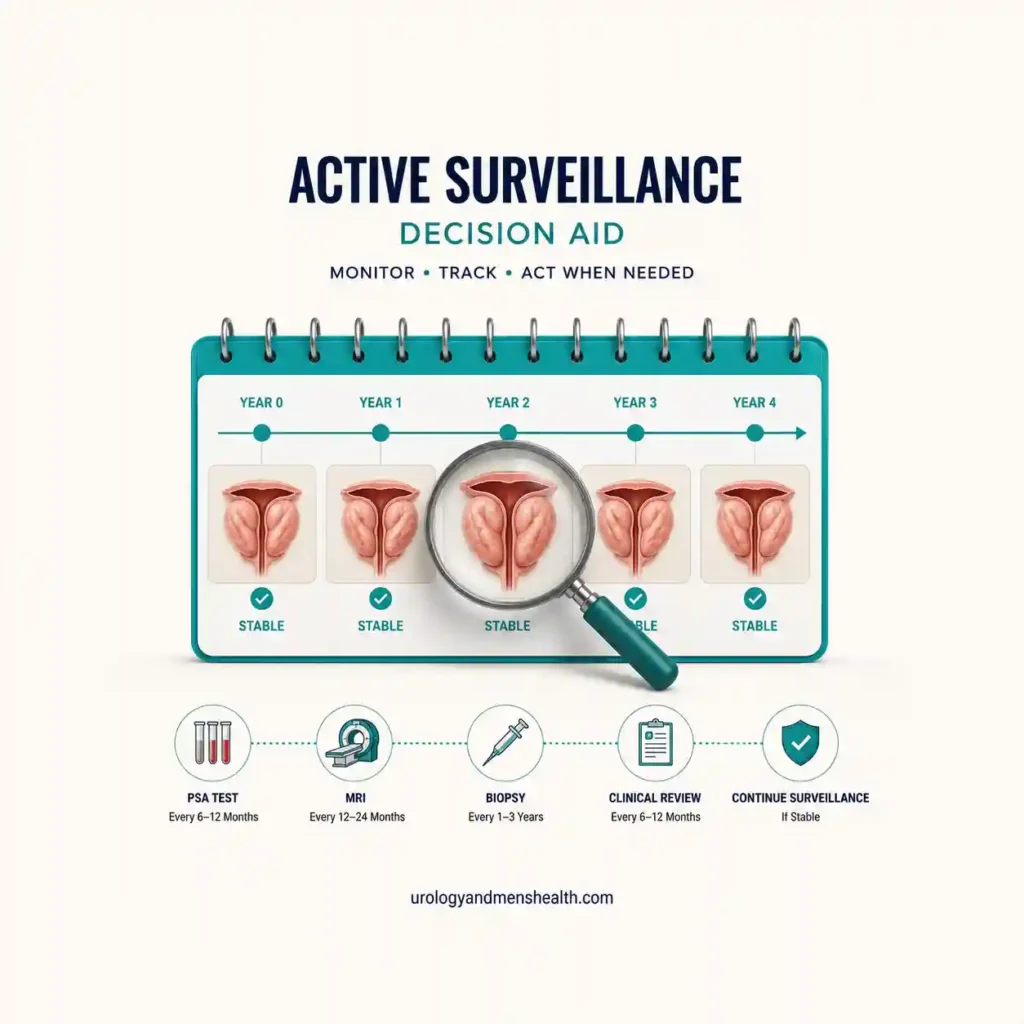
The Tool
Related Prostate Tools
Full Clinical Guide
In This Guide:
- Active surveillance is a structured monitoring plan for low-risk prostate cancer – not “doing nothing.”
- Your Grade Group (Gleason score) is the biggest factor; PSA and stage refine it.
- For very-low and low-risk cancer, NCCN and AUA name surveillance the preferred first choice.
- This aid needs a confirmed biopsy grade – it is for men already diagnosed, not for screening.
What This Active Surveillance Decision Aid Measures
This active surveillance decision aid translates your prostate cancer diagnosis into the same risk language your urologist uses. It maps three facts from your pathology and blood work – your Grade Group (Gleason score), your PSA, and your clinical stage – onto the NCCN risk groups, the stratification system that underpins modern prostate cancer guidelines [1][2]. It is built for men who already have a biopsy-confirmed diagnosis and are weighing whether to monitor the cancer or treat it now. It does not screen for cancer and it does not replace your specialist; it organizes what you already know so the conversation about active surveillance starts from the right footing.
How Your Risk Group Decides the Recommendation
Grade Group is the single strongest driver. Grade Group 1 (Gleason 6) behaves so indolently that it rarely spreads, which is why surveillance dominates that group; Grade Group 4-5 (Gleason 8-10) behaves aggressively, which is why it almost never does. PSA and stage refine the picture in between. The decisive middle category is favorable intermediate-risk – a single intermediate feature, Grade Group 1 or 2, with under half the biopsy cores involved – where surveillance is offered to selected men rather than as a default [3]. Think of it as a sieve: grade sorts the coarse buckets, then PSA, core burden, and PSA density settle the borderline cases. If you want to understand the grade itself first, our Gleason Score Risk Interpreter walks through what each pattern means.
Reading Your Recommendation
The aid lands on one of three messages. Surveillance preferred means your cancer is very-low or low-risk and guidelines back monitoring as the first choice – the long-term ProtecT trial found that men with low-risk disease who chose monitoring had very similar prostate cancer survival to those treated immediately, with a somewhat higher chance the cancer spreads over the years [4][5]. Depends on the details means you are in the favorable-intermediate or borderline zone, where your PSA density and core count decide it. Treatment recommended means the grade or stage has crossed into the range where watching carries real risk, and definitive treatment is standard. A confirmatory MRI often shifts a borderline result before any final choice is made.
What to Do With Your Result
If surveillance is preferred, your job is to make monitoring concrete: confirm the risk group, lock in a PSA and biopsy schedule, and learn the triggers that would change the plan. If your result depends on the details, get the exact numbers – PSA density, positive-core count – in writing, because they decide which way you fall. If treatment is recommended, the next move is staging and meeting both a surgeon and a radiation oncologist before you choose. Wherever you land, knowing your own numbers changes the conversation; the PSA Age-Adjusted Interpreter helps you put your PSA in context first.
If you are unsure about your result, the PDF report this tool generates gives you a ready-made framework to bring to your next appointment.
In My Practice
“The first confirmatory biopsy – usually within a year of starting surveillance – tells me more about whether monitoring fits than any single PSA reading. Some men are reclassified upward and the plan changes; many simply confirm a low-grade cancer and settle into monitoring for years. I ask men to treat that first year as the real test, not the day of diagnosis.”
Surveillance is judged over the first year of monitoring, not decided in a single clinic visit.
References
- NCCN Guidelines Insights: Prostate Cancer, Version 3.2024. Journal of the NCCN. Risk stratification; active surveillance preferred for very-low and low-risk disease.
- Eastham JA, et al. Clinically Localized Prostate Cancer: AUA/ASTRO Guideline, Part II – Principles of Active Surveillance. J Urol 2022;208:19-25. Journal of Urology.
- Eastham JA, et al. Clinically Localized Prostate Cancer: AUA/ASTRO Guideline, Part I – Risk Assessment, Staging, and Risk-Based Management. J Urol 2022;208:10-18. Journal of Urology. Favorable intermediate-risk definition.
- EAU Guidelines on Prostate Cancer. European Association of Urology. uroweb.org. Risk-adapted management and surveillance criteria.
- Hamdy FC, et al. Fifteen-Year Outcomes after Monitoring, Surgery, or Radiotherapy for Prostate Cancer. N Engl J Med 2023;388:1547-1558. PubMed. The ProtecT trial.
Frequently Asked Questions
Does active surveillance mean my prostate cancer goes untreated?
What is the difference between active surveillance and watchful waiting?
Can I switch to treatment later if my cancer changes or I change my mind?
How accurate is this tool, and can I rely on it?
How do I use this result at my doctor’s appointment?
Dr. Muhammad Khalid
MBBS · FCPS (Urology) · MCPS (General Surgery) · CHPE · CRSM · IMC #539472
Specialist urologist with 11+ years of clinical experience across tertiary teaching hospitals. Trained at Lady Reading Hospital and Khyber Teaching Hospital, Peshawar. Author or co-author of five peer-reviewed international publications, including in Cureus and the World Journal of Surgery. Procedural expertise: URS, PCNL, RIRS, TURP, TURBT, and major open urological surgery. Full profile →
This article is for educational purposes only and does not constitute medical advice. Always consult your physician or urologist for diagnosis and treatment decisions specific to your condition.