Prostate MRI vs Biopsy: Why MRI Should Come First
For decades, an elevated PSA meant a needle biopsy was the next step. Multiparametric MRI changed that math — and the men I see who skipped this step often paid for it. Here's when MRI should come before the biopsy, and when it shouldn't.

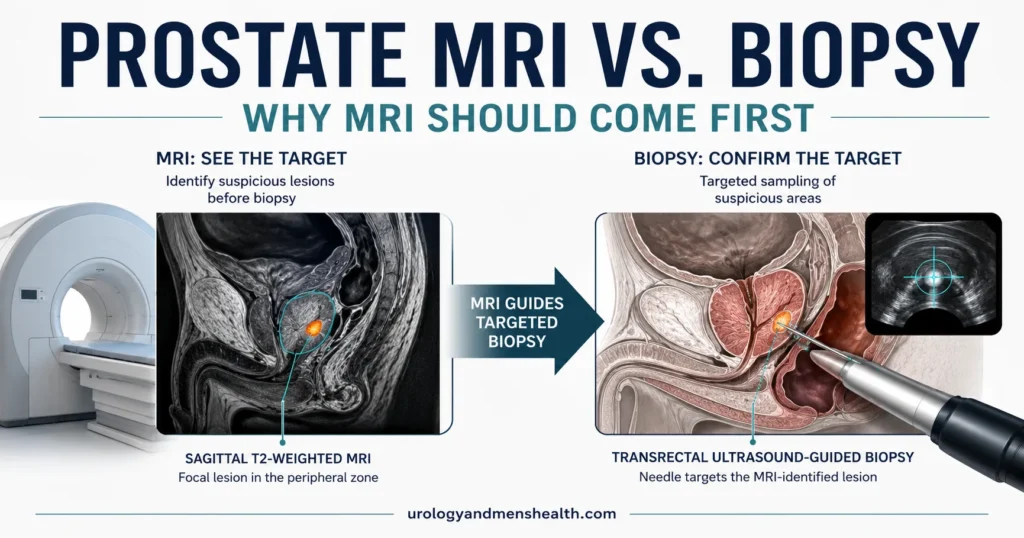
The decision to do a prostate MRI vs biopsy used to be simple, and it was almost always wrong. For thirty years, a man with an elevated PSA went straight to a transrectal needle biopsy — twelve cores, blind to where any cancer might actually be. Many men were biopsied who didn’t need to be, and a meaningful slice of clinically significant cancers were missed anyway. Multiparametric MRI changed that math. In my clinic, I now order an MRI before the biopsy in most men with a grey-zone PSA, and the 2023 American Urological Association guideline backs that approach for the right candidates [1]. This article walks through when MRI should come first, what PI-RADS scores actually mean for your odds, the three ways a targeted biopsy can be done, and the situations where MRI alone is not enough. For the full picture on screening and PSA, see our complete Prostate Health Hub.
Key Takeaways
- Multiparametric MRI (mpMRI) before biopsy reduces unnecessary biopsies by around 28% and detects more clinically significant prostate cancer than blind systematic biopsy alone (PRECISION trial, 2018).
- PI-RADS 1-2 on MRI usually means no biopsy is needed — your risk of high-grade cancer is below 10%. PI-RADS 4-5 means biopsy is strongly recommended.
- MRI-targeted biopsy with software fusion is the AUA-preferred approach in 2026. Transperineal access drops sepsis risk from 2-5% (transrectal) to under 1%.
- MRI is not perfect — it misses around 10-15% of clinically significant cancers. A normal MRI does not override an abnormal digital rectal exam or a steeply rising PSA.
Why Going Straight to Biopsy Was the Wrong Default
For decades, the diagnostic pipeline ran like this: PSA above 4 ng/mL → transrectal ultrasound-guided biopsy → 12 systematic cores taken in a standardized pattern → wait for pathology. The problem is that ultrasound cannot see prostate cancer. The needles are placed by anatomical mapping, not by aiming at the lesion. You are essentially fishing in the dark.
This produced two failures at the same time. First, around two-thirds of men with PSAs in the 4-10 ng/mL grey zone do not have prostate cancer at all — but they got biopsied, which carries a 2-5% risk of sepsis from transrectal needle entry and around a 1 in 200 risk of hospital admission. Second, the blind systematic approach missed a meaningful proportion of high-grade cancers that were sitting in anterior zones the standardized template did not adequately sample [2]. We were biopsying men who shouldn’t have been biopsied and missing cancers in men who really did need treatment. Multiparametric MRI fixes both problems at once.
What a Multiparametric Prostate MRI Actually Sees
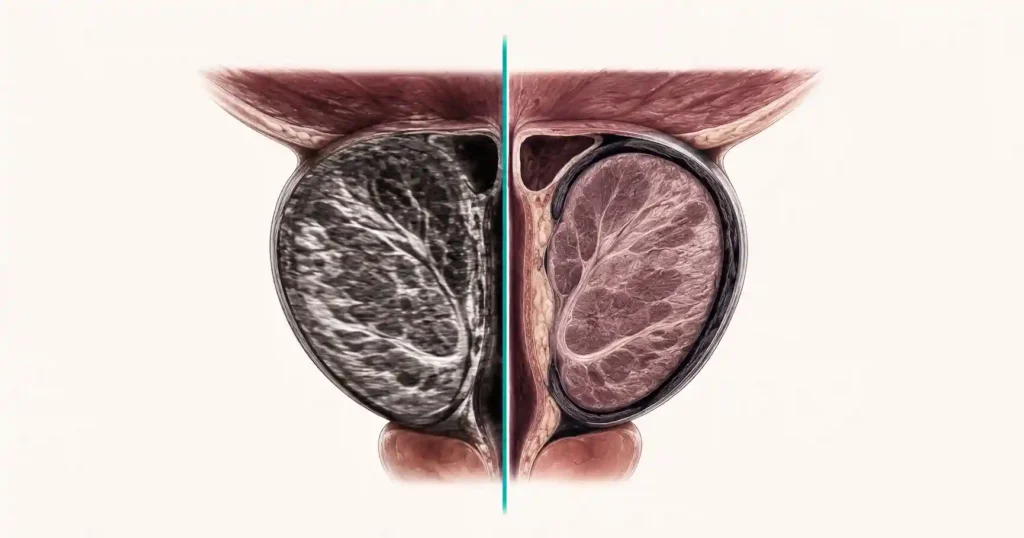
“Multiparametric” means the MRI combines three different scan sequences, each highlighting something different about the tissue. Together they let a trained radiologist do something ultrasound never could: visualize a suspicious lesion and assign a confidence score to it.
T2-Weighted Imaging
This is the anatomical map. T2 shows the zonal architecture of the prostate clearly — peripheral zone (where most cancers arise), transition zone (where BPH grows), and central zone. Normal peripheral zone tissue appears bright; cancer typically shows up as a darker, lower-signal area. T2 alone is not enough to call cancer, but it is the foundation the other sequences are read against.
Diffusion-Weighted Imaging (DWI)
This is the workhorse sequence for finding cancer. Tumor cells are packed together more densely than normal tissue, which restricts the movement of water molecules. DWI detects that restriction and lights it up as a bright spot. A focal area of restricted diffusion in the peripheral zone is the single strongest MRI predictor of clinically significant prostate cancer.
Dynamic Contrast Enhancement (DCE)
A contrast agent is injected and the scanner watches how quickly tissue takes it up and washes it out. Cancer tissue is more vascular and shows faster, more avid enhancement than normal prostate. DCE is most useful for problem-solving in the peripheral zone when DWI is equivocal.
A modern protocol pulls these three sequences together and a radiologist trained in prostate imaging and PSA interpretation assigns a PI-RADS score. The whole scan takes 30-45 minutes, requires no anesthesia, and at most centers does not even require an endorectal coil any more.
In My Practice
I had a patient last year, 62 years old, with a PSA that had drifted from 3.2 to 4.6 over two years. His digital rectal exam was unremarkable. The old script said biopsy. We did an mpMRI instead — PI-RADS 2, no suspicious lesion. We agreed on PSA monitoring every six months. Eighteen months later his PSA is stable at 4.4 and he has had zero needles in his prostate. That outcome is now the rule for grey-zone PSAs in my clinic, not the exception.
An MRI-first pathway is not about replacing biopsy — it is about making sure the biopsy you do get is the one you actually needed.
PI-RADS: What Your MRI Score Actually Means
PI-RADS — short for Prostate Imaging Reporting and Data System — is the 5-point scale a radiologist uses to communicate how suspicious the MRI looks for clinically significant cancer. “Clinically significant” in this context means Gleason 3+4 or higher, the kind that actually needs treatment. Indolent low-grade disease is intentionally not what PI-RADS is designed to find.
- PI-RADS 1 — Very low. Clinically significant cancer is highly unlikely (under 5%). No biopsy is generally recommended unless other risk factors push the decision.
- PI-RADS 2 — Low. Clinically significant cancer is unlikely (around 10%). The standard recommendation is PSA monitoring rather than biopsy.
- PI-RADS 3 — Equivocal. The lesion is ambiguous (around 20% risk). This is the shared-decision zone — PSA density, age, family history, and DRE findings tip the balance.
- PI-RADS 4 — High. Clinically significant cancer is likely (around 60% risk). Targeted plus systematic biopsy is strongly recommended.
- PI-RADS 5 — Very high. Clinically significant cancer is highly likely (over 85% risk). Biopsy is essentially mandatory.
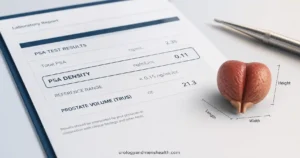
PI-RADS 3 is where most clinical disagreement lives. My approach in clinic is to bring in PSA density — your PSA divided by your prostate volume in cubic centimeters. A PI-RADS 3 lesion with a PSA density above 0.15 ng/mL/cc gets biopsied. A PI-RADS 3 with density under 0.10 ng/mL/cc usually gets a repeat MRI in 6-12 months and a PSA trend check. You can estimate your own PSA density using our PSA Age-Adjusted Interpreter.
The Three Ways to Biopsy When MRI Says Yes
If your MRI is PI-RADS 4 or 5, the next step is a targeted biopsy — aimed at the lesion rather than scattered across the gland. Three methods exist, and the one your urologist offers depends on the equipment available at your center.
Cognitive Fusion
The urologist reviews the MRI, mentally maps where the lesion sits, and then aims the ultrasound-guided biopsy needle at that location from memory. It is the lowest-tech approach and the cheapest, but accuracy depends entirely on the operator. In experienced hands it works; in inexperienced hands it has the same miss rate as systematic biopsy.
Software (MRI-Ultrasound) Fusion
This is the AUA-preferred standard in 2026. Specialized software overlays the pre-acquired MRI onto a live ultrasound image during the biopsy. The urologist sees the MRI-defined lesion as a colored target on the ultrasound screen and aims directly at it. Detection of clinically significant cancer in PI-RADS 4-5 lesions runs around 60-75% — far above the 30-40% rate of cognitive fusion.
In-Bore MRI-Guided Biopsy
The patient lies inside the MRI scanner and the needle is placed under direct, real-time MRI guidance. Accuracy is highest of any approach, but the procedure is long (60-90 minutes), expensive, and available at relatively few centers in the US, UK, or Australia. I reserve in-bore for men whose software-fusion biopsy was negative but MRI suspicion remains very high — a “second-look” scenario.
Regardless of which technique is used, modern practice is to take the MRI-targeted cores plus a set of systematic cores from the rest of the gland — typically 4 targeted plus 8-12 systematic. The systematic cores catch the small percentage of significant cancer that MRI misses outside the suspicious area.
Facing a PSA result you do not fully understand? Download Dr. Khalid’s PSA & Prostate Cancer Decision Guide.
Enter your email below to receive Dr. Khalid’s complete PSA & Prostate Cancer Decision Guide as a free, printable PDF.
Transperineal vs Transrectal: The Route Matters as Much as the Targeting
One of the most important shifts in prostate biopsy practice over the last five years is the move from the transrectal to the transperineal route. The transrectal approach pushes the needle through the rectal wall — a non-sterile environment full of bacteria, including resistant strains. Sepsis rates of 2-5% have been documented in some series, and rates of fluoroquinolone-resistant E. coli infections have climbed worldwide [3].
The transperineal route puts the needle through the skin of the perineum instead, after a local anesthetic block. The needle never crosses the rectal wall, and sepsis rates fall to under 1%. In countries where the transition has been completed — much of the UK, parts of Australia, and increasingly major US academic centers — antibiotic prophylaxis has been reduced or eliminated entirely. If your urologist is still offering transrectal biopsy, it is reasonable to ask whether transperineal is available at your center or a nearby one.
The transperineal access route works with all three fusion techniques (cognitive, software, in-bore) — it is the entry point, not the targeting method. For the full procedural picture including local anesthesia, sedation options, and recovery, see our detailed guide on what a prostate biopsy actually feels like and how to prepare.
The MRI-First Pathway: When It Applies and When It Doesn’t
The AUA/SUO 2023 Early Detection of Prostate Cancer guideline endorses mpMRI before biopsy in biopsy-naive men with a suspicious PSA or DRE, provided high-quality MRI and experienced radiology reading are available [1]. That covers most men in the grey-zone PSA scenario. The PRECISION randomized trial showed that this pathway diagnosed 38% of men with clinically significant cancer using MRI-targeted biopsy alone, versus 26% with standard transrectal biopsy — while sparing 28% of men a biopsy altogether [4].
The pathway is even stronger for men with a prior negative biopsy but persistently rising PSA. Here the systematic biopsy has already failed, and the MRI’s ability to find anterior or apical lesions the template missed is most valuable. The PROMIS trial demonstrated mpMRI’s sensitivity for clinically significant cancer in this group at 93%, compared to 48% for transrectal ultrasound-guided systematic biopsy [5].
There are still scenarios where I will go to biopsy without MRI first: a very high PSA (above 20 ng/mL) where the pre-test probability of cancer is so high that imaging will not change the decision; a hard, fixed, clearly abnormal DRE; or a man with a PSA trajectory that has doubled in a year. In these cases MRI is still useful for staging, but it does not change whether to biopsy. You can track your trend with our PSA Velocity Tracker.
Where MRI Falls Short — And Why DRE Still Matters
mpMRI is the best non-invasive tool we have ever had for prostate cancer detection, but it is not infallible. Around 10-15% of clinically significant cancers are invisible on MRI [2]. These tend to be small, infiltrative high-grade tumors, or lesions sitting in zones where MRI signal is degraded by motion or post-procedure changes. A PI-RADS 1-2 scan reduces your risk but does not zero it.
Three things temper a reassuring MRI result. First, the digital rectal exam still matters — a hard, asymmetric nodule on DRE pushes me toward biopsy even with a negative MRI, because palpable abnormalities sometimes mark MRI-invisible cancers. Second, PSA velocity matters — if PSA continues to rise sharply over the next 6-12 months despite a clean MRI, the scan needs to be repeated. Third, family history of high-risk prostate cancer or known BRCA2 mutation shifts the threshold; in these men I have a lower bar for proceeding to biopsy even on a PI-RADS 2.
Quality also varies enormously. A 1.5 Tesla scanner with an older protocol and a non-specialist radiologist will miss things a 3 Tesla scanner with an experienced uroradiologist would catch. If your MRI is read by a radiologist who reports fewer than 50 prostate MRIs a year, the report is less reliable than the same images read at a high-volume center. It is reasonable to ask where your MRI will be performed and read before you book it.
When MRI Should Not Delay Action
An MRI-first pathway makes sense in most grey-zone PSA scenarios, but do not let waiting for an MRI delay urgent workup if any of the following apply:
- PSA above 20 ng/mL on a confirmed (repeat) test — biopsy and staging proceed together.
- Hard, fixed, asymmetric nodule on DRE — proceed to biopsy.
- Visible blood in semen or urine that persists after antibiotics — urgent cystoscopy and imaging.
- Bone pain plus elevated PSA — staging takes priority over MRI sequencing.
- PSA that has more than doubled in 12 months — proceed without delay.
After the Biopsy: Reading the Pathology Report
If the targeted biopsy comes back positive, the pathology report will give you a Gleason score (or ISUP grade group, the newer system). This is the single most important number for deciding what happens next — active surveillance, surgery, radiation, or focal therapy. Targeted biopsies tend to give more accurate Gleason grading than blind systematic biopsies because the needle is in the lesion rather than the edge of it, which reduces understaging of high-grade disease. For a full breakdown of what each Gleason combination means, see our guide on Gleason score and what your biopsy report actually says.
If the report is favorable — Gleason 6 (ISUP 1) or low-volume 3+4 (ISUP 2) — active surveillance is increasingly the standard of care, and modern protocols rely heavily on follow-up MRI to monitor disease. If the report shows higher-grade disease, the next conversations move to surgery, radiation, or hormonal therapy depending on stage, age, and comorbidity. Either way, the MRI-first pathway has given you a more accurate starting point for those decisions than a blind biopsy would have.
Cost, Insurance, and Access in 2026
A multiparametric prostate MRI in the US runs anywhere from $400 to $2,500 depending on facility, contrast use, and insurance contract — Medicare and most major commercial insurers now cover it for elevated PSA after the AUA guideline change. In the UK, NHS coverage is standard for grey-zone PSA following NICE NG131. In Australia and Ireland, public-system access is available but waiting times can run 6-12 weeks; private MRI is faster but out of pocket.
If cost or wait time is a barrier, ask three things. First, does your insurance cover MRI before biopsy specifically — some plans still require a prior biopsy. Second, is contrast (DCE) included or biparametric (T2 + DWI only) — biparametric is faster and cheaper and performs nearly as well for screening, though full mpMRI is preferred. Third, is the report read by a fellowship-trained uroradiologist — this single factor changes accuracy more than the scanner model. Cardiovascular risk factors and high blood pressure sometimes complicate the contrast decision; ask your radiologist if your kidney function or BP is borderline.
Frequently Asked Questions
Do I really need a prostate MRI before a biopsy if my PSA is only mildly elevated?
For most men with a PSA between 4 and 10 ng/mL and a normal DRE, the answer is yes — that is exactly the group where prostate MRI vs biopsy decisions are most clearly settled in favor of MRI-first. The PRECISION trial showed 28% of men in this scenario were spared a biopsy entirely because their MRI was PI-RADS 1-2. The 2023 AUA guideline now endorses this pathway. If your urologist sends you straight to biopsy without offering MRI, it is reasonable to ask why. See our grey-zone PSA guide for the full decision framework.
What does PI-RADS 3 mean and should I get a biopsy?
PI-RADS 3 means the lesion is equivocal — around 20% chance of clinically significant cancer. It is the genuine shared-decision zone. I bring in PSA density (PSA divided by prostate volume) to tip the balance: above 0.15 ng/mL/cc I biopsy, below 0.10 I monitor with a repeat MRI in 6-12 months. Age, family history, and BRCA status also shift the call. PI-RADS 3 is not a “wait and see” verdict by default — it is a conversation.
Can a normal prostate MRI definitively rule out cancer?
No. mpMRI misses approximately 10-15% of clinically significant prostate cancers. A PI-RADS 1-2 scan substantially reduces your risk but does not eliminate it. If your DRE is abnormal, your PSA velocity remains high, or you have a strong family history of prostate cancer or a BRCA2 mutation, biopsy may still be appropriate. A clean MRI is reassurance, not a discharge.
What is the difference between targeted and systematic biopsy after an MRI?
A targeted biopsy aims needles at the specific lesion identified on MRI — typically 3-5 cores per target. A systematic biopsy takes 10-12 cores from a standardized template across the whole gland, regardless of where MRI saw anything. Current best practice does both at the same procedure: targeted cores find the MRI-visible cancer, systematic cores catch the small percentage of significant disease MRI misses. Most men come out of the room with around 12-15 cores total.
Is the transperineal biopsy better than the transrectal route?
For most men, yes. Transperineal biopsy goes through the skin of the perineum rather than the rectal wall, dropping sepsis rates from 2-5% down to under 1% and substantially reducing the antibiotic burden. Anterior prostate lesions are also easier to reach transperineally. The main downside is slightly more discomfort during the procedure, which is why many centers use sedation. If your urologist still does transrectal-only, ask whether a transperineal option is available locally.
Will my insurance cover a prostate MRI before biopsy in 2026?
In the US, Medicare and most major commercial insurers now cover mpMRI before biopsy for an elevated PSA following the 2023 AUA guideline endorsement, though prior authorization may be required. In the UK, NICE-aligned NHS coverage is standard. In Australia, public system coverage is available but waiting times can stretch to 6-12 weeks; private scans are quicker but out of pocket. Ask the imaging facility for a written cost estimate and confirm whether contrast is included before you book.
References
- Wei JT, Barocas D, Carlsson S, et al. Early Detection of Prostate Cancer: AUA/SUO Guideline Part I and Part II. Journal of Urology. 2023;210(1):46-53. AUA Guidelines
- Ahmed HU, Bosaily AE, Brown LC, et al. Diagnostic accuracy of multi-parametric MRI and TRUS biopsy in prostate cancer (PROMIS): a paired validating confirmatory study. The Lancet. 2017;389(10071):815-822. PubMed
- Pilatz A, Veeratterapillay R, Köves B, et al. Update on the prevention and treatment of infectious complications after prostate biopsy. European Urology. 2021;79(1):11-15. EAU Guidelines
- Kasivisvanathan V, Rannikko AS, Borghi M, et al. MRI-Targeted or Standard Biopsy for Prostate-Cancer Diagnosis (PRECISION). New England Journal of Medicine. 2018;378(19):1767-1777. PubMed
- Ahmed HU, et al. PROMIS trial outcomes: clinical implications for the diagnostic pathway. The Lancet. 2017;389(10071):815-822. PubMed
- National Institute for Health and Care Excellence. Prostate cancer: diagnosis and management. NICE guideline NG131. 2019 (updated 2021). NICE NG131
Dr. Muhammad Khalid
MBBS · FCPS (Urology) · MCPS (General Surgery) · CHPE · CRSM · IMC #539472
Specialist urologist with 11+ years of clinical experience across tertiary teaching hospitals. Trained at Lady Reading Hospital and Khyber Teaching Hospital, Peshawar. Author or co-author of five peer-reviewed international publications, including in Cureus and the World Journal of Surgery. Procedural expertise: URS, PCNL, RIRS, TURP, TURBT, and major open urological surgery. Full profile →
This article is for educational purposes only and does not constitute medical advice. Always consult your physician or urologist for diagnosis and treatment decisions specific to your condition.