
Hydration Calculator for Kidney Stone Prevention
This hydration calculator for kidney stone prevention turns the guideline urine-output goal into a daily fluid target built around your weight, climate, and activity. If you have passed a stone, keeping your urine dilute is the single most effective thing you can do to stop the next one. Enter three details to see your number, then learn how to actually hit it in the Kidney Stones Hub.

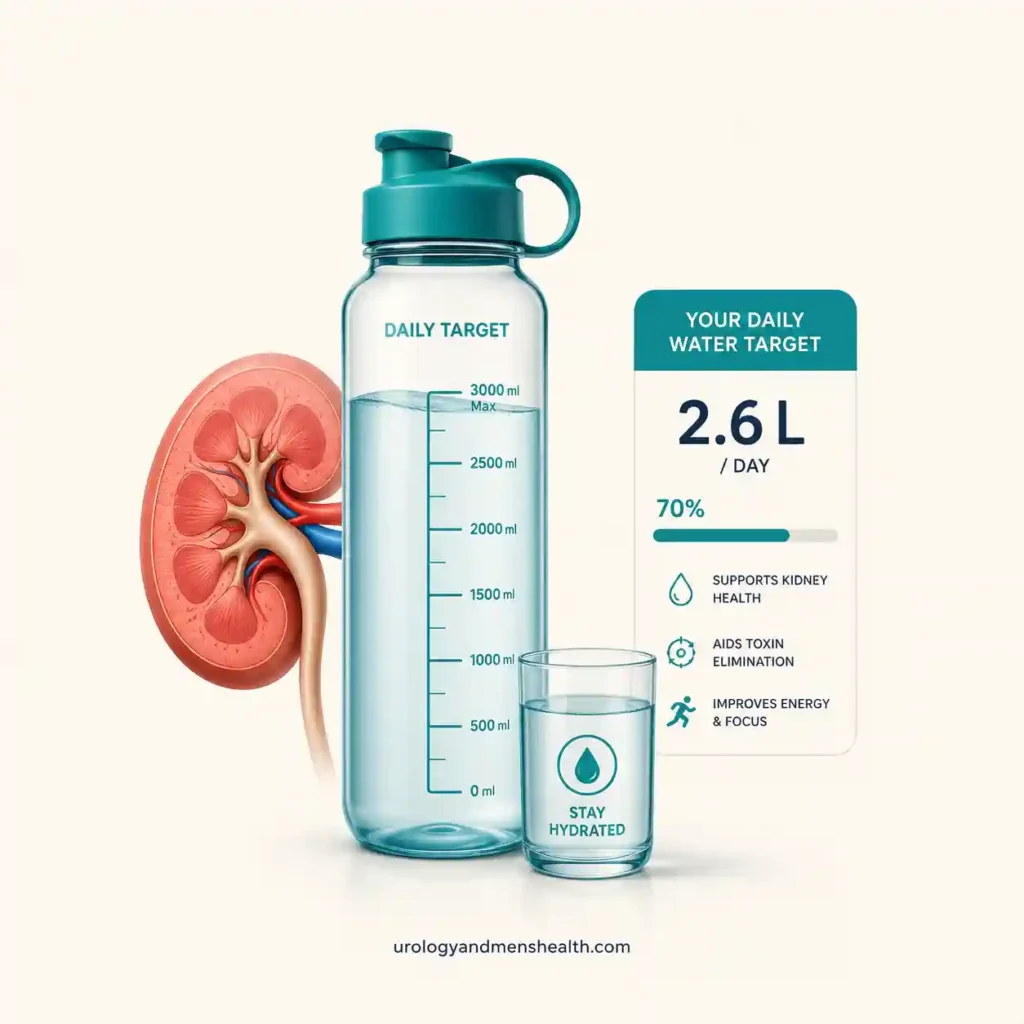
The Tool
Related Kidney Tools
Full Clinical Guide
In This Guide:
- The goal is a urine output of at least 2.5 litres a day, not a fixed number of glasses — your intake has to run ahead of it because of sweat and breathing losses.
- A larger body and a hotter, more active day both raise your target; the calculator adjusts for both.
- Spacing beats chugging — steady sips, including an evening glass, keep urine dilute around the clock, when most crystals form.
- Plain water is first-line; lemon or lime adds citrate, a natural crystal inhibitor, while sugary sodas push risk the wrong way.
What This Hydration Calculator Measures
This hydration calculator for kidney stone prevention takes the fluid goal urological guidelines set and turns it into a personal daily number. The target the American Urological Association and the European Association of Urology both work from is not an amount you drink but an amount you produce: a urine output of at least 2.5 litres (about 85 fl oz) a day.[1][2] For most adults, reaching that means drinking roughly 3 litres of fluid, because some water always leaves through your skin and breath before it ever reaches your bladder. The calculator starts from a weight-based estimate of your baseline need, then adds for a warm climate or an active day, since both raise how much you lose. The result is the intake target most likely to keep your urine dilute enough to resist the next stone — though your real fluid needs shift with the weather, your health, and your stone type.
Why Urine Volume, Not Glasses, Is the Real Target
A stone begins when the salts in your urine — most often calcium and oxalate — grow concentrated enough to crystallise and clump together. Dilution is the direct counter: the more water passing through, the lower the salt concentration, and the less chance crystals have to form and grow. That is why the figure that matters is urine output, not the glasses you count — two people can drink the same litre and pass very different volumes depending on how much they sweat. The practical consequence is timing, not just total. Urine is most concentrated overnight, when most people stop drinking, so an evening glass and steady daytime sips protect you better than the same volume drunk all at once. The landmark trial behind this advice followed first-time calcium-stone formers and found that raising fluid intake roughly halved five-year recurrence — from 27% to about 12%.[3]
How to Read Your Daily Fluid Target
Your number lands in one of three bands. Under about 3 litres is a standard target: realistic for a lower-risk adult of average build in a cool climate, and reached with steady sipping. Between 3 and 4 litres is an elevated target, usually driven by a larger body, heat, or regular exercise — here, replacing what you sweat out matters as much as the baseline. At 4 litres or more you are in the high band the guidelines reserve for the highest-risk formers and specific stone types such as cystine, where the urine goal itself climbs to 3.5 to 4 litres a day.[2][4] Wherever you land, the target is an intake figure; the goal it serves is the 2.5-litre urine output underneath it. Pale straw urine through the day is the simplest sign you are getting there.
Read: The Kidney Stone Diet — A Urologist’s Clinical ProtocolWhat to Do With Your Number
Whatever your target, consistency beats intensity — a measured bottle you refill on a schedule turns the number into a habit you can keep, instead of a figure you hit once and forget. Track how reliably you reach it rather than guessing, because the days you fall short are the days a stone gets its opening.
Open: Kidney Stone Prevention Compliance TrackerIf you form stones repeatedly, fluid is the foundation but rarely the whole answer; pair this with the kidney stone risk profiler and ask your doctor about a 24-hour urine test, which shows whether high oxalate, low citrate, or another driver is at work. And if you have heart or kidney disease, confirm any large increase in fluid with your doctor before you make it. If you are unsure about your result, the PDF report this tool generates gives you a ready-made framework to bring to your next appointment.
In My Practice
The single biggest predictor of who comes back with another stone, in my clinic, is not how much someone says they drink — it is what their urine looks like first thing in the morning. The patients who relapse are almost always the ones whose overnight urine is dark and strong because they stop drinking after dinner and then sleep eight hours dry.
If your morning urine is consistently dark, your daytime total is hiding a long nightly gap that no calculator will close for you. An evening glass is often the highest-value change you can make.
References
- Pearle MS, Goldfarb DS, Assimos DG, et al. Medical Management of Kidney Stones: AUA Guideline (2014). American Urological Association. Recommends a fluid intake achieving urine volume of at least 2.5 L/day (Standard; Grade B).
- EAU Guidelines on Urolithiasis — Metabolic Evaluation and Recurrence Prevention. European Association of Urology. Fluid amount 2.5–3.0 L/day; 3.5–4.0 L/day for high-risk stone formers.
- Borghi L, Meschi T, Amato F, et al. Urinary volume, water and recurrences in idiopathic calcium nephrolithiasis: a 5-year randomized prospective study. J Urol. 1996;155(3):839–843. PubMed. 5-year recurrence 12.1% vs 27% (p=0.008).
- Bargagli M, Ferraro PM, Vittori M, et al. Hydration for Adult Patients with Nephrolithiasis: Specificities and Current Recommendations (2023). PMC. Reviews the ≥2.5 L/day target and higher goals for cystine and hyperoxaluria.
Frequently Asked Questions
How much water should I drink to prevent kidney stones?
There is no single number for everyone. The guideline target is an output of at least 2.5 litres (about 85 fl oz) of urine a day, which for most adults means drinking roughly 3 litres of fluid, since some water is always lost through skin and breathing. A larger body, a hot climate, and heavy activity all raise the figure. The calculator above estimates your personal target, and the kidney stone risk profiler shows how much hitting it matters for you.
Does the type of fluid matter, or is any drink fine?
Water is first-line and the simplest choice. Adding fresh lemon or lime gives you citrate, a natural inhibitor that makes it harder for calcium-oxalate crystals to form. Sugary sodas and drinks high in fructose can push risk the other way, and alcohol and strong coffee count toward fluid but are easy to overdo. If oxalate is your problem, what you eat matters as much as what you drink — the oxalate food list shows where it hides.
Can I drink too much water?
For most healthy people, drinking to a 2.5 to 4 litre target is safe and simply means more trips to the bathroom. It becomes risky if you have heart failure, advanced kidney disease, or take medication that affects fluid balance — in those cases, agree any increase with your doctor first. Forcing large volumes far beyond thirst in a single sitting is also unwise. Steady sips through the day, not sudden big drinks, is the safe way to reach your number.
How accurate is this tool, and can I rely on it?
This calculator gives an evidence-based estimate built on the fluid-intake targets in the AUA and EAU stone-prevention guidelines, adjusted for your weight and activity. It is a screening and planning aid, not a personal prescription, and it cannot account for your stone type, kidney function, or medications. Treat the number as a sensible starting target to confirm with your own doctor, especially if you form stones often or have another medical condition.
How do I use this result at my doctor’s appointment?
Use the Download My Report button to generate a two-page PDF with your target, your inputs, and a short list of questions to ask. Bringing a specific number — your fluid target in litres per day — makes the conversation concrete and helps your doctor decide whether a 24-hour urine test or a dietary change is worth adding. It also gives you a record to compare against next time your weight or routine changes.
Dr. Muhammad Khalid
MBBS · FCPS (Urology) · MCPS (General Surgery) · CHPE · CRSM · IMC #539472
Specialist urologist with 11+ years of clinical experience across tertiary teaching hospitals. Trained at Lady Reading Hospital and Khyber Teaching Hospital, Peshawar. Author or co-author of five peer-reviewed international publications, including in Cureus and the World Journal of Surgery. Procedural expertise: URS, PCNL, RIRS, TURP, TURBT, and major open urological surgery. Full profile →
This article is for educational purposes only and does not constitute medical advice. Always consult your physician or urologist for diagnosis and treatment decisions specific to your condition.