
Andropause Likelihood Calculator
This andropause likelihood calculator scores the symptoms of age-related low testosterone - also called late-onset hypogonadism - using the validated Aging Males' Symptoms scale. Answer 17 quick questions about your energy, mood, and sexual health, and you'll see how heavy your symptom burden is and whether a simple blood test is worth discussing. It is a starting point, not a diagnosis. Explore more in the sexual health hub.

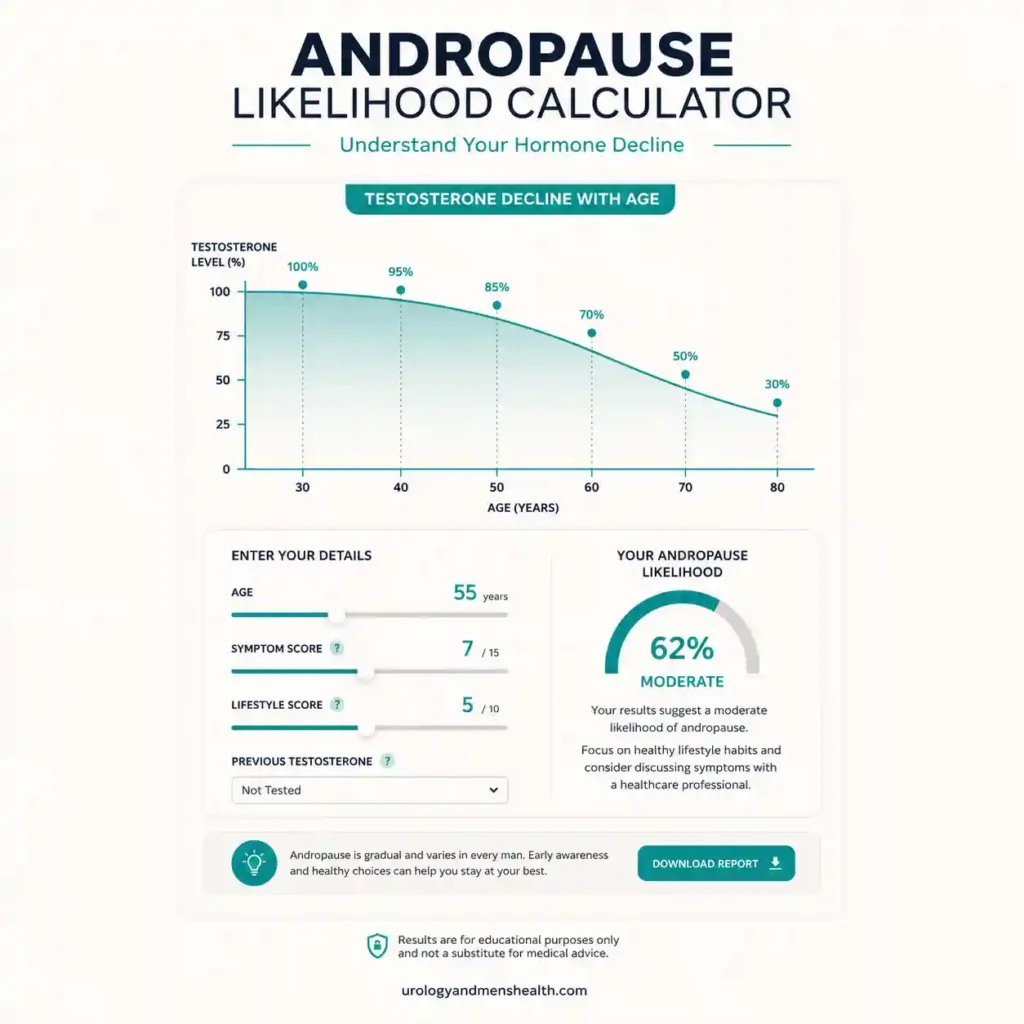
The Tool
Related Sexual Health Tools
Full Clinical Guide
In This Guide:
- This tool scores the Aging Males’ Symptoms (AMS) scale, the validated 17-item questionnaire for symptoms of age-related low testosterone.
- A higher score flags a heavier symptom burden – it does not measure your testosterone. Only a morning blood test can do that.
- A diagnosis needs both symptoms and a confirmed low level on two early-morning samples. Guidelines are clear that a questionnaire alone is not enough.
- Many causes of a high score – poor sleep, weight gain, stress – lower testosterone as a consequence and are often reversible.
What This Tool Measures
This andropause likelihood calculator scores the Aging Males’ Symptoms (AMS) scale, the questionnaire developed by Heinemann and colleagues in the late 1990s to measure the symptoms men report as testosterone declines with age [1]. “Andropause” is the popular name for what doctors call late-onset hypogonadism – a slow, age-related fall in testosterone that shows up as symptoms rather than a sudden event like menopause.
The scale groups 17 symptoms into three clusters: physical and energy complaints, mood and mental symptoms, and sexual symptoms. Its reference values were set from a sample of 992 men, and it is used worldwide to track how heavy a man’s symptom burden is. What it does not do – and was never designed to do – is measure the hormone itself. It tells you how loud the symptoms are, which is the first half of the question, not the whole of it.
Why These Symptoms Cluster Together
Testosterone supports muscle, mood, sleep quality, and sexual function all at once, so when it falls, symptoms tend to arrive as a group rather than one at a time. That is why the scale bundles physical, psychological, and sexual complaints – they share a common driver. Testosterone declines only gradually with age, by a low single-digit percentage per year [4], so age by itself rarely produces a dramatic drop.
The bigger lever is usually metabolic. Excess weight, poor sleep, and conditions like type 2 diabetes push testosterone down – and low testosterone then worsens energy and weight, which feeds back into the loop. This is why the fix so often starts with the basics rather than a prescription.
How to Read Your Score
Your total runs from 0 to 68. A low likelihood result means minimal symptoms and makes clinically low testosterone unlikely. A moderate likelihood result means your symptoms have crossed the level at which the AMS scale is commonly read as a positive screen [1] – enough to justify a blood test, though not proof of anything. A high likelihood result means a symptom load the scale treats as clinically significant, which warrants a proper hormone workup.
The three subscores matter as much as the total. A high sexual subscore with a modest physical one points more specifically toward a hormone question; a high physical or mood subscore with normal sexual function often has other explanations worth chasing first. If erection changes dominate your score, the Low Testosterone Symptom Quiz approaches the same ground from a different angle.
What to Do With Your Result
Whatever your score, the correct next step is the same in structure: symptoms point you toward a test, and only the test settles it. A diagnosis of low testosterone needs a low reading on two separate early-morning blood samples – most guidelines put the cut-off somewhere around 264 to 300 ng/dL (roughly 9 to 10.4 nmol/L) – together with symptoms [2][3]. Major urology guidelines are explicit that a symptom questionnaire like this one should not be used on its own to diagnose low testosterone or to decide who starts treatment [2].
A low score points to protecting sleep, weight, and activity, with testing reserved for anything specific that nags you. A moderate or high score points to asking for that morning testosterone test, drawn correctly and repeated if low. Because excess weight is one of the strongest reversible causes, it is worth checking your metabolic picture alongside your hormones with the BMI & Metabolic Syndrome Risk Screen. If you are unsure about your result, the PDF report this tool generates gives you a ready-made framework to bring to your next appointment.
In My Practice
The single most common thing I correct in men worried about “andropause” is the belief that the symptom list equals a diagnosis. A man reads that low mood, tiredness, and a softer libido mean low testosterone, and he is halfway to ordering a gel online before we have measured a single level. The symptoms are genuine – but I have seen just as many of them resolve by treating sleep apnea or losing 10 kg (22 lb) as by prescribing testosterone.
Symptoms tell you to look. A blood test – drawn correctly, in the morning, and repeated once – tells you what you are actually dealing with.
References
- Daig I, Heinemann LAJ, Kim S, et al. The Aging Males’ Symptoms (AMS) scale: review of its methodological characteristics. Health Qual Life Outcomes. 2003;1:77. PMC155679. Validation and structure of the AMS scale.
- American Urological Association. Evaluation and Management of Testosterone Deficiency (2018, reaffirmed 2024). AUA Guideline. Diagnostic cut-off, two-morning-sample rule, and the recommendation against questionnaire-only diagnosis.
- European Association of Urology. Sexual and Reproductive Health Guidelines – Male Hypogonadism (2024). EAU Guidelines. Screening in symptomatic men and treatment thresholds.
- Tancredi A, Reginster JY, Luyckx F, et al. The Aging Males’ Symptoms scale: predictive value for lowered circulating androgens. Aging Male. 2012. doi:10.3109/13685538.2012.729232. Age-related testosterone decline and symptom correlation.
Frequently Asked Questions
Is andropause a real medical condition?
Does a high score mean I have low testosterone?
What blood test should I ask for?
How accurate is this tool, and can I rely on it?
How do I use this result at my doctor’s appointment?
Dr. Muhammad Khalid
MBBS · FCPS (Urology) · MCPS (General Surgery) · CHPE · CRSM · IMC #539472
Specialist urologist with 11+ years of clinical experience across tertiary teaching hospitals. Trained at Lady Reading Hospital and Khyber Teaching Hospital, Peshawar. Author or co-author of five peer-reviewed international publications, including in Cureus and the World Journal of Surgery. Procedural expertise: URS, PCNL, RIRS, TURP, TURBT, and major open urological surgery. Full profile →
This article is for educational purposes only and does not constitute medical advice. Always consult your physician or urologist for diagnosis and treatment decisions specific to your condition.