Obesity and Erectile Dysfunction: The Testosterone Link
Carrying extra weight around the middle doesn't just strain your heart — it quietly converts your testosterone into estrogen. Here's how obesity drives ED, and how much weight loss can undo it.

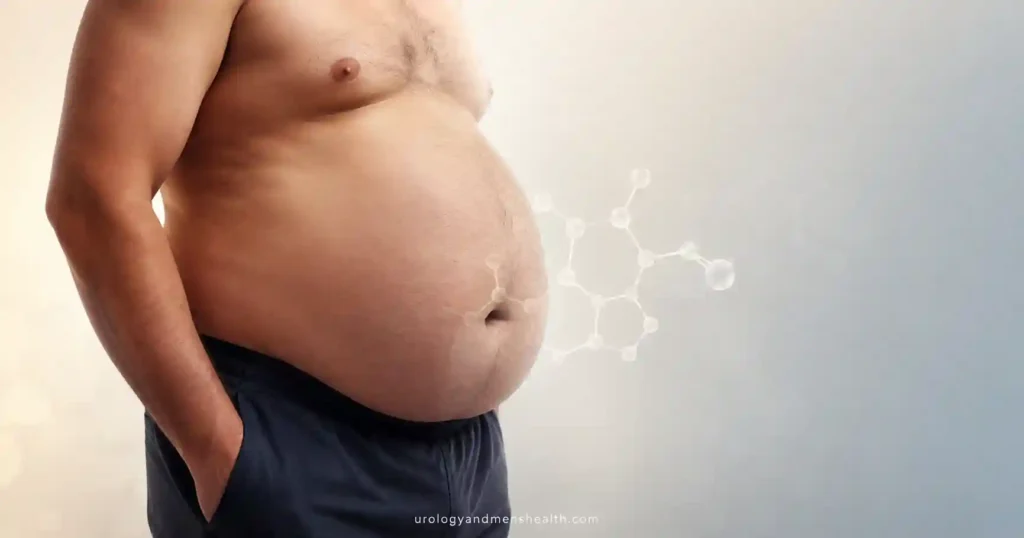
The link between obesity and erectile dysfunction is one I explain in clinic almost every week, and it rarely lands the way men expect. Most assume ED is purely a plumbing problem — a blood-flow issue in the penis. That’s part of it. But in men carrying extra weight, a second engine runs underneath: your fat tissue is actively lowering your testosterone. Body fat, especially around the abdomen, behaves like a hormone-processing organ. It converts testosterone into estrogen and sends signals to your brain that dial down testosterone production at the source. The result is a slow slide in libido, morning erections, and firmness that no amount of willpower fixes on its own. The encouraging part — and the reason this article exists — is that this particular cause of ED is one of the few that can genuinely reverse. Not with a pill first, but by breaking the cycle at its root. Here’s exactly how obesity, testosterone, and ED connect, and what the evidence says about turning it around.
Key Takeaways
- Abdominal fat is packed with aromatase, an enzyme that converts your testosterone into estrogen — the more visceral fat you carry, the lower your testosterone tends to run.
- Obesity attacks erections on two fronts at once: reduced blood flow (a vascular problem) and lowered testosterone (a hormonal one), which is why weight-related ED often resists pills alone.
- In a landmark trial, roughly one in three obese men with ED regained erectile function after losing about 10% of their body weight over two years — with no medication involved.
- For obesity-driven low testosterone, weight loss is the guideline-recommended first move; testosterone injections alone can leave the underlying fat-hormone cycle running.
How Belly Fat Quietly Lowers Your Testosterone
Fat is not an inert storage sack. Adipose tissue — particularly the visceral fat around your organs — produces an enzyme called aromatase, which irreversibly converts testosterone into estrogen. The more fat you carry, the more aromatase you run, and the more of your own testosterone gets siphoned off into estrogen. This is where the wider picture of male metabolic health starts, and our Men’s Wellness Hub maps how these systems connect.
The damage doesn’t stop there. That rising estrogen feeds back to your brain and suppresses the luteinizing hormone (LH) signal that tells your testicles to make testosterone in the first place. So you lose testosterone twice: once to conversion in the fat, and again to a quieter command signal from the brain. Doctors call this pattern obesity-associated hypogonadotropic hypogonadism — low testosterone driven by low central signaling rather than a broken testicle[3].
Then it becomes a loop. Low testosterone makes it easier to gain fat and harder to build muscle, which adds more aromatase, which lowers testosterone further. This self-reinforcing cycle is why weight tends to creep up steadily once it starts, and why men often feel their energy, drive, and erections all fade together rather than one at a time.
How Obesity and Erectile Dysfunction Are Connected
An erection is a vascular event powered by a hormonal environment. Obesity degrades both at the same time, which is what makes weight-related ED so stubborn.
The vascular hit
Visceral fat drives chronic inflammation and damages the endothelium — the thin lining inside your blood vessels that releases nitric oxide, the molecule that lets penile arteries relax and fill. When that lining is impaired, the arteries can’t widen enough to produce a firm erection. Because the penile arteries are narrow, they clog and stiffen earlier than the coronary arteries, which is why ED is often the first visible sign of blood-vessel disease. I explain that overlap in detail in our guide on why ED can be an early warning of heart disease.
The hormonal hit
Testosterone doesn’t create the erection directly, but it maintains libido and keeps the erectile tissue and its nerve signaling healthy. When testosterone falls, desire drops, spontaneous morning erections fade, and the response to sexual stimulation weakens. Stack that on top of poor blood flow and you have a man whose erections are failing from two directions — which is exactly why a single ED tablet, working only on the vascular side, so often underdelivers in men with obesity.
In My Practice
A 44-year-old came to me convinced his sildenafil had “stopped working.” It hadn’t. His waistline had grown four inches over three years, his morning erections had vanished first, and his total testosterone had drifted into the low-normal range. The tablet was fighting a hormonal headwind it was never designed to beat. We didn’t change his prescription — we changed his weight. Eight months and 26 pounds (about 12 kg) later, he was off the tablets entirely.
When a previously reliable ED pill fades in a man who is gaining weight, I look at the hormones and the waistline before I reach for a stronger drug.
Is your weight driving your low testosterone? Get the testing-and-treatment guide
Enter your email below to receive Dr. Khalid’s complete Low Testosterone: Testing & Treatment Guide as a free, printable PDF.
Does Losing Weight Reverse ED? What the Evidence Shows
This is the part worth being honest about, because it cuts both ways. The strongest single trial randomized 110 obese men who had ED but no diabetes, hypertension, or high cholesterol. The intervention group aimed to lose at least 10% of their body weight through diet and exercise over two years. Roughly one in three men regained normal erectile function on weight loss alone — no medication[2]. Alongside that, a large meta-analysis confirmed that losing weight reliably reverses obesity-associated low testosterone, with bigger losses producing bigger hormonal gains and surgical weight loss producing the largest rises of all[3].
The honest caveat: a third recovering fully means two-thirds saw partial or no full recovery in that window. Longstanding, severe ED — especially where the arteries are already heavily damaged — may improve without fully reversing. Weight loss is not a guaranteed cure, but it is one of the few interventions that treats the actual cause rather than masking the symptom, and it improves the response to ED medication in men who still need it.
A practical starting point is knowing where you stand. Our BMI and metabolic syndrome risk screen shows how far your current weight sits from the range where testosterone and vascular function tend to recover, and if your symptoms point to genuinely low hormones, our overview of low testosterone symptoms in men over 40 explains what to watch for.
Should You Just Take Testosterone Instead?
It’s the obvious question, and the answer is more nuanced than the clinics advertising quick testosterone shots would suggest. AUA guidance is clear that every man with low testosterone should be counseled on weight loss and physical activity as a treatment strategy, and that men who are overweight should pursue weight loss alongside any testosterone therapy rather than instead of it[1].
Here’s why weight loss comes first for obesity-driven low T. If you inject testosterone into a body still carrying heavy visceral fat, a chunk of that extra testosterone is simply aromatized straight into estrogen — you feed the same cycle you were trying to escape. Testosterone therapy also shuts down the body’s own production and can suppress sperm counts, which matters for any man who still wants children. The 2021 T4DM trial showed that testosterone can add benefit on top of a structured weight-loss program, but the program remained the foundation, not the shot.
None of this means testosterone therapy is wrong. In men whose levels stay genuinely low after real weight loss, or who have a testicular cause rather than an obesity cause, treatment can be appropriate and effective. The point is sequence: fix the fat-hormone cycle first, then reassess. If you’re unsure whether your symptoms fit low testosterone at all, our low testosterone symptom quiz is a sensible first check before any injection is on the table.
A Realistic Plan to Break the Cycle
You don’t need to reach an ideal weight to see benefit. The gains start early, and they compound. Here is the sequence I give men in clinic.
- Target a 5–10% loss first, not a transformation. For a 220 lb (100 kg) man, that’s roughly 11–22 lb (5–10 kg). This is the range where testosterone and erectile function start moving, and it’s achievable enough to sustain.
- Combine resistance training with cardio. Rapid dieting alone burns muscle, which lowers testosterone. Lifting two to three times a week preserves muscle and protects your hormones while the fat comes off.
- Ask your doctor for a morning total testosterone test. Levels are highest in the morning, so a sample before roughly 10 a.m. is the standard. Retest after three to six months of weight loss to see the trend, not just one snapshot.
- Get screened for sleep apnea. Obesity and disrupted sleep both crush testosterone, and untreated sleep apnea will blunt everything else you do.
Fold these into the broader picture with our 40+ men’s health checklist, and if you’re past 50, our guide to the urological changes men face after 50 covers how these hormone shifts evolve with age.
When ED Is a Warning Sign, Not Just a Weight Problem
Erectile dysfunction can be the first visible signal of blood-vessel disease that also threatens your heart. Don’t assume it’s only about weight — see a doctor promptly if your ED comes with any of the following:
- Chest pain, pressure, or breathlessness when you exert yourself
- ED that appeared suddenly rather than creeping in gradually
- Calf or thigh pain when walking that eases with rest
- New ED before age 40
- ED alongside very low libido, shrinking testicles, or breast tenderness — signs that point to a hormonal cause needing bloodwork
Frequently Asked Questions
Does losing weight really increase testosterone, or is that a myth?
It’s well established, not a myth. Fat tissue converts testosterone into estrogen and suppresses the brain signals that drive testosterone production, so shedding fat reverses both effects. Meta-analysis data show weight loss reliably raises testosterone, with larger losses producing larger gains and surgical weight loss producing the biggest rises. If your levels are low, our low testosterone guide explains which numbers actually matter.
How much weight do I need to lose to improve my erections?
In the trial that defined this, obese men aimed for a loss of about 10% of their body weight over two years, and roughly one in three regained erectile function. You may notice improvement earlier and with less loss — even 5% often lifts energy and libido. A useful starting point is checking where you stand with our BMI and metabolic risk screen.
I’m obese with low testosterone — should I start TRT or lose weight first?
For obesity-driven low testosterone, guidelines put weight loss first, because testosterone injections alone leave the fat-hormone cycle intact and can suppress fertility. Weight loss treats the cause; testosterone treats the number. In some men a doctor may combine both, but body composition is the foundation. Our low testosterone guide covers when treatment is genuinely warranted.
Can belly fat cause erectile dysfunction even if my testosterone is normal?
Yes. The connection between obesity and erectile dysfunction runs through blood vessels as much as hormones. Visceral fat damages the endothelium — the lining that lets penile arteries widen — so erections weaken even when testosterone reads normal. That vascular pathway is the same one behind heart disease, which is why ED can be an early warning; our guide on ED and heart disease explains the overlap.
Will GLP-1 weight-loss drugs like Ozempic improve my ED and testosterone?
Indirectly, and mainly through the weight loss they produce. As body fat falls, testosterone tends to rise and vascular function improves, so erections often follow. The drugs aren’t ED treatments themselves, and rapid weight loss needs muscle-preserving exercise to protect testosterone. Our guide on GLP-1 drugs and men’s sexual health goes deeper on what to expect.
References
- Mulhall JP, Trost LW, Brannigan RE, et al. Evaluation and management of testosterone deficiency: AUA guideline. J Urol. 2018;200(2):423-432. AUA
- Esposito K, Giugliano F, Di Palo C, et al. Effect of lifestyle changes on erectile dysfunction in obese men: a randomized controlled trial. JAMA. 2004;291(24):2978-2984. PubMed
- Corona G, Rastrelli G, Monami M, et al. Body weight loss reverts obesity-associated hypogonadotropic hypogonadism: a systematic review and meta-analysis. Eur J Endocrinol. 2013;168(6):829-843. PubMed
Dr. Muhammad Khalid
MBBS · FCPS (Urology) · MCPS (General Surgery) · CHPE · CRSM · IMC #539472
Specialist urologist with 11+ years of clinical experience across tertiary teaching hospitals. Trained at Lady Reading Hospital and Khyber Teaching Hospital, Peshawar. Author or co-author of five peer-reviewed international publications, including in Cureus and the World Journal of Surgery. Procedural expertise: URS, PCNL, RIRS, TURP, TURBT, and major open urological surgery. Full profile →
This article is for educational purposes only and does not constitute medical advice. Always consult your physician or urologist for diagnosis and treatment decisions specific to your condition.