GLP-1 Drugs and Erectile Dysfunction: What Men Should Know
The evidence on GLP-1 drugs and erectile dysfunction has moved a long way since the 2024 headlines, and it now splits by which agent you are actually taking. Here is what I tell men in clinic today.

GLP-1 drugs and erectile dysfunction became linked in men’s minds in early 2024, when a single database study made international news. Since then I have had a steady stream of men in clinic asking me the same question, usually a few weeks after starting Ozempic, Wegovy, Mounjaro or Zepbound: is this drug going to ruin my erections? What almost none of them have seen is that the evidence moved considerably after that headline, and it moved in the opposite direction. We now have a randomized trial that measured erectile function directly, a head-to-head comparison of the two most-prescribed agents, and an analysis of the entire FDA adverse-event database. None of them support the idea that this drug class damages erections as a rule. What they show instead is more useful to you: the answer depends on which agent you are taking and what your metabolic starting point was. For the wider picture on how blood flow, hormones and body weight interact, see our complete Sexual Health Hub.
Key Takeaways
- The most-quoted ED finding came from a records database, covered only non-diabetic obese men on semaglutide, and cannot show that the drug caused anything.
- The one randomized trial that measured erectile function directly found slightly fewer new cases of moderate or severe ED on a GLP-1 than on placebo across 3,725 men.
- Head to head in men with type 2 diabetes, tirzepatide carried roughly one third lower ED risk than injectable semaglutide.
- Across the whole FDA adverse-event database, GLP-1 drugs generated fewer sexual-dysfunction reports than the average medication, not more.
- If your erections worsen on a GLP-1, the rate of weight loss and your baseline testosterone explain it far more often than the drug itself.
GLP-1 Drugs and Erectile Dysfunction: Where the Scare Started
The origin of this worry is one paper. Researchers searched a large multi-hospital records network for non-diabetic men with obesity who had been prescribed semaglutide for weight loss, compared them against similar men who had not, and found a higher recorded rate of erectile dysfunction diagnoses in the semaglutide group [1]. That is a real finding and I am not going to wave it away.
But you need to understand what that kind of study can and cannot tell you. A records database captures what a clinician typed into a chart. It does not decide who gets which drug. Men prescribed a weight-loss injection are, almost by definition, men who have already been flagged as metabolically unwell, and they are also men who are now seeing doctors more often than they used to. Both of those things increase the odds that erectile dysfunction gets noticed and coded, entirely independently of what the drug does to blood vessels.
There is a second limitation that matters more than the first. That study looked at one drug, semaglutide, in one population, non-diabetic men with obesity. It was never designed to answer the question the headlines turned it into, which was whether GLP-1 drugs as a class harm erections.
The Only Randomized Trial Points the Other Way
Almost nobody writing about this topic mentions the REWIND analysis, and it is the single most informative piece of evidence available. REWIND was a double-blind, placebo-controlled randomized trial of the GLP-1 drug dulaglutide, run across 371 sites in 24 countries. Within it, researchers tracked erectile function using a standard questionnaire in 3,725 men with type 2 diabetes, average age 65.5 years, more than half of whom already had moderate or severe erectile dysfunction when they started [2].
New cases of moderate or severe erectile dysfunction occurred at 21.3 per 100 person-years on the GLP-1 drug versus 22.0 per 100 person-years on placebo (hazard ratio 0.92, 95% CI 0.85 to 0.99). Men on the drug also lost slightly less erectile function over time than men on placebo.
I want to be honest about the size of that. It is a small advantage, not a treatment for erectile dysfunction, and it was an exploratory analysis rather than the trial’s main purpose. But the direction matters enormously, because randomization is what separates evidence from correlation. When you flip a coin to decide who gets the drug, the sicker men and the healthier men are distributed evenly by chance, and the confounding that plagues a records database largely disappears.
So the strongest available evidence, from the only design capable of showing cause, found a modest benefit rather than harm.
Semaglutide vs Tirzepatide: The Difference That Actually Matters
This is the part of the story that has not reached patients yet, and it is the part I now spend the most consultation time on.
Semaglutide (Ozempic, Wegovy) acts on the GLP-1 receptor. Tirzepatide (Mounjaro, Zepbound) acts on two receptors, GLP-1 and GIP. They are related but not interchangeable, and the assumption that they must behave identically for sexual function was never more than an assumption.
A 2025 study tested it properly. Researchers took men aged 18 to 70 with type 2 diabetes and no prior erectile dysfunction, then matched tirzepatide users one-to-one against users of injectable semaglutide, dulaglutide and sitagliptin, so the groups were comparable on age, weight and comorbidities. The outcome measured was a new ED diagnosis or a first prescription for a PDE5 inhibitor such as sildenafil [3].
Tirzepatide came out ahead of every comparator. Against injectable semaglutide the risk ratio was 0.67 (95% CI 0.62 to 0.72), which is roughly a one-third lower rate of developing erectile dysfunction. Against sitagliptin it was 0.70.
Now the caveat, and it is not a small one. That study was done in men with type 2 diabetes. The alarming semaglutide finding was in non-diabetic men taking it for weight loss. These are different populations with different vascular risk, and you cannot simply lay one result on top of the other and conclude that tirzepatide is the safe one and semaglutide is the dangerous one. What you can reasonably conclude is narrower and still useful: within men with diabetes, the two agents did not perform the same, and the difference favored tirzepatide.
There is one more dataset worth knowing about, because it reframes the whole question. When researchers examined every report of male sexual dysfunction submitted to the FDA’s adverse event database between 2003 and early 2024, they found 182 cases linked to GLP-1 drugs in total. The reporting odds ratio was 0.41 [4]. A figure below 1 means these drugs are reported for sexual problems less often than medications in general, not more. The authors described the association as weak and the overall patient risk as low.
In My Practice
A 46-year-old man came to see me convinced Wegovy had caused his erectile dysfunction. He had lost 22 kg (about 48 lb) in five months and his erections had become noticeably softer over the same period. He wanted to stop the drug that week. When I asked whether he still woke with erections, he said yes, most mornings, which told me the plumbing was intact and the problem was probably not vascular damage. His morning testosterone came back at the low end of normal, his diet during those five months had been severely restricted, and he had been sleeping badly. We kept the medication, corrected the eating pattern, and rechecked at twelve weeks. His erections had returned to baseline and his testosterone had climbed.
Rapid, poorly nourished weight loss suppresses the male hormone axis on its own, and men attribute the result to whichever drug they happen to be holding.
Worried about erections on a GLP-1 drug? Get the step-by-step ED assessment I use in clinic
Enter your email below to receive Dr. Khalid’s complete ED & Sexual Function Action Plan as a free, printable PDF.
What About Testosterone?
The short version, because this deserves its own article rather than a paragraph buried in one about erections.
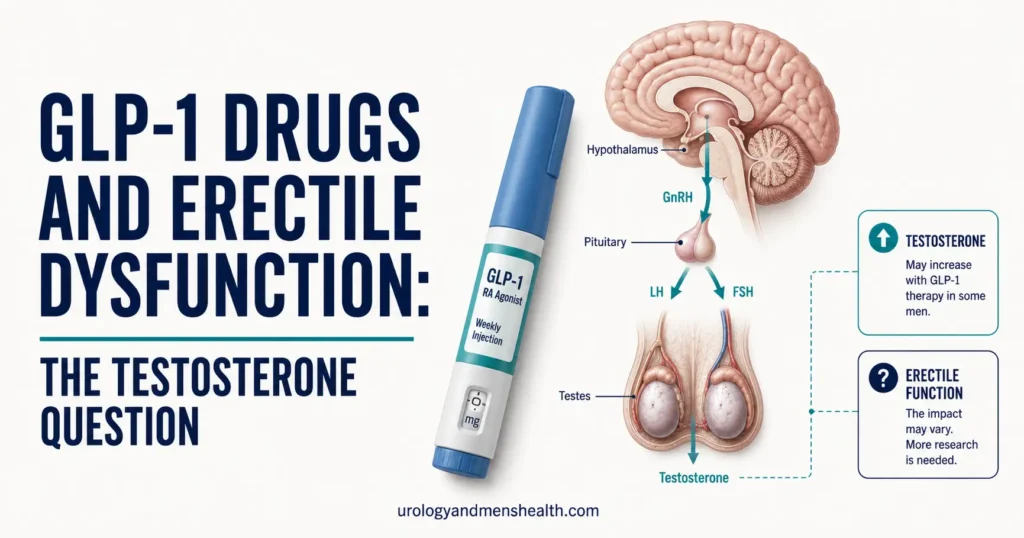
Excess abdominal fat contains an enzyme called aromatase, which converts testosterone into estrogen. The rising estrogen then signals the pituitary to reduce its stimulation of the testes, so testosterone production falls further. It is a loop that feeds itself, and it is the reason so many men with obesity have low testosterone without any disease of the testicles at all. That mechanism is covered in detail in our guide to how obesity drives low testosterone and erectile dysfunction.
Break the loop by removing the fat, and testosterone tends to recover. Data presented at the American Urological Association’s 2026 annual meeting went further than that, reporting a median rise in total testosterone of roughly 99 ng/dL in men on GLP-1 therapy, with the increase persisting after adjustment for age and body mass index [5]. This was a conference abstract rather than a peer-reviewed publication, so treat it as promising rather than settled.
The full picture, including what this means for men currently on testosterone replacement, is covered in our dedicated review of what GLP-1 drugs do to testosterone levels.
Trying to conceive while on one of these drugs? Here is what the evidence says about GLP-1 medications, sperm and male fertilityDoes the Wegovy Pill Change Anything?
In December 2025 the FDA approved a once-daily semaglutide tablet marketed as the Wegovy pill, the first oral GLP-1 licensed for weight management, and it reached US pharmacies in January 2026 [6]. A second oral agent from a different manufacturer is under review. I am already seeing men who switched from the injection to the tablet and want to know whether that changes the sexual side-effect picture.
Mechanistically, it should not. The tablet contains the same molecule as the injection. What differs is absorption and dosing schedule, not what the drug does once it is in your bloodstream. The tablet must be taken on an empty stomach with a small amount of water, with nothing else for the next 30 minutes.
The honest answer is that no study has yet measured erectile function specifically in men taking oral semaglutide. Anyone telling you the pill is safer or riskier for erections is guessing. What I would say is that the tablet makes it easier to stop and restart than a weekly injection does, and inconsistent dosing produces the erratic weight swings that unsettle the hormone axis. Take it consistently or discuss switching, but do not drift.
What I Do When a Man on a GLP-1 Says His Erections Got Worse
Stopping the medication is almost never my first move, and it should not be yours either. Here is the sequence I work through.
- Ask about morning erections first. If you still wake with erections at least some mornings, the nerve and blood supply are working and the cause is more likely hormonal, psychological or situational than structural damage.
- Calculate the rate of weight loss. Losing more than roughly 1% of body weight per week, especially on a very low calorie intake, suppresses the hormone axis independently of any drug. This is the single most common explanation I find.
- Request a morning total testosterone drawn before 10am, plus HbA1c and a fasting lipid panel. Ask for the testosterone to be repeated on a second morning if the first is low, because a single reading is not a diagnosis.
- Score your erectile function formally rather than relying on memory, using our ED vascular risk screener to check whether the pattern points toward a circulatory cause.
- Reassess at 12 weeks before changing anything. Weight loss, hormone recovery and vascular improvement all run on a timescale of months, not weeks.
If erections have genuinely not recovered at three months and your testosterone is confirmed low on two morning samples, that is the point to have a proper conversation with a urologist about whether the agent should change, whether a PDE5 inhibitor is appropriate alongside the GLP-1, and whether anything else is contributing.
When Erection Trouble Is Not About the Drug at All
New erectile dysfunction is frequently the earliest sign of arterial disease, and it can precede a cardiac event by several years. The penile arteries are narrower than the coronary arteries, so they clog first and cause symptoms sooner. Do not let a GLP-1 prescription become the explanation that stops the investigation.
- Erections that failed suddenly and completely, rather than declining gradually over months
- No morning erections at all, over several weeks
- Chest tightness, breathlessness on exertion, or calf pain when walking
- Erectile dysfunction alongside blood pressure that has never been formally measured
- A painful erection lasting more than four hours, which is a same-day emergency and needs a hospital, not a phone call
Frequently Asked Questions
Do GLP-1 drugs and erectile dysfunction actually go together, or does Ozempic cause ED?
Not as a class, on the current evidence. The scare traces to one records-database study of non-diabetic men on semaglutide, which cannot establish cause. The only randomized trial to measure erectile function directly found slightly fewer new cases of moderate or severe ED on a GLP-1 than on placebo. If your erections have not improved as your weight falls, our urologist’s guide to ED treatment covers the assessment properly.
Is tirzepatide safer for erections than semaglutide?
In men with type 2 diabetes, a 2025 matched comparison found roughly one third lower ED risk with tirzepatide than with injectable semaglutide. That result has not been reproduced in non-diabetic men using these drugs purely for weight loss, so it is not yet a reason on its own to switch. Score your baseline first with the IIEF-5 erectile function assessment so any change is measured rather than remembered.
Should I stop my GLP-1 drug if my erections get worse?
Rarely, and not as a first step. In my experience the rate of weight loss and a restricted diet explain far more of these cases than the medication does. Check whether you still get morning erections, request a morning testosterone with HbA1c and lipids, and reassess at twelve weeks before changing drugs. Our ED vascular risk screener helps establish whether the pattern is circulatory.
Will my erections improve once I have lost the weight?
For most men with obesity-driven problems, yes, though it takes months rather than weeks. Losing abdominal fat reduces the conversion of testosterone to estrogen, lifts testosterone, and improves the arterial function erections depend on. The mechanism is set out in our guide to obesity, testosterone and erectile dysfunction. If nothing has changed by six months, something else is contributing.
Does the Wegovy pill carry the same erection risk as the injection?
No study has measured erectile function specifically in men taking oral semaglutide, so nobody can answer this with data. The tablet contains the same molecule as the injection, so there is no mechanistic reason to expect a different sexual-function profile. If fertility rather than erections is your concern, see our review of GLP-1 drugs, weight loss and male fertility.
References
- Able C, Liao B, Saffati G, et al. Prescribing semaglutide for weight loss in non-diabetic, obese patients is associated with an increased risk of erectile dysfunction: a TriNetX database study. Int J Impot Res. 2025;37(4):315-319. DOI
- Bajaj HS, Gerstein HC, Rao-Melacini P, et al. Erectile function in men with type 2 diabetes treated with dulaglutide: an exploratory analysis of the REWIND placebo-controlled randomised trial. Lancet Diabetes Endocrinol. 2021;9(8):484-490. PubMed
- Cowart K, Murphy C, Carris N. Association of tirzepatide with erectile dysfunction in people with type 2 diabetes. J Diabetes Complications. 2025;39:109116. PubMed
- Pourabhari Langroudi A, Chen AL, Basran S, et al. Male sexual dysfunction associated with GLP-1 receptor agonists: a cross-sectional analysis of FAERS data. Int J Impot Res. 2025;37(8):661-667. DOI
- Guillen-Lozoya AH, et al. Testosterone levels improve in men under GLP-1 receptor agonist therapy. Abstract PD26-01. J Urol. 2026. American Urological Association 2026 Annual Meeting. AUA
- Novo Nordisk. FDA approves the Wegovy pill, the first oral GLP-1 receptor agonist for weight management. Company announcement, 22 December 2025. Novo Nordisk
- American Urological Association. Erectile Dysfunction: AUA Guideline. auanet.org. AUA
Dr. Muhammad Khalid
MBBS · FCPS (Urology) · MCPS (General Surgery) · CHPE · CRSM · IMC #539472
Specialist urologist with 11+ years of clinical experience across tertiary teaching hospitals. Trained at Lady Reading Hospital and Khyber Teaching Hospital, Peshawar. Author or co-author of five peer-reviewed international publications, including in Cureus and the World Journal of Surgery. Procedural expertise: URS, PCNL, RIRS, TURP, TURBT, and major open urological surgery. Full profile →
This article is for educational purposes only and does not constitute medical advice. Always consult your physician or urologist for diagnosis and treatment decisions specific to your condition.