
Sedentary Impact Score: How Sitting Affects Your Prostate and Bladder
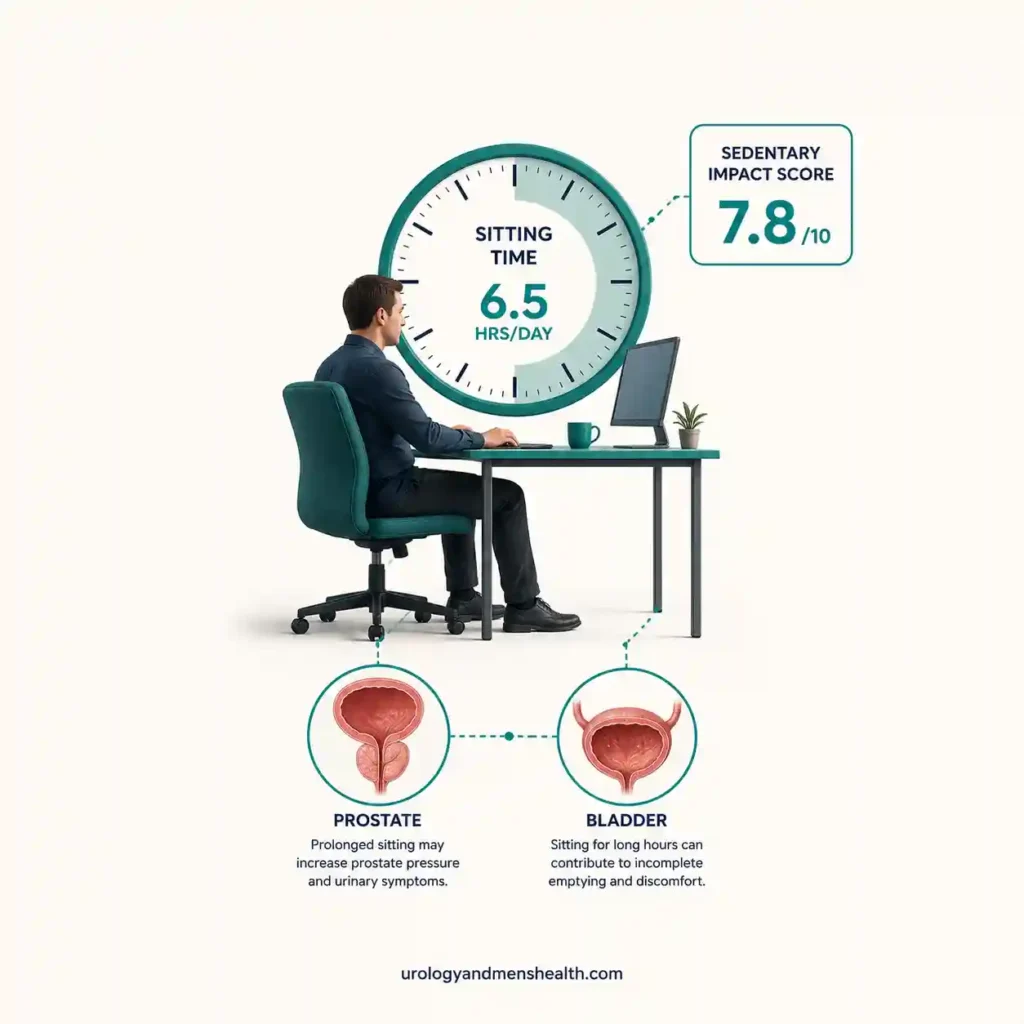
The Sedentary Impact Score turns your daily sitting, exercise, and movement habits into a single 0-100 number showing how much your routine is loading your prostate and bladder. It is for any man who spends long hours at a desk and wonders whether it is feeding his urinary symptoms. Answer four quick questions to see your result, what it means, and the changes that move it fastest. It sits inside our men's wellness hub.

The Tool
Related Wellness Tools
Full Clinical Guide
In This Guide:
- Long daily sitting and low activity are modifiable risk factors for an enlarged prostate and an irritable bladder, not just harmless habits.
- The Sedentary Impact Score is a lifestyle-risk aggregator, not a validated test – it turns your habits into a 0-100 number to act on.
- Both the AUA and EAU place lifestyle change ahead of medication as the first-line step for bothersome urinary symptoms.
- The biggest levers are usually weekly activity minutes and how long you sit without a break.
What This Tool Measures
The Sedentary Impact Score measures how your everyday sitting, activity, and movement habits load your prostate and bladder, and returns a single number from 0 to 100. It is not a diagnosis and it is not a validated clinical instrument – it is a lifestyle-risk aggregator that combines four inputs (daily sitting hours, weekly moderate-to-vigorous activity, how often you break up long sitting, and, optionally, your waist) into one score you can act on and re-check. Each threshold it uses is guideline-anchored: the World Health Organization’s floor of 150 minutes of moderate activity per week, and the established waist cut-offs for men. The reason sitting earns its own tool is that physical activity is one of the few habits with real evidence behind it in urology – a European Urology meta-analysis pooling data on more than 43,000 men found that being physically active was linked to lower odds of both benign prostatic hyperplasia (BPH, an enlarged prostate) and lower urinary tract symptoms [3]. If you want the background, our guide on sitting and prostate and bladder health covers the why in plain terms.
The Physiology Behind the Score
Two mechanisms do most of the work. First, sympathetic nervous-system tone: prolonged sitting and low activity keep your “fight-or-flight” signaling elevated, and that same signaling tightens the smooth muscle in the prostate and bladder neck – the exact muscle tone that alpha-blocker drugs like tamsulosin are designed to relax. In a large Harvard cohort of male health professionals, more physically active men had roughly a quarter lower risk of developing an enlarged prostate, an effect the authors tied directly to lower sympathetic drive [2]. Second, central fat: a sedentary pattern drives visceral fat, insulin resistance, and low-grade inflammation, the metabolic mix repeatedly linked to a larger, faster-growing prostate. Think of it as two dials – one turning up muscle tension (a voiding, weak-stream problem), the other feeding tissue growth and bladder irritability (a storage, urgency problem). Which dial is turned up further shapes what helps most, which is why it can be worth pairing this with an IPSS symptom score.
How to Interpret Your Result
The score falls into three bands, and a man who scores 15 and a man who scores 70 get genuinely different advice. A Low impact score (0-33) means your habits sit on the protective side – your job now is to keep the pattern as you age. A Moderate score (34-59) means your sitting-to-activity balance is nudging risk up; this is the band where one change, usually adding activity minutes or breaking up long sitting, moves the number fastest. A High score (60-100) means several habits are pushing the same way at once, and it deserves to be treated as the first-line therapy it is. One honest caveat: there is no official “safe” sitting limit, because the WHO judged the evidence not yet strong enough to set one [1] – so the sitting bands here are a pragmatic construct, not a validated cut-off. Simple pelvic-floor work helps across all three bands.
What to Do With Your Result
Match your action to your band. For any score, aim for the WHO target of 150 to 300 minutes of moderate activity a week (or 75 to 150 vigorous), plus muscle-strengthening on two days. If your score is moderate or high, pick the one lever that fits your life and hold it for 6 to 8 weeks before adding another – a daily 20-minute walk plus an hourly stand-up closes most gaps. If your waist is over 94 cm (37 in), and especially over 102 cm (40 in), make waist reduction a named target, because central fat tracks closely with prostate and bladder symptoms. A high score, or symptoms that do not ease, is a reason to see your primary care doctor or urologist: ask them to score your symptoms with IPSS, check a PSA, and consider a post-void residual (PVR) or uroflowmetry to see how well you empty. Both the AUA and EAU put lifestyle change first, before drugs like alpha-blockers or 5-alpha-reductase inhibitors [4][5]. It can also help to sanity-check your metabolic risk. If you are unsure about your result, the PDF report this tool generates gives you a ready-made framework to bring to your next appointment.
In My Practice
The men who dismiss lifestyle advice fastest are usually the ones with the most to gain from it. For years I said “try to move more” and watched it bounce off – it is too vague to act on. The moment we put a number on the sitting instead, the conversation changes: a man who sees an 11-hour sitting day written down in front of him treats it the way he treats a raised PSA, as something to bring down.
Putting a figure on a habit is what turns “I should exercise” into a plan you actually follow – which is the entire point of scoring it.
References
- Bull FC, et al. World Health Organization 2020 guidelines on physical activity and sedentary behaviour. Br J Sports Med / WHO. Sets the 150-300 min/week floor; notes evidence was insufficient to define a sitting-time threshold.
- Platz EA, et al. Physical activity and benign prostatic hyperplasia. Arch Intern Med, 1998. Health Professionals Follow-up Study; more active men had ~25% lower BPH risk (OR 0.75).
- Parsons JK, Kashefi C. Physical activity, benign prostatic hyperplasia, and lower urinary tract symptoms. Eur Urol, 2008. Systematic review and meta-analysis, 11 studies, 43,083 men.
- American Urological Association. Management of Lower Urinary Tract Symptoms Attributed to BPH: AUA Guideline. AUA. Behavioural and lifestyle modification as first-line management.
- European Association of Urology. Management of Non-neurogenic Male LUTS. EAU / Uroweb. Lifestyle advice offered to all men with bothersome LUTS (strong recommendation).
Frequently Asked Questions
Does sitting really affect the prostate and bladder?
Is the Sedentary Impact Score a medically validated test?
Can changing my activity actually improve urinary symptoms?
How accurate is this tool, and can I rely on it?
How do I use this result at my doctor’s appointment?
Dr. Muhammad Khalid
MBBS · FCPS (Urology) · MCPS (General Surgery) · CHPE · CRSM · IMC #539472
Specialist urologist with 11+ years of clinical experience across tertiary teaching hospitals. Trained at Lady Reading Hospital and Khyber Teaching Hospital, Peshawar. Author or co-author of five peer-reviewed international publications, including in Cureus and the World Journal of Surgery. Procedural expertise: URS, PCNL, RIRS, TURP, TURBT, and major open urological surgery. Full profile →
This article is for educational purposes only and does not constitute medical advice. Always consult your physician or urologist for diagnosis and treatment decisions specific to your condition.