Sitting and Prostate Health: What It Does to Your Bladder
Patients ask me all the time whether a desk job is quietly wrecking their prostate. The honest answer is more nuanced than "sitting is bad" — here is what the evidence actually shows about sitting, your bladder, and your pelvic floor.

Sitting and prostate health get bundled together in a lot of online advice, and the men who ask me about it are usually office workers, long-haul drivers, or anyone whose day is built around a chair. The worry is reasonable: if you spend eight, ten, twelve hours seated, it feels like something down there must be paying the price. The truth is more specific than “sitting is bad for your prostate.” Prolonged sitting does not appear to cause prostate disease directly, but a sedentary day affects your bladder, your pelvic floor, and your urinary symptoms in ways that are real and measurable. For the bigger picture on staying ahead of male urinary problems, our Men’s Wellness Hub pulls the related guides together. In this article I will separate what the evidence supports from what gets exaggerated, and give you a plan that actually fits a desk-bound life.
Key Takeaways
- Sitting does not directly cause an enlarged prostate or prostate cancer — but a sedentary lifestyle is linked to worse lower urinary tract symptoms.
- Men who are physically active have roughly a 25% lower risk of BPH and urinary symptoms than sedentary men, based on a meta-analysis of over 43,000 men.
- Holding urine at your desk and chronic pelvic floor tension are the two most underrated effects of sitting all day.
- Standing or walking every 30-60 minutes and not delaying urination protect your bladder far more than any supplement.
How Sitting Affects the Prostate
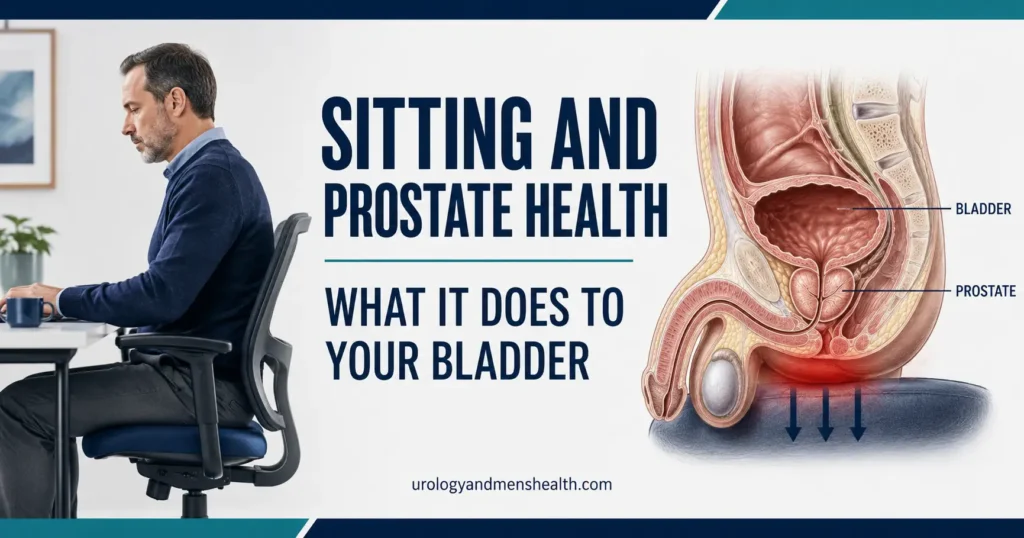
When you sit, your body weight presses down on the perineum — the area between the scrotum and the anus, where the prostate sits just behind the pubic bone. Sustained pressure here compresses the small blood vessels and the pudendal nerve that supply the region. In a single meeting, that means nothing. Over a working life of all-day sitting, it can contribute to pelvic congestion (a sluggish, engorged feeling in the pelvic blood supply) and to the muscle tension patterns I see in men with chronic pelvic pain.
What sitting does not do is enlarge the prostate gland itself. Benign prostatic hyperplasia (BPH) — the age-related growth of the prostate that squeezes the urethra — is driven mainly by aging and hormones, not by your chair. If your stream is already weak or you are getting up at night, that is a prostate-mechanics issue worth assessing on its own; our guide on when an enlarged prostate needs treatment or surgery walks through the thresholds. The sitting question matters more for your symptoms than for the size of the gland.
What Prolonged Sitting Does to Your Bladder
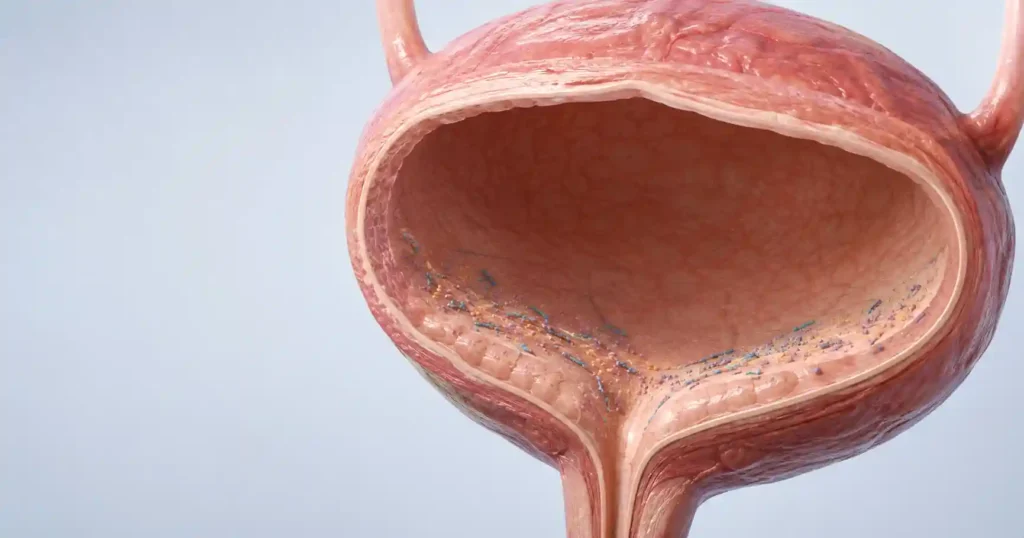
The bladder is where sitting causes the most avoidable trouble, and it usually comes down to two habits. The first is holding urine. When you are locked into a task, it is easy to ignore the urge and let the bladder over-fill. Do this repeatedly and the detrusor — the muscular bladder wall — gets stretched and stops contracting efficiently, which over time can leave you emptying incompletely.
The second is pelvic floor tension. Sitting for hours encourages you to clench the muscles that wrap around the bladder neck and urethra. A chronically tight pelvic floor can produce exactly the symptoms men assume are prostate problems: urgency, a stop-start stream, and frequency. There is also a measurable link between a sedentary lifestyle and urinary symptoms in general — and if frequency and urgency are already part of your day, our guide on overactive bladder in men covers the treatable causes. A quick way to gauge where you stand is the IPSS urinary symptom score, which puts a number on how much your symptoms are affecting you.
In My Practice
A 38-year-old software developer came to me convinced he had a prostate infection — burning, urgency, perineal ache, worse by every afternoon. His exams and cultures were clean. What he actually had was a pelvic floor that never relaxed across a twelve-hour coding day, plus a habit of “holding it” until he finished a build. We changed almost nothing medically: a stand-up timer every 45 minutes, scheduled bathroom breaks, and pelvic floor down-training with a physiotherapist. Six weeks later his symptoms were 80% better.
In younger men especially, sitting-driven pelvic floor tension is mistaken for a prostate or infection problem far more often than people realize.
Over 40 and overdue a proper check? Download Dr. Khalid’s Men’s Health Screening Checklist.
Enter your email below to receive Dr. Khalid’s complete Men’s Health Screening Checklist as a free, printable PDF.
Does Sitting Cause BPH or Prostate Cancer?
This is the question that actually keeps men up at night, so let me answer it plainly. There is no good evidence that sitting causes prostate cancer. There is also no evidence that sitting, on its own, structurally enlarges the prostate. What the research does show is an association between being sedentary and having worse lower urinary tract symptoms.
A systematic review and meta-analysis of 11 studies covering more than 43,000 men found that moderate to vigorous physical activity was associated with up to a 25% lower risk of BPH and lower urinary tract symptoms compared with a sedentary lifestyle [1]. A large prospective study from the Health Professionals Follow-up Study added an important detail: more activity and less sedentary time were each independently linked to a lower risk of developing new urinary symptoms — and that held true even after accounting for body weight [2].
I want to be honest about the strength of this evidence, because it cuts the other way too. When researchers tested exercise as a treatment for established symptoms in controlled trials, a Cochrane review rated the quality of that evidence as very low [3]. So the fair conclusion is this: an active body is associated with fewer urinary problems, the link is biologically plausible through shared cardiovascular and metabolic pathways, but movement is not a guaranteed fix once symptoms exist. It is prevention you can bank on more than a cure.
How to Protect Your Prostate and Bladder if You Sit All Day
You do not need a standing desk or a gym membership to undo most of the damage. The fixes are about breaking up the sitting and respecting your bladder’s signals.
- Stand or walk every 30-60 minutes. Set a timer. Even two minutes resets the perineal pressure and relaxes the pelvic floor. This single habit does more than any product.
- Do not hold urine. When you feel the urge, go within a few minutes. Train yourself out of the “I’ll finish this first” reflex that over-stretches the bladder.
- Hydrate steadily, not in bursts. Sip water across the day rather than chugging at lunch, which spikes urgency and tempts you to ration fluids — both of which backfire.
- Down-train a tight pelvic floor. If you have urgency or perineal ache, the goal is relaxation, not more Kegels. A pelvic floor physiotherapist can teach this in a few sessions.
- Hit roughly 150 minutes of moderate activity a week. A daily brisk walk is enough to land in the “active” category the research rewards.
If you want to see how your own sitting habits stack up, our Sedentary Impact Score for prostate and bladder health turns your daily pattern into a quick risk read. And because the symptoms sitting worsens overlap with conditions you should be screened for after 40 anyway, it is worth pairing these habits with the tests in our 40+ men’s health checklist.
When Sitting Symptoms Need a Doctor, Not a Stand-Up Desk
Lifestyle changes are the right first move for mild symptoms. See a urologist promptly if you notice any of the following, because these point to causes that movement alone will not fix:
- Blood in your urine or semen.
- Inability to urinate, or a sudden severe drop in your stream.
- Waking two or more times a night to urinate, or a stream that has steadily weakened over months.
- Fever with pelvic or testicular pain, which can signal infection rather than muscle tension.
- Pelvic pain lasting more than three months despite changing your sitting habits.
Frequently Asked Questions
Does sitting all day actually cause prostate problems?
Not in the way most men fear. Sitting does not cause prostate cancer or structurally enlarge the gland. The real link between sitting and prostate health is symptom-related: prolonged sitting raises perineal pressure and pelvic floor tension, which can mimic prostate symptoms. If your stream or night-time urination is the issue, read our guide on enlarged prostate treatment to understand the actual mechanics.
Can prolonged sitting make you pee more often or urgently?
Yes. Two mechanisms drive sitting and bladder problems: holding urine until a task is done, which over-stretches the bladder muscle, and chronic pelvic floor clenching, which produces urgency and a stop-start stream. These are very treatable. If frequency and urgency dominate your day, the causes covered in our overactive bladder in men guide are the place to start.
Is sitting linked to chronic pelvic pain in men?
In my clinic, sitting-driven pelvic floor tension is one of the most common contributors to chronic pelvic pain in younger and desk-bound men. The muscles around the bladder neck and perineum stay tight across a long seated day and refer pain that feels prostatic. The fix is pelvic floor down-training and breaking up sitting, not antibiotics — clean cultures point you away from infection.
How often should I stand up at a desk job to protect my bladder?
Aim to stand or walk for a minute or two every 30 to 60 minutes. This resets perineal pressure and lets the pelvic floor relax, and pairing it with not delaying urination addresses the two biggest sitting-related risks. You can gauge how your routine scores with our sedentary impact tool.
Does sitting on a hard chair or a soft seat matter more for the prostate?
Seat firmness matters less than total time seated. A softer or contoured seat can reduce direct perineal pressure and is worth trying if you get a sore, congested feeling, but it does not replace the benefit of standing regularly. The duration of uninterrupted sitting, not the cushion, is what the sedentary-lifestyle urinary symptom research tracks.
References
- Parsons JK, Kashefi C. Physical activity, benign prostatic hyperplasia, and lower urinary tract symptoms: a systematic review and meta-analysis. Eur Urol. 2008;53(6):1228-1241. PubMed
- Mondul AM, Giovannucci E, Platz EA. A prospective study of physical activity, sedentary behavior, and incidence and progression of lower urinary tract symptoms. J Gen Intern Med. 2020;35(8):2281-2288. PubMed
- Silva V, Grande AJ, Peccin MS. Physical activity for lower urinary tract symptoms secondary to benign prostatic obstruction. Cochrane Database Syst Rev. 2019;(4):CD012044. Cochrane
Dr. Muhammad Khalid
MBBS · FCPS (Urology) · MCPS (General Surgery) · CHPE · CRSM · IMC #539472
Specialist urologist with 11+ years of clinical experience across tertiary teaching hospitals. Trained at Lady Reading Hospital and Khyber Teaching Hospital, Peshawar. Author or co-author of five peer-reviewed international publications, including in Cureus and the World Journal of Surgery. Procedural expertise: URS, PCNL, RIRS, TURP, TURBT, and major open urological surgery. Full profile →
This article is for educational purposes only and does not constitute medical advice. Always consult your physician or urologist for diagnosis and treatment decisions specific to your condition.