Zinc, Selenium, Lycopene: Do They Help the Prostate?
Three names dominate the prostate supplement aisle: zinc, selenium, and lycopene. The trial evidence is more sobering than the marketing — and for two of them, the data runs the wrong way.

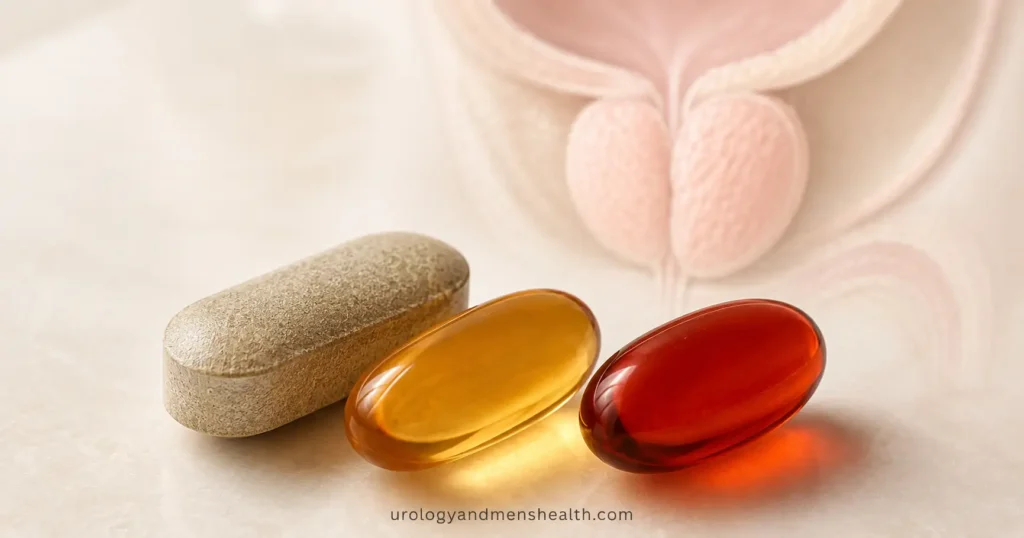
Zinc, selenium, and lycopene are the three ingredients you will find on almost every prostate supplement bottle, and patients ask me about them every week. The pitch is appealing: a few inexpensive capsules that protect the prostate from cancer and ease urinary symptoms. The honest answer, once you read the actual clinical trials instead of the label, is more sobering — and for two of these three, the strongest evidence points the wrong way. I am Dr. Muhammad Khalid, a specialist urologist, and I want to show you what each supplement is supposed to do, what the data found, and what I tell men who want to take something. For the wider picture on products marketed to men, our Men’s Wellness Hub pulls the evidence together. This is not a story about harmless, useless pills. High-dose zinc and high-dose vitamin E carry measurable risks, and those risks matter when a supplement is taken every day for years.
Key Takeaways
- Supplemental zinc above 100 mg per day was linked to more than double the risk of advanced prostate cancer in a 46,974-man Harvard study — more is not safer.
- In the SELECT trial of over 35,000 men, neither selenium nor vitamin E prevented prostate cancer, and vitamin E raised the risk by 17%.
- The Cochrane review of lycopene found too little quality evidence to say it prevents prostate cancer either way.
- A normal diet with tomatoes, seafood, nuts, and seeds supplies all three nutrients safely — the risk signals appear at supplement doses, not food doses.
How zinc, selenium, and lycopene ended up in prostate supplements
Each of these three earned its spot on the label for a real biological reason. The prostate concentrates zinc at roughly ten times the level of most soft tissue, so “zinc for the prostate” sounds logical. Selenium sits inside the body’s antioxidant selenoproteins, which made it a natural cancer-prevention candidate. Lycopene is the red carotenoid in tomatoes, and observational studies repeatedly found that men who ate more cooked tomatoes had lower rates of prostate cancer.
Plausible biology is exactly why all three were put through serious clinical trials rather than left as marketing claims. The problem is what those trials returned. We compared the most-marketed prostate products separately in our evidence review of prostate supplements; this article focuses on the micronutrient trio specifically, because the data on these three is clearer — and less flattering — than most men expect.
Zinc and prostate cancer risk: when more becomes harmful
Because the prostate stores so much zinc, it is easy to assume that swallowing more must help. A Harvard analysis of 46,974 men followed for 14 years found close to the opposite at high doses. Men taking up to 100 mg per day of supplemental zinc had no change in prostate cancer risk. But men taking more than 100 mg per day had a relative risk of advanced prostate cancer of 2.29, and men who used supplemental zinc for 10 years or longer had a risk of 2.37 — more than double [1].
This was an observational study, so it cannot prove zinc caused those cancers. What it does show is that the signal points toward harm at high doses, not protection — and that alone is reason enough not to mega-dose. Dietary zinc from oysters, beef, and pumpkin seeds is not the concern; the concern is the high-dose, long-term capsule. The tolerable upper limit for an adult man is 40 mg per day, and many “prostate complex” products quietly exceed it.
Zinc will not lower your risk, and it will not replace the test that actually finds prostate cancer early. If risk reduction is your goal, the higher-value move is knowing your screening schedule — see our guide to prostate cancer screening by age.
Selenium and vitamin E: what the SELECT trial actually showed
Selenium had the strongest early promise of the three, which is why the US government funded one of the largest cancer-prevention trials ever run. The Selenium and Vitamin E Cancer Prevention Trial, known as SELECT, randomized 35,533 men to selenium (200 micrograms per day), vitamin E (400 IU per day), both agents, or placebo [2].
The result ended the hype. Neither selenium nor vitamin E reduced prostate cancer. Worse, men taking vitamin E alone had a 17% higher rate of prostate cancer than men on placebo, and the trial was stopped early once it was clear the supplements were not helping [2][3]. Selenium showed no protective effect, and separate long-term data have tied selenium supplements to a higher risk of type 2 diabetes. Many prostate formulas still pair selenium with vitamin E — the exact combination that failed in the trial built to test it.
Over 40 and overdue a proper check? Download Dr. Khalid’s Men’s Health Screening Checklist.
Enter your email below to receive Dr. Khalid’s complete Men’s Health Screening Checklist as a free, printable PDF.
Lycopene and prostate cancer: a popular product on thin evidence
Lycopene is the carotenoid that makes tomatoes red, and the early case for it came from observational studies where men who ate more cooked tomatoes had lower prostate cancer rates. Those studies generated headlines, but eating tomato sauce is not the same as swallowing a lycopene capsule — diet studies cannot separate lycopene from everything else a tomato-eater tends to do differently.
When researchers pooled the randomized trials, the picture thinned out fast. The Cochrane review of lycopene for prostate cancer prevention found only three randomized trials, two of them at high risk of bias, and concluded there was not enough quality evidence to support or refute any benefit [4]. That is not proof lycopene fails; it is an absence of proof that it works. Eating tomatoes, watermelon, and pink grapefruit is a healthy habit I encourage — but paying for lycopene pills to prevent cancer is buying a result no trial has actually shown.
What I actually recommend
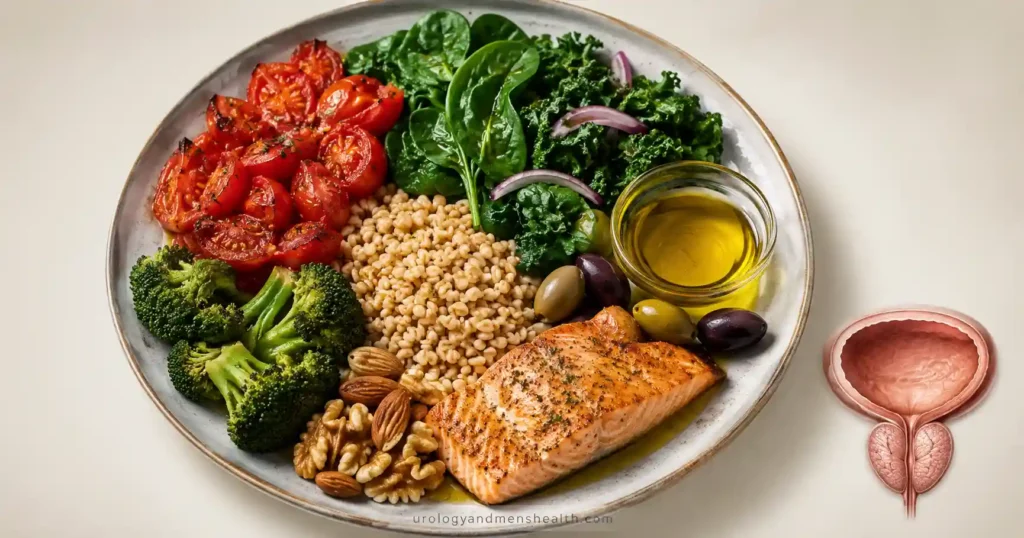
Food first. A normal mixed diet supplies all three nutrients at safe doses: seafood and seeds for zinc, brazil nuts and fish for selenium, cooked tomatoes for lycopene. Every concerning signal in the trials appeared at supplement doses, not food doses. If you already take a prostate “complex,” read the label for two things — zinc above 40 mg and any vitamin E. Those are the two I ask men to drop.
If you still want to take a supplement, make that decision with your own doctor — especially if you are on active surveillance for prostate cancer, where adding antioxidants without evidence is not a risk worth taking. When men want to compare products by how strong the data behind them actually is, our evidence-based supplement matcher ranks them by quality of evidence rather than marketing.
In My Practice
I regularly meet men who arrive with a shopping bag of prostate supplements and a PSA they have never had checked. One patient in his sixties had taken a high-dose zinc-and-saw-palmetto formula for eight years, certain it was protecting him; when we finally measured it, his PSA was 14.
Supplements give a feeling of control, but they are not a substitute for the one test that actually finds prostate cancer early.
When to Stop and See a Doctor
No supplement replaces evaluation. Book a urology review promptly if you have any of the following, rather than reaching for another capsule:
- Blood in your urine or semen
- A PSA above the normal range for your age
- New trouble urinating, a weak stream, or getting up repeatedly at night
- Bone pain alongside a known prostate condition
- Long-term use of more than 40 mg per day of supplemental zinc — review this with your doctor
Frequently asked questions
Does zinc shrink the prostate or lower prostate cancer risk?
No. The prostate stores a lot of zinc, but that does not mean swallowing more helps it. Supplemental zinc has not been shown to shrink an enlarged prostate, and doses above 100 mg per day were linked to roughly double the risk of advanced prostate cancer. Getting zinc from food and a sensible routine — like the one in our men’s health checklist for over-40s — is the safer approach.
Did the SELECT trial prove selenium is dangerous?
Not dangerous, but not helpful. In the SELECT trial of more than 35,000 men, selenium did not prevent prostate cancer at all, and the vitamin E arm showed a 17% higher rate of the disease. Selenium has also been linked to a higher risk of type 2 diabetes with long-term use, so there is little reason to supplement it for prostate health.
Should I eat tomatoes or take lycopene capsules for my prostate?
Eat the tomatoes. The observational signal for lycopene came from food, mostly cooked tomato products, not pills. When the randomized trials were pooled in the Cochrane review, there was not enough quality evidence to say lycopene supplements prevent prostate cancer. A diet with cooked tomatoes, watermelon, and pink grapefruit gives you lycopene with none of the cost or uncertainty of a capsule.
Is there any supplement worth taking for prostate health?
For most men, none of these three — zinc, selenium, or lycopene — has earned a recommendation as a supplement, and the screening that actually catches prostate cancer early matters far more than any capsule. The most useful step is knowing which checks you are due for, which you can map out with our men’s health screening generator, then discussing any supplement with your own doctor before starting it.
References
- Leitzmann MF, Stampfer MJ, Wu K, et al. Zinc supplement use and risk of prostate cancer. J Natl Cancer Inst. 2003;95(13):1004-1007. PubMed
- Klein EA, Thompson IM, Tangen CM, et al. Vitamin E and the risk of prostate cancer: the Selenium and Vitamin E Cancer Prevention Trial (SELECT). JAMA. 2011;306(14):1549-1556. PubMed
- Lippman SM, Klein EA, Goodman PJ, et al. Effect of selenium and vitamin E on risk of prostate cancer and other cancers: the Selenium and Vitamin E Cancer Prevention Trial (SELECT). JAMA. 2009;301(1):39-51. PubMed
- Ilic D, Forbes KM, Hassed C. Lycopene for the prevention of prostate cancer. Cochrane Database Syst Rev. 2011;(11):CD008007. PubMed
Dr. Muhammad Khalid
MBBS · FCPS (Urology) · MCPS (General Surgery) · CHPE · CRSM · IMC #539472
Specialist urologist with 11+ years of clinical experience across tertiary teaching hospitals. Trained at Lady Reading Hospital and Khyber Teaching Hospital, Peshawar. Author or co-author of five peer-reviewed international publications, including in Cureus and the World Journal of Surgery. Procedural expertise: URS, PCNL, RIRS, TURP, TURBT, and major open urological surgery. Full profile →
This article is for educational purposes only and does not constitute medical advice. Always consult your physician or urologist for diagnosis and treatment decisions specific to your condition.