Men’s Health After 50: Urological Changes to Expect
Men's health after 50 brings three near-universal urological shifts — a slower stream, softer erections, and a gradual testosterone decline. Here's which are ordinary aging and which need a urologist.

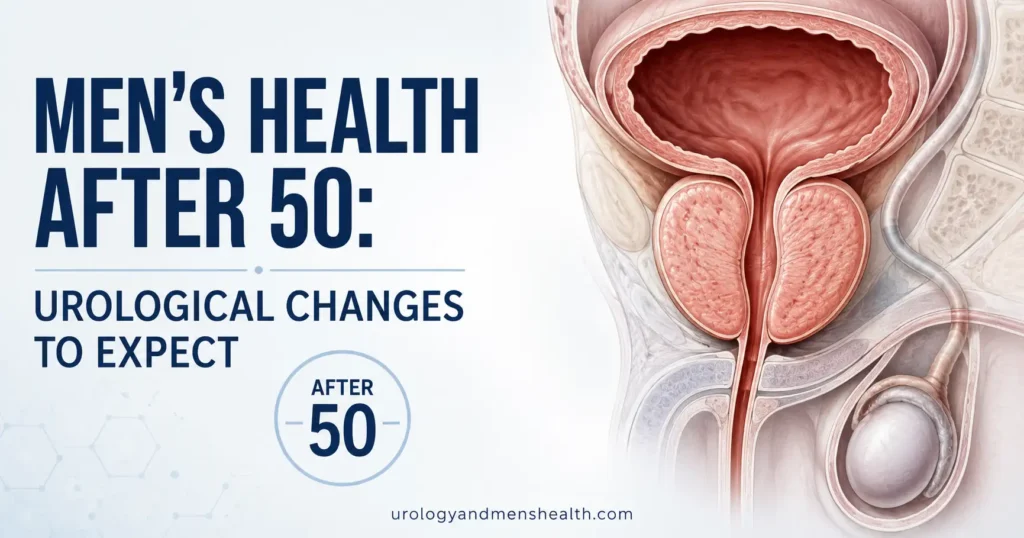
Men’s health after 50 changes in ways most men notice quietly and almost none are warned about in advance. The urinary stream weakens. Sleep gets interrupted by trips to the bathroom. Erections that used to be automatic now need more coaxing, and daytime energy dips. Most of this is ordinary aging — the prostate enlarges, the bladder muscle stiffens, and testosterone drifts down a little each year. But a handful of these same symptoms are early signals of something that needs treatment, and the difficulty is telling them apart. As a urologist, I see men in their 50s and 60s every week who either ignored a warning sign for too long or panicked over a change that was completely normal. This article walks through what actually shifts in the male urinary and reproductive system after 50, which changes are expected, which ones warrant a visit, and the screening tests worth asking for. For a wider overview of staying well in this decade, see our Men’s Wellness Hub.
Key Takeaways
- An enlarged prostate (BPH) affects roughly half of men by their 60s — a slower stream and night-time urination are usually BPH, not cancer.
- Testosterone falls by about 1% per year after 40; treatment only helps when a morning blood test confirms a low level and you have matching symptoms.
- Some degree of erectile difficulty affects 52% of men aged 40 to 70 — and new ED is often the first warning of heart or blood vessel disease.
- Visible blood in the urine, a stream that suddenly stops completely, or a rapidly rising PSA are never normal aging and need urgent assessment.
What Changes in Your Urinary Tract After 50
The single biggest driver of urological changes after 50 is the prostate. This walnut-sized gland sits directly beneath the bladder and wraps around the urethra, the tube urine flows through. From around age 40 it slowly grows, a process called benign prostatic hyperplasia (BPH) — “benign” meaning not cancer. As it enlarges, it squeezes the urethra like a hand tightening around a garden hose. BPH affects roughly half of men in their 50s and 60s and the great majority of men by their 80s.[1]
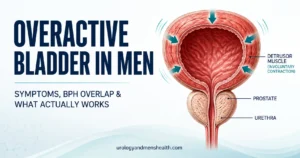
That narrowing produces the classic cluster of symptoms: a weaker stream, a delay before flow starts (hesitancy), dribbling at the end, and a sense that the bladder hasn’t fully emptied. Over time the bladder muscle has to push harder against the resistance, becomes thicker and more irritable, and starts signaling urgency even when it isn’t full. That bladder irritability is why many men over 50 also develop frequency and sudden urges — a pattern that overlaps with overactive bladder in men.
Night-time urination, or nocturia, deserves a special mention because men assume it is just aging. One trip a night is common and usually harmless. Waking two or more times is worth investigating — it can come from the prostate, an irritable bladder, blood pressure, or sleep apnea. If your stream has changed, the practical first step is to put a number on it: score your symptoms with our IPSS prostate symptom calculator and bring that score to your doctor rather than guessing how bad things are.
In My Practice
A man in his late 50s once came to me convinced his weakening stream meant cancer, because his father had died of prostate cancer. His PSA was normal, his exam showed a smoothly enlarged gland, and his IPSS put him squarely in the moderate-symptom range — textbook BPH. The relief on his face when I explained the difference was greater than any treatment I gave him that day.
Most urinary symptoms after 50 are caused by benign enlargement, not cancer — but the only way to know is to be assessed rather than assume.
Testosterone and Sexual Function After 50
Testosterone declines slowly and steadily with age. The Baltimore Longitudinal Study of Aging, which followed hundreds of healthy men over years, found total testosterone drops by roughly 1% per year after age 40.[2] By 50 or 60, many men have levels meaningfully below where they were at 30. The mistake men make is assuming this gradual drift automatically means they need testosterone replacement. It usually doesn’t.
The distinction that matters is between age-related decline and true hypogonadism — a clinically low level that is causing real symptoms. Treatment is only worthwhile when two things line up: a genuinely low reading on a morning blood test (testosterone peaks early in the day), repeated to confirm it, plus symptoms such as low libido, persistent fatigue, or loss of morning erections. A single borderline result on an afternoon sample is not a reason to start lifelong therapy. If you suspect this pattern, our guide to low testosterone symptoms in men over 40 explains what to ask for.
Erections also change. Some degree of erectile difficulty affects 52% of men aged 40 to 70, and the likelihood climbs steadily with each decade.[3] Here is the point I make sure every patient hears: new erectile dysfunction is often the first sign of cardiovascular disease, not a testosterone problem. The arteries that supply the penis are narrower than the coronary arteries, so they show furring and stiffening earlier. A man developing ED in his 50s should have his blood pressure, cholesterol, and blood sugar checked — the erection is sometimes the canary in the coal mine.
The Screening Schedule Every Man Needs After 50
After 50, a few checks do most of the heavy lifting. Blood pressure at every visit, because hypertension is common, silent, and damages the kidneys and heart for years before symptoms appear. A fasting lipid and glucose panel, because the same vascular disease that causes ED also drives heart attacks and strokes. And a shared-decision conversation about PSA testing for prostate cancer.
PSA is not a simple yes-or-no test. Major guidelines recommend that men and their doctors weigh the benefits and harms together rather than testing automatically, with the conversation typically beginning around age 50 for average-risk men and earlier for those with a family history or of Black ethnicity.[4] The right answer is individual — what matters is having the discussion on purpose rather than defaulting into or out of it. To build an age-appropriate list to take to your appointment, use our men’s health screening generator, and for the full picture see our men’s health checklist for the over-40s.
Over 40 and overdue a proper check? Download Dr. Khalid’s Men’s Health Screening Checklist.
Enter your email below to receive Dr. Khalid’s complete Men’s Health Screening Checklist as a free, printable PDF.
Red Flags: Changes That Are Not Normal Aging
Most of what changes after 50 is benign. A small number of symptoms are not, and they are the ones men most often talk themselves out of acting on. The rule of thumb: gradual changes that creep in over months are usually aging; sudden, dramatic, or bloody changes are not.
The most important is visible blood in the urine. Even a single episode that clears on its own needs investigation, because it can be the only early sign of bladder or kidney cancer. Do not wait for it to happen again. A complete inability to pass urine with a painful, swollen lower belly is a different emergency — acute urinary retention — and needs same-day care.
Red Flags That Are Not Normal Aging
See a doctor promptly — or go to the emergency room the same day for the items marked urgent — if you notice any of these after 50:
- Visible blood in the urine, even once and even if it clears — needs assessment, not watchful waiting.
- Inability to pass urine at all with a painful, full bladder — urological emergency, go to the ER the same day.
- A rapidly rising PSA or a hard, irregular area felt on prostate exam.
- A new lump in a testicle, or unexplained weight loss and bone pain alongside urinary symptoms.
- Fever with burning urination and back pain — possible kidney infection.
Frequently Asked Questions
Is a slower urine stream after 50 a sign of prostate cancer?
Almost always, no. A weaker stream after 50 is usually caused by benign prostatic hyperplasia, where the prostate enlarges and squeezes the urethra. Prostate cancer rarely causes urinary symptoms until it is advanced. If your stream has weakened, score your symptoms with our IPSS prostate symptom calculator and raise it with your doctor rather than assuming the worst.
Does testosterone always drop after 50, and should I treat it?
Testosterone falls gradually with age, about 1% per year after 40, so a modestly low level on its own is often just aging. Treatment is only worthwhile when a morning blood test confirms a genuinely low level and you have matching low testosterone symptoms such as low energy, reduced libido, or loss of morning erections. A single borderline result is not a reason to start testosterone.
Which screening tests matter most for men’s health after 50?
The core checks are a blood pressure reading, a fasting lipid and glucose panel, and a shared-decision conversation about PSA testing for prostate cancer. Depending on your history, your doctor may add kidney function and testosterone. Our men’s health screening generator builds an age-appropriate list you can take to your appointment.
Is waking up at night to urinate just part of aging after 50?
Partly. One trip a night is common after 50 and usually harmless. But waking two or more times, called nocturia, can signal an enlarged prostate, an overactive bladder, poorly controlled blood pressure, or sleep apnea. If it is disrupting your sleep it is worth investigating. Cutting evening fluids and reviewing your medications with your doctor is a sensible first step.
When should urological changes after 50 send me to a doctor urgently?
Go promptly if you see visible blood in your urine, cannot pass urine at all, or develop fever with urinary pain. A complete inability to urinate with a painful, full bladder is a urological emergency, so go to the emergency room the same day. A new lump in a testicle or unexplained weight loss alongside urinary symptoms also needs prompt assessment, not watchful waiting.
References
- National Institute of Diabetes and Digestive and Kidney Diseases. Prostate Enlargement (Benign Prostatic Hyperplasia). NIDDK
- Harman SM, Metter EJ, Tobin JD, et al. Longitudinal effects of aging on serum total and free testosterone levels in healthy men. Baltimore Longitudinal Study of Aging. J Clin Endocrinol Metab. 2001;86(2):724-731. PubMed
- Feldman HA, Goldstein I, Hatzichristou DG, et al. Impotence and its medical and psychosocial correlates: results of the Massachusetts Male Aging Study. J Urol. 1994;151(1):54-61. PubMed
- American Urological Association. Early Detection of Prostate Cancer: AUA/SUO Guideline. AUA
Dr. Muhammad Khalid
MBBS · FCPS (Urology) · MCPS (General Surgery) · CHPE · CRSM · IMC #539472
Specialist urologist with 11+ years of clinical experience across tertiary teaching hospitals. Trained at Lady Reading Hospital and Khyber Teaching Hospital, Peshawar. Author or co-author of five peer-reviewed international publications, including in Cureus and the World Journal of Surgery. Procedural expertise: URS, PCNL, RIRS, TURP, TURBT, and major open urological surgery. Full profile →
This article is for educational purposes only and does not constitute medical advice. Always consult your physician or urologist for diagnosis and treatment decisions specific to your condition.