
Blood Pressure & Kidney Damage Risk Calculator
This blood pressure kidney damage risk calculator maps your reading onto the two tests that actually detect kidney injury: your eGFR and your urine albumin-to-creatinine ratio. Enter your blood pressure alone, or add your lab results for a full KDIGO risk zone. It takes under a minute, and it tells you which test to ask for next. Part of our blood pressure hub.

The Tool
Related Blood Pressure Tools
Full Clinical Guide
In This Guide:
- Blood pressure damages kidneys along two separate axes — albumin leaking out (uACR) and filtering capacity falling (eGFR). You need both numbers, not one.
- A normal eGFR does not rule out damage. Albumin usually leaks years before the filtering rate moves at all.
- The uACR is the test that gets skipped. A urine dipstick at a routine check-up misses low-level albumin entirely. Ask for the uACR by name.
- Once albumin is leaking, which drug you take matters more than how many — an ACE inhibitor or ARB protects the kidney beyond its effect on the reading.
What This Tool Measures
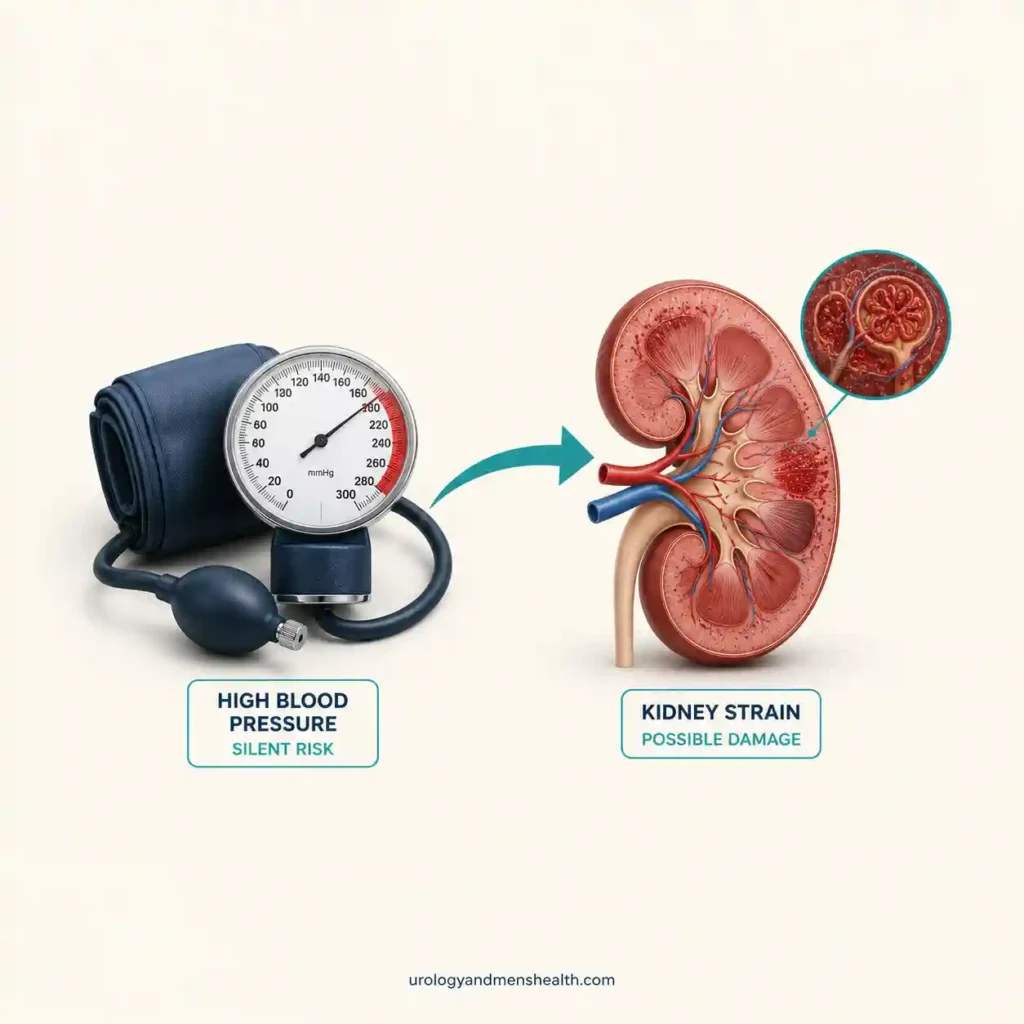
This blood pressure kidney damage risk calculator does not use a homemade score. It runs your numbers through two frameworks that kidney specialists use every day. The first is the blood pressure staging in the 2025 AHA/ACC High Blood Pressure Guideline: normal below 120/80 mmHg, elevated at 120–129 systolic, stage 1 hypertension at 130–139 or 80–89, and stage 2 at 140/90 mmHg or above [2]. The second is the KDIGO 2024 CGA risk grid, which cross-tabulates your filtering rate against the albumin leaking into your urine and returns a green, yellow, orange, or red risk zone [1]. High blood pressure is the second leading cause of kidney failure in the United States after diabetes, and roughly one in five American adults with high blood pressure has chronic kidney disease [5] — which is why I built this as a kidney tool rather than another blood pressure and kidney damage explainer.
The Physiology Behind the Score
Each kidney holds around a million glomeruli — tiny filter units, each a knot of capillaries wrapped in a membrane fine enough to hold protein back while letting water and waste through. Think of that membrane as a fine mesh sieve. Push water through it gently for decades and it holds. Push it under pressure and the mesh stretches, and the first thing through is albumin, the smallest of the blood proteins. That is why damage shows up as albumin in the urine before the filtering rate falls: the sieve leaks long before it clogs. KDIGO grades the leak in three bands — A1 below 30 mg/g, A2 from 30 to 300, and A3 above 300 — and grades filtering capacity from G1 at 90 mL/min/1.73 m² or above, down through G3a at 45–59 and G4 at 15–29 [1]. Two axes, measured by two different tests.
How to Interpret Your Result
Two men can walk into my clinic with the same 138/86 mmHg and receive completely different advice. The first has a uACR of 12 mg/g and an eGFR of 95 — green zone, low risk. He needs a home BP average, a repeat urine test in a year, and no medication yet. The second has a uACR of 420 mg/g and the same eGFR of 95 — orange zone, high risk, despite a filtering rate a nephrologist would call perfect. He needs an ACE inhibitor or ARB now, a repeat in three months, and a serious conversation about referral. Identical readings, opposite pathways, and the only thing separating them is a urine test that costs almost nothing and is ordered far too rarely. If your result flagged albumin, this is the piece to read next.
What to Do With Your Result
If you landed in the low band, the single most useful action is asking for a uACR you have probably never had. If you landed in the increased or high band, the action is a conversation about drug class, not drug count: KDIGO recommends an ACE inhibitor or an ARB for anyone with severely increased albuminuria regardless of diabetes status, and for those with diabetes at moderate levels too, and it recommends an SGLT2 inhibitor for adults with an eGFR of 20 or above and a uACR at or above 200 mg/g [1]. On targets: KDIGO suggests a systolic below 120 mmHg in CKD when tolerated, using standardized office measurement, largely on the strength of SPRINT — a trial of 9,361 adults, 28% of whom had CKD at entry, where intensive control cut cardiovascular events and deaths [3][4]. Be honest with yourself about how that reading was taken; a rushed cuff in a busy corridor is not the same measurement. On diet, aim below 2,300 mg of sodium per day and toward 1,500 mg [2] — but do not reach for a potassium-based salt substitute if your kidney function is reduced, because that is one of the few pieces of standard BP advice that becomes dangerous in CKD. If your eGFR is the number worrying you, our blood pressure log and trend tracker will give you the averaged reading your doctor actually needs. If you are unsure about your result, the PDF report this tool generates gives you a ready-made framework to bring to your next appointment.
In My Practice
The conversation I have most often in this area is not about blood pressure at all. It is with a man in his sixties, sent to me for an enlarged prostate, whose routine pre-operative bloods come back with an eGFR of 44. He is astonished. He has no symptoms, he has never had a uACR, and his blood pressure has been “a bit high, but they said not to worry” for fifteen years. I am the first person to tell him he has chronic kidney disease, and I am a urologist who was supposed to be looking at his prostate.
Kidney damage from blood pressure is silent by design, so it will not interrupt you. You have to go looking for it, and looking costs one blood test and one urine test.
References
- Kidney Disease: Improving Global Outcomes (KDIGO) CKD Work Group. KDIGO 2024 Clinical Practice Guideline for the Evaluation and Management of Chronic Kidney Disease. KDIGO. Source of the CGA risk grid, the A1–A3 and G1–G5 categories, and the RASi/SGLT2i recommendations.
- Jones DW, Ferdinand KC, Taler SJ, et al. 2025 AHA/ACC/Multisociety Guideline for the Prevention, Detection, Evaluation and Management of High Blood Pressure in Adults. JACC. Source of the BP categories, the sodium targets, and the PREVENT-based treatment thresholds.
- KDIGO Blood Pressure Work Group. KDIGO 2021 Clinical Practice Guideline for the Management of Blood Pressure in Chronic Kidney Disease. Kidney International. Recommendation 3.1.1: target systolic below 120 mmHg when tolerated, using standardized office measurement.
- SPRINT Research Group. A Randomized Trial of Intensive versus Standard Blood-Pressure Control. N Engl J Med. 2015;373:2103–2116. PubMed. 9,361 participants; 28% had CKD at baseline.
- National Institute of Diabetes and Digestive and Kidney Diseases. High Blood Pressure & Kidney Disease. NIDDK. Hypertension as the second leading cause of kidney failure in the United States.
Frequently Asked Questions
Can high blood pressure damage my kidneys without any symptoms?
Yes, and that is the usual pattern. Kidney damage from blood pressure is silent until it is advanced. There is no pain, no change in how you pass urine, and often no swelling. The first detectable sign is albumin leaking into your urine, which you cannot see or feel. Only a blood test and a urine test find it, which is why the stages of chronic kidney disease are defined by test results rather than by symptoms.
What is a uACR test, and why has no one ordered mine?
The urine albumin-to-creatinine ratio is a single urine sample that measures albumin leaking through your kidney filter. It costs very little and catches damage years before your eGFR moves. It gets skipped because a standard check-up orders a blood panel and a urine dipstick, and a dipstick misses low-level albumin entirely. Ask for it by name. If it comes back above 30 mg/g, that changes which blood pressure drug you should be taking.
Will lowering my blood pressure reverse kidney damage that has already happened?
Established scarring does not reverse. What lowering your pressure does is slow or stop further loss, and it can reduce albuminuria substantially, which is itself a sign the filter is under less strain. The two levers with the fastest effect are the drug class you are on and your sodium intake, which the 2025 AHA/ACC guideline puts below 2,300 mg per day and ideally under 1,500 mg. Our sodium intake tracker shows where yours actually sits.
How accurate is this tool, and can I rely on it?
This tool applies the KDIGO 2024 risk grid and the 2025 AHA/ACC blood pressure categories, which are the same frameworks used in clinic. It is a screening aid, not a diagnosis. Its accuracy depends entirely on your inputs: a single office reading overestimates many men, and without an eGFR and a uACR the tool can only tell you what your pressure alone implies. It does not replace assessment by your own doctor.
How do I use this result at my doctor’s appointment?
Press Download My Report. You get a two-page PDF with your entries, your blood pressure category, your KDIGO risk zone if you had the numbers, and a set of questions written for this specific result. Hand it over at the start of the appointment rather than describing it from memory. It gives your doctor the whole picture in about thirty seconds and keeps the conversation on the decision that matters.
Dr. Muhammad Khalid
MBBS · FCPS (Urology) · MCPS (General Surgery) · CHPE · CRSM · IMC #539472
Specialist urologist with 11+ years of clinical experience across tertiary teaching hospitals. Trained at Lady Reading Hospital and Khyber Teaching Hospital, Peshawar. Author or co-author of five peer-reviewed international publications, including in Cureus and the World Journal of Surgery. Procedural expertise: URS, PCNL, RIRS, TURP, TURBT, and major open urological surgery. Full profile →
This article is for educational purposes only and does not constitute medical advice. Always consult your physician or urologist for diagnosis and treatment decisions specific to your condition.