
Vasectomy Reversal Success Calculator
This vasectomy reversal success calculator estimates your likely patency and pregnancy odds from the three factors that matter most: how long ago you had the vasectomy, your age, and your partner's age. It uses the landmark Vasovasostomy Study Group data to give you a realistic starting point before you see a microsurgeon. For the full picture of restoring fertility, visit the sexual health hub.

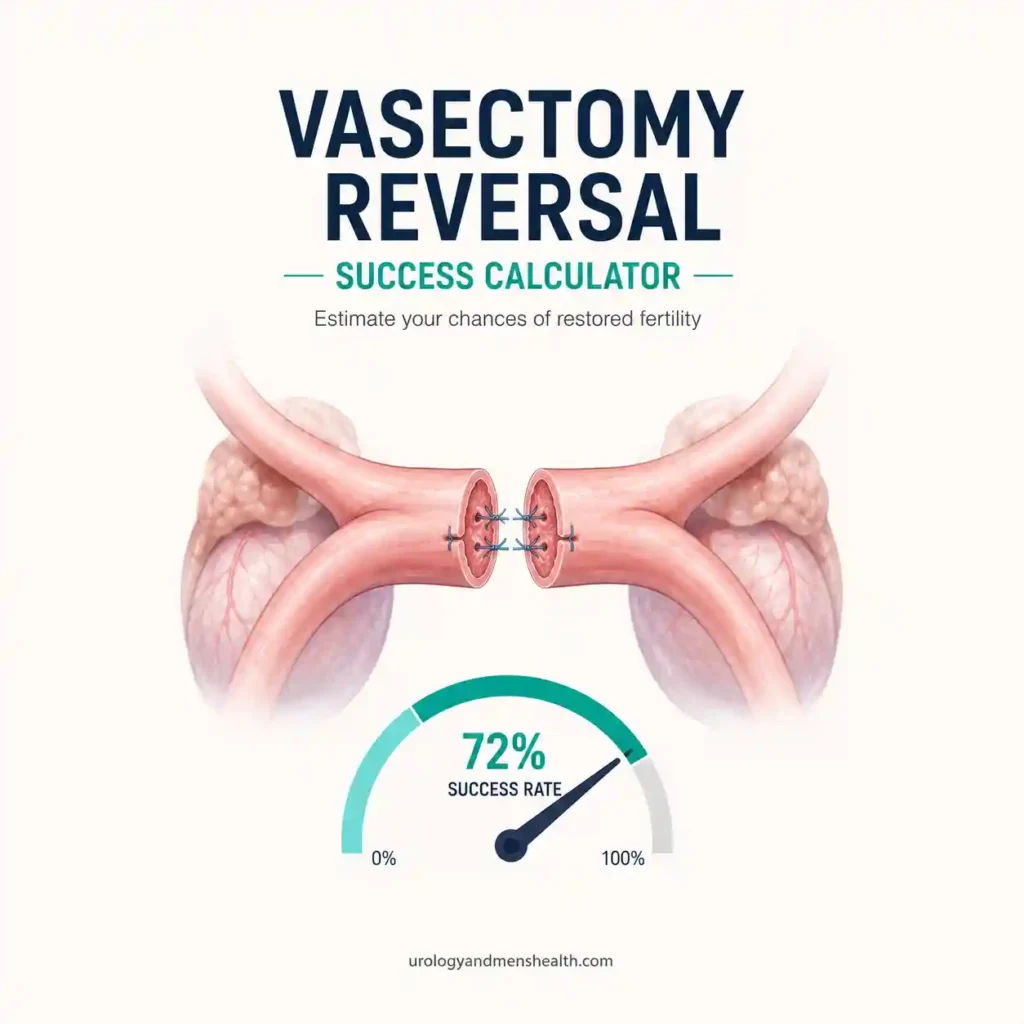
The Tool
Related Sexual Health Tools
Full Clinical Guide
In This Guide:
- The time since your vasectomy is the single strongest predictor: reversed under 3 years, sperm return to the semen in about 97% of men; at 15 years or more, about 71%.
- Your partner’s age can matter more than the surgery. Over 40, the natural-conception window shifts the balance toward IVF, even when sperm return is likely.
- Whether the surgeon finds sperm in the vasal fluid on the day decides the simpler vasovasostomy versus the harder vasoepididymostomy.
- This is a starting estimate, not a promise – a specific microsurgeon’s own success rate is the number that applies to you.
What This Calculator Measures
This vasectomy reversal success calculator turns three simple numbers into a realistic estimate of two very different things: patency (whether sperm return to your semen) and natural pregnancy (whether that leads to a baby). The estimate is anchored to the landmark Vasovasostomy Study Group study, which followed 1,469 microsurgical reversals and remains the reference dataset urologists cite today [1]. It builds on the three factors the American Urological Association names as the best preoperative predictors of reversal success: the length of the obstructive interval, your age, and your female partner’s age [2]. The tool does not replace a surgical consultation – it gives you a grounded expectation to walk in with, so the conversation starts from real numbers rather than best-case marketing figures.
The Two Operations Behind the Number
A vasectomy blocks the vas deferens, the tube that carries sperm. Reversing it means rejoining that plumbing, and there are two ways to do it. A vasovasostomy reconnects the cut ends of the vas directly – the simpler repair, with the higher success. A vasoepididymostomy is needed when years of back-pressure have caused a “blowout” in the epididymis (the coiled tube where sperm mature), forcing the surgeon to bypass the blockage by joining the vas straight onto the epididymis. It is far more delicate and has lower patency. Crucially, the surgeon often cannot know which operation you need until they open up and inspect the fluid: finding sperm in the vasal fluid is the strongest on-the-day predictor of success, which is why the AUA rates it a Grade B recommendation and insists reversal surgeons be able to perform both operations [2]. With modern microsurgery, European guidelines put patency for a straightforward reversal in the 90-97% range [3].
How to Interpret Your Result
Read your two numbers separately. The headline figure is estimated patency – the chance sperm come back. In the Vasovasostomy Study Group data this tracks the interval closely: about 97% under 3 years, 88% at 3 to 8 years, 79% at 9 to 14 years, and 71% at 15 years or more [1]. The pregnancy figure in your subscores is lower and falls faster (76%, 53%, 44%, then 30% across the same bands), because a pregnancy needs a fertile partner as well as returned sperm. This is why a man can see a high patency number and still land in the “weigh all options” band: female partner age is an independent predictor, and over 40 it becomes the rate-limiting step regardless of your sperm [4]. The tool colours your result by the less favorable of your interval and your partner’s age – the honest bottleneck, not the flattering one.
What to Do With Your Result
If your estimate is favorable, the job is execution: get to a urologist who does microsurgical reversal regularly, confirm they can switch to a vasoepididymostomy if needed, and plan a follow-up semen analysis to prove sperm have returned. If it is individualized or lower, put two paths side by side: microsurgical reversal, versus surgical sperm retrieval (MESA, PESA or TESE) combined with IVF using ICSI, where a single sperm is injected into an egg [2]. For couples with an older partner or a very long interval, the retrieval-plus-IVF route can reach a live birth sooner, and freezing sperm during the reversal keeps that option open [3]. Whatever the number, decide quickly rather than letting months drift. If you are unsure about your result, the PDF report this tool generates gives you a ready-made framework to bring to your next appointment.
In My Practice
The figure a man quotes me from the internet is almost always the best-case vasovasostomy number – the 97 percent that belongs to someone reversed within a couple of years. His own number depends on his interval, on what the surgeon finds in the vas on the day, and on that particular microsurgeon’s personal results, which vary widely. I would rather a man walk in knowing that range than anchored to a single hopeful headline.
The most useful question is not “what is the success rate” but “what is your success rate, and what will you do if the fluid shows no sperm?” The honest estimate is a band, not a single number – and the surgeon in front of you owns the figure that actually applies to you.
References
- Belker AM, Thomas AJ Jr, Fuchs EF, et al. Results of 1,469 microsurgical vasectomy reversals by the Vasovasostomy Study Group. J Urol. 1991;145(3):505-511. PubMed. The reference dataset for interval-specific patency and pregnancy rates.
- American Urological Association. Vasectomy: AUA Guideline (2026). AUA. Names obstructive interval, patient age and partner age as the best preoperative predictors; vasal-fluid microscopy as the best intraoperative predictor.
- European Association of Urology. Guidelines on Male Sexual and Reproductive Health: 2025 Update on Male Infertility. Eur Urol. 2025. European Urology. Microsurgical reversal patency 90-97%; sperm retrieval plus ICSI as the alternative.
- Magheli A, Rais-Bahrami S, Kempkensteffen C, et al. Impact of obstructive interval and sperm granuloma on patency and pregnancy after vasectomy reversal. Int J Androl. 2010;33(5):730-735. Int J Androl. Female partner age as an independent predictor of pregnancy.
Frequently Asked Questions
What is the single biggest factor in vasectomy reversal success?
Will a vasectomy reversal change my testosterone or sex drive?
Will my erections be affected after a reversal?
How accurate is this tool, and can I rely on it?
How do I use this result at my doctor’s appointment?
Dr. Muhammad Khalid
MBBS · FCPS (Urology) · MCPS (General Surgery) · CHPE · CRSM · IMC #539472
Specialist urologist with 11+ years of clinical experience across tertiary teaching hospitals. Trained at Lady Reading Hospital and Khyber Teaching Hospital, Peshawar. Author or co-author of five peer-reviewed international publications, including in Cureus and the World Journal of Surgery. Procedural expertise: URS, PCNL, RIRS, TURP, TURBT, and major open urological surgery. Full profile →
This article is for educational purposes only and does not constitute medical advice. Always consult your physician or urologist for diagnosis and treatment decisions specific to your condition.