
Urinary Incontinence Score: ICIQ-SF Severity Calculator
This urinary incontinence score turns three quick questions about leakage into your ICIQ-UI SF total, from 0 to 21 - the same validated measure urologists use to gauge how much bladder leakage is affecting you. It works for men and women, gives you a severity band in under two minutes, and builds a report you can take to your appointment. For the wider picture, start with the men's wellness hub.

The Tool
Related Wellness Tools
Full Clinical Guide
In This Guide:
- The ICIQ-UI SF turns your leakage into one score from 0 to 21, from three items: how often, how much, and how much it interferes.
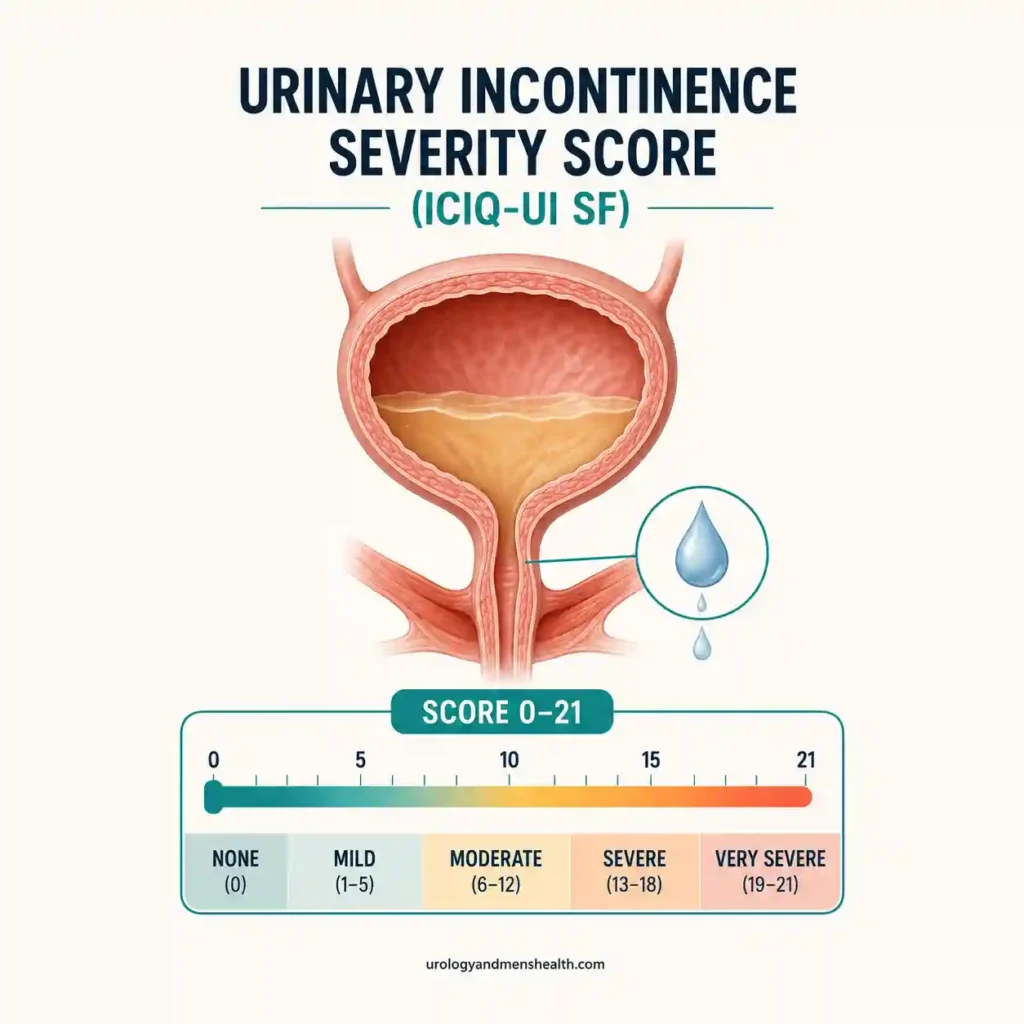
- Bands: 1-5 slight, 6-12 moderate, 13-18 severe, 19-21 very severe; a flat 0 means no leakage.
- The score tells you how bad the leaking is; when it happens tells you which type – stress, urgency, or overflow – and that decides treatment.
- Retaking after a training block shows whether an improvement is real rather than a good day.
What This Tool Measures
This urinary incontinence score is built on the International Consultation on Incontinence Questionnaire, Urinary Incontinence Short Form (ICIQ-UI SF), a patient-reported measure developed by Avery and colleagues through the Bristol Urological Institute and endorsed by the International Consultation on Incontinence [1]. It condenses your leakage into a single number from 0 to 21, drawn from three scored items: how often you leak, how much comes out, and how much it interferes with everyday life. Two further items on the full form – your details and the situations that trigger leaks – are recorded but not scored, because they describe rather than measure. The result is one of the most widely used incontinence measures in the world, translated and validated across dozens of languages, so a score from this tool means the same thing to a urologist in Dublin as in Karachi.
The Physiology Behind the Score
The three items are not weighted equally, and that is deliberate. Frequency runs 0 to 5, the amount you leak jumps 0, 2, 4, 6, and daily interference stretches 0 to 10 – so how much a leak disrupts your life carries the most weight, which matches how bothered patients actually feel. Leakage itself has a few different engines. Stress leakage escapes when pressure rises – a cough, a lift, a sneeze – and points to a weak sphincter, common after prostate surgery. Urgency leakage arrives with a sudden, hard-to-defer need and points to an overactive bladder muscle. Overflow leakage dribbles from a bladder that never fully empties, often behind an enlarged prostate. The score measures how bad the leaking is; the pattern of when it happens tells you which engine is driving it.
How to Interpret Your Result
Klovning and colleagues split the 0 to 21 range into four bands: slight (1 to 5), moderate (6 to 12), severe (13 to 18), and very severe (19 to 21); a flat 0 means no leakage at all [2]. The gap between bands is not academic. A man who scores 3 – the odd drop after a sneeze, no real impact – and a man who scores 18 – leaking most days, changing pads, avoiding the gym – sit at opposite ends of the same scale, and their next steps look nothing alike. The first needs reassurance and a few pelvic floor exercises; the second needs a proper assessment and likely active treatment. Your band is the fastest way to place yourself on that spectrum and to see whether a change over time is real or just noise.
What to Do With Your Result
A slight score is usually a signal to start pelvic floor muscle training and recheck in a few weeks – most men need nothing more. From the moderate band up, the priority shifts to naming the type of leak, because that decides the treatment: stress leakage responds to pelvic floor work and, in some men, a sling; urgency leakage to bladder retraining and drugs such as an antimuscarinic or the beta-3 agonist mirabegron; overflow to relieving the obstruction behind it. Your doctor will usually confirm the picture with a bladder diary, a urinalysis, and a post-void residual scan, adding uroflowmetry or a pad-weight test when the story is unclear. If the leak followed prostate surgery and is severe, an artificial urinary sphincter becomes a realistic option. A structured pelvic floor programme is the common thread across almost every path – our guide to Kegel exercises for men covers the technique – and if voiding symptoms sit alongside the leakage, the IPSS prostate symptom score adds a second angle worth bringing to the same appointment. If you are unsure about your result, the PDF report this tool generates gives you a ready-made framework to bring to your next appointment.
In My Practice
The figure most men read first is the last one – the interference score – and it is usually the honest one. I have had men downplay how often they leak, then rate the impact an 8, and that mismatch tells me more than either number alone: the leaking has quietly reshaped what they will and will not do. Once we name whether it is stress, urgency, or overflow, the score stops being a verdict and becomes a plan.
A high impact score with a modest frequency is not a contradiction – it is a signal that leakage is costing you more than the raw count suggests, and it deserves a proper look.
References
- Avery K, Donovan J, Peters TJ, Shaw C, Gotoh M, Abrams P. ICIQ: a brief and robust measure for evaluating the symptoms and impact of urinary incontinence. Neurourol Urodyn. 2004;23(4):322-330.
- Klovning A, Avery K, Sandvik H, Hunskaar S. Comparison of two questionnaires for assessing the severity of urinary incontinence: the ICIQ-UI SF versus the incontinence severity index. Neurourol Urodyn. 2009;28(5):411-415.
- American Urological Association / GURS / SUFU. Incontinence after Prostate Treatment: AUA/GURS/SUFU Guideline.
- European Association of Urology. Management of Non-neurogenic Male LUTS (incl. male urinary incontinence).
- International Consultation on Incontinence Questionnaire. ICIQ-UI SF – official questionnaire and scoring.
Frequently Asked Questions
What counts as a normal or concerning ICIQ score?
A total of 0 means no leakage. Above that, 1 to 5 is slight, 6 to 12 moderate, 13 to 18 severe, and 19 to 21 very severe, using the bands proposed by Klovning and colleagues. No single number means “see a doctor” – any score above 0 that bothers you is worth raising. If urgency drives your leaks, the overactive bladder symptom score pairs well with this result.
Does this score work for men, or mainly women?
The ICIQ-UI SF is validated in both men and women, so the total score and its meaning apply to you either way. One caveat worth knowing: the four severity bands were first defined in a large study of women, then adopted broadly, so treat a man’s band as a strong guide rather than a precise male-specific threshold. Everything else – the items and the total – applies equally to men.
Can I lower my score without surgery?
Often, yes. Many men reduce leakage with pelvic floor muscle training, bladder retraining, timed voiding, and cutting evening fluids and caffeine, sometimes with an antimuscarinic or a beta-3 agonist such as mirabegron for urgency. Improvement usually takes 6 to 12 weeks of consistent effort. Retaking this score after a training block shows whether it is working. Our guide to Kegel exercises for men walks through the technique.
How accurate is this tool, and can I rely on it?
This tool uses the International Consultation on Incontinence Questionnaire (ICIQ-UI SF), a validated, widely used measure of incontinence severity, and applies the published severity bands. It is a screening and tracking aid, not a diagnosis: it cannot tell you why you leak or rule out a bladder or prostate problem. Use it to describe your symptoms clearly and to monitor change over time, and take anything persistent to a clinician.
How do I use this result at my doctor’s appointment?
Bring the result with you. Tap Download My Report to save a two-page PDF with your ICIQ score, severity band, and a short list of questions to ask. It gives your doctor a clear symptom baseline in seconds and saves you describing everything from memory. If you have started pelvic floor work, note when – it helps your doctor judge whether to wait or act.
Dr. Muhammad Khalid
MBBS · FCPS (Urology) · MCPS (General Surgery) · CHPE · CRSM · IMC #539472
Specialist urologist with 11+ years of clinical experience across tertiary teaching hospitals. Trained at Lady Reading Hospital and Khyber Teaching Hospital, Peshawar. Author or co-author of five peer-reviewed international publications, including in Cureus and the World Journal of Surgery. Procedural expertise: URS, PCNL, RIRS, TURP, TURBT, and major open urological surgery. Full profile →
This article is for educational purposes only and does not constitute medical advice. Always consult your physician or urologist for diagnosis and treatment decisions specific to your condition.