Post-Micturition Dribble in Men: Causes & Treatment
Most men who get post-micturition dribble assume their prostate is failing. In clinic it is almost always a few drops of urine stranded in the urethra after voiding — and that is fixable in weeks, not years.

Post-micturition dribble is the leak that arrives after you thought you were finished. You shake, zip up, walk three steps, and feel warmth spreading into your underwear. Men bring this to me constantly, usually after two or three years of quietly folding a piece of tissue into their shorts every morning and assuming their prostate is failing. It almost never is. In most men the bladder emptied perfectly well — a small volume of urine simply got stranded in a bend of the urethra and gravity released it once you started moving. That distinction matters, because a bladder problem and a urethral emptying problem have completely different treatments, and the treatment for this one is free, takes about ninety seconds a day, and works within weeks in most men. For the wider picture on male urinary changes, see our Men’s Wellness Hub.
Key Takeaways
- Post-micturition dribble is urine stranded in the bulbar urethra after voiding, not urine leaking out of the bladder.
- Prostate size does not predict it. A community study of men in their 40s to 70s found no relationship between this symptom and prostate volume or peak urine flow rate.
- The IPSS questionnaire used in most prostate clinics contains no question about post-micturition symptoms, which is why the complaint is routinely missed.
- In a randomized trial, pelvic floor exercises reduced post-void urine loss by an adjusted mean of 4.7 g at 13 weeks and urethral milking by 2.9 g, while counseling alone produced no measurable improvement.
What Post-Micturition Dribble Actually Is
Urinary symptoms in men fall into three groups, and the group a symptom belongs to tells you where the fault sits. Storage symptoms happen while the bladder is filling: frequency, urgency, waking at night. Voiding symptoms happen during the stream: hesitancy, weak flow, straining, a slow trailing end. Post-micturition symptoms happen after the stream has stopped, and there are only two of them — the feeling that the bladder did not fully empty, and post-micturition dribble. The International Continence Society formalized this classification in 2002, and it has governed how urologists categorize the complaint ever since [1].
The definition is narrow and worth holding onto: the involuntary loss of urine immediately after urination has finished, usually as the man leaves the toilet. Not during the stream. Not an hour later. Within seconds to a minute of walking away.
How common is it? Honestly, the published numbers are all over the place, and you should know that before anyone quotes a single figure at you. The Boston Area Community Health survey, which interviewed 2,301 American men aged 30 to 79, found post-micturition symptoms in 11.8% of men, rising with age [2]. The Tampere Ageing Male Urological Study, which surveyed 4,384 Finnish men aged 30 to 80, found post-micturition dribble in 58.7% and ranked it the second most burdensome urinary symptom in the entire male population, behind only urgency [3]. A Japanese community study broke it down by decade: 13.6% of men in their 40s, 39.0% in their 50s, 44.2% in their 60s, 41.2% in their 70s [4].
That tenfold spread is not a contradiction. It reflects how the question was asked. Ask men whether they are bothered by leaking after urination and roughly one in ten says yes. Ask whether it ever happens and more than half say yes. Both are true. The practical takeaway is that this is an extremely common experience that most men never mention to a doctor, and the Finnish data showed something that surprises people: in men aged 30 and 40, post-micturition dribble was the single most burdensome urinary symptom of all. This is not an old man’s problem.
Why the Urine Is Still There: The Bulbar Urethra and the Muscle That Empties It
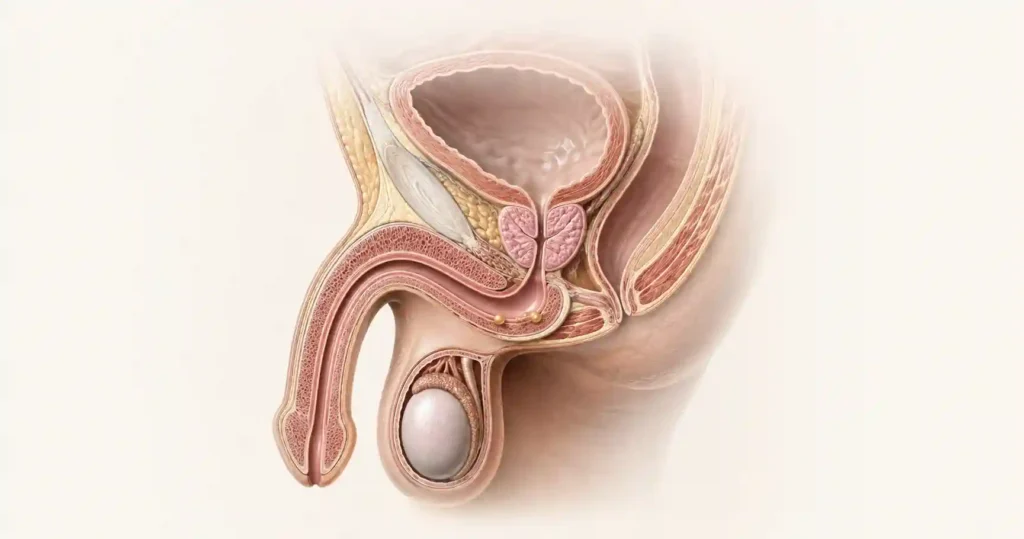
The male urethra is about 20 cm long (roughly 8 inches) and it does not run in a straight line. Just below the scrotum it curves through the perineum in a shallow U before turning forward into the penis. That segment is the bulbar urethra, and it is the low point of the whole system. Think of it as the trap under a sink: when the water stops running, a small amount stays sitting in the bend.
Nature accounted for this. A muscle called the bulbospongiosus wraps around that segment, and at the end of a normal void it gives several strong reflex contractions that strip the bulbar urethra clean — the same muscle, incidentally, that produces the pumping contractions of ejaculation. When those contractions are strong and well timed, nothing is left behind. When they are weak, poorly coordinated, or fire before the urethra has finished draining, somewhere between one and five milliliters of urine stays in the dip. Then you stand up straight, start walking, and the pelvic floor relaxes. Gravity does the rest.
Weakness or failure of the pelvic floor muscles is currently considered the most important cause of the symptom, and it explains why the fix is muscular rather than pharmaceutical [5]. It also explains why women rarely complain of it — a female urethra is around 4 cm long and runs almost straight down, with no bend for urine to collect in.
Here is the part that contradicts what most men assume. In that Japanese community study, researchers measured prostate volume by ultrasound and peak urine flow rate in every participant, then checked whether either predicted post-micturition dribble. Neither did. There was no significant relationship between the symptom and prostate size, and none with flow rate [4]. A man with a 30 mL prostate and a strong stream is about as likely to dribble as a man with a 70 mL prostate. If you are dribbling after urination and everything else about your stream is normal, an enlarged prostate is probably not the explanation, and treating the prostate will not fix it.
Dribbling After Urination Is Not the Same as Incontinence
Men use the word “leaking” for four completely different problems, and the one you have determines the entire workup. Timing separates them faster than any test.
- Post-micturition dribble — a few drops, within seconds to a minute of finishing, with no warning sensation and no trigger. You are dry until you walk away.
- Stress leakage — drops that escape on coughing, sneezing, lifting, or standing from a chair, at any time of day. In men this points toward sphincter weakness, most often after prostate surgery.
- Urgency leakage — a sudden desperate need to go, then loss of a larger volume before reaching the toilet. This is bladder muscle behavior, not urethral, and belongs to the overactive bladder spectrum.
- Overflow from incomplete emptying — near-continuous seepage through the day, often with a weak stream and a sense of never fully finishing. This one needs measuring, not reassurance.
There is a fifth pattern that gets confused with post-micturition dribble constantly: terminal dribbling. That is the slow trailing-off at the end of the stream itself, where the last portion comes out in drips rather than a flow. Terminal dribbling is a voiding symptom and it does correlate with obstruction. Post-micturition dribble happens after the stream has already stopped. If you are unsure which one you have, stand at the toilet an extra 20 seconds after you think you are done and see whether urine is still emerging. If it is, that is terminal dribbling and the assessment is different.
One structural reason this symptom gets missed: the International Prostate Symptom Score, the seven-question form used in nearly every prostate clinic in the world, contains no question about post-micturition symptoms at all. The European Association of Urology lists this explicitly as a limitation of the instrument [6]. You can score a 3 out of 35 — officially “mildly symptomatic” — and still be changing your underwear twice a day. If you are going to fill one in before your appointment, do it with the IPSS symptom score calculator, then write the dribbling on the form by hand, because the questionnaire will not ask you about it.
In My Practice
A 34-year-old software engineer came to me convinced he had early prostate cancer. He had seen two doctors, had a normal PSA and a normal flow study, and had spent two years folding a square of tissue into his underwear every morning without telling his partner. I asked one question: does it happen while you are standing at the toilet, or after you walk away? After, he said — about the time he reaches the sink. That answer alone made the diagnosis. I taught him urethral milking in about four minutes at the end of the consultation, and at his review six weeks later he was using nothing.
The timing of the leak relative to the end of the stream is the most useful piece of information in the entire history, and it costs nothing to ask.
Stop Post-Void Dribbling: The Pelvic Floor Retraining Guide
Enter your email below to receive Dr. Khalid’s complete OAB & Incontinence Guide as a free, printable PDF.
How to Stop Post-Micturition Dribble: Urethral Milking and Pelvic Floor Training
Two treatments have randomized evidence behind them. They work through different mechanisms and they are best used together — one empties the urethra now, the other retrains the muscle so it empties itself.
Urethral milking (bulbar urethral massage)
NICE guidance for men with lower urinary tract symptoms is direct on this point: men with post-micturition dribble should have urethral milking explained to them [7]. Most men have never heard of it because nobody demonstrated it. The technique takes one session to learn.
- Finish urinating normally. Do not shake — shaking moves the penis, not the urine sitting behind the scrotum.
- Place your fingertips on the perineum, behind the scrotum, at the base of the penis. That is directly over the bulbar urethra.
- Press firmly and sweep forward and upward along the line of the urethra, toward the tip. Firm, not painful.
- Repeat two or three times, then express the last drops at the tip as normal.
- Sitting to urinate opens the angle of the bulbar urethra and makes the sweep more effective. If your dribbling is heavy, sit for the first few weeks.
Pelvic floor training with a post-void squeeze-out
Milking manages the symptom. Pelvic floor training addresses the cause, and the trial data favor it for durability. In a three-arm randomized study of 49 men, participants were assigned to pelvic floor exercises, urethral milking, or counseling alone for 12 weeks, with urine loss measured by pad weight. At 13 weeks the exercise group had an adjusted mean improvement of 4.7 g of urine loss and the milking group 2.9 g, while the counseling group showed no improvement at all [8]. To put 4.7 g in context, that is close to a teaspoon of urine — small in volume, and the entire difference between a dry pair of underwear and a wet one.
A second randomized trial added the specific detail that matters most. Fifty-five men were taught pelvic floor exercises that included a deliberate strong post-void squeeze-out contraction — a hard pelvic floor squeeze performed immediately after finishing, timed to strip the urethra. Of the 36 men who reported dribbling at baseline, 27 (75%) were symptom-free after three months of supervised training plus three months of home exercises [9]. The generic advice to “do your pelvic floor exercises” fails here; the contraction has to be deliberately placed at the end of the void.
Ask your doctor or a pelvic health physiotherapist to confirm you are contracting the right muscle before you commit to a program — a substantial proportion of men squeeze the abdomen or buttocks instead, and months of the wrong movement changes nothing. Expect partial improvement by four to six weeks and to judge the full result at twelve.
How to find and train the right muscle: pelvic floor exercises for men, step by stepOn medication: there is no drug licensed for this symptom. Small trials of low-dose PDE5 inhibitors such as tadalafil have reported reductions in dribble scores, and the mechanism is plausible given the association between this symptom and erectile dysfunction, but the evidence base remains thin and it is not standard care [5]. Do the muscular work first. It costs nothing and outperforms everything else on offer.
When Post-Micturition Dribble Needs a Urologist
Isolated dribbling in a man with an otherwise normal stream is a benign mechanical problem and a reasonable thing to self-manage for eight to twelve weeks. What changes that calculation is the company it keeps.
Red Flags — Book an Assessment
Post-micturition dribble alone is not urgent. Post-micturition dribble alongside any of the following needs a clinician:
- Visible blood in the urine, at any point in the stream, even once
- Pain or burning on urination, or fever with urinary symptoms
- New dribbling together with a weak or splitting stream, straining, or a spraying stream — this pattern suggests a urethral stricture rather than a pelvic floor problem
- Dribbling that began after catheter insertion, urethral instrumentation, or a straddle injury to the perineum
- Wetness that continues through the day rather than resolving within a minute of finishing
- Numbness in the saddle area, new leg weakness, or bowel changes — this combination is a neurological emergency, not a urinary one
At the appointment, ask for four specific things rather than a general review: a urinalysis to exclude infection and microscopic blood; a bladder scan for post-void residual volume, which takes two minutes and settles whether your bladder is actually emptying; a uroflowmetry study to record your flow curve; and, if the stream is weak or spraying, a discussion about whether a retrograde urethrogram is appropriate to look for a stricture. Bring a written note of when the leak occurs relative to the end of the stream, because that timing is what the assessment turns on.
It also helps to arrive with a number rather than an impression. Quantify how much you are actually losing and how much it interferes using the ICIQ urinary incontinence severity score before you go, and take the result with you. “A few drops after I finish, score 6, bothering me most days” gets you a targeted assessment. “I think I might be leaking” gets you a PSA test and a follow-up in six months.
Frequently Asked Questions
Is post-micturition dribble a sign of an enlarged prostate?
Usually not. A community study that measured prostate volume by ultrasound and peak flow rate in men aged 40 to 79 found no significant relationship between either measurement and post-micturition dribble. The symptom comes from the bulbar urethra and the pelvic floor, not the prostate. If your stream is weak, hesitant, or you strain to start, that is a separate voiding pattern worth reading about in our guide to enlarged prostate treatment.
How long do pelvic floor exercises take to stop post-micturition dribble?
Expect partial improvement at four to six weeks and judge the final result at twelve. In the randomized trial with the best outcomes, men trained for three months under supervision and then continued at home for a further three months, at which point 75% of those who started with dribbling were symptom-free. The contraction must be placed deliberately at the end of the void, which is covered in our guide to pelvic floor exercises for men.
Why does urine still come out after I shake and wait at the toilet?
Because shaking moves the penis and the trapped urine is not in the penis. It sits in the bulbar urethra, in the perineum behind the scrotum, and no amount of shaking at the tip will move it forward. Urethral milking works because the pressure starts behind the scrotum, over the actual pool of urine, and sweeps forward. Sitting to urinate also opens that curve and helps it drain, as covered in the Men’s Wellness Hub.
Can post-micturition dribble happen in men in their 20s and 30s?
Yes, and it is not rare. Finnish population data found that in men aged 30 and 40, post-micturition dribble caused a greater symptom burden than any other urinary complaint, including urgency and nocturia. Young men tend to assume it signals something sinister and delay asking about it for years. If you want a broader picture of what is and is not worth acting on, our men’s health checklist covers screening in context.
Does urethral milking cause any damage if I do it after every void?
No. It is external pressure applied along the perineum and shaft with fingertips, not instrumentation, and no harm has been reported from routine use. Firm pressure is enough; it should never be painful. Many men use it indefinitely and treat it as part of normal toilet routine. If the amount you are losing is increasing rather than steady, quantify it with the ICIQ incontinence score and get assessed rather than compensating harder.
References
- Abrams P, Cardozo L, Fall M, et al. The standardisation of terminology of lower urinary tract function: report from the Standardisation Sub-committee of the International Continence Society. Neurourol Urodyn. 2002;21(2):167-178. PubMed
- Maserejian NN, Kupelian V, McVary KT, et al. Prevalence of post-micturition symptoms in association with lower urinary tract symptoms and health-related quality of life in men and women. BJU Int. 2011;108(9):1452-1458. PubMed
- Pöyhönen A, Åkerla J, Häkkinen JT, et al. Severity and bother of lower urinary tract symptoms among men aged 30-80 years: Tampere Ageing Male Urological Study. Scand J Urol. 2018;52(4):296-301. PubMed
- Kobayashi K, Fukuta F, Masumori N. Prevalence of post-micturition dribble in Japanese men and its relationship with benign prostatic hyperplasia/lower urinary tract symptoms. Low Urin Tract Symptoms. 2019;11(2):O38-O41. PubMed
- Yang DY, Lee WK. A current perspective on post-micturition dribble in males. Investig Clin Urol. 2019;60(3):142-147. PubMed
- European Association of Urology. Management of Non-neurogenic Male LUTS: Diagnostic Evaluation. EAU Guidelines, 2026. EAU
- National Institute for Health and Care Excellence. Lower urinary tract symptoms in men: management. Clinical guideline CG97. NICE
- Paterson J, Pinnock CB, Marshall VR. Pelvic floor exercises as a treatment for post-micturition dribble. Br J Urol. 1997;79(6):892-897. PubMed
- Dorey G, Speakman M, Feneley R, et al. Pelvic floor exercises for treating post-micturition dribble in men with erectile dysfunction: a randomized controlled trial. Urol Nurs. 2004;24(6):490-497. PubMed
Dr. Muhammad Khalid
MBBS · FCPS (Urology) · MCPS (General Surgery) · CHPE · CRSM · IMC #539472
Specialist urologist with 11+ years of clinical experience across tertiary teaching hospitals. Trained at Lady Reading Hospital and Khyber Teaching Hospital, Peshawar. Author or co-author of five peer-reviewed international publications, including in Cureus and the World Journal of Surgery. Procedural expertise: URS, PCNL, RIRS, TURP, TURBT, and major open urological surgery. Full profile →
This article is for educational purposes only and does not constitute medical advice. Always consult your physician or urologist for diagnosis and treatment decisions specific to your condition.