Laser Lithotripsy Recovery: URSL Week-by-Week Guide
Most men are booked for laser lithotripsy as a day case and assume they will feel normal by the evening. The surgery is the easy part — laser lithotripsy recovery is almost entirely about the stent nobody warned them about.

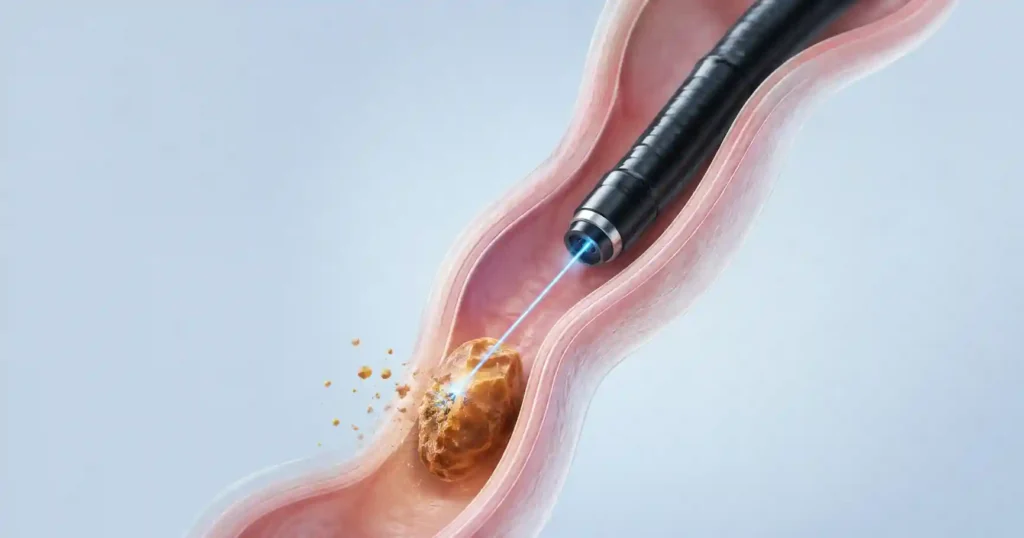
Laser lithotripsy recovery is rarely what men expect. You are booked as a day case, told a laser will break the stone, and sent home the same afternoon with a leaflet. Then day two arrives and you are passing pink urine, feeling a dragging ache in your flank every time you empty your bladder, and wondering whether something went wrong. Almost always, nothing has. What you are feeling is the ureteral stent, not the surgery. I perform ureteroscopic laser lithotripsy — URSL — regularly, and the single biggest gap between what patients are told and what they experience sits in the seven to fourteen days after they leave the hospital. This article walks through what actually happens during the procedure, what each phase of recovery feels like, which symptoms are expected and which ones mean you pick up the phone. For the wider picture of endoscopic stone treatment, see our Urological Surgery & Recovery hub.
Key Takeaways
- The laser itself causes no pain — nearly all discomfort in laser lithotripsy recovery comes from the ureteral stent, and in one multicenter study 88.2% of patients with a conventional double-J reported pain at two weeks.
- Burning on urination, visible blood, and a flank ache that arrives exactly when you void are expected with a stent in place; they are not signs the operation failed.
- The AUA Guideline (2026) states clinicians may omit a stent altogether after uncomplicated ureteroscopy — ask before surgery whether you are a candidate.
- Most desk workers return to work 2 to 4 days after URSL; manual work and the gym should wait until the stent is out.
- A temperature of 38 degrees C (100.4 degrees F) or higher with flank pain after URSL is an emergency department problem, not a wait-and-see problem.
What Actually Happens During Laser Lithotripsy (URSL)
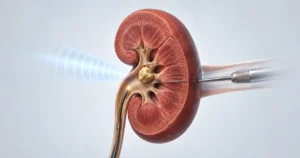
URSL means ureteroscopic laser lithotripsy. There is no incision anywhere on your body. A thin telescope passes up the natural route — urethra, bladder, then up the ureter to the stone. For a stone sitting in the ureter I use a semi-rigid scope; for a stone inside the kidney I use a flexible ureteroscope, which is the procedure often labelled RIRS.
Once the stone is in view, a laser fiber roughly the thickness of a fishing line is passed down the working channel. Two laser types are in mainstream use: the holmium:YAG laser and the newer thulium fiber laser. The AUA Guideline (2026) treats them as equivalent options and leaves the choice to the surgeon [1]. A 2024 meta-analysis of 2,166 patients in European Urology found the thulium fiber laser produced higher stone-free rates for kidney stones (odds ratio 3.14) but no meaningful difference for ureteral stones [3]. If your stone is in the ureter, the laser brand on the machine is not the thing that determines your outcome.
Your surgeon then chooses between two strategies. Dusting pulverizes the stone into particles fine enough to wash out on their own. Fragmenting and basketing breaks the stone into retrievable pieces that are physically removed with a wire basket. The AUA supports either approach [1]. Basketing gets you a stone specimen to send for analysis, which matters more than most patients realize — I come back to that at the end.
Most URSL procedures take 30 to 60 minutes under general anesthesia. The EAU advises keeping operative time under 90 minutes, because complication rates climb beyond that point [5]. A ureteral access sheath — a soft protective tube through which the scope passes — may be used for kidney stones to keep pressure inside the kidney low.
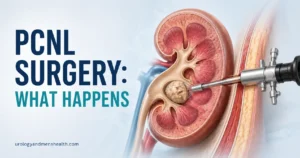
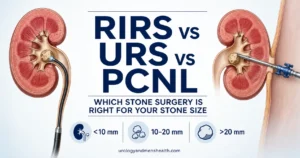
Not sure why URSL was chosen over shockwave or PCNL? Compare the three stone operations side by sideLaser Lithotripsy Recovery: The First 72 Hours
Four things are normal in the first three days, and knowing that in advance changes how you cope with them.
- Burning when you urinate. The scope passed through your urethra. That lining is inflamed for 48 to 72 hours. It is friction, not infection.
- Visible blood. Urine ranges from rosé pink to weak tea, and it fluctuates — clear in the morning, pink after you walk to the shops. With a stent in place this can persist intermittently for the full two weeks.
- A flank ache that arrives when you void. This one alarms people most. When the bladder contracts, urine refluxes up the stent lumen and briefly pressurizes the renal pelvis. It lasts seconds and then fades.
- Bladder spasms. A sudden gripping urge to urinate when the bladder is nearly empty, caused by the lower coil of the stent resting against the trigone.
For pain control, the AUA (2026) directs clinicians toward a multi-modal, non-opioid regimen and explicitly toward minimizing opioids after stone surgery [1]. In practice that means a scheduled NSAID — ibuprofen or diclofenac — as the backbone, paracetamol/acetaminophen layered on top, and opioids reserved for breakthrough pain only. Take the NSAID on a clock for the first 72 hours rather than waiting for pain to build. This applies only if your kidney function is normal and you have no contraindication, so confirm it with your surgeon before you leave.
Aim for around 2.5 liters of fluid daily (roughly 85 fl oz, or 10 cups) unless you have been told otherwise. Steady intake flushes stone dust and blood clot out of the system. Do not overshoot into 4 or 5 liters trying to speed things up — that increases urine volume refluxing up the stent and usually makes the flank ache worse, not better.
In My Practice
The call I get most often on day three is never about the operation. It is a man telling me the surgery itself went fine, but he cannot sit through a meeting because a dragging ache hits his flank every time he stands up or empties his bladder, and he is convinced something has been damaged. Nothing has. He is describing the lower coil of the stent against the trigone and reflux up the stent when the bladder contracts. I have learned to explain this before the operation rather than after, because the men who are warned tolerate it, and the men who are not warned assume the surgery failed.
Set expectations about the stent before surgery, not at the first post-op call — the counselling is as much a part of the treatment as the laser is.
The Stent Is the Recovery — Not the Surgery
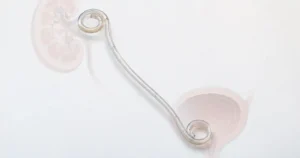
A double-J stent is a soft hollow tube with a coil at each end — one coil in the kidney, one in the bladder — that keeps the ureter open and draining while it recovers from the scope and the stone. It is not there because something went wrong. It is there because a ureter that has just had an impacted stone removed from it swells.
The numbers on how much this bothers people are stark. In a prospective multicenter study using the validated Ureteral Stent Symptom Questionnaire, 88.2% of patients with a conventional double-J reported pain at two weeks, alongside significant hits to work performance and general health scores [4]. That is not a rare complication. That is the default experience.
Which raises the obvious question: do you need one? The AUA (2026) states that clinicians may omit post-operative stent placement following uncomplicated ureteroscopy [1]. The EAU reaches the same position and specifies when a stent genuinely is required — ureteral trauma or perforation, residual fragments, significant bleeding, infection, or pregnancy [5]. A stent is also placed after bilateral same-session surgery or in a solitary kidney, where obstruction would be dangerous. If your stone was small, unimpacted, and cleanly cleared, ask your surgeon at the pre-operative consultation whether a stentless URSL is reasonable in your case. Ask before the operation — afterwards the decision is already made.
If you do end up with one, three things reduce the misery. A stent on a string lets you or a nurse remove it at home without a second cystoscopy. An alpha-blocker such as tamsulosin relaxes ureteral and bladder-neck smooth muscle and reliably takes the edge off. And in a randomized trial of 94 men, daily sildenafil 50 mg significantly reduced total stent symptom scores compared with no treatment [6] — an option worth raising if you are struggling and have no cardiac contraindication.
Tracking your symptoms day by day is more useful than trying to recall them at a follow-up appointment. Our Ureteral Stent Symptom Tracker is built on the USSQ, the same instrument used in the studies above, and produces a printable summary you can hand to your urologist. For the pain-management detail specifically, our guide to controlling kidney stone stent pain goes further than I can here.
Recovering from laser lithotripsy? Get the day-by-day stent care and URSL recovery plan
Enter your email below to receive Dr. Khalid’s complete Urology Surgery Recovery Guide as a free, printable PDF.
Week by Week: When You Get Your Life Back
Days 0 to 3
Home the same day in most cases. Expect fatigue from the anesthetic on top of everything above. Do not drive for 24 hours after a general anesthetic, and do not drive at all while you still need opioid breakthrough doses. Short walks are better than bed rest — they reduce clot formation and help fragments move.
Days 4 to 7
Most desk-based workers are back at a laptop by day 3 or 4, though usually not at full capacity — the work-performance domain of the stent questionnaire drops for a reason. Manual work, lifting above about 10 kg (22 lb), and running should wait. Bleeding usually settles to occasional pink tinges triggered by activity.
Stent removal, typically day 5 to 14
This is the turning point, and it is quick. If your stent is on a string it comes out in seconds. If not, it is a brief flexible cystoscopy in clinic under local anesthetic gel. Most men describe a sharp few seconds and then immediate relief. Expect one or two more days of burning and pink urine afterwards while the ureter settles. Our guide to what stent removal actually feels like covers the appointment in detail.
Weeks 3 to 4
By this point urine should be consistently clear, urination should be normal, and there should be no flank pain. Resume the gym, manual work, and sexual activity once the stent is out and burning has stopped — typically 3 to 7 days post-removal. If you still have flank pain at four weeks with no stent in place, that needs imaging rather than reassurance.
Red Flags After URSL: What Cannot Wait Until Monday
Serious complications after URSL are uncommon, but the ones that occur move fast. The single most dangerous is infection in an obstructed system, which can progress to urosepsis within hours. This is why the AUA (2026) requires pre-operative prophylactic antibiotics before ureteroscopy and forbids operating on untreated bacteriuria [1].
When to Go to the Emergency Room
Go to the emergency department immediately — do not wait for a clinic appointment — if you develop any of the following after laser lithotripsy:
- Temperature of 38 degrees C (100.4 degrees F) or higher, with or without shaking chills
- Flank pain that is constant rather than triggered by urinating, and is escalating
- Complete inability to pass urine, or passing only small amounts with a full, painful bladder
- Passing thick clots, or urine the color of red wine that is getting darker rather than lighter
- Pain that your prescribed oral medication no longer touches
- Vomiting that stops you keeping fluids or tablets down
Tell the triage nurse you had ureteroscopic laser lithotripsy and state whether a stent is still in place. That one sentence changes how quickly you are assessed.
Call your urology team the same working day — but not the emergency department — for a stent string that has come loose or been pulled, bleeding that is worsening rather than settling, or burning that is getting worse after day four instead of better, which suggests a urinary tract infection rather than scope irritation.
After the Stent Comes Out: The Follow-Up That Matters
Recovery from the operation is not the same as being finished. Four things should happen in the three months after URSL, and in my experience at least one of them is routinely skipped.
Stone analysis. The AUA (2026) states clinicians should obtain stone material for analysis whenever possible [1]. Composition dictates prevention: calcium oxalate, uric acid, struvite, and cystine stones each need a different strategy. If your stone was dusted rather than basketed there may be no specimen — ask directly whether one was sent, and if not, ask whether a strainer should be used for fragments you pass at home.
Follow-up imaging. Ask specifically for imaging to assess residual stone burden and to check for hydronephrosis, usually an ultrasound with a plain KUB X-ray at around 4 to 12 weeks. This is guideline-directed, not optional extra caution [1]. It is the only way to detect the two problems that are otherwise silent: leftover fragments, and a narrowing ureter.
Ureteral stricture. This is the late complication worth knowing about. A 2024 systematic review and meta-analysis of 43 studies found a pooled stricture rate of 1.9% after ureteroscopy, rising to 2.7% in studies from the last five years and 4.9% when the stone had been impacted. Intraoperative ureteral perforation raised the odds roughly sevenfold [2]. A stricture is usually painless at first and shows up as hydronephrosis on a scan — which is precisely why the follow-up imaging is not negotiable if your stone was impacted.
Metabolic workup. If this was your second stone, or your first stone was large, bilateral, or in a solitary kidney, ask for a 24-hour urine collection. Removing the stone treats the episode; the metabolic workup is what stops the next one.
Facing a second procedure for residual fragments? Work through the Kidney Stone Surgery Selector before your next appointmentFrequently Asked Questions
How long does laser lithotripsy recovery actually take?
Split it into two phases. With a stent in place, expect 5 to 14 days of burning, intermittent blood, and flank ache on urination — most desk workers return to work by day 3 or 4 but at reduced capacity. After the stent comes out, symptoms settle within 3 to 7 days and you can resume the gym, manual work, and sex. Without a stent, full recovery is often under a week. Compare this with recovery after the other stone operations before you assume URSL is the longest road.
Why does my flank hurt every single time I urinate after URSL?
Because a double-J stent is an open tube. When your bladder contracts to empty, some urine is forced back up the stent lumen and briefly raises pressure inside the renal pelvis. That is the ache you feel, and it should last only a few seconds and fade as the stream ends. Constant flank pain, or pain that keeps escalating between urinations, is different and needs assessment. Our detailed guide to managing stent pain covers the medication options.
Can I refuse a ureteral stent after laser lithotripsy?
Sometimes, and it is a fair question to raise before surgery rather than after. The AUA Guideline (2026) allows omitting a stent following uncomplicated ureteroscopy. But a stent is required if your ureter was perforated or traumatized, if fragments remain, if there is significant bleeding or infection, or if you have a single functioning kidney. Your surgeon may not know which of these applies until the operation is underway. If you do end up with one, our Ureteral Stent Symptom Tracker gives you objective scores to bring to your follow-up.
Is blood in my urine two weeks after URSL normal?
With a stent still in place, yes — intermittent pink or tea-colored urine that comes and goes with activity is expected for as long as the stent is there, because the coils rub against the kidney and bladder lining. What is not normal is blood that is getting steadily heavier, urine the color of red wine, or passing thick clots, particularly with fever. Most men notice a clear improvement within a day or two of having the stent removed.
Will one laser lithotripsy clear the whole stone, or will I need a second procedure?
Ureteroscopy has a higher stone-free rate than shockwave lithotripsy, which is why it is often chosen, but a single session does not always achieve complete clearance — particularly with larger kidney stones or lower-pole stones. This is exactly what the follow-up imaging at 4 to 12 weeks is for. If fragments remain, the AUA (2026) supports a shared decision about secondary endoscopic removal rather than automatic re-operation. Working through the Kidney Stone Surgery Selector will help you frame that conversation.
References
- Pearle MS, Matlaga BR, Antonelli JA, et al. Surgical Management of Kidney and Ureteral Stones: AUA Guideline (2026). J Urol. 2026. AUA
- Moretto S, Saita A, Scoffone CM, et al. Ureteral stricture rate after endoscopic treatments for urolithiasis and related risk factors: systematic review and meta-analysis. World J Urol. 2024;42(1):234. PubMed
- Uleri A, Farré A, Izquierdo P, et al. Thulium fiber laser versus holmium:yttrium aluminum garnet for lithotripsy: a systematic review and meta-analysis. Eur Urol. 2024;85(6):529-540. PubMed
- Bosio A, Ferretti S, Alessandria E, et al. Patients undergoing double J substitution with a pigtail suture stent report a significant decrease of stent-related symptoms. World J Urol. 2024;42(1):186. PubMed
- Skolarikos A, Neisius A, Somani B, et al. EAU Guidelines on Urolithiasis. European Association of Urology; 2026. EAU
- Tharwat M, Elsaadany MM, Lashin AM, El-Nahas AR. A randomized controlled trial evaluating sildenafil citrate in relieving ureteral stent-related symptoms. World J Urol. 2018;36(11):1877-1881. PubMed
Dr. Muhammad Khalid
MBBS · FCPS (Urology) · MCPS (General Surgery) · CHPE · CRSM · IMC #539472
Specialist urologist with 11+ years of clinical experience across tertiary teaching hospitals. Trained at Lady Reading Hospital and Khyber Teaching Hospital, Peshawar. Author or co-author of five peer-reviewed international publications, including in Cureus and the World Journal of Surgery. Procedural expertise: URS, PCNL, RIRS, TURP, TURBT, and major open urological surgery. Full profile →
This article is for educational purposes only and does not constitute medical advice. Always consult your physician or urologist for diagnosis and treatment decisions specific to your condition.