
BPH Treatment Finder: Compare Your Options for an Enlarged Prostate
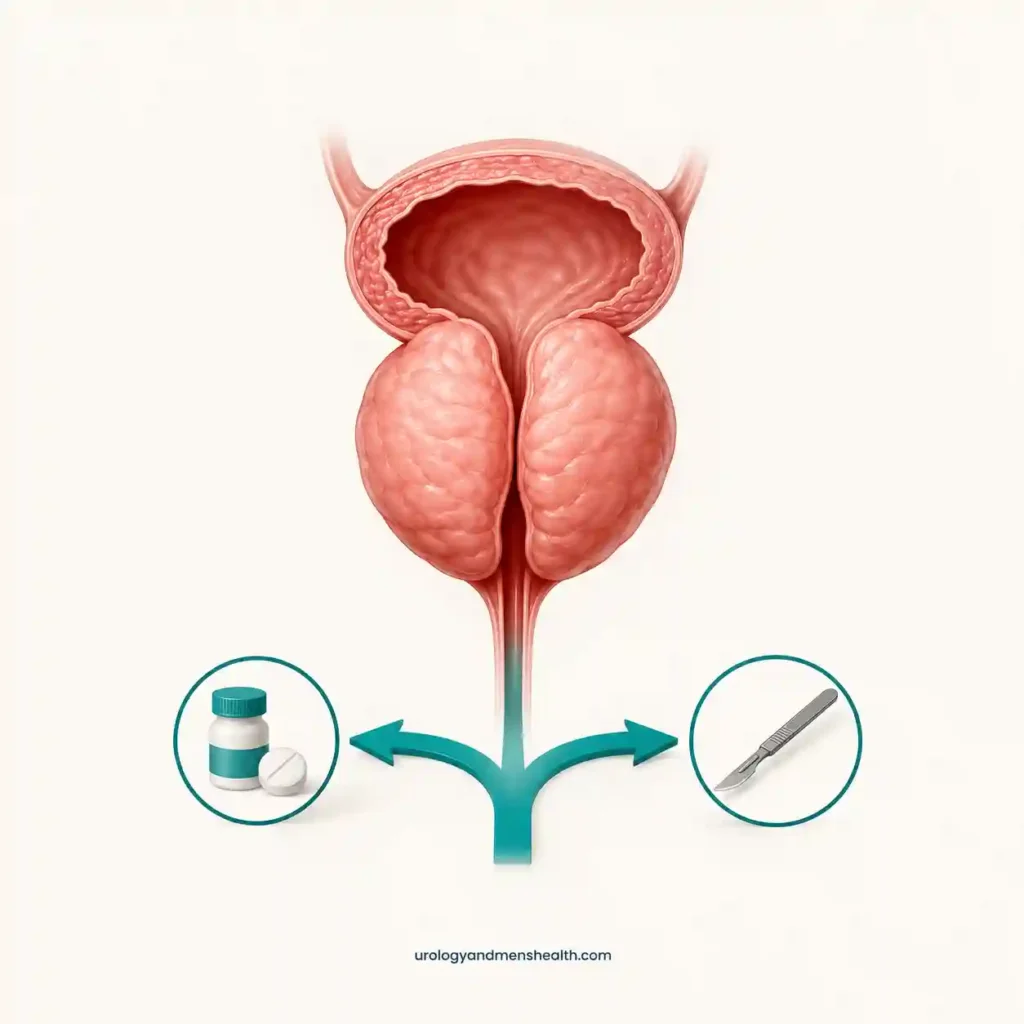
The BPH treatment finder maps your symptom severity, prostate size, and personal priorities against current urology guidelines to show which paths fit an enlarged prostate — medical, minimally invasive, or surgical. There is no single best option; the right one depends on your anatomy and what you most want to protect. Answer three short questions to prepare for a focused appointment. For the wider picture, start at our prostate health hub.

The Tool
Related Prostate Tools
Full Clinical Guide
In This Guide:
- BPH treatment is matched to three things: symptom severity, prostate size, and what you most want to protect.
- Prostate size gates the options — ejaculation-sparing keyhole procedures (UroLift, Rezum) suit roughly 30–80 g glands with no obstructing middle lobe.
- Medication controls BPH but does not cure it: alpha-blockers relax the gland for fast relief, 5-ARIs shrink it over months.
- Surgery (TURP, HoLEP) is durable but commonly causes retrograde ejaculation, while erections are usually preserved.
What the BPH Treatment Finder Measures
This BPH treatment finder is not a diagnostic test; it is a structured way to line up your symptom severity, your prostate size, and your personal goals against the treatment options urologists actually use. Benign prostatic hyperplasia (BPH) means the prostate has enlarged and is squeezing the urethra it surrounds, which slows and weakens the urinary stream. The first input is symptom burden, anchored to the International Prostate Symptom Score (IPSS), the 0 to 35 questionnaire endorsed by the American Urological Association and used worldwide to band symptoms as mild (0–7), moderate (8–19), or severe (20–35) [1]. If you have not scored yourself yet, our IPSS prostate symptom score calculator takes two minutes and gives you the number this tool expects. For the full picture of how an enlarged prostate is assessed and treated, the companion guide on when BPH surgery becomes the answer goes deeper than any tool can.
Why Your Prostate Size and Goals Decide the Path
Two things steer almost every BPH decision: how obstructed you are, and how big the gland is. A normal adult prostate weighs about 20–30 g (cc); the guidelines treat a gland as meaningfully enlarged above 30 g, and as very large above 80 g [1][2]. Size gates which procedures are even possible. Keyhole, ejaculation-sparing options such as the prostatic urethral lift (UroLift) and water-vapor therapy (Rezum) are recommended for glands of roughly 30–80 g with no obstructing middle lobe, and are specifically designed to preserve ejaculation [2][5]; the EAU sets its lift threshold a little lower, under 70 mL [2]. Above 80 g those options come off the table, and the conversation shifts to enucleation or resection. The second steer is what you value — relief, ejaculation, getting off pills, or durability — because for the same prostate those priorities lead to genuinely different operations. If you have an imaging report, our prostate volume calculator turns the measurements into a single number in grams.
How to Read Your Result: Medication, MIST, or Surgery
A man who scores 4 on the IPSS and a man who scores 24 are not on the same path at all — one needs reassurance and a few habit changes, the other a real conversation about procedures, even with an identically sized prostate. If your result points to medication, the logic follows symptom severity and gland size. Alpha-blockers such as tamsulosin relax the prostate and bladder-neck muscle and tend to work within days, but they do not shrink the gland. A 5-alpha-reductase inhibitor (finasteride or dutasteride) does shrink it, by roughly 20–25% over 6 to 12 months, and lowers the longer-term risk of urinary retention and surgery — which is why larger glands are often treated with the two combined [1][3]. If the result points to surgery, the trade-off to understand is ejaculation: retrograde ejaculation (a dry climax, where semen passes backward into the bladder) is common after both transurethral resection (TURP) and laser enucleation (HoLEP), reported in roughly half to three-quarters of men and not meaningfully different between the two, while erectile function is usually preserved [4].
What to Do With Your Result
For mild symptoms, the honest answer is often to do less: trim evening fluids, cut caffeine and alcohol, and recheck your IPSS in six months. For moderate symptoms, start with the least invasive option that fits and give it a fair trial before escalating. For severe symptoms — especially any episode of being unable to pass urine — treat it as a reason to be seen within weeks, not months, because long-standing obstruction can quietly load the bladder and back up toward the kidneys. Whichever path you are on, ask your urologist to tie the choice to your measured prostate size and your own priorities. If side effects are your main worry with medication, our BPH medication side effect checker breaks down what each drug class commonly causes. If you are unsure about your result, the PDF report this tool generates gives you a ready-made framework to bring to your next appointment.
Read: UroLift and Rezum — minimally invasive BPH optionsIn My Practice
One of the most useful questions I ask in clinic is not “how bad are your symptoms” but “what are you most afraid of losing”. The man who fears losing normal ejaculation and the man who fears another decade of pills will choose different procedures for the very same prostate — and both end up satisfied, because the operation was matched to what they actually cared about.
There is no single best BPH treatment; there is only the best fit for your prostate size, your symptom burden, and the outcome you most want to protect. This tool is built to surface that fit, not to replace the conversation that confirms it.
References
- American Urological Association. Management of Lower Urinary Tract Symptoms Attributed to Benign Prostatic Hyperplasia: AUA Guideline (2023). J Urol.
- European Association of Urology. EAU Guidelines on the Management of Non-neurogenic Male LUTS.
- Cindolo L, et al. Rates of prostate surgery and acute urinary retention in men treated with 5-ARIs (dutasteride or finasteride). (5-ARIs reduce prostate volume and lower the risk of retention and surgery.)
- Liu Y, et al. Impact on sexual function of endoscopic enucleation vs TURP: systematic review and meta-analysis. J Endourol, 2020.
- Luo G, et al. Ejaculatory function preservation in minimally invasive surgical treatments for BPH: a narrative review. Transl Androl Urol, 2025.
Frequently Asked Questions
Which BPH treatment is the gold standard?
Historically TURP — transurethral resection of the prostate — has been the reference standard, and it still is for many men. For larger glands, laser enucleation (HoLEP) is increasingly treated as the modern standard, because it removes more tissue with less bleeding and a very low chance of needing a repeat procedure. Our comparison of HoLEP vs TURP walks through how they differ.
Can BPH be treated without surgery?
BPH cannot be permanently cured by medication, but it is very often well controlled by it. Alpha-blockers such as tamsulosin relax the muscle in the prostate and bladder neck for fast relief, while 5-alpha-reductase inhibitors such as finasteride slowly shrink the gland over months. Many men stay comfortable on medication for years without ever needing a procedure.
Will treatment affect my sex life?
It depends entirely on the procedure. Resection and enucleation (TURP and HoLEP) commonly cause retrograde ejaculation — a dry climax — though they rarely harm erections. If keeping normal ejaculation matters most to you, minimally invasive options like UroLift and Rezum are designed to preserve it. Our guide on whether BPH and its treatments affect erectile function covers this in detail.
How accurate is this tool, and can I rely on it?
This tool maps your answers against published AUA and EAU treatment guidelines, but it cannot examine you, measure your prostate, or see your full history. It is a screening and preparation aid, not a diagnosis or a substitute for a urologist. Treat its suggestions as a starting point for a conversation, and let a specialist confirm what actually fits your anatomy.
How do I use this result at my doctor’s appointment?
Press the Download My Report button to generate a two-page PDF that summarizes your answers, your suggested pathways, and a set of questions to ask. Bring it to your appointment so the visit starts from your priorities and prostate size rather than from scratch. It does not replace your doctor’s judgment, but it makes the limited time in the room far more productive.
Dr. Muhammad Khalid
MBBS · FCPS (Urology) · MCPS (General Surgery) · CHPE · CRSM · IMC #539472
Specialist urologist with 11+ years of clinical experience across tertiary teaching hospitals. Trained at Lady Reading Hospital and Khyber Teaching Hospital, Peshawar. Author or co-author of five peer-reviewed international publications, including in Cureus and the World Journal of Surgery. Procedural expertise: URS, PCNL, RIRS, TURP, TURBT, and major open urological surgery. Full profile →
This article is for educational purposes only and does not constitute medical advice. Always consult your physician or urologist for diagnosis and treatment decisions specific to your condition.