
PSA Velocity Tracker and Doubling Time Calculator
This PSA velocity tracker plots your dated PSA readings to calculate how fast your level is rising - your PSA velocity in ng/mL per year and your doubling time. The trend often matters more than any single value: a fast climb inside the 'normal' range can outweigh a stable, mildly high result. Enter two or more readings; nothing is stored. Start from the prostate health hub.

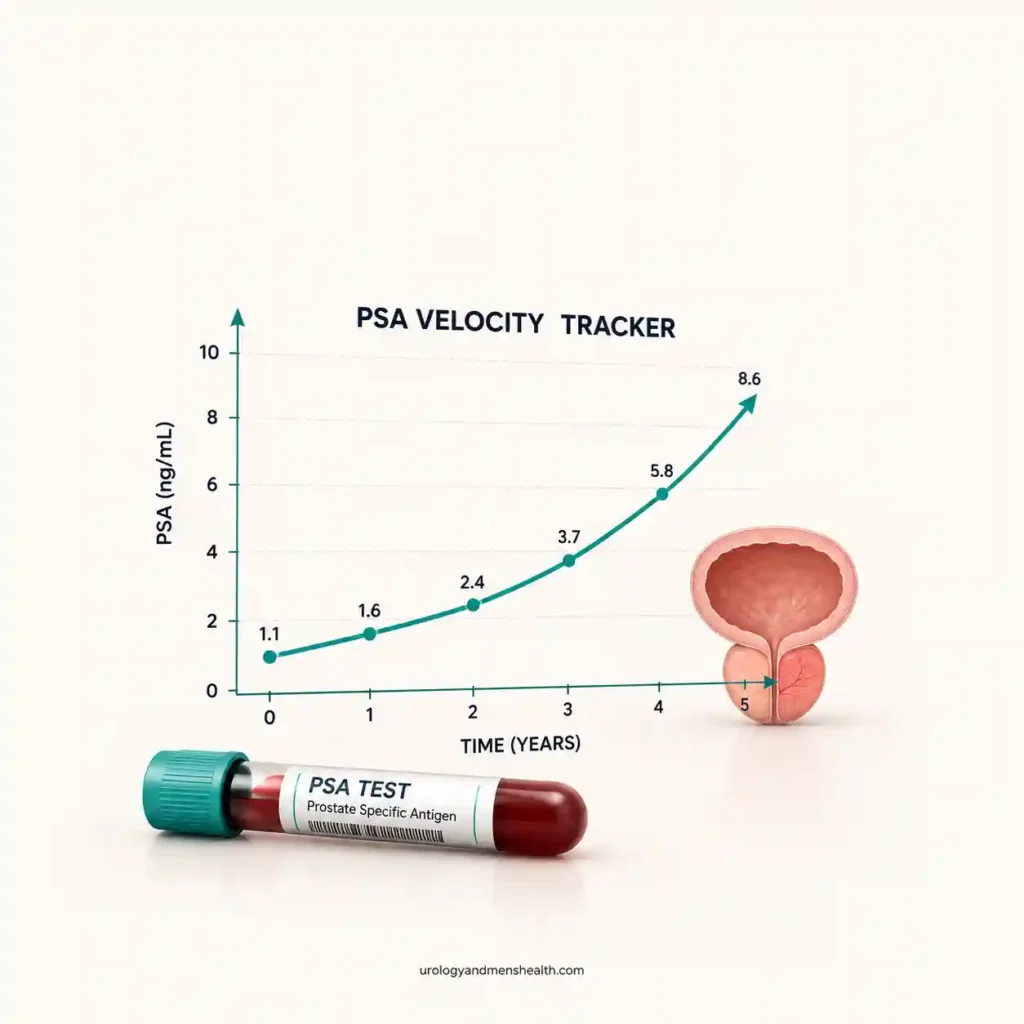
The Tool
Add a PSA Reading
Logged Readings (0)
Latest PSA
—
Lowest PSA
—
Total Rise
—
Trend
—
Your PSA Trend Over Time
In My Practice
—
Your Next Steps
Questions for Your Doctor
Facing a PSA result you do not fully understand? Download Dr. Khalid’s PSA & Prostate Cancer Decision Guide.
Enter your email below to receive Dr. Khalid’s complete PSA & Prostate Cancer Decision Guide as a free, printable PDF.
Copied to clipboard
Retake when you receive a new PSA result.
🔒 Nothing you enter is stored, logged, or sent to any server. All readings stay in your browser only.
Related Prostate Tools
Full Clinical Guide
In This Guide:
- PSA is a trajectory, not a single number. Plotting every dated result you have is the highest-value thing you can do before an appointment.
- A fast rise inside the “normal” range can carry more weight than a stable, slightly elevated value.
- Current AUA guidance is explicit: velocity should not trigger a biopsy on its own. It is read alongside your PSA, PSA density, MRI and a validated risk calculator.
- Calculate doubling time if you are on active surveillance or post-treatment – a doubling measured in months, not years, is the one that changes the plan.
What This PSA Velocity Tracker Measures
This PSA velocity tracker calculates two numbers a single reading cannot give you: PSA velocity (PSAV), the rate your PSA rises in nanograms per milliliter per year, and PSA doubling time (PSADT), how long it takes your PSA to double. Both come from landmark work. In a Johns Hopkins cohort of 980 men, Carter and colleagues found that a PSAV above 0.35 ng/mL per year measured 10-15 years before diagnosis predicted prostate-cancer survival 25 years later – 92% survival below that rate versus 54% above it [1]. A separate study of 1,095 men by D’Amico linked a rise faster than 2.0 ng/mL per year to a higher risk of dying from prostate cancer despite surgery [3]. One honest caveat sits over all of this: current AUA guidance states that velocity should not be used as the sole reason for a biomarker test, scan, or biopsy, because large studies showed it adds little beyond standard risk factors [2]. So this tool’s job is to show you the trend and frame the conversation – not to hand down a verdict.
The Physiology Behind a Rising PSA
PSA is a protein made by both healthy and cancerous prostate cells. Think of it as smoke from a chimney: a steady, gentle plume is normal, while a sudden change in volume signals that something inside has shifted. Three forces push PSA upward, and velocity helps separate them. Benign prostatic hyperplasia (BPH) – the non-cancerous enlargement most men develop after 50 – produces a slow, steady ramp that usually tracks well under 0.35 ng/mL per year. Inflammation from prostatitis, a urinary infection, recent ejaculation, or instrumentation such as a cystoscopy causes sharp, short-lived spikes that settle once the irritation clears, which is why a 48-hour gap after ejaculation and 24 hours off the bike before testing matters. Prostate cancer, when it makes PSA, tends to do so out of proportion to its size, so a small but biologically active tumor can drive a sustained climb while the absolute PSA still reads “normal.” BPH gives a gentle ramp; inflammation gives a spike that resolves; cancer gives a sustained, accelerating rise.
How to Interpret Your Velocity and Doubling Time
The reference bands come from the original studies, and they are best read as conversation triggers rather than thresholds that act on their own. A velocity under 0.35 ng/mL per year is reassuring and consistent with BPH or normal aging [1]. Between 0.35 and 0.75 is a monitoring zone – most men here turn out to have benign causes, but the rate justifies closer follow-up than annual-only testing. The 0.75 to 2.0 band is where most urologists want a proper conversation, and a sustained rise above 2.0 ng/mL per year is the one D’Amico’s data tied to worse outcomes [3]. The practical difference is real: a man whose PSA drifts up at 0.2 ng/mL per year and a man climbing at 1.7 get very different advice, even if today’s single value looks identical. Crucially, current guidelines do not let any of these numbers stand alone – the AUA reads velocity together with your PSA, your PSA density, an MRI, and a validated risk calculator [2]. Doubling time is a second lens used mainly after diagnosis: a PSADT measured in months rather than years signals more aggressive disease, while a long, stable doubling time is reassuring.
Related read: My PSA Is 4.5 — Do I Have Cancer? Understanding Grey Zone Results →
What to Do With Your Result
If your velocity is under 0.35 ng/mL per year, keep testing annually – your accumulating trend is your best protection against missing an acceleration later. In the monitoring zone (0.35-0.75), repeat the PSA at about six months rather than waiting a full year, and rule out reversible causes first: leave 48 hours after ejaculation and 24 hours after vigorous cycling, and treat any active urinary infection before retesting. In the 0.75-2.0 band, ask for a urologist referral and raise the trend explicitly, and ask whether a multiparametric MRI before any biopsy is appropriate – both AUA and EAU support MRI-first pathways because they spare men who do not need a biopsy [2][4]. Above 2.0, escalate to a same-week or next-available specialist slot. One adjustment matters if you take a 5-alpha reductase inhibitor such as finasteride or dutasteride: these lower PSA, so older guidance doubled the reading – but suppression varies, and the AUA notes only about a third of men get a 40-60% drop at one year, so the safest step is to flag your full medication history rather than trust a fixed multiplier [2]. You can also sanity-check a single value against age norms with the PSA interpreter. If you are unsure about your result, the PDF report this tool generates gives you a ready-made framework to bring to your next appointment.
Related read: Prostate Cancer Screening — The Age-by-Age Guide Every Man Needs →
In My Practice
The most common pattern I see is not a missed cancer or a panicked patient – it is a man with four PSA values across five years that nobody has ever plotted on one graph. Each result was filed in isolation, each “normal” or “borderline” depending on the year, and the velocity sitting hidden inside that scatter was never calculated. He arrives in my office only because his latest value finally crossed an absolute number someone noticed.
Your PSA is a trajectory, not a number. The single most useful thing you can do with this tool is plot every PSA result you have ever had and bring the graph to your next appointment – whether your latest value looks reassuring or worrying.
References
- Carter HB, Ferrucci L, Kettermann A, et al. Detection of life-threatening prostate cancer with prostate-specific antigen velocity during a window of curability. J Natl Cancer Inst. 2006;98(21):1521-1527. PubMed. The 0.35 ng/mL/year threshold; 980 men, Baltimore Longitudinal Study of Aging.
- American Urological Association / SUO. Early Detection of Prostate Cancer: AUA/SUO Guideline (2023; amended 2026). AUA. States PSA velocity should not be the sole indication for a biomarker, imaging, or biopsy.
- D’Amico AV, Chen MH, Roehl KA, Catalona WJ. Preoperative PSA velocity and the risk of death from prostate cancer after radical prostatectomy. N Engl J Med. 2004;351(2):125-135. PubMed. The >2.0 ng/mL/year finding; 1,095 men.
- European Association of Urology. EAU Guidelines on Prostate Cancer (2024). EAU. Supports an MRI-first pathway before biopsy.
- Carter HB, Pearson JD, Waclawiw Z, et al. Prostate-specific antigen variability in men without prostate cancer: effect of sampling interval on PSA velocity. Urology. 1995;45(4):591-596. PubMed. Why widely spaced readings give a more reliable velocity.
Frequently Asked Questions About PSA Velocity
What is PSA velocity and why does it matter more than a single PSA result?
PSA velocity (PSAV) is the rate your PSA rises, in ng/mL per year. It adds context a single value lacks. A PSA of 4.8 in a man whose PSA was 4.5 last year is reassuring; the same 4.8 in a man whose PSA was 2.2 eighteen months ago is a velocity of roughly 1.7 ng/mL per year. That said, current guidelines treat velocity as a trend signal read alongside other factors, not a standalone trigger. See our guide to grey zone PSA results.
What PSA velocity is worrying enough to see a urologist?
There is no single cut-off that acts on its own. The historical reference points are roughly 0.35, 0.75, and 2.0 ng/mL per year, drawn from older landmark studies. A sustained rise above about 0.75 ng/mL per year is worth raising with a urologist in context, and a rise above 2.0 ng/mL per year was tied to worse outcomes in D’Amico’s data. Current AUA guidance is clear that velocity should not be the sole reason for a biopsy. Our age-by-age screening guide covers the full picture.
What is PSA doubling time and what does it tell my urologist?
PSA doubling time (PSADT) is how long your PSA takes to double, usually expressed in months. It matters most after diagnosis – in men on active surveillance or after surgery or radiation. A doubling time measured in months rather than years points to more aggressive, faster-moving disease and usually prompts closer evaluation, while a long, stable doubling time is reassuring. It is interpreted alongside repeat imaging and biopsy grade, not in isolation. See our article on active surveillance for prostate cancer.
My PSA is in the normal range but the tracker shows a rapid rise – should I act?
A rising PSA within the normal range is worth documenting and discussing, because the trend can matter even when the absolute value looks fine. It is not an automatic biopsy. The right move is to confirm the rise on a repeat test, rule out reversible causes such as infection or recent ejaculation, and bring the plotted trend to your primary care doctor or urologist so it is formally recorded. Our grey zone PSA guide explains how clinicians weigh this.
How often should I have PSA tests for meaningful velocity tracking?
Velocity is more reliable when readings are spread out rather than bunched together – widely spaced samples reduce the effect of normal biological variation, which is the point of Carter’s sampling-interval work. Annual testing over two or more years gives a meaningful trend, usually within three to four years. Avoid drawing conclusions from tests taken weeks apart, since PSA naturally fluctuates between closely spaced samples. Our screening guide covers when to start.
I take finasteride or dutasteride – does that change how I read my PSA velocity?
Yes. Finasteride and dutasteride are 5-alpha reductase inhibitors that lower PSA after about six months of use. Older guidance doubled the reading as an adjustment, but suppression varies a lot between men – the AUA notes only about a third see a 40-60% drop at one year – so a fixed “double it” rule can mislead. The safest approach is to bring your full medication history so your clinician interprets each value correctly rather than relying on a multiplier. Our screening guide covers what to ask.
How accurate is this tool, and can I rely on it?
This tool calculates PSA velocity and doubling time using the standard formulas urologists use – linear velocity across paired readings and exponential doubling time. The reference bands (0.35, 0.75, 2.0 ng/mL per year) come from published landmark studies. Note that current AUA guidance de-emphasizes velocity as a standalone trigger, so the tool’s purpose is to plot your trend and structure a conversation with your doctor, not to replace clinical assessment. See our PSA interpreter for single-value context.
How do I use this result at my doctor’s appointment?
Use the Download My Report (PDF) button below your result. It produces a printable summary showing every PSA value you entered, your calculated velocity, your doubling time, your tier, and questions to ask. Bring it printed or open it on your phone, and open the consultation by handing it over: “I plotted my PSA history myself – these are the questions it raised.” That reframes a routine PSA review into a structured trend discussion. Our screening guide has more on preparing.
Dr. Muhammad Khalid
MBBS · FCPS (Urology) · MCPS (General Surgery) · CHPE · CRSM · IMC #539472
Specialist urologist with 11+ years of clinical experience across tertiary teaching hospitals. Trained at Lady Reading Hospital and Khyber Teaching Hospital, Peshawar. Author or co-author of five peer-reviewed international publications, including in Cureus and the World Journal of Surgery. Procedural expertise: URS, PCNL, RIRS, TURP, TURBT, and major open urological surgery. Full profile →
This article is for educational purposes only and does not constitute medical advice. Always consult your physician or urologist for diagnosis and treatment decisions specific to your condition.