
Premature Ejaculation Test (PEDT Score)
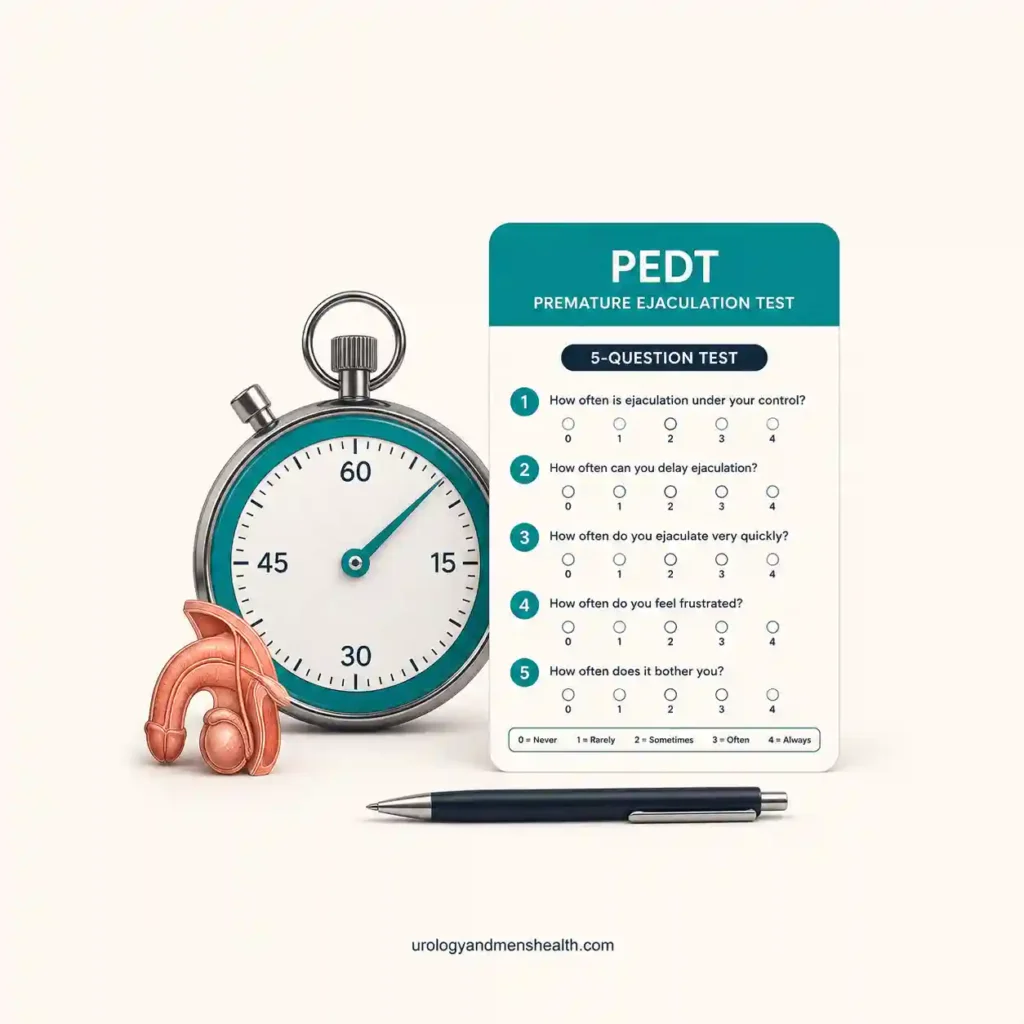
This premature ejaculation test scores your answers with the PEDT, the five-item questionnaire urologists use to separate real premature ejaculation from normal variation. It takes about a minute. You get your 0 to 20 score, what that number means clinically, and a printable report you can hand to your doctor. Nothing you enter is stored or sent. For the wider picture, start at my sexual health hub.

The Tool
Related Sexual Health Tools
Full Clinical Guide
In This Guide:
- The PEDT runs 0 to 20. Eight or below means PE is unlikely, 9 or 10 is probable, 11 or more meets the threshold.
- It is not a stopwatch. Control, distress and the effect on your partner carry as much weight as the clock.
- The AUA and SMSNA define lifelong PE as ejaculation within about two minutes of penetration since your first sexual experiences, with poor control and real bother.
- PE is treatable: behavioral technique, topical anesthetics, and SSRIs – and if your erections are also failing, the erection gets treated first.
What This Premature Ejaculation Test Measures
This premature ejaculation test is the PEDT — the Premature Ejaculation Diagnostic Tool, published by Symonds and colleagues in European Urology in 2007 and now the short instrument used to define entry criteria in premature ejaculation clinical trials [1]. Five items, each scored 0 to 4, giving a total of 0 to 20. The five deliberately cover five different things: how much control you have, how often it happens, whether it happens after very little stimulation, how much it bothers you, and how much it affects your partner.
The authors validated the PEDT questionnaire against three groups of men: 292 with premature ejaculation diagnosed by a clinician and an ejaculation time of two minutes or less, 309 who described themselves as premature ejaculators, and 701 who did not. Sensitivity and specificity analysis set the cut points from there: 8 or below means PE is unlikely, 9 or 10 is probable, and 11 or more meets the threshold [1].
Why the Stopwatch Does Not Settle It
Ejaculation is a spinal reflex. Sensory signals from the penis feed a group of neurons in the lower spinal cord that fire once a threshold is crossed, and serotonin signaling in the brain sets how high that threshold sits. More serotonin activity at the relevant receptors means a longer latency; less means a shorter one. That is the entire reason an antidepressant class ends up being the mainstay of a condition with no depression anywhere in it.
Timing alone misses all of that. The AUA and SMSNA define lifelong premature ejaculation as ejaculation within about two minutes of penetration, present since a man’s first sexual experiences, together with poor control and genuine bother; acquired PE is a latency markedly shorter than it used to be [2]. The International Society for Sexual Medicine puts the lifelong figure at about one minute and the acquired figure at about three [4]. The bodies disagree on the clock and agree on everything else — which tells you which part is load-bearing.
Lifelong versus acquired is the split that separates the treatment paths. Lifelong PE behaves like a threshold set low from the start, so the work is behavioral plus serotonergic. Acquired PE is a change, and a change has a cause worth finding — a new medication, heavy drinking, thyroid disease, prostate inflammation, or erectile difficulty. That last one matters most: guidelines direct that comorbid erectile dysfunction is treated before the ejaculation problem, because rushing to finish before an erection fades imitates PE exactly [2]. If that describes you, score your erections with the IIEF-5 erectile function assessment before you treat anything else.
How to Interpret Your PEDT Score
Three bands, three different conversations. Eight or below: control, timing and distress are not all present at once, and the variation you notice is physiology — latency shortens with novelty, with alcohol, and with a long gap since you last ejaculated. Nine or ten is the grey band the authors built in on purpose; the pattern is real, the questionnaire cannot label it alone, and a ten-minute sexual history settles it. Eleven or more meets the diagnostic threshold.
A man who scores 6 and a man who scores 17 walk out of my clinic with completely different plans. The first gets an explanation, a look at his drinking and his sleep, and no prescription — his problem is usually the comparison he is making, not the physiology. The second gets a full sexual history, a focused examination, and a treatment decision the same day. Neither one gets sent home with a stopwatch.
What to Do With Your Result
Below 9, treat the worry rather than the timing: check alcohol and sleep across four to six occasions, and if sex still feels tense despite a normal premature ejaculation score, book fifteen minutes and describe the anxiety, not the clock. At 9 or 10, work out before the appointment whether this has been true since your first sexual experiences or is a change from how you used to be — that single answer decides the direction of the whole consultation. Routine blood tests are not needed to diagnose lifelong PE [2].
At 11 or above the pathway has three rungs and they stack. Behavioral technique with your partner — stop-start, or the squeeze — costs nothing and is done as a pair. A lidocaine-prilocaine cream or spray applied to the glans before sex cuts sensory input at the source. Oral treatment turns serotonin signaling up: an SSRI daily or on demand, prescribed off-label in the United States because no drug carries FDA approval there for PE [5], or dapoxetine, a short-acting SSRI licensed on demand in many other countries, where 30 mg and 60 mg give roughly 2.5-fold and 3-fold increases in ejaculation latency [3]. Combining behavioral and drug treatment may beat either alone [2], and if erections are part of the picture, run the ED treatment step-up protocol alongside this. Surgery and injectable bulking agents are experimental and belong only inside a trial [2].
If you are unsure about your result, the PDF report this tool generates gives you a ready-made framework to bring to your next appointment.
In My Practice
The consultation rarely opens with the word ejaculation. It opens with a man saying things at home are strained, or that he has been finding reasons not to come to bed at the same time as his partner, and it takes a direct question to reach the actual complaint. Most men have been carrying this quietly for years before they say it out loud to anyone at all.
That delay is exactly why I put a number in front of men rather than an opinion. A number is easier to say than a sentence, and once the number is on the table the rest of it — lifelong or acquired, erections or not, what to try first — takes about ten minutes.
References
- Symonds T, Perelman MA, Althof S, et al. Development and validation of a premature ejaculation diagnostic tool. Eur Urol. 2007;52(2):565-73. PubMed. The PEDT development and validation study; source of the 0-20 scale and the 8 / 9-10 / 11 cut points.
- Shindel AW, Althof SE, Carrier S, et al. Disorders of Ejaculation: An AUA/SMSNA Guideline. J Urol. 2022;207(3):504-512. American Urological Association. Source of the two-minute lifelong definition, the treat-ED-first statement, and the combination-therapy and experimental-surgery statements.
- Salonia A, Bettocchi C, Capogrosso P, et al. EAU Guidelines on Male Sexual and Reproductive Health: 2025 Update. Eur Urol. 2025. European Urology. Source of the dapoxetine 30 mg and 60 mg latency figures and its licensing status outside the United States.
- Sexual Medicine Society of North America. Disorders of Ejaculation: Guideline Highlights. SMSNA. Source of the ISSM one-minute and three-minute latency definitions.
- Urology Care Foundation. Premature Ejaculation. Urology Care Foundation. Source of the statement that no drug is approved in the United States for premature ejaculation.
Frequently Asked Questions
Is the PEDT the same as timing myself with a stopwatch?
No, and that is the point. The PEDT scores five things: control, how often it happens, how little stimulation it takes, how much it bothers you, and the effect on your partner. Time is one input among several. Plenty of men with a two-minute latency have no distress and no diagnosis, and some men who last longer are genuinely suffering. I go through why the clock misleads in my guide to premature ejaculation causes and treatment.
What counts as a normal time to last during sex?
There is no single number, which is why the guidelines disagree. The AUA and SMSNA put lifelong premature ejaculation at ejaculation within about two minutes of penetration, present since a man’s first sexual experiences. The International Society for Sexual Medicine uses about one minute for lifelong PE and about three minutes for acquired PE. Every one of those definitions also requires poor control and genuine distress. Time on its own diagnoses nothing.
Can premature ejaculation start later in life?
Yes, and that version has its own name: acquired premature ejaculation, meaning a latency markedly shorter than yours used to be. It is worth investigating rather than accepting, because it usually sits on top of something else — a new medication, heavy drinking, thyroid disease, prostate inflammation, or erectile difficulty that makes you rush to finish before the erection fades. If erections are part of your picture, score them with the IIEF-5 erectile function assessment first.
How accurate is this tool, and can I rely on it?
The PEDT is a validated screening questionnaire, not a diagnosis. Its cut points were set against clinician diagnoses across more than 1,300 men, and it separates men with premature ejaculation from men without it well enough to be used as trial entry criteria. But it cannot examine you, review your medications, or tell lifelong from acquired PE. Use the score to start a conversation with your doctor, not to replace one.
How do I use this result at my doctor’s appointment?
Press Download My Report. You get a two-page PDF: your five answers and your score on page one, and on page two my interpretation for your band, your next steps, and the questions to ask, with your score already filled in. Hand it over at the start of the appointment. It saves you having to say the hardest sentence out loud, and it puts the consultation straight onto the decision that matters.
Dr. Muhammad Khalid
MBBS · FCPS (Urology) · MCPS (General Surgery) · CHPE · CRSM · IMC #539472
Specialist urologist with 11+ years of clinical experience across tertiary teaching hospitals. Trained at Lady Reading Hospital and Khyber Teaching Hospital, Peshawar. Author or co-author of five peer-reviewed international publications, including in Cureus and the World Journal of Surgery. Procedural expertise: URS, PCNL, RIRS, TURP, TURBT, and major open urological surgery. Full profile →
This article is for educational purposes only and does not constitute medical advice. Always consult your physician or urologist for diagnosis and treatment decisions specific to your condition.