
Ureteral Stent Symptom Tracker
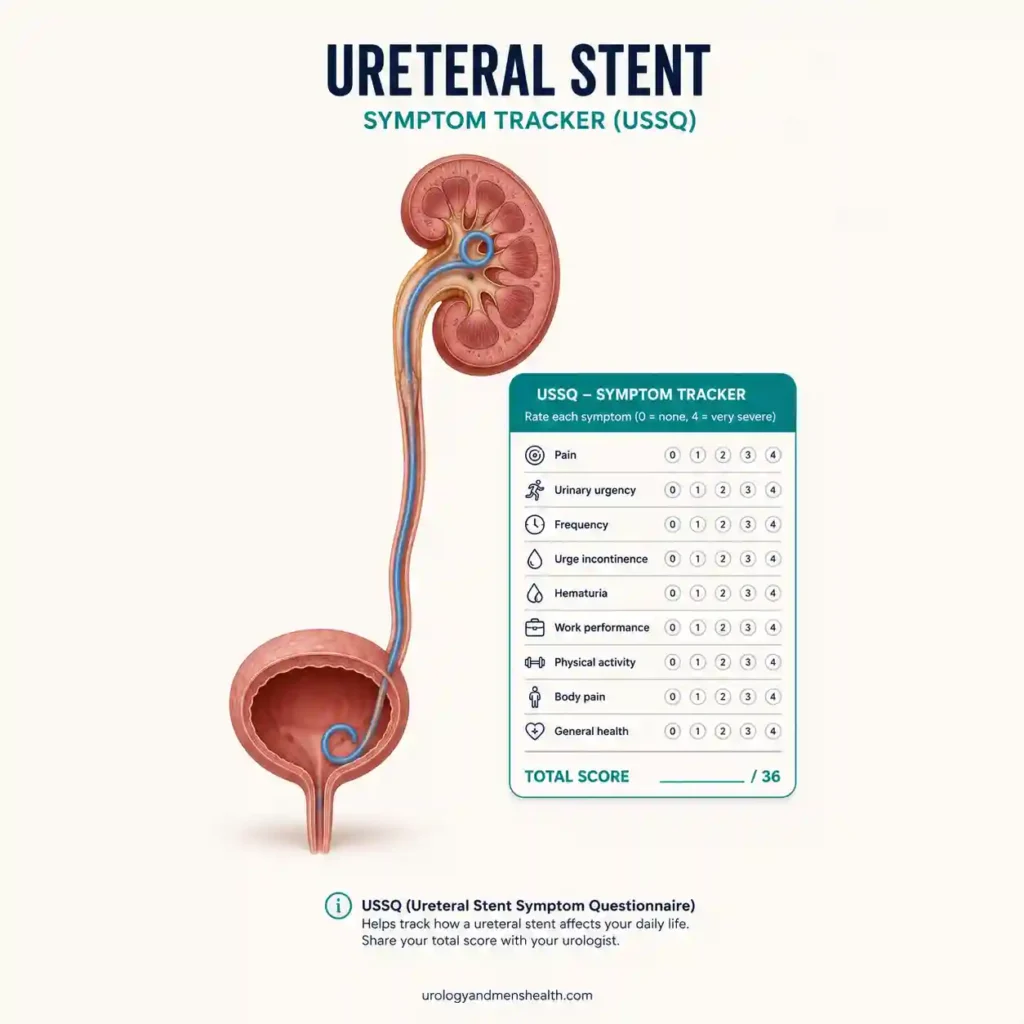
This Ureteral Stent Symptom Tracker turns the discomfort of an indwelling stent into a simple score you can act on. Answer ten quick questions about urinary symptoms, flank and bladder pain, and how the stent is affecting daily life, and you will get a clear severity band, a plain-English interpretation from a urologist, and a printable report for your next visit. See more on the surgery recovery hub.

The Tool
Related Surgery Tools
Full Clinical Guide
In This Guide:
- Most stent symptoms — frequency, a twinge of flank pain, a little blood in the urine — are expected and settle completely once the stent is removed.
- Two mechanisms drive the discomfort: bladder trigone irritation (urgency, frequency) and urine refluxing up the stent (flank pain) — and they respond to different medicines.
- An alpha-blocker such as tamsulosin is under-used and reliably takes the edge off; ask for it if symptoms affect daily life.
- Fever with stent symptoms is never routine — it is an urgent call, not something to track.
What This Ureteral Stent Symptom Tracker Measures
This ureteral stent symptom tracker scores how much an indwelling ureteral (JJ or double-J) stent is affecting you, across the same areas of life that the validated Ureteral Stent Symptom Questionnaire (USSQ) was built to measure. The USSQ was developed and validated by Joshi and colleagues in 2003 across more than 300 patients, using 38 items grouped into six domains — urinary symptoms, body pain, general health, work performance, sexual matters and additional problems [1]. This tracker is a plain-English self-monitoring version built on those domains, not the scored research instrument, which needs licensed administration. A stent is usually placed to keep the ureter draining after a stone is treated or passed — the same situation covered in how to pass a kidney stone fast.
The Physiology Behind the Score
A stent is a soft hollow tube with a coil curled in the kidney and a coil curled in the bladder. The bladder coil rests against the trigone — the sensitive triangle at the base of the bladder that is rich in the same nerve receptors targeted by bladder medicines — which is why so many people feel urgency, frequency and burning even with no infection present. The upper coil, and the pressure of urine travelling back up the stent when you pass water, produce the classic twinge of flank or kidney pain during voiding. This is why up to about 80% of people with a stent notice at least one symptom, and why medication that relaxes ureteral and bladder smooth muscle helps: an alpha-blocker such as tamsulosin has been shown across randomized trials to lower stent urinary and pain scores [2]. The one time to worry is duration — the longer a stent stays in, the greater the risk of it encrusting with mineral, which is the single biggest reason forgotten stents cause trouble [5]. If your stent went in after a stone, the kidney stone passage calculator puts that episode in context.
How to Interpret Your Result
The tracker adds your ten answers into a 0–40 score and sorts it into three practical bands: mild (0–13), moderate (14–26) and severe (27–40). These are guidance thresholds for self-monitoring, not official USSQ cut-offs. In clinic the contrast is stark: a person who scores 6 and a person who scores 30 are living with the same piece of plastic but need completely different advice — one needs reassurance and a confirmed removal date, the other needs a phone call today. A mild score means the stent is behaving as expected and comfort measures are the priority. A moderate score usually means one or both mechanisms are loud enough to justify medication. A severe score means the symptoms are hurting your function and deserve a prompt review, partly to rule out infection or a poorly sitting stent.
Read: Kidney Stone Stent Pain — How to Manage ItWhat to Do With Your Result
Match the action to the band. For mild scores, keep urine dilute with around 2 to 2.5 liters (about 68 to 85 fl oz) of water a day unless your fluids are restricted, empty your bladder when the urge comes rather than holding on, and confirm your removal date is actually booked — most stents are meant to stay in only days to a few weeks. For moderate scores, this is a medication conversation: ask specifically about tamsulosin 0.4 mg once daily, and whether a medicine for urgency (an antimuscarinic or mirabegron) would help your particular mix of symptoms. For severe scores, or any fever, contact your urology team promptly rather than waiting for the removal date. Both the EAU and AUA urolithiasis guidelines treat stent burden and the risk of a retained, encrusting stent as reasons to keep the removal plan tight [3][4]. If your stent followed a specific operation, the post-operative recovery timeline shows where stent removal usually falls in the schedule.
Read: RIRS (Flexible Ureteroscopy) ExplainedIf you are unsure about your result, the PDF report this tool generates gives you a ready-made framework to bring to your next appointment.
In My Practice
Over the years the pattern I trust most is the phone call that starts “the stent is worse today and I feel shivery.” Frequency and flank ache I can usually manage over the phone; a fever changes the whole plan, because a stent sitting above an infection is an emergency, not an inconvenience. I would rather see ten people whose temperature turns out normal than miss the one whose doesn’t.
Track your symptoms by all means — but let a thermometer, not a symptom score, decide whether today’s call is urgent.
References
- Joshi HB, Newns N, Stainthorpe A, et al. Ureteral stent symptom questionnaire: development and validation of a multidimensional quality of life measure. J Urol. 2003;169(3):1060–1064. PubMed. The USSQ validation study (309 patients, 38 items, six domains).
- Lamb AD, Vowler SL, Johnston R, et al. Meta-analysis showing the beneficial effect of alpha-blockers on ureteric stent discomfort. BJU Int. 2011;108(11):1894–1902. PubMed. Alpha-blockers reduce stent urinary and pain scores.
- European Association of Urology. Guidelines on Urolithiasis. 2025. EAU Guidelines. Stent use, encrustation risk and removal.
- American Urological Association / Endourological Society. Surgical Management of Stones Guideline. AUA Guideline. Peri-procedural stenting.
- EAU Young Academic Urologists Urolithiasis Group. Endourological management of encrusted ureteral stents: an up-to-date guide and treatment algorithm. 2022. PMC. Indwelling time is the key encrustation driver.
Frequently Asked Questions
How long do ureteral stent symptoms usually last?
Which medicines help ureteral stent pain?
When should stent symptoms make me worried?
How accurate is this tool, and can I rely on it?
How do I use this result at my doctor’s appointment?
Dr. Muhammad Khalid
MBBS · FCPS (Urology) · MCPS (General Surgery) · CHPE · CRSM · IMC #539472
Specialist urologist with 11+ years of clinical experience across tertiary teaching hospitals. Trained at Lady Reading Hospital and Khyber Teaching Hospital, Peshawar. Author or co-author of five peer-reviewed international publications, including in Cureus and the World Journal of Surgery. Procedural expertise: URS, PCNL, RIRS, TURP, TURBT, and major open urological surgery. Full profile →
This article is for educational purposes only and does not constitute medical advice. Always consult your physician or urologist for diagnosis and treatment decisions specific to your condition.