
24-Hour Urine Test Interpreter for Kidney Stones
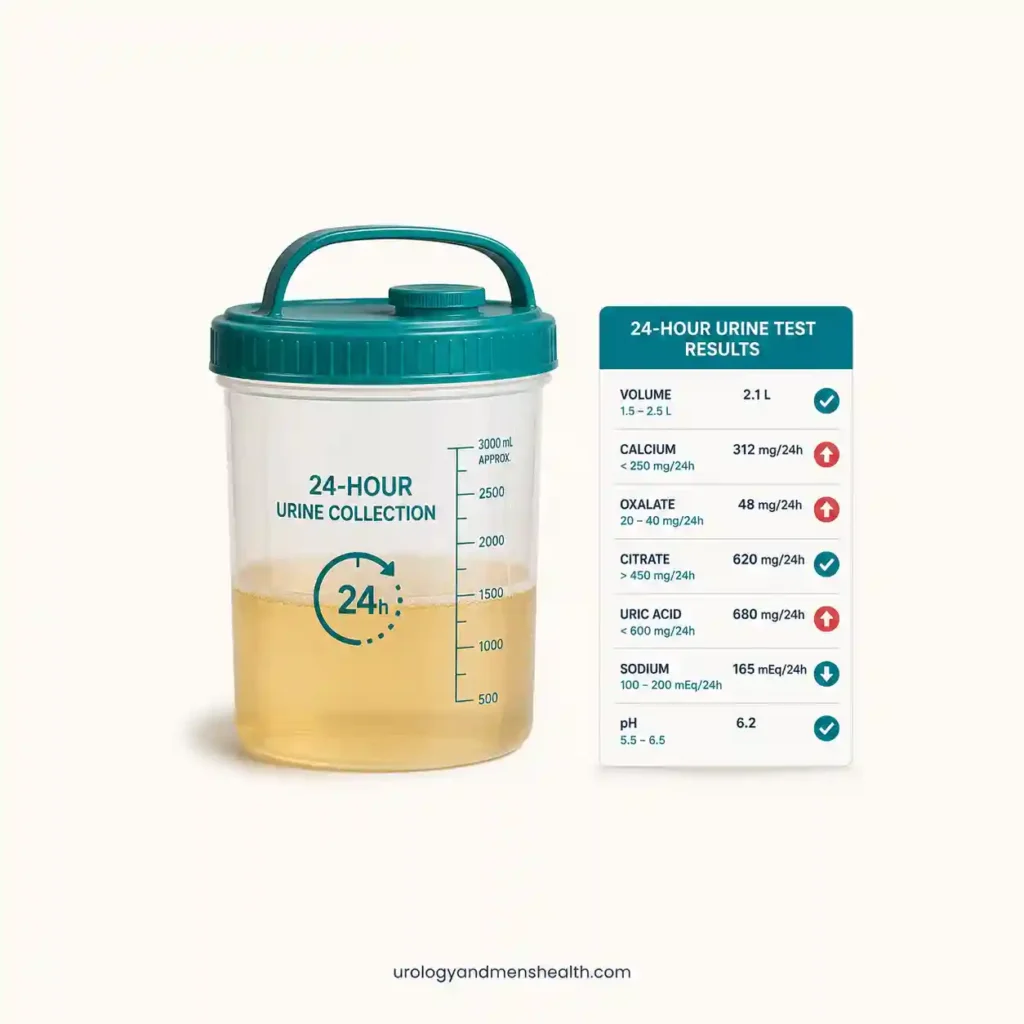
This 24-hour urine test interpreter turns the raw numbers on your stone-prevention report - volume, calcium, oxalate, citrate and more - into a plain-English readout of which risk factors are flagged and which are protecting you. It is built for anyone who has done a 24-hour urine collection after a kidney stone and wants to understand the result before their follow-up. Enter your values to see your profile against AUA and EAU reference ranges, then read the kidney stones hub for the full prevention picture.

The Tool
Related Kidney Tools
Full Clinical Guide
In This Guide:
- A 24-hour urine test is the metabolic fingerprint of why you form stones – it shows the drivers behind the stone, not just the stone itself.
- The values that matter most are volume, calcium, oxalate and citrate; low volume is the single most common and most fixable problem.
- One clean collection is a snapshot, not a verdict – it reflects how you ate and drank that day, which is why a second collection is often worth doing.
- A flagged result is a to-do list, not a sentence: each abnormal value points to a specific fluid, diet or medication fix, confirmed by a re-test in 8 to 12 weeks.
What This Tool Measures
This 24-hour urine test interpreter reads the chemistry panel that urologists use to understand why you form kidney stones. After you collect every drop of urine for a full day, the lab measures how much of each stone-related chemical you excrete. The American Urological Association recommends this panel measure, at minimum, total volume, pH, calcium, oxalate, uric acid, citrate, sodium, potassium and creatinine [1]. A single stone tells you that you made one; the 24-hour urine tells you why, which is the difference between treating an episode and preventing the next one. If you have had more than one stone, the result of this test usually decides your entire prevention plan – the same reasoning behind a full metabolic workup for recurrent stones.
The Chemistry Behind the Result
Stones form when urine becomes supersaturated – so crowded with stone-forming salts that they crystallize out of solution, the way sugar stops dissolving in iced tea once you add too much. Three things control that balance. Water dilutes everything, which is why a low volume raises risk on its own. Calcium and oxalate are the building blocks of the most common stone, so when either runs high the urine tips toward crystal formation. Citrate is the brake: it wraps around calcium and stops crystals from sticking together, so low citrate (hypocitraturia) removes your natural protection. Reading your panel is really a question of which of these levers is out of position – and your overall recurrence odds, which a tool like the Kidney Stone Risk Profiler estimates, depend heavily on how many of them are off at once.
How to Interpret Your Result
The tool counts how many of your values fall outside the protective range. A low-risk profile (no flags) means every measured value is working in your favor on the day you collected – the priority is confirming this is your steady state, not a single good day. Correctable risk factors (one or two flags) is the most common and most fixable pattern: low volume below 2 liters, high calcium (250 mg/day or more in men, 200 in women), high oxalate above 40 mg/day, or low citrate each map to a specific lever. A multiple or high-risk profile (three or more flags, or one extreme value such as oxalate above 75 mg/day) usually needs a specialist-led plan that pairs diet with targeted medication. Your target volume sits at 2.5 liters of urine a day or more, which for most people means drinking noticeably more than that.
What to Do With Your Result
Match the fix to the flag rather than overhauling everything at once. If volume is low, build toward 2.5 liters of urine daily and re-measure – this alone resolves a large share of profiles. If calcium is high, the first move is usually less salt, because urinary sodium drags calcium into the urine; working toward roughly 2,300 mg of sodium (about 100 mmol) a day often pulls calcium back down without cutting dietary calcium, which you should keep at a normal 1,000 to 1,200 mg/day. If oxalate is high, pairing oxalate-rich foods with a calcium source at the same meal binds oxalate in the gut – the logic built into the Calcium-Oxalate Meal Balancer. If citrate is low, more fruit and vegetables and sometimes potassium citrate restore the brake. Then re-test in 8 to 12 weeks to confirm the number actually moved.
If you are unsure about your result, the PDF report this tool generates gives you a ready-made framework to bring to your next appointment.
In My Practice
The mistake I see most often is a patient who fixes one number, feels finished, and never re-collects. A man drops his sodium, his calcium falls beautifully – and we only know because we repeated the test. Without that second collection he would have been guessing, and guessing is how the next stone arrives.
A 24-hour urine is most powerful as a before-and-after pair. The first one finds the problem; the second one proves you fixed it.
References
- Pearle MS, et al. Medical Management of Kidney Stones: AUA Guideline. American Urological Association. Target urine volume ≥2.5 L/day; hyperuricosuria >800 mg/day; citrate target ≥600 mg/day; primary hyperoxaluria suspected >75 mg/day.
- EAU Guidelines Panel on Urolithiasis. Metabolic Evaluation and Recurrence Prevention. European Association of Urology. Two 24-hour collections for high-risk stone formers; follow-up collection 8-12 weeks after starting prevention.
- Leslie SW, et al. 24-Hour Urine Testing for Nephrolithiasis: Interpretation and Treatment Guidelines. StatPearls, NCBI Bookshelf. Core abnormalities: low volume, hypercalciuria, hyperoxaluria, hyperuricosuria, hypocitraturia, high urinary sodium.
- Improved 24-hour urine parameters associated with reduced symptomatic kidney stone recurrence. Urolithiasis (2025). Abnormality definitions: hypercalciuria M≥250 / F≥200 mg/day; hyperoxaluria >40 mg/day; hypocitraturia M≤450 / F≤550 mg/day.
Frequently Asked Questions
What values does a 24-hour urine test for kidney stones measure?
Which number on the report matters most?
Why was my result normal when I clearly form stones?
How accurate is this tool, and can I rely on it?
How do I use this result at my doctor’s appointment?
Dr. Muhammad Khalid
MBBS · FCPS (Urology) · MCPS (General Surgery) · CHPE · CRSM · IMC #539472
Specialist urologist with 11+ years of clinical experience across tertiary teaching hospitals. Trained at Lady Reading Hospital and Khyber Teaching Hospital, Peshawar. Author or co-author of five peer-reviewed international publications, including in Cureus and the World Journal of Surgery. Procedural expertise: URS, PCNL, RIRS, TURP, TURBT, and major open urological surgery. Full profile →
This article is for educational purposes only and does not constitute medical advice. Always consult your physician or urologist for diagnosis and treatment decisions specific to your condition.