
UPOINT Phenotype Classifier for Chronic Prostatitis (CP/CPPS)
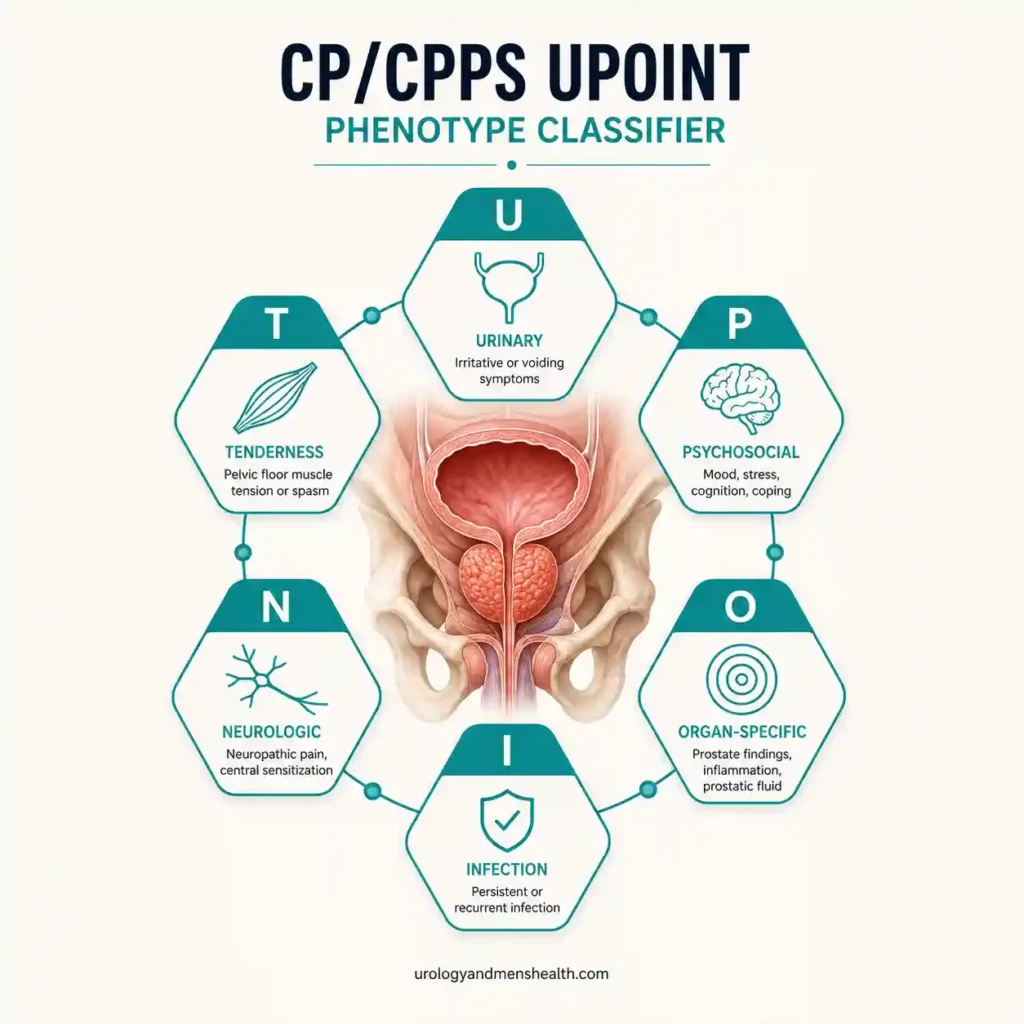
This UPOINT phenotype classifier maps your chronic prostatitis (CP/CPPS) symptoms across six clinical domains - urinary, psychosocial, organ-specific, infection, neurologic, and tenderness - so you can see which targeted treatments fit your pattern. It is built on the validated UPOINT system urologists use to move past one-size-fits-all antibiotics. Answer six quick questions, then take your phenotype to the UTIs and infections hub for the wider picture.

The Tool
Related UTI & Infection Tools
Full Clinical Guide
- UPOINT sorts CP/CPPS into six treatable domains – Urinary, Psychosocial, Organ-specific, Infection, Neurologic, Tenderness – because chronic prostatitis is several overlapping problems, not one.
- The number of positive domains tracks with how severe your symptoms are, so this tool reports your domain count and points each domain to its matched therapy.
- A negative Infection domain is the rule, not the exception – most CP/CPPS is not an active infection, which is why repeat antibiotics so often fail.
- More than one positive domain calls for multimodal therapy – treating each driver in parallel, the approach with the best trial evidence.
What This UPOINT Phenotype Classifier Measures
This UPOINT phenotype classifier sorts chronic prostatitis / chronic pelvic pain syndrome (CP/CPPS) into the six clinical domains of the UPOINT system: Urinary, Psychosocial, Organ-specific, Infection, Neurologic/systemic, and Tenderness of the pelvic floor muscles. UPOINT was developed and validated by Shoskes and colleagues in 2009 in a study of 90 men, where the number of positive domains correlated with symptom severity on the NIH Chronic Prostatitis Symptom Index [1]. CP/CPPS is the most common urologic diagnosis in men under 50 and accounts for the large majority of all prostatitis cases, yet it has no single cause – which is exactly the problem UPOINT was built to solve. The tool does not diagnose you; it organizes your symptoms into a phenotype that points toward the treatments most likely to help.
Why Phenotyping Beats One-Size-Fits-All
For decades, CP/CPPS was treated as if it were a stubborn prostate infection, and nearly everyone received antibiotics. The reason that approach disappoints is simple: in most men the prostate is not infected at all. CP/CPPS behaves more like a “snowflake” condition – each man carries his own mix of drivers, from a tight pelvic floor to a sensitized nervous system to the psychological weight of months of pain. Think of UPOINT as six separate dials rather than a single switch; two men with identical pain scores can have completely different dials turned up. Pinning down which dials are raised is what turns a vague diagnosis into a plan. If you want to put a number on the severity those dials are producing, the NIH-CPSI symptom score measures it directly and pairs naturally with this phenotype.
How to Interpret Your Phenotype
Your result reports how many of the six domains you flagged, grouped into three patterns. A focused phenotype (0-1 domains) usually has one clear target and one clear first-line therapy. A multi-domain phenotype (2-3 domains) means several mechanisms are active at once. A complex phenotype (4-6 domains) explains why single-drug trials failed and calls for coordinated, combined care. The contrast is real: a man with one positive domain might need nothing more than a six-week course of pelvic floor physical therapy, while a man with five positive domains needs physical therapy, a bladder drug, a nerve-pain medication, and psychological support running together. Each domain maps to its own evidence-based therapy:
| Domain | Typical first-line therapy |
|---|---|
| U – Urinary | Alpha-blocker (e.g. tamsulosin) or a bladder-calming antimuscarinic |
| P – Psychosocial | Cognitive behavioral therapy; treat depression/anxiety; address catastrophizing |
| O – Organ-specific | Quercetin or pollen extract; a 5-alpha-reductase inhibitor in older men |
| I – Infection | A targeted antibiotic course – only when a culture confirms infection |
| N – Neurologic | A neuromodulator such as amitriptyline, pregabalin, or gabapentin |
| T – Tenderness | Pelvic floor physical therapy and myofascial release with a specialist |
What to Do With Your Result
If you have a focused phenotype, ask your doctor to start the single matched therapy and judge it at six weeks. If you have a multi-domain or complex phenotype, the goal changes: ask for a multimodal plan that treats each positive domain in parallel, because in a prospective study of 100 men, 84% achieved a meaningful improvement – a fall of six or more points on the NIH-CPSI – with UPOINT-directed multimodal therapy [2]. Whatever your count, do not accept another reflex antibiotic prescription if your Infection domain is negative; that single point spares many men from courses that cannot work. A common overlap is pelvic floor tightness that mimics other pelvic conditions, so it is worth understanding how urinary and infective symptoms differ before assuming the cause. If you are unsure about your result, the PDF report this tool generates gives you a ready-made framework to bring to your next appointment.
In My Practice
The single most useful thing UPOINT does in clinic is slow the conversation down. A man arrives certain he has a stubborn infection because every doctor reached for antibiotics; mapping his six domains usually shows the infection box is empty and the tenderness and psychosocial boxes are full. Naming that out loud changes what we treat – and changes how he understands his own body.
UPOINT’s value is not the label. It is redirecting treatment away from the domains you do not have and toward the ones you do.
References
- Shoskes DA, Nickel JC, Dolinga R, Prots D. Clinical phenotyping of patients with chronic prostatitis/chronic pelvic pain syndrome and correlation with symptom severity. Urology. 2009;73(3):538-543. The original 90-man UPOINT validation; more positive domains correlated with greater symptom severity and longer duration.
- Shoskes DA, Nickel JC, Kattan MW. Phenotypically directed multimodal therapy for chronic prostatitis/chronic pelvic pain syndrome: a prospective study using UPOINT. Urology. 2010;75(6):1249-1253. 100 men; 84% had a 6-point or greater fall in NIH-CPSI on UPOINT-directed multimodal therapy.
- European Association of Urology. EAU Guidelines on Chronic Pelvic Pain. Covers CP/CPPS definition, phenotype-directed assessment, and prevalence (reported between roughly 2% and 14% of men depending on population).
- American Urological Association. Diagnosis and Management of Male Chronic Pelvic Pain (CP/CPPS): AUA Guideline. Endorses individualized, multimodal, phenotype-aware management.
Frequently Asked Questions
What is the UPOINT system?
UPOINT is a six-domain framework that classifies chronic prostatitis / CP/CPPS by which mechanisms are driving a man’s symptoms: Urinary, Psychosocial, Organ-specific, Infection, Neurologic/systemic, and Tenderness. Each positive domain has its own matched treatment, which is why phenotyping guides therapy better than a single drug. To measure how severe those symptoms are, pair it with the NIH-CPSI score.
Does a positive Infection domain mean I have an infection?
Only if a laboratory culture confirmed it. The Infection domain is positive when a urine or prostatic-fluid culture grew bacteria, or you have had repeated culture-proven UTIs – not from symptoms alone. In most men with CP/CPPS this domain is negative, which is the central reason ongoing antibiotics so often fail. Our CP/CPPS treatment guide explains this distinction in detail.
Can I have CP/CPPS if I flagged only one domain?
Yes. A focused, single-domain phenotype is common and is often the easiest to treat, because there is one clear target. Flagging no domains is the signal worth a second look – it may mean your symptoms fit a different condition, so it is worth asking your doctor to reconsider the diagnosis and check for an overlooked cause such as incomplete bladder emptying.
How accurate is this tool, and can I rely on it?
This classifier follows the published UPOINT system, which has been validated against symptom severity in multiple cohorts. It is a screening and organizing aid, not a diagnosis: it reflects the answers you give and cannot examine you, review your cultures, or feel your pelvic floor. Use it to structure the conversation with a clinician who can confirm each domain, not to replace that assessment.
How do I use this result at my doctor’s appointment?
Tap “Download My Report” to generate a two-page PDF listing your positive domains, an interpretation, and questions to ask. Bring it to your primary care doctor or urologist so you can agree which domains to treat first and how progress will be measured. It turns a vague “the pain is still there” visit into a focused, domain-by-domain plan.
Dr. Muhammad Khalid
MBBS · FCPS (Urology) · MCPS (General Surgery) · CHPE · CRSM · IMC #539472
Specialist urologist with 11+ years of clinical experience across tertiary teaching hospitals. Trained at Lady Reading Hospital and Khyber Teaching Hospital, Peshawar. Author or co-author of five peer-reviewed international publications, including in Cureus and the World Journal of Surgery. Procedural expertise: URS, PCNL, RIRS, TURP, TURBT, and major open urological surgery. Full profile →
This article is for educational purposes only and does not constitute medical advice. Always consult your physician or urologist for diagnosis and treatment decisions specific to your condition.