Pelvic Floor Dysfunction in Men vs CPPS: The Difference
Pelvic floor dysfunction in men is the most common driver of what gets labeled chronic prostatitis — and the one thing almost nobody examines. Here is how I tell the two apart, and why the answer changes the treatment.

Pelvic floor dysfunction in men is the most commonly missed explanation for pain that has already been labeled chronic prostatitis. The man sitting opposite me has usually had three years of perineal ache, four courses of antibiotics, and a urine culture that came back sterile every single time. Nobody has ever examined his pelvic floor muscles. That is the gap this article closes.
Chronic pelvic pain syndrome (CPPS) and pelvic floor dysfunction are not two rival diagnoses where one has to be wrong. CPPS is the umbrella label for pelvic pain lasting three months or longer with no proven infection. Pelvic floor dysfunction is one of the mechanisms sitting underneath that umbrella — and in the phenotyping study that reshaped how urologists classify these men, muscle tenderness was present in more than half of them [1].
What follows is how I separate the two in clinic, what the physical exam actually has to include, and why the treatment for a tight pelvic floor is close to the opposite of what most men get told to do. For the wider picture of male pelvic and urinary conditions, see our UTIs and Infections Hub.
Key Takeaways
- In 90 men with CPPS phenotyped by the UPOINT system, muscle tenderness was present in 53% while infection was present in only 16% — the pelvic floor is by far the more common finding.
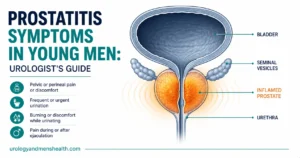
- A hypertonic (over-tight) pelvic floor produces perineal pain, a slow or stop-start stream, and post-ejaculatory ache — symptoms that read as prostate symptoms but originate in muscle inches away.
- The diagnosis is made by palpating the levator ani during a rectal exam and asking whether that pressure reproduces your usual pain — not by a PSA, a scan, or a fifth urine culture.
- Kegel exercises can make a tight pelvic floor worse. Relaxation training comes first; strengthening is for weak floors, not tight ones.
What pelvic floor dysfunction in men actually is
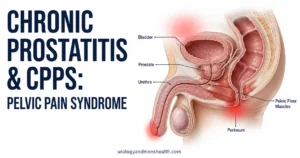
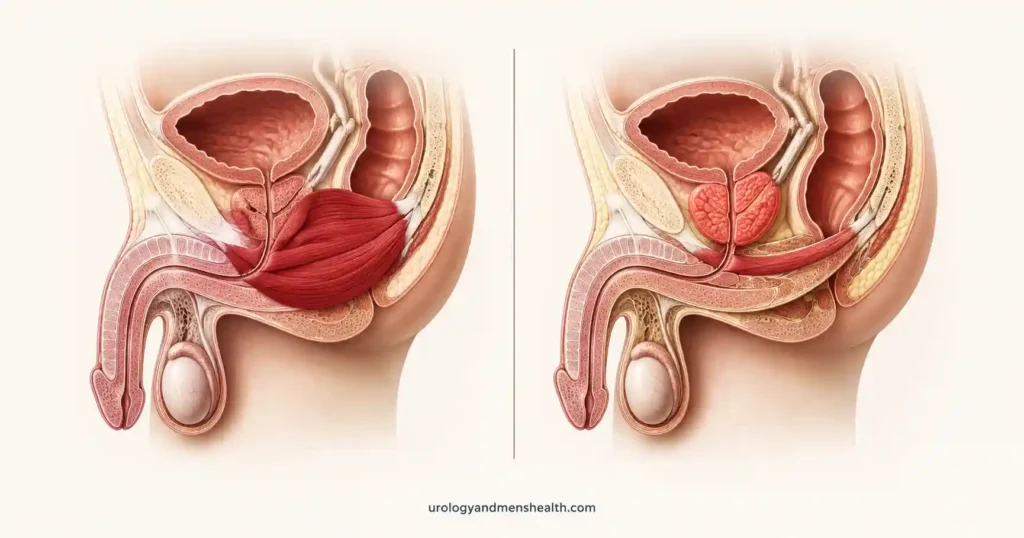
Your pelvic floor is a muscular hammock slung from the pubic bone at the front to the tailbone at the back. The main group is the levator ani — puborectalis, pubococcygeus, and iliococcygeus — with the obturator internus sitting on the side wall of the pelvis. The urethra and rectum pass straight through it.
These muscles have to do two opposite jobs. They hold tone all day so you stay continent and supported. Then, on demand, they have to let go completely so you can pass urine or open your bowels. Pelvic floor dysfunction is a failure of one of those two jobs.
There are two versions. A hypotonic floor is too weak — that is the man leaking urine after a radical prostatectomy, and it does need strengthening. A hypertonic floor is stuck in low-grade contraction and never fully releases. That is the version that gets misfiled as prostatitis, and it is the one this article is about.
Think about clenching your fist and holding it for a year. It aches on its own. It aches far more when someone presses it. And when you finally try to open the hand, it does not open smoothly. A hypertonic pelvic floor behaves the same way, with one extra problem: muscles this deep refer their pain elsewhere. Trigger points in puborectalis send pain to the tip of the penis. Obturator internus sends it to the suprapubic area and inner thigh. So the man points at his prostate, and the pain is coming from a muscle a few centimeters away. The European Association of Urology now treats the pelvic floor as a core part of the chronic pelvic pain assessment rather than an afterthought [7].
CPPS and pelvic floor dysfunction: where the definitions overlap
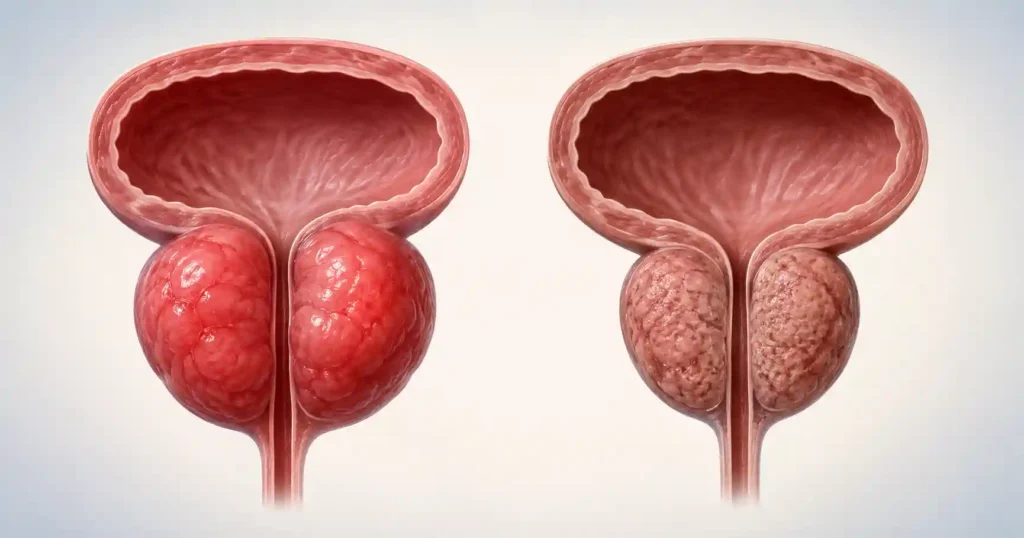
The NIH classification splits prostatitis into four categories: acute bacterial (I), chronic bacterial (II), chronic prostatitis/chronic pelvic pain syndrome (III), and asymptomatic inflammatory prostatitis (IV) [8]. Category III is the one almost every man in my clinic has been given, and it is defined by what is absent — no proven infection — rather than by what is causing the pain.
That is why the UPOINT system exists. It sorts men into six domains: Urinary, Psychosocial, Organ-specific, Infection, Neurologic/systemic, and Tenderness of skeletal muscle. Pelvic floor dysfunction is not an alternative to CPPS — it is the T domain.
When Shoskes and colleagues applied UPOINT to 90 men with CPPS, the domain frequencies were: organ-specific 61%, tenderness 53%, urinary 52%, neurologic/systemic 37%, psychosocial 34%, and infection just 16% [1]. Read that last pair again. Muscle tenderness was more than three times as common as infection, yet antibiotics remain the reflex prescription and a muscle exam remains optional.
The same study found something that should change how quickly men get referred: the number of positive domains rose with symptom severity, and men with symptoms lasting longer than two years carried significantly more positive domains than men below that mark [1]. Waiting does not simplify this problem. It recruits more of them.
How chronic prostatitis and CPPS are treated when the cause is not bacterialGet the Chronic Prostatitis / CPPS Guide — what to ask for when antibiotics have not worked
Enter your email below to receive Dr. Khalid’s complete Chronic Prostatitis / CPPS Guide as a free, printable PDF.
The symptom patterns that point at muscle, not prostate
No single symptom proves it. But these patterns move my suspicion strongly toward the pelvic floor, and each one has a mechanical reason behind it.
- Pain that builds with sitting and eases when you stand or walk. A hard seat compresses levator and obturator trigger points directly. Prostatic inflammation does not behave this predictably with posture.
- Pain at the tip of the penis with a completely normal urinalysis. This is referred pain from puborectalis. Men describe it as burning after urination has finished, which makes no sense for a urinary infection and perfect sense for a muscle.
- A hesitant or stop-start stream in a man in his twenties to forties. The prostate at that age is too small to obstruct. What is happening is the pelvic floor and external sphincter failing to relax on cue while the bladder contracts against them.
- An ache after ejaculation that lasts hours or into the next day. Ejaculation is a pelvic floor event — those muscles contract hard and rhythmically. A floor that is already tight contracts, then cannot let go.
- A sensation of sitting on a golf ball, or of never emptying fully, with a low post-void residual. The bladder is empty. The muscle tension is producing the sensation of fullness.
- Constipation and straining that predate the urinary symptoms. The same muscles fail to relax for defecation, and men often forget to mention it because it seems unrelated.
- An identifiable trigger. Heavy squatting or deadlifting, a jump in long-distance cycling, a period of sustained stress, or a genuine bacterial infection that was cured while the protective muscle guarding never switched back off.
Equally, some features send me straight away from this diagnosis: fever with a hot, exquisitely tender prostate points to acute bacterial prostatitis; a genuinely positive culture points to a bacterial category; and visible blood in the urine needs its own workup regardless of how well the pelvic floor story fits. The distinction between the acute and chronic bacterial pictures is worth understanding on its own — I cover it in acute versus chronic prostatitis.
How the diagnosis is actually made
Start with a number you can track. The NIH Chronic Prostatitis Symptom Index is a nine-item validated questionnaire scoring pain, urinary symptoms, and quality of life impact, developed and psychometrically tested by the Chronic Prostatitis Collaborative Research Network [6]. Score yourself before you start anything, because a change of six points or 25% is the threshold treatment trials use to call a response meaningful [4]. Without a baseline you will be guessing about whether you are improving. You can generate and print your baseline with our NIH-CPSI symptom score tool.
Then the exam that decides it. During the rectal exam, the examining finger should do two separate things. First, assess the prostate itself for size, tenderness, and nodules. Second — and this is the step that gets skipped — angle laterally and posteriorly to palpate the levator ani muscle belly and the obturator internus, one side at a time.
The question asked out loud during that palpation is the whole test: “Is this your pain?” Reproduction of your exact everyday symptom by pressing on muscle, in the presence of a non-tender prostate, is the finding that reclassifies you. It takes about twenty extra seconds.
In My Practice
A 34-year-old cyclist came to me on his fifth antibiotic course, carrying a folder with four negative cultures in it. He had been told his prostate was the problem by three different doctors, none of whom had recorded a muscle exam. On palpation his left levator ani reproduced the exact burning he felt at the tip of his penis, and his prostate was completely non-tender. He looked genuinely angry — not at me, but at the three years.
When a man has a folder of negative cultures and no documented pelvic floor exam, the exam is the missing test, not another culture.
Around that exam, a short and finite list of investigations: a urinalysis and culture (once, not repeatedly), sexually transmitted infection testing if there is any exposure history, and a post-void residual measured by bladder ultrasound to confirm you are actually emptying. A uroflow rate is worth adding if your stream is genuinely poor. Repeat cultures, transrectal ultrasound, and cystoscopy add nothing in the absence of red flags. Working through which domains are driving your particular case is what the UPOINT phenotype classifier is built to do.
Treatment: why the antibiotics failed and what works instead
The 2019 Cochrane review of drug treatment for CP/CPPS pooled six antibiotic trials in 693 men. Quinolones reduced the NIH-CPSI score by a mean of 2.43 points versus placebo, on low-quality evidence [4]. That sits well below the six-point bar the same review sets for a clinically meaningful change. One empirical course in a man who has never had one is defensible. The fourth course is not treatment, it is habit.
Alpha-blockers fare only marginally better. Across 18 trials in 1,524 men the pooled reduction was about five points, but the evidence was rated very low quality and the drugs carried a higher rate of dizziness and postural drops in blood pressure [4]. If your urinary domain dominates, a six-week trial is reasonable — with a hard stop and reassessment at six weeks if nothing has shifted.
The intervention with the strongest signal in this population targets the muscle directly. The Stanford protocol combined internal myofascial trigger point release with paradoxical relaxation training in 138 men whose CP/CPPS had already failed conventional therapy; 72% reported moderate or marked improvement, with the first measurable change typically appearing after a median of five sessions [2]. The NIH-funded multicenter randomized trial then compared myofascial physical therapy against general therapeutic massage and found a global response rate of 57% versus 21% [3]. That is the comparison that matters — it was not tested against nothing, it was tested against a plausible placebo and still won.
What to ask for specifically: a physical therapist with training in internal (transrectal) male pelvic floor work, not general core rehabilitation. Book a block of 8 to 12 sessions before judging whether it is working, and re-score your NIH-CPSI at session 6 and at the end.
Now the part almost everyone gets backwards. NIDDK lists both Kegel exercises and myofascial release among the measures used for prostatitis [8], and men take that as permission to start squeezing. If your floor is hypertonic, strengthening a muscle that already will not release is the wrong direction, and it is the single most common reason a man tells me his pain got worse after he “started doing his exercises.” Relaxation work — diaphragmatic breathing, heat, deliberate letting-go on the out-breath, reduced sitting time, a cut-out saddle if you cycle, and treating any constipation — comes first. Strengthening has a real place, but it belongs to the weak pelvic floor, and I set out when it applies in Kegel exercises for men.
Two adjuncts carry better evidence than their reputation suggests. In the 2018 Cochrane review of non-drug treatments, acupuncture reduced NIH-CPSI scores by a mean of 5.79 points against a sham procedure on high-quality evidence, and extracorporeal shockwave therapy by 6.18 points, also high quality — although the shockwave benefit may not hold at medium-term follow-up [5]. Neither replaces physical therapy. Both are worth discussing if progress stalls.
When This Is Not Your Pelvic Floor
Pelvic floor dysfunction is a diagnosis you reach after excluding the dangerous causes, never before. Seek care on these timelines:
- Emergency room the same day: fever with chills and pelvic pain, or complete inability to pass urine.
- Emergency room within hours: sudden severe pain in one testicle, with or without nausea — testicular torsion is time-critical.
- Emergency room immediately: numbness in the saddle area, new weakness in a leg, or loss of bowel or bladder control. This is a spinal cord and nerve root emergency, not a muscle problem.
- Urology within two weeks: visible blood in the urine at any age, and especially if you are over 50 or a current or former smoker.
- Urgent urology review: unexplained weight loss, bone pain, or a PSA that is rising on repeat testing.
Frequently Asked Questions
Is pelvic floor dysfunction in men the same thing as chronic prostatitis?
No — but they are not rivals either. Chronic prostatitis/CPPS is an umbrella label for pelvic pain lasting three months or more with no proven infection. Pelvic floor dysfunction is one of the mechanisms underneath it, and it is the tenderness domain of the UPOINT phenotype system. Most men carry more than one domain, which is why single-target treatment so often disappoints. The UPOINT classifier maps which apply to you.
How do I know whether my pelvic floor is too tight or too weak?
Symptoms point in opposite directions. A tight floor causes pain, a hesitant or stop-start stream, post-ejaculatory ache, and a sensation of incomplete emptying. A weak floor causes leakage — typically after prostate surgery. If pain is your main complaint, assume tightness until a clinician examines you. Guessing wrong matters, because the exercises for one make the other worse.
Will Kegel exercises help my pelvic pain?
Usually not, and they frequently make it worse. Kegels strengthen and shorten muscles. A hypertonic pelvic floor is already shortened and unable to release, so adding contraction reinforces the problem. Relaxation training comes first — breathing, heat, reduced sitting, and hands-on release. Strengthening has a genuine role once tone is normal, which I explain in Kegel exercises for men.
How long does pelvic floor physical therapy take to work for CPPS?
In the Stanford series, the first measurable change appeared after a median of five sessions, with 72% of men reporting moderate or marked improvement overall. Commit to a block of 8 to 12 sessions with a therapist trained in internal male pelvic floor work before deciding it has failed, and re-score your symptoms at the halfway point using the NIH-CPSI tool rather than relying on memory.
Can a tight pelvic floor really cause a weak urine stream and pain after ejaculation?
Yes, and both have straightforward mechanics. The pelvic floor and external sphincter must relax for urine to flow; when they do not, the stream becomes hesitant or stop-start even with a small prostate. Ejaculation is itself a forceful pelvic floor contraction, so a floor that is already tight contracts hard and then cannot release, producing an ache lasting hours.
References
- Shoskes DA, Nickel JC, Dolinga R, Prots D. Clinical phenotyping of patients with chronic prostatitis/chronic pelvic pain syndrome and correlation with symptom severity. Urology. 2009;73(3):538-542. PubMed
- Anderson RU, Wise D, Sawyer T, Chan C. Integration of myofascial trigger point release and paradoxical relaxation training treatment of chronic pelvic pain in men. J Urol. 2005;174(1):155-160. PubMed
- FitzGerald MP, Anderson RU, Potts J, et al. Randomized multicenter feasibility trial of myofascial physical therapy for the treatment of urological chronic pelvic pain syndromes. J Urol. 2009;182(2):570-580. PubMed
- Franco JVA, Turk T, Jung JH, et al. Pharmacological interventions for treating chronic prostatitis/chronic pelvic pain syndrome. Cochrane Database Syst Rev. 2019;10(10):CD012552. Cochrane Library
- Franco JVA, Turk T, Jung JH, et al. Non-pharmacological interventions for treating chronic prostatitis/chronic pelvic pain syndrome. Cochrane Database Syst Rev. 2018;5(5):CD012551. Cochrane Library
- Litwin MS, McNaughton-Collins M, Fowler FJ, et al. The National Institutes of Health chronic prostatitis symptom index: development and validation of a new outcome measure. J Urol. 1999;162(2):369-375. PubMed
- European Association of Urology. EAU Guidelines on Chronic Pelvic Pain. EAU Guidelines Office, Arnhem, the Netherlands; 2025. EAU
- National Institute of Diabetes and Digestive and Kidney Diseases. Prostatitis: Inflammation of the Prostate. NIDDK
Dr. Muhammad Khalid
MBBS · FCPS (Urology) · MCPS (General Surgery) · CHPE · CRSM · IMC #539472
Specialist urologist with 11+ years of clinical experience across tertiary teaching hospitals. Trained at Lady Reading Hospital and Khyber Teaching Hospital, Peshawar. Author or co-author of five peer-reviewed international publications, including in Cureus and the World Journal of Surgery. Procedural expertise: URS, PCNL, RIRS, TURP, TURBT, and major open urological surgery. Full profile →
This article is for educational purposes only and does not constitute medical advice. Always consult your physician or urologist for diagnosis and treatment decisions specific to your condition.