Acute vs Chronic Prostatitis: How to Tell the Difference
The difference between acute vs chronic prostatitis is not severity — it is whether bacteria are involved at all. That one distinction decides whether you need antibiotics, an ambulance, or neither.

The difference between acute vs chronic prostatitis is not how badly it hurts. It is whether bacteria are involved at all — and that single question decides whether a man needs an urgent same-day assessment, a four-week antibiotic course, or a treatment plan that contains no antibiotics whatsoever. I see this confusion constantly. A man arrives having been given three separate antibiotic courses over eight months for pelvic pain that never had an infection behind it in the first place. Meanwhile another man sits at home with a fever of 39°C (102°F) and worsening pelvic pain, assuming it is “just prostatitis” that will settle. One of those men is being over-treated; the other is at real risk of sepsis. Both were told they had prostatitis. For the wider picture of male urinary infections, see our UTIs and Infections Hub.
Key Takeaways
- Acute bacterial prostatitis comes on over hours to days with fever, rigors, and an exquisitely tender prostate — it is treated as an urgent problem, not an outpatient one.
- Chronic prostatitis is defined by pelvic pain lasting three months or longer, and in most men no bacteria are ever found.
- Roughly nine out of ten chronic prostatitis diagnoses are Category III (CP/CPPS), where repeat antibiotic courses do not help and often delay effective treatment.
- A urine culture taken before antibiotics start is the single test that separates the two — once antibiotics begin, that answer is usually lost for weeks.
- Chronic bacterial prostatitis is the rarer middle ground: real bacteria, no fever, and a required antibiotic course of four to six weeks rather than one.
The Four Types of Prostatitis — And Why the Category Decides the Treatment
“Prostatitis” is not one disease. Since 1999 it has been a family of four separate conditions grouped under a single National Institutes of Health classification [1]. They share a symptom — pelvic or perineal discomfort — and share almost nothing else.
- Category I — acute bacterial prostatitis. A genuine bacterial infection of the gland, arriving over hours to days, with systemic illness: fever, shaking chills, and severe pain.
- Category II — chronic bacterial prostatitis. The same organism keeps growing on culture and keeps causing relapsing urinary infections, but there is no fever and no systemic illness between flares.
- Category III — chronic prostatitis / chronic pelvic pain syndrome (CP/CPPS). Pelvic pain for at least three months with no bacteria ever identified. Subdivided into IIIA (inflammatory cells present in prostatic fluid) and IIIB (no inflammatory cells).
- Category IV — asymptomatic inflammatory prostatitis. Inflammation found incidentally on a biopsy specimen or during a fertility workup, in a man with no symptoms at all. It generally needs no treatment.
The reason this taxonomy matters practically: Categories I and II respond to antibiotics because bacteria are actually there. Category III does not, because they are not. Giving a Category III patient his fifth course of ciprofloxacin is not cautious medicine — it is the wrong drug for the wrong mechanism, with tendon and gastrointestinal risk attached.
What actually works for CP/CPPS when antibiotics have already failedAcute Bacterial Prostatitis: The Version That Sends Men to the ER
Acute bacterial prostatitis usually begins when gut bacteria — most often E. coli, sometimes Klebsiella, Proteus, or Enterococcus — ascend the urethra and reflux into the prostatic ducts. The gland becomes acutely inflamed and swollen. Because the prostate wraps around the urethra, that swelling can squeeze the urinary channel shut.
The presentation is not subtle. Men describe fever above 38°C (100.4°F), shaking chills, deep perineal or low back pain, burning on passing urine, and a stream that has become weak or stopped entirely. On rectal examination the prostate is hot, boggy, and so tender that the examination has to stop. That tenderness is itself a diagnostic finding — and it is why vigorous prostate massage is avoided in suspected acute infection, since it can push bacteria into the bloodstream.
The complication I watch for hardest is acute urinary retention. A swollen prostate plus painful urination is a setup for a bladder that stops emptying, and a man who has not passed urine for eight hours with lower abdominal distension needs a catheter that day, not an appointment next week. Our guide to why the bladder suddenly stops emptying and what happens next covers the emergency pathway in detail.
Treatment is antibiotics, and the course is long. The European Association of Urology recommends a minimum of two weeks of treatment in men with febrile urinary infection, with a fluoroquinolone preferred because prostatic tissue penetration is otherwise poor [2]. In practice I frequently extend that toward four weeks. If a man is septic, vomiting, or in retention, that treatment starts intravenously in hospital, not with a prescription pad.
Go to the Emergency Room Today If
Acute bacterial prostatitis can progress to bacteraemia and sepsis within hours. Do not wait for a routine appointment if you have any of the following:
- Fever above 38°C (100.4°F) with shaking chills alongside pelvic or perineal pain
- Inability to pass urine, or only dribbling, with a painful swollen lower abdomen
- Confusion, dizziness on standing, a racing pulse, or vomiting that stops you keeping fluids down
- Pain that keeps escalating despite 36 to 48 hours on an appropriate antibiotic — this raises the question of a prostatic abscess and needs imaging
Get the Chronic Prostatitis and CPPS Guide — what each of the four categories actually needs
Enter your email below to receive Dr. Khalid’s complete Chronic Prostatitis / CPPS Guide as a free, printable PDF.
Chronic Prostatitis: Two Conditions Wearing the Same Name
“Chronic prostatitis” means symptoms lasting three months or longer. Beyond that shared timeline, Category II and Category III behave like different illnesses.
Chronic bacterial prostatitis (Category II)
This is the uncommon one, and it has a signature: the same organism grows on culture again and again. A man clears a urinary infection, feels well for six weeks, then relapses with the identical bacterium. Bacteria have established themselves inside prostatic ducts and calcifications where antibiotic concentrations stay low, so a standard seven-day course knocks the infection back without eradicating it.
Chronic prostatitis / chronic pelvic pain syndrome (Category III)
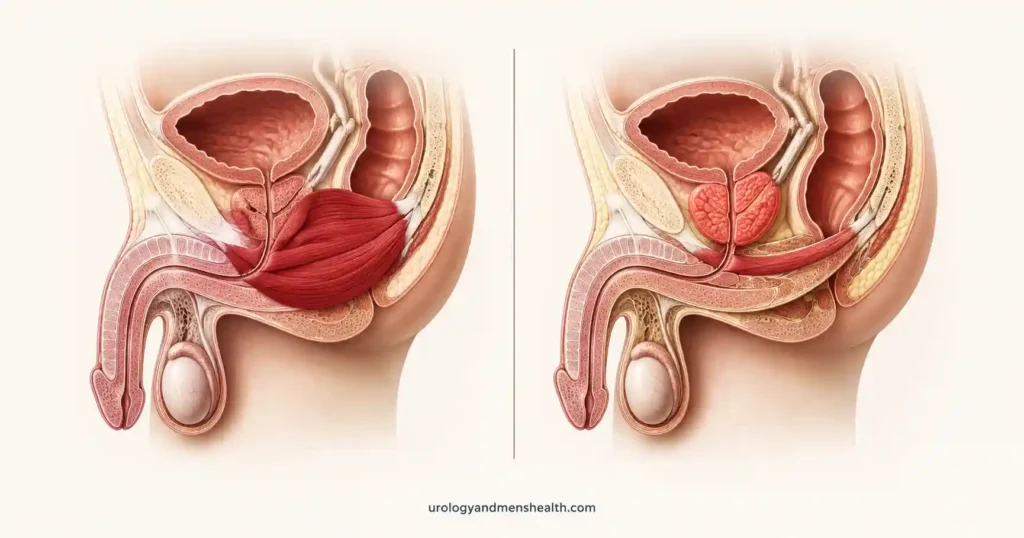
This is the overwhelming majority — around nine in ten men carrying a chronic prostatitis label [3]. Cultures are negative, repeatedly. The pain is real, the disability is real, but the mechanism is not infection. It typically involves some combination of pelvic floor muscle overactivity, central pain sensitisation, bladder outlet dysfunction, and the anxiety that a year of unexplained genital pain reasonably produces.
Severity here is measured, not guessed. The NIH Chronic Prostatitis Symptom Index scores pain, urinary symptoms, and quality-of-life impact on a 0 to 43 scale, and it is the validated instrument used in every serious trial in this area [5]. Scoring yourself before your appointment gives your urologist a baseline number to treat against rather than a description. You can complete it using our NIH-CPSI chronic prostatitis symptom score tool and bring the printable result with you.
Acute vs Chronic Prostatitis: The Differences That Change Management
Six features separate them in clinic, and none of them require advanced imaging.
- Onset. Acute builds over hours to a couple of days. Chronic accumulates over weeks and is usually months old by the time a man seeks help.
- Fever. Present and often dramatic in Category I. Absent in Categories II and III — a febrile man does not have CP/CPPS.
- The examination. An acutely infected prostate is hot, swollen, and too tender to examine properly. In chronic disease the gland usually feels normal, while the pelvic floor muscles around it are tight and tender.
- The urine culture. Positive in Category I, positive intermittently with the same organism in Category II, persistently negative in Category III.
- Duration. Category I resolves with treatment over days to weeks. Chronic disease is defined by three months or more.
- Where it is treated. Acute infection is assessed the same day, often in hospital. Chronic disease is a structured outpatient workup with no urgency but plenty of persistence required.
One practical instruction that matters more than any of the above: ask for a urine sample to be sent for culture before the first antibiotic tablet is swallowed. Once treatment has started, cultures turn negative and the single test that would have told us which category you are in is gone for weeks. This is also why relapsing infections in men deserve a proper diagnostic workup rather than repeat prescriptions — the pattern is covered in our guide to urinary tract infection in men and when it signals something structural.
In My Practice
A 34-year-old man came to me having been treated for “prostatitis” five times in fourteen months. Every course made him feel marginally better for about ten days. When I looked back through his records, not one urine culture had ever grown an organism — every prescription had been empirical. On examination his prostate was unremarkable, but his levator muscles were rigid and reproduced his exact pain on gentle palpation. He had never had a bacterial infection. He had pelvic floor dysfunction that no one had examined for, because everyone had reached for the prescription pad first.
When a man has been through three or more antibiotic courses with negative cultures each time, the diagnosis is almost never infection — and the next step is a pelvic floor examination, not a sixth prescription.
Treatment: Four to Six Weeks of Antibiotics, or None at All
Each category has a distinct treatment logic, and mixing them up is the commonest error I correct.
Category I (acute bacterial): antibiotics for at least two weeks, frequently extended to four, with hospital admission and intravenous therapy if there is sepsis, vomiting, or retention [2]. Ask your doctor specifically what your urine culture grew and whether the antibiotic you were given matches the sensitivity result — empirical choices are sometimes wrong once the lab reports back at 48 to 72 hours.
Category II (chronic bacterial): the EAU recommends a fluoroquinolone such as ciprofloxacin or levofloxacin as first-line therapy, given for four to six weeks rather than the usual one to two [2]. Stopping at two weeks because symptoms improved is the standard route to relapse three months later.
Category III (CP/CPPS): no single drug fixes this. The 2019 Cochrane review found that alpha blockers produce only a small reduction in NIH-CPSI scores, with dizziness and low blood pressure as trade-offs, and that antibiotics, anti-inflammatories, and phytotherapy each deliver at best a small symptom decrease on low-certainty evidence [3]. What works better is targeting the specific domains driving that individual man’s symptoms — the UPOINT approach, which sorts patients across urinary, psychosocial, organ-specific, infection, neurologic, and muscular tenderness domains and treats each identified domain rather than the label [4]. Working through our UPOINT phenotype classifier for chronic pelvic pain before your consultation tells you which domains apply to you, which is exactly the conversation worth having with a urologist.
One more point that generates a lot of unnecessary fear: acute prostatitis can push PSA into alarming territory, sometimes into double figures. That elevation is inflammatory, not malignant. A PSA drawn during or shortly after an acute episode should not be interpreted at all — repeat it six to eight weeks after the infection has fully settled and use that value as the real one.
Frequently Asked Questions
How do I know whether I have acute vs chronic prostatitis?
Fever is the fastest separator. Acute bacterial prostatitis produces fever, chills, and severe pain building over hours to days, with a prostate too tender to examine. Chronic prostatitis produces pelvic discomfort lasting three months or longer with no fever and a gland that usually feels normal. If you have a fever alongside pelvic pain, treat it as acute and seek same-day assessment.
Can acute bacterial prostatitis turn into chronic prostatitis?
It can, and inadequate treatment length is the usual reason. If an acute episode is treated for only five to seven days, bacteria surviving inside prostatic ducts can persist and produce Category II chronic bacterial prostatitis with relapsing infections. This is why acute episodes warrant at least two weeks of antibiotics, and why a follow-up urine culture after finishing the course is worth requesting rather than assuming cure.
Why did antibiotics not work for my chronic prostatitis?
Because in roughly nine out of ten men with chronic prostatitis, no bacteria are present to kill. Category III CP/CPPS is driven by pelvic floor muscle overactivity, nerve sensitisation, and bladder dysfunction rather than infection. Repeated courses delay effective treatment and carry real side effects. Scoring your symptoms with the NIH-CPSI and identifying your treatment domains is a more productive next step.
Does prostatitis raise PSA levels?
Yes, and substantially. Acute bacterial prostatitis can push PSA well above 10 ng/mL purely through inflammation. A PSA measured during or immediately after an acute episode tells you nothing useful about cancer risk. Ask for it to be repeated six to eight weeks after the infection has fully resolved, and treat that later result as your baseline for screening decisions.
How long does chronic prostatitis last, and does it ever fully resolve?
By definition it has already lasted three months at diagnosis, and many men have symptoms for a year or more. Complete resolution does happen, but the realistic goal with CP/CPPS is meaningful symptom reduction through domain-targeted treatment rather than cure. Men who follow a structured multimodal plan improve considerably more often than those cycling through single treatments, as outlined in our CPPS treatment guide.
References
- Krieger JN, Nyberg L Jr, Nickel JC. NIH consensus definition and classification of prostatitis. JAMA. 1999;282(3):236-237. JAMA
- European Association of Urology. EAU Guidelines on Urological Infections. Arnhem: EAU Guidelines Office. EAU
- Franco JVA, Turk T, Jung JH, et al. Pharmacological interventions for treating chronic prostatitis/chronic pelvic pain syndrome. Cochrane Database Syst Rev. 2019;10(10):CD012552. PubMed
- Shoskes DA, Nickel JC, Rackley RR, Pontari MA. Clinical phenotyping in chronic prostatitis/chronic pelvic pain syndrome and interstitial cystitis: a management strategy for urologic chronic pelvic pain syndromes. Prostate Cancer Prostatic Dis. 2009;12(2):177-183. PubMed
- Litwin MS, McNaughton-Collins M, Fowler FJ, et al. The National Institutes of Health Chronic Prostatitis Symptom Index: development and validation of a new outcome measure. J Urol. 1999;162(2):369-375. PubMed
Dr. Muhammad Khalid
MBBS · FCPS (Urology) · MCPS (General Surgery) · CHPE · CRSM · IMC #539472
Specialist urologist with 11+ years of clinical experience across tertiary teaching hospitals. Trained at Lady Reading Hospital and Khyber Teaching Hospital, Peshawar. Author or co-author of five peer-reviewed international publications, including in Cureus and the World Journal of Surgery. Procedural expertise: URS, PCNL, RIRS, TURP, TURBT, and major open urological surgery. Full profile →
This article is for educational purposes only and does not constitute medical advice. Always consult your physician or urologist for diagnosis and treatment decisions specific to your condition.