Epididymitis vs Testicular Cancer: How to Tell the Difference
Nearly every man who finds a lump asks the same question in the same tone of voice. The difference between epididymitis vs testicular cancer is one you can usually feel with your own fingers — here is how.

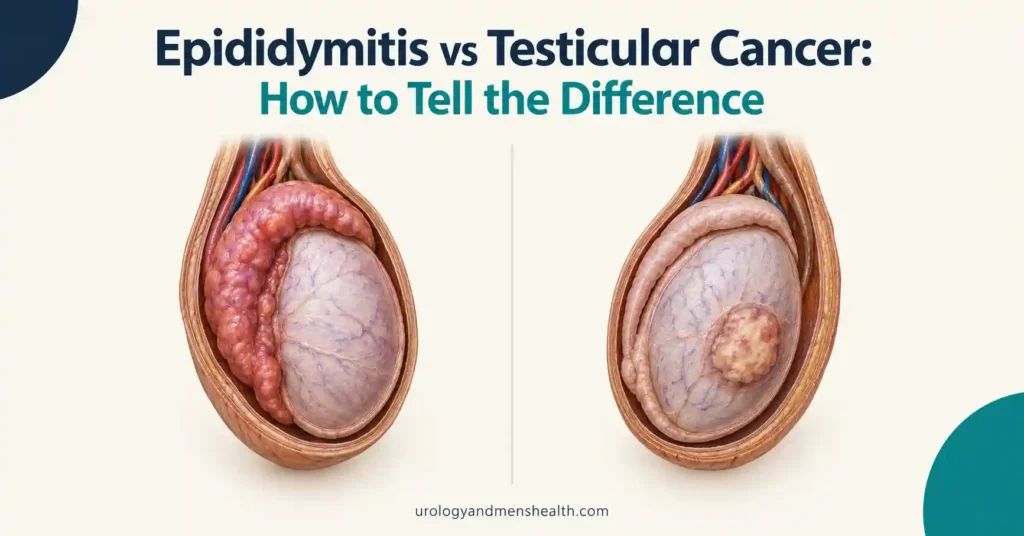
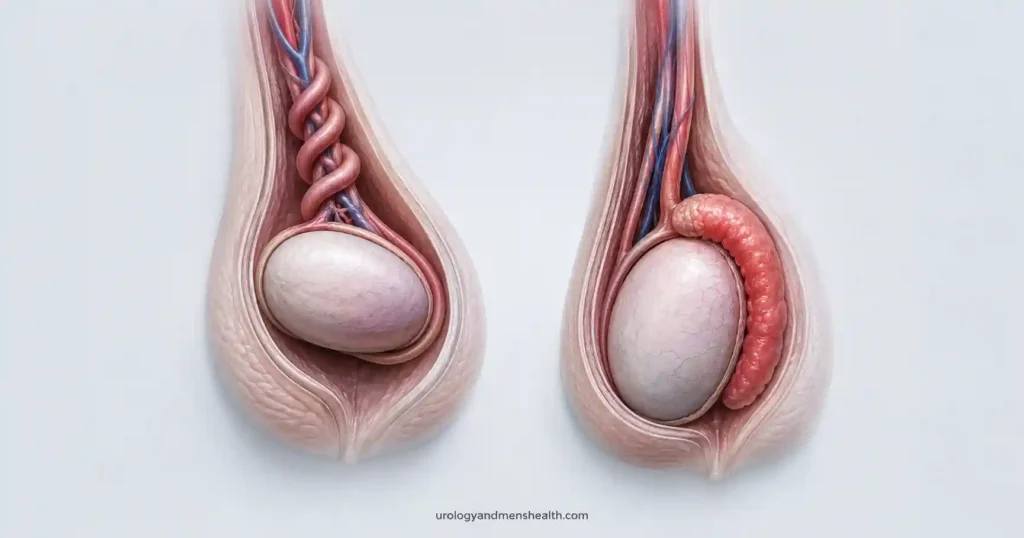
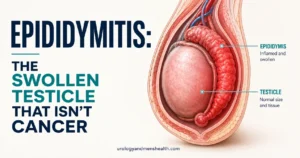
The difference between epididymitis vs testicular cancer usually comes down to one thing: where the lump actually sits. Epididymitis is an infection of the coiled tube behind the testicle. Testicular cancer is a growth inside the testicle itself. Those two structures sit a few millimeters apart, and that gap is most of the diagnosis.
I see men who are on their second or third course of antibiotics for a swelling that never settled. Sometimes the antibiotics were the right call and the swelling is simply slow. Sometimes the wrong thing has been treated for eight weeks. The men who do badly are not the ones who turned out to have cancer — most of them do very well. They are the ones who accepted a repeat prescription instead of a scan.
This article gives you the examination, the timeline, and the single rule that decides who needs an ultrasound this week. For the wider picture on scrotal and urinary infection, see our UTIs and Infections Hub.
Key Takeaways
- Epididymitis is felt as a tender ridge behind and above the testicle; a tumor is felt as a firm lump inside the testicle, and in most men it does not hurt at all.
- CDC guidance is explicit: if epididymitis has not improved within 72 hours of the correct antibiotic, the diagnosis needs rechecking — not a second prescription.
- In a 2025 multicenter series of 254 men with testicular cancer, the absence of pain more than doubled the odds of a delayed diagnosis, and delay tracked with larger tumors and metastatic disease.
- A scrotal ultrasound answers the question in about fifteen minutes. Normal tumor markers do not rule cancer out — pure seminoma never raises AFP.
Where the Lump Sits: The Difference You Can Feel
The epididymis is one continuous coiled tube — roughly 6 meters of it (about 20 feet) — packed into a structure that runs down the back of the testicle from top to bottom. Sperm leave the testis, spend around two weeks maturing inside that tube, then exit through the vas deferens. It is a separate organ pressed against the testis, not part of it.
That anatomy is the entire examination. Infection reaches the epididymis by traveling backward from the urethra or bladder along the vas deferens, so it arrives at the tail first — the bottom of the ridge behind your testicle [1]. That is why early epididymitis is tender in one specific spot low on the back of the scrotum, and why you can often still roll the testis forward between finger and thumb and feel it as smooth and separate from the swollen part.
A germ cell tumor does the opposite. It grows within the testis, so there is no gap to find. When you try to trace its edges you are feeling testicle the whole way around. It is firm in a way that normal testicular tissue is not — men describe a marble, a pebble, or a hard patch that was not there last month. And in the largest recent series, it did not hurt in roughly four out of five men [2].
The one that cannot wait: torsion
Neither pattern above describes testicular torsion. Torsion is sudden — severe pain building over minutes rather than days, often waking a man at night or striking during sport, usually with nausea or vomiting, and the affected testicle frequently sits higher than its partner. It is a six-hour surgical problem, not a diagnostic puzzle. If that is your story, stop reading and go to an emergency room now.
If you are genuinely unsure which pattern fits, our breakdown of why torsion and epididymitis get confused in the first place will sort it faster than more searching, and the acute testicular pain triage tool will tell you whether this is an emergency-room problem or a clinic problem.
Epididymitis vs Testicular Cancer: Side by Side
Every row below has exceptions. Epididymitis can be almost painless in an older man with an obstructed bladder; a tumor can bleed into itself and hurt exactly like an infection. Use this to work out how worried to be and how fast to move — not to reach a diagnosis on your own.
| What you notice | Epididymitis | Testicular cancer |
|---|---|---|
| Where it sits | A tender ridge behind and above the testicle, separable from it | A firm lump within the body of the testicle, continuous with it |
| How it started | Over 1-3 days, often after urinary symptoms or a new partner | Found by chance, usually in the shower, with no clear start date |
| Pain | The dominant symptom; aching, worse on standing | Absent in about 4 of 5 men; a dull heaviness at most |
| Texture | Swollen, warm, markedly tender, often with fluid around it | Hard and irregular, not tender, does not shrink |
| Fever and urinary symptoms | Common — burning, discharge, frequency, temperature | Absent |
| Typical age | Two peaks: 20-39, and again over 60 | Average age at diagnosis is 33 |
| Response to antibiotics | Clear improvement inside 72 hours | No change at all |
| What settles it | Urine testing, STI swabs, clinical examination | Scrotal ultrasound, then urgent referral |
If your examination and your urine tests point to infection, the treatment is well defined and the recovery is slower than most men expect. The CDC regimen for a sexually transmitted cause is ceftriaxone 500 mg by injection plus doxycycline 100 mg twice daily for 10 days; where enteric bacteria are the likely cause, such as after a prostate biopsy or catheter, it is levofloxacin 500 mg daily for 10 days [1]. The antibiotics finish in ten days, but the swelling often does not. I have written that recovery curve out week by week in the full epididymitis treatment and timeline guide.
The Antibiotic Trap and the 72-Hour Rule
Here is where the harm happens. Antibiotics do nothing to a tumor, but they do reduce the reactive fluid and inflammation sitting around it, so a man can come back at two weeks feeling somewhat better while the mass underneath is unchanged. That partial improvement gets read as a partial response, and a second course gets written. The clock keeps running.
The CDC guidance leaves no room for that. Men should return if symptoms have not improved within 72 hours, and swelling or tenderness that persists after the antibiotic course is finished requires evaluation for other diagnoses including tumor, abscess, infarction, testicular cancer and tuberculosis [1]. That is a written instruction to re-open the diagnosis, not to extend the treatment.
The cost of ignoring it is measurable. In a 2025 multicenter Japanese study of 254 men who underwent orchiectomy for testicular cancer, a delay of more than 53 days from first symptom to surgery was associated with a tumor 6 cm or larger (about 2.4 inches, odds ratio 2.77), with metastatic disease (OR 2.12), with stage III disease (OR 3.20), and with needing second-line chemotherapy (OR 3.36). Two things independently predicted that delay: being 36 or older, and having no pain (OR 2.29) [2].
A 2022 series from two Texas hospitals found the same shape: median time from symptom to diagnosis was 38 days, and men who turned out to have metastatic disease had waited 76 days against 31 for those with localized disease [3]. A Polish cohort reported five-year survival of 78.1% where diagnosis took longer than 10 weeks, against 92.5% where it did not [4].
So the rule I give every man leaving my clinic with antibiotics for a swollen testicle is this: one course, one reassessment at 72 hours, and an ultrasound if you are not clearly better. Never a second course without a scan first.
In My Practice
A man in his late twenties came to me on his third antibiotic prescription for what two clinicians had called epididymitis. He was frustrated rather than frightened — the pain had settled, the swelling had not. When I examined him the epididymis felt entirely normal. The firmness was in the testis, low on the anterior surface, and it moved with the testis rather than against it. His ultrasound that afternoon showed a 3 cm solid intratesticular mass. He had stage I disease and did well. What struck me afterwards was that nobody had re-examined him after the first prescription; each new course had been issued on the phone.
The lesson I take from that case is simple: an antibiotic decision made without hands on the scrotum is not a diagnosis, it is a guess with a refill.
Get the Testicular Self-Check Guide: exactly what a normal testicle should feel like, and the three findings that need a scan
Enter your email below to receive Dr. Khalid’s complete Testicular Cancer Self-Check Guide as a free, printable PDF.
What the Ultrasound and the Blood Tests Actually Show
A scrotal ultrasound with Doppler is quick, painless and needs no preparation. The European Association of Urology 2026 guideline carries a strong recommendation to perform bilateral testicular ultrasound in every patient in whom testicular cancer is suspected — bilateral, because the other side needs looking at too [5].
Understand what the scan is for. It answers one binary question: is the abnormality inside the testis or outside it. Extratesticular swelling — epididymis, cord, surrounding fluid — is almost never cancer. A solid mass within the testis is cancer until proven otherwise, and that finding alone triggers referral. The CDC makes the corresponding point from the other direction: ultrasound adds little to confirming epididymitis when the clinical picture already fits, and a negative scan does not exclude it [1]. The scan is not there to prove the infection. It is there to exclude torsion and to answer the tumor question.
Three blood markers usually go with it: alpha-fetoprotein (AFP), beta human chorionic gonadotropin (beta-hCG) and lactate dehydrogenase (LDH). They matter enormously for staging and for tracking treatment. They are poor at ruling things out. A pure seminoma never raises AFP, and plenty of men with early-stage disease have entirely normal levels across all three [5]. If someone tells you your markers were normal so it cannot be cancer, that reasoning is wrong.
One more point that surprises men: a suspicious testicular mass is not biopsied through the scrotum with a needle. The diagnosis and the treatment are the same operation — removal of the testis through a groin incision — and sperm banking is discussed beforehand [5].
For proportion, the American Cancer Society expects about 9,810 new cases and 630 deaths in the United States in 2026. A man’s lifetime chance of developing testicular cancer is about 1 in 250; his lifetime chance of dying from it is about 1 in 5,000 [6]. This is one of the most curable cancers in medicine. Almost all of the remaining damage is done by delay.
What to Do This Week
Find your situation below and act on that line rather than on the average advice.
- Sudden severe pain within the last few hours — emergency room now. Do not book a clinic appointment, do not wait for morning.
- A painless firm lump you can feel within the testicle itself — ask your doctor for a scrotal ultrasound with Doppler within 7 days, and request AFP, beta-hCG and LDH at the same blood draw so the results are already back when you are seen.
- Treated for epididymitis and not clearly better at 72 hours — go back and ask specifically for imaging rather than a second antibiotic. The sentence that works is: I would like a scrotal ultrasound before we change antibiotics.
- Swelling still present 4-6 weeks after finishing antibiotics — request an ultrasound even if the pain has gone. Persistent swelling after a completed course is the trigger point in the CDC guidance [1].
- Nothing wrong right now — check yourself once a month after a warm shower, when the scrotum is relaxed. Our step-by-step self-exam walkthrough takes about two minutes, and the symptoms that should prompt a call are worth reading once so you recognize them without hesitating.
Go to the Emergency Room, Not the Clinic
These findings need assessment the same day, not an appointment next week:
- Sudden severe testicular pain reaching its peak within an hour, especially with nausea or vomiting
- A testicle that has visibly changed position or sits higher than the other
- Fever above 38.5°C (101.3°F) with a red, hot, rapidly swelling scrotum
- Scrotal skin that has turned dusky, dark or is starting to break down, or pain that is far worse than the appearance suggests
- A hard testicular lump found alongside new back pain, breast tenderness or shortness of breath
Frequently Asked Questions
How do doctors tell epididymitis vs testicular cancer apart on examination?
By locating the abnormality. In epididymitis the tender swelling forms a ridge behind and above the testicle, and a clinician can usually roll the testis forward and feel it as smooth and separate. In cancer the firmness is continuous with the testis and has no separable edge. Fever, discharge and burning point to infection; a hard painless lump with none of those points to a tumor.
Can testicular cancer be painful?
Yes, in a minority. In a 2025 series of 254 men with testicular cancer, 13.4% presented with testicular pain and a further 5.1% with discomfort, while 79.5% had painless swelling or a mass. Pain usually means bleeding into the tumor or infarction within it. Pain does not exclude cancer, and its absence is precisely what delays diagnosis.
How long should swelling take to settle after antibiotics for epididymitis?
Pain and fever should improve inside 72 hours. Swelling is slower — complete resolution of discomfort may take a few weeks after the ten-day course finishes, and a firm residual thickening of the epididymis can persist for months. The distinction that matters is direction of travel. Steadily shrinking is normal. Static or growing at four to six weeks needs a scan.
Do normal tumor markers rule out testicular cancer?
No, and this is a common misunderstanding. Pure seminoma never produces AFP, and many men with early-stage disease have normal AFP, beta-hCG and LDH together. Markers are used for staging, risk grouping and monitoring response, not for excluding disease. A solid mass inside the testis on ultrasound outranks any set of normal blood results.
What else causes a lump in the scrotum that is neither infection nor cancer?
Several things, and most are harmless. A hydrocele is fluid around the testis; a spermatocele is a fluid-filled cyst at the head of the epididymis; a varicocele feels like a bag of worms above the testis and empties when you lie down. All three sit outside the testis, which is why ultrasound sorts them quickly — see our guide to hydroceles and spermatoceles for how each one feels.
References
- Centers for Disease Control and Prevention. Epididymitis. Sexually Transmitted Infections Treatment Guidelines. 2021. CDC
- Honda K, Kawai T, Taguchi S, et al. Impact and risk factors of diagnostic delay in patients with testicular cancer: a multicenter retrospective study. Int J Urol. 2025;32(11):1593-1601. PubMed
- Badia RR, Chertack N, Meng X, et al. Predictive factors of diagnostic delay and effect on treatment patterns in testicular germ cell tumor patients. Urol Oncol. 2022;40(5):201.e1-201.e7. PubMed
- Cieślikowski WA, Kasperczak M, Milecki T, Antczak A. Reasons behind the delayed diagnosis of testicular cancer: a retrospective analysis. Int J Environ Res Public Health. 2023;20(6):4752. PubMed
- European Association of Urology. EAU Guidelines on Testicular Cancer. 2026 edition. EAU
- American Cancer Society. Key statistics for testicular cancer. Revised January 2026. American Cancer Society
Dr. Muhammad Khalid
MBBS · FCPS (Urology) · MCPS (General Surgery) · CHPE · CRSM · IMC #539472
Specialist urologist with 11+ years of clinical experience across tertiary teaching hospitals. Trained at Lady Reading Hospital and Khyber Teaching Hospital, Peshawar. Author or co-author of five peer-reviewed international publications, including in Cureus and the World Journal of Surgery. Procedural expertise: URS, PCNL, RIRS, TURP, TURBT, and major open urological surgery. Full profile →
This article is for educational purposes only and does not constitute medical advice. Always consult your physician or urologist for diagnosis and treatment decisions specific to your condition.