Fournier’s Gangrene: Symptoms of a Urological Emergency
Most men who develop Fournier's gangrene are told the pain looks worse than the skin does. That gap — severe pain, unremarkable skin — is the single most useful early warning sign I know.

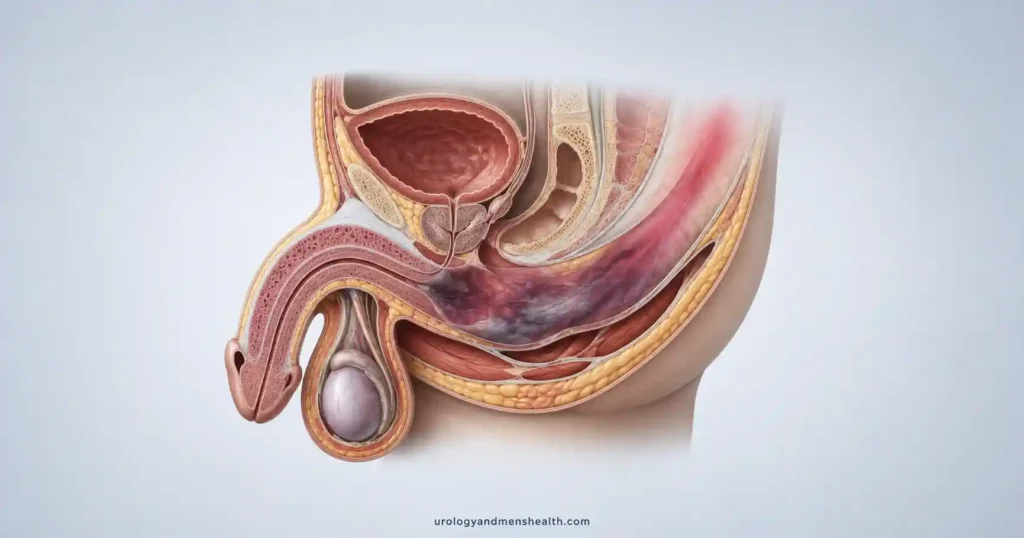
Fournier’s gangrene is the one urological infection where the clock outranks every other consideration. It is a rapidly destructive infection of the skin, fat, and connective tissue of the scrotum, penis, perineum, and the region around the anus — tissue dies while the man is still walking, talking, and being told it is probably just cellulitis. What makes it so dangerous is not simply that it moves fast. It is that during the first several hours the skin can look almost unremarkable while the tissue underneath is already dead. Men get sent home from urgent care with antibiotics for a groin infection and return the next day in septic shock. I have written this to cover four things: what the earliest signs actually feel like, who is at highest risk, what happens once you reach an emergency room, and what recovery genuinely looks like afterward. For the wider picture on male genitourinary infection, see our UTIs and Infections Hub. If you are reading this because something in your groin hurts far more than it looks like it should, stop reading and go to an emergency room now.
Key Takeaways
- Pain far out of proportion to how the skin looks is the earliest reliable sign — normal-looking scrotal skin does not rule this out.
- US population data puts the rate at about 1.6 cases per 100,000 men per year, peaking at 3.3 per 100,000 in men aged 50 to 79.
- Diabetes is the most common underlying condition, and in August 2018 the FDA added a Fournier’s gangrene warning to the label of every SGLT2 inhibitor.
- European Association of Urology guidance is unambiguous: broad-spectrum antibiotics on arrival and surgical debridement within 24 hours of presentation, repeated as often as the wound demands.
- Population-wide survival is far better than the figures men find online — 7.5% mortality in US inpatient data versus 20% or higher in specialist referral series.
What Fournier’s Gangrene Actually Is
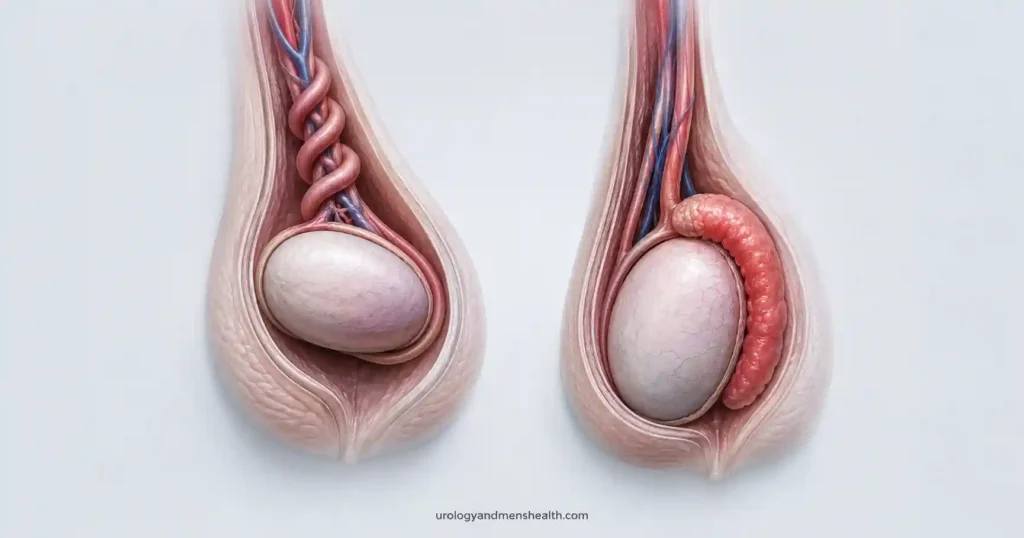
Fournier’s gangrene is necrotizing fasciitis that happens to occur in the perineum and external genitalia. Necrotizing fasciitis means the infection destroys the fascia — the tough sheets of connective tissue that wrap and separate muscle groups — rather than staying in the skin.[3] That single anatomical fact explains almost everything about how the condition behaves.
Fascia has a poor blood supply compared with skin or muscle. Bacteria that reach this layer meet very little immune resistance and travel along it the way water travels along a channel. The infection releases enzymes that clot off the small vessels feeding the overlying skin, so the tissue dies from the inside outward. By the time the skin turns dusky or blistered, the fascia beneath it has usually been dead for hours.
It is almost always polymicrobial — a mixed infection combining oxygen-using bacteria such as E. coli and Klebsiella with oxygen-avoiding bacteria such as Bacteroides and Clostridium.[4] The two groups work together: the aerobes consume local oxygen and the anaerobes then flourish in the low-oxygen tissue that results. This is why single-agent antibiotics fail and why gas can form under the skin, producing the crackling sensation clinicians call crepitus.
It is genuinely uncommon. Analysis of US State Inpatient Databases identified 1,641 men and 39 women with the condition, representing under 0.02% of all hospital admissions, at an overall rate of 1.6 per 100,000 males per year and 3.3 per 100,000 in men aged 50 to 79.[1] Two-thirds of US hospitals treat no cases at all in a given year. That rarity is precisely the problem — the emergency clinician assessing you may never have seen one.
What Fournier’s Gangrene Feels Like in the First 24 Hours
The single most useful early feature is disproportion. The pain is severe, deep, and escalating hour by hour, while the skin looks like a moderate case of cellulitis at worst. Men describe it as a burning or tearing sensation deep in the scrotum or between the scrotum and the anus, unrelieved by position change and not matching anything visible.
The sequence typically runs like this. Hours 0 to 12 bring intense localized pain, swelling, and redness with tenderness extending well past the visible red margin. Hours 12 to 24 add fever, a racing heart, and a sense of being profoundly unwell that is out of keeping with a skin infection. Beyond 24 hours the skin turns grey, purple, or black, blisters appear, a distinctive foul odor develops, and crepitus becomes palpable — and paradoxically the area may become less painful as the nerves die.[4]
The conditions it gets confused with are the ones it most resembles early. Epididymitis presents as a hot, swollen, tender hemiscrotum and is far more common; you can read how that condition normally behaves in our guide to a swollen, painful testicle and what causes it. Balanitis and simple cellulitis of the scrotal skin also start with redness and tenderness — our article on foreskin and glans infection covers that presentation. The separating question is always trajectory: ordinary infections settle or plateau on antibiotics within 24 to 48 hours. This one accelerates.
In My Practice
The case I still think about was a man in his fifties, well-controlled type 2 diabetes, who came to the emergency room at 9pm with what the triage note called a scrotal abscess. The skin was red over an area the size of a coin. He was gripping the trolley rail with both hands and could not keep still. What made me operate that night was not the skin — it was that his heart rate was 118 with a benign-looking scrotum, and when I pressed two inches away from the redness on the perineum, he flinched. Tenderness outside the visible margin is the finding that changes the plan. At surgery the fascia had already separated from the scrotum to the pubic bone.
Tenderness that extends beyond the red area, in a man who looks systemically unwell, is a surgical finding until proven otherwise — no matter how ordinary the skin appears.
Go to the Emergency Room Now If You Have
Do not wait for a same-day appointment and do not start a leftover course of antibiotics at home. Ask to be seen in an emergency department and use the words severe genital pain at triage.
- Pain in the scrotum, penis, perineum, or around the anus that is worsening hour by hour and feels worse than the skin looks
- Fever above 100.4°F (38°C) together with any genital redness, swelling, or tenderness
- Skin that has turned grey, purple, mottled, or black, or has blistered
- A crackling or bubble-wrap sensation when the skin is pressed
- A foul or sweet-rotten smell from the area
- Feeling confused, faint, or shivering uncontrollably alongside any genital symptom
Who Gets Fournier’s Gangrene
The infection needs two things: a way in, and a host whose small blood vessels and immune response are already compromised. The entry point is urogenital, anorectal, or cutaneous. A urethral stricture that causes urine to leak into surrounding tissue is a classic urogenital route — our guide to urethral narrowing and how it is treated explains why untreated stricture disease carries this risk. Perianal abscesses and fistulas account for a large share of anorectal cases, and instrumentation, injections, insect bites, or scrotal skin breakdown make up the cutaneous group. A significant minority of cases have no identifiable source at all.
Diabetes is the dominant risk factor. A 2024 systematic review across 57 studies and 3,646 patients found diabetes to be the most frequent comorbidity among those who died, with the highest mortality rate of any comorbid group seen in patients living with HIV at 54.2%.[2] High blood glucose impairs neutrophil function, damages the microvasculature that would otherwise deliver antibiotics to infected tissue, and provides glucose-rich urine that supports bacterial growth. Alcohol use disorder, obesity, chronic kidney disease, immunosuppressive medication, and chemotherapy all act through the same final pathway.
Recurrent or poorly treated urinary infection also raises the stakes. Because a urinary infection in an adult man is never routine in the way it can be in a woman, it deserves proper investigation rather than a repeat prescription — our article on why a UTI in a man always warrants a workup sets out what that assessment should include.
The SGLT2 Inhibitor Question
On 29 August 2018 the FDA required a Fournier’s gangrene warning to be added to the prescribing information and Medication Guide of every SGLT2 inhibitor — canagliflozin, dapagliflozin, empagliflozin, and ertugliflozin — after 12 cases were identified between March 2013 and May 2018.[5] A subsequent FDA review published in Annals of Internal Medicine in 2019 documented 55 cases reported to the Adverse Event Reporting System, with onset ranging from 5 days to 49 months after starting the drug; all 55 required surgical debridement and three died. For comparison, only 19 cases were reported across all other glucose-lowering agents between 1984 and 2019.[6]
Here is the honest reading of that data. The absolute risk is very small — roughly 1.7 million US patients were dispensed these drugs in 2017 alone — and these agents deliver substantial cardiovascular and kidney protection that saves far more lives than this complication costs. The signal is real, but it is a reason for awareness, not for stopping the drug. What it should change is your threshold for getting genital pain assessed: if you take an SGLT2 inhibitor and develop genital or perineal tenderness with a fever, say so explicitly at triage.
Check where your weight and metabolic risk sit → BMI & Metabolic Syndrome Risk ScreenWhat Happens Once You Reach the Emergency Room
Treatment runs on three tracks simultaneously: resuscitation, antibiotics, and surgery. The EAU Guidelines on Urological Infections carry two strong recommendations — start broad-spectrum antibiotics at presentation and refine them according to culture results, and commence repeated surgical debridement within 24 hours of presentation. The same guidance advises against adjunctive treatments such as hyperbaric oxygen outside clinical trials, because the evidence does not support them.[3]
A CT scan is often ordered to map how far the infection has tracked and to look for a colorectal source, but it does not need to hold up the operation. A 2023 single-center study of 76 patients found that obtaining a preoperative CT did not lengthen the time from arrival to surgery. The diagnosis remains clinical — a negative scan in a patient who looks like this does not overrule the examination.
Surgery means removing every millimeter of dead tissue until healthy bleeding tissue is reached, which is why the wound is almost always larger than the visible skin change suggested. A planned second look within 24 to 48 hours is standard, and most men need three or more procedures. Depending on the source and extent, surgeons may divert urine with a suprapubic catheter or divert stool with a temporary colostomy so the wound is not repeatedly contaminated. If you have previously dealt with acute inability to pass urine and emergency catheterization, the urinary side of this will be familiar territory.
Death, when it occurs, is almost always from overwhelming infection rather than the wound itself. A 17-year meta-analysis found sepsis responsible for 76% of deaths and multiple organ failure for 66%, which is why intensive care support runs in parallel with the surgery.[7]
Recovery, Reconstruction, and Life After Fournier’s Gangrene
Start with the number men actually need, because the internet will give you the wrong one. Case series from tertiary referral hospitals — which by definition receive the sickest transfers — report mortality of 20% to 40%, and the 2024 systematic review calculated a pooled rate of 20.4%.[2] But population-based US inpatient data, which captures every case rather than only the referred ones, found a case fatality rate of 7.5%.[1] If you or someone you love is being treated today, the second figure is the more honest one. That same analysis found that hospitals treating more than one case per year had 42% to 84% lower mortality, which is a strong argument for transfer to a center that sees this condition.
Recovery is long and it is staged. The first two weeks are repeat debridement, dressing changes, glycemic control, and nutritional support — protein requirements roughly double while a large open wound is healing. Weeks two to six typically involve negative pressure wound therapy to encourage the wound bed to granulate. Reconstruction with split-thickness skin grafts or local flaps usually follows at the two-to-four-month mark, once infection is fully cleared. Scar maturation continues for a year.
Testicular function is usually preserved. The testicles receive their blood supply from the spermatic cords rather than the scrotal skin, so they commonly survive even when the entire scrotum has been removed, and testosterone production continues. Sexual function is a slower conversation: sensation, erectile function, and comfort during intercourse can take six to twelve months to reach their final state, and scar contracture sometimes needs a revision procedure. Ask your surgical team for a specific reconstruction plan and a named follow-up appointment before you leave hospital — not a general instruction to come back if there are problems.
The part that gets least attention is psychological. Men who have lost genital skin, spent time in intensive care, and lived with a colostomy frequently describe a period of grief and body-image distress that outlasts the wound. That is a normal response to an abnormal event, and it responds to treatment. Raise it at your first outpatient review rather than waiting for someone to ask.
See what a staged surgical recovery looks like week by week → Post-Operative Recovery TimelineFrequently Asked Questions
Can Fournier’s gangrene look like an ordinary scrotal infection at first?
Yes, and that is exactly why it gets missed. Early Fournier’s gangrene can present as a red, swollen, tender scrotum indistinguishable from cellulitis or epididymitis. The separating feature is disproportion — the pain is severe and worsening by the hour while the skin changes lag behind. If you are being treated for a swollen testicle and the pain escalates rather than settling within 24 hours on antibiotics, return to an emergency room the same day.
How fast does Fournier’s gangrene spread once the pain starts?
Faster than most people expect. Necrosis travels along the fascial planes beneath the skin, so infection can extend from the scrotum to the abdominal wall while the visible skin still looks only mildly inflamed. Fever above 100.4°F (38°C), a racing heart, and confusion mean sepsis is already established. A recent urinary infection in a man is one of the more common starting points.
Should I stop my SGLT2 inhibitor because of the Fournier’s gangrene warning?
Not on your own. The FDA added a Fournier’s gangrene warning to every SGLT2 inhibitor label in 2018, but the absolute risk is very low measured against real cardiovascular and kidney benefits. Ask your prescriber to review your overall risk at your next appointment rather than stopping mid-course. Weight, glycemic control, and metabolic risk are the levers that move outcomes more.
Will I need a colostomy or a catheter after surgery for Fournier’s gangrene?
Often, at least temporarily. If the infection reaches the perianal region, surgeons may divert stool through a temporary colostomy so the wound is not repeatedly contaminated. A urinary catheter or suprapubic tube is common when the urethra or perineum is involved. Both are usually reversible once the wound has healed, and men who have previously experienced urinary retention will find the catheter part familiar.
Does sexual function come back after Fournier’s gangrene surgery?
It often does, but rarely on the timeline men hope for. The testicles have their own blood supply and are usually preserved even when scrotal skin is lost, so testosterone production typically continues. Erectile function and sensation can take six to twelve months to settle after grafting, and scar contracture may need a second procedure. Ask your surgeon where you sit on a realistic recovery timeline.
References
- Sorensen MD, Krieger JN, Rivara FP, et al. Fournier’s gangrene: population based epidemiology and outcomes. J Urol. 2009;181(5):2120-2126. PubMed
- Shet P, Mustafa AD, Varshney K, et al. Risk factors for mortality among patients with Fournier gangrene: a systematic review. Surg Infect (Larchmt). 2024;25(4):261-271. PubMed
- European Association of Urology. Urological Infections: Fournier’s Gangrene. EAU Guidelines. Arnhem, The Netherlands; 2026. EAU Guidelines
- Montrief T, Long B, Koyfman A, Auerbach J. Fournier gangrene: a review for emergency clinicians. J Emerg Med. 2019;57(4):488-500. PubMed
- US Food and Drug Administration. FDA warns about rare occurrences of a serious infection of the genital area with SGLT2 inhibitors for diabetes. Drug Safety Communication, 29 August 2018. FDA
- Bersoff-Matcha SJ, Chamberlain C, Cao C, Kortepeter C, Chong WH. Fournier gangrene associated with sodium-glucose cotransporter-2 inhibitors: a review of spontaneous postmarketing cases. Ann Intern Med. 2019;170(11):764-769. PubMed
- El-Qushayri AE, Khalaf KM, Dahy A, et al. Fournier’s gangrene mortality: a 17-year systematic review and meta-analysis. Int J Infect Dis. 2020;92:218-225. PubMed
Dr. Muhammad Khalid
MBBS · FCPS (Urology) · MCPS (General Surgery) · CHPE · CRSM · IMC #539472
Specialist urologist with 11+ years of clinical experience across tertiary teaching hospitals. Trained at Lady Reading Hospital and Khyber Teaching Hospital, Peshawar. Author or co-author of five peer-reviewed international publications, including in Cureus and the World Journal of Surgery. Procedural expertise: URS, PCNL, RIRS, TURP, TURBT, and major open urological surgery. Full profile →
This article is for educational purposes only and does not constitute medical advice. Always consult your physician or urologist for diagnosis and treatment decisions specific to your condition.