Balanitis in Men: Causes, Treatment, and When It Returns
Most men I see with balanitis have been treated for thrush two or three times before anyone checked their blood sugar or looked properly at the skin. Here is what actually causes it — and what fixes it.

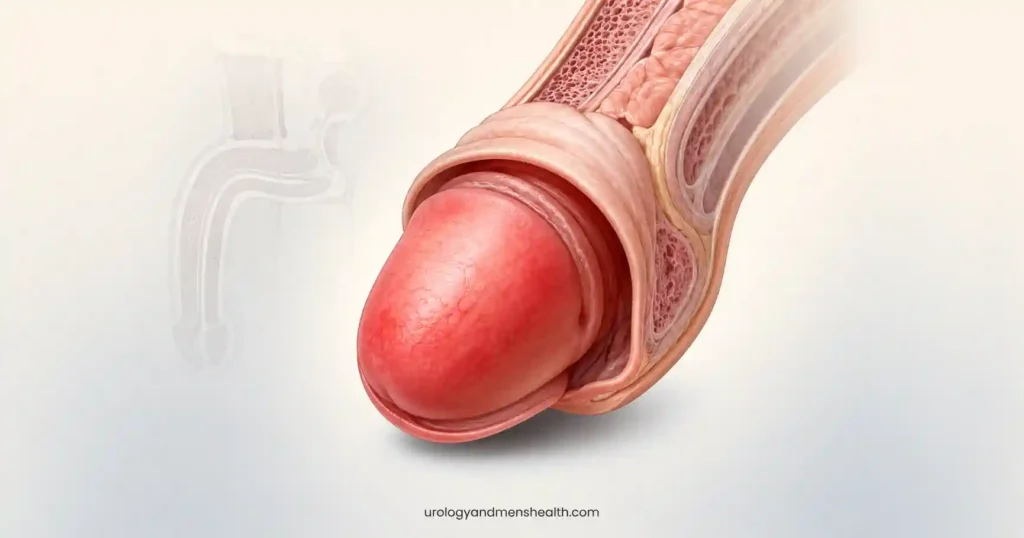
Balanitis is inflammation of the glans — the head of the penis — and it is one of the most consistently misdiagnosed conditions in men’s health. The pattern rarely varies. A man notices redness, itching and soreness under his foreskin. He is told it is thrush, given an antifungal cream, and it settles. Three months later it is back. By the time he reaches a urology clinic he has usually been through three or four courses of the same cream, and nobody has asked the two questions that decide the outcome: what is his blood sugar, and has anyone actually looked at the skin. Balanitis affects roughly 3% to 11% of men at some point in life [1]. It is not one disease. It is a shared appearance produced by at least a dozen different processes. For the wider picture of male genital and urinary infection, see our UTIs and Infections Hub.
Key Takeaways
- Balanitis is an appearance, not a diagnosis — yeast, bacteria, soap irritation, psoriasis, lichen sclerosus and early premalignant change all look similar in the first week.
- Two or more episodes in twelve months is a reason to check fasting glucose or HbA1c, not a reason for a fourth tube of antifungal cream.
- Cream that works and then keeps failing is the classic presentation of lichen sclerosus being treated as thrush.
- Any red or white patch that has not cleared after four to six weeks of correct treatment needs a biopsy.
What Balanitis Is — and Why the Foreskin Changes Everything
Three words get used interchangeably and they are not the same thing. Balanitis is inflammation of the glans alone. Posthitis is inflammation of the foreskin alone. When both are involved — which is most of the time — the correct term is balanoposthitis, and it affects around 6% of uncircumcised men [1].
The reason the foreskin matters is mechanical. Between the inner foreskin and the glans sits an enclosed pocket that stays warm, moist and covered. Small amounts of urine, shed skin cells and natural secretions collect there after every void. That environment suits Candida and anaerobic bacteria very well. Remove the pocket and you remove most of the problem, which is why balanoposthitis is close to non-existent in circumcised men.
Balanitis is also not a urinary tract infection, although the two are confused constantly because both can burn at the tip. In balanitis the pain is on the outside surface and is worse on touch, retraction or after washing. In a urinary infection the burning happens during the stream and is often accompanied by urgency and frequency. If your symptoms sit closer to the second description, our guide to why a urinary infection in a man always needs investigating is the more relevant read.
The Six Causes of Balanitis I See Most Often
1. Candidal (yeast) balanitis
The commonest infective cause. The glans looks evenly red and slightly glazed, with small separate red spots scattered beyond the main patch — satellite lesions, and the single most useful sign. There may be a soft white curd-like material in the coronal groove. Itch dominates over pain. It is not caught from a partner in the usual sense; Candida lives on skin normally and overgrows when the conditions favor it.
2. Irritant and contact dermatitis
The most under-recognized cause, and usually self-inflicted with good intentions. Soap, shower gel, antibacterial washes and repeated scrubbing strip the thin mucosal surface of the inner foreskin. The result is diffuse dull redness, soreness rather than itch, and no discharge. Men who wash the area three or four times a day because it feels unclean are the classic group. Spermicide-coated condoms and residual laundry detergent do the same thing.
3. Bacterial balanitis
Two patterns worth separating. Streptococcal balanitis produces bright, sharply demarcated redness that is genuinely painful and often follows a sore throat in a younger man. Anaerobic balanoposthitis produces a swollen prepuce, a foul-smelling discharge and superficial erosions. The smell is the giveaway and it does not respond to antifungal cream.
4. Inflammatory skin conditions
Psoriasis on the glans looks like a well-demarcated red plaque with far less scale than psoriasis elsewhere, because the surface is moist. Check the scalp, elbows and nails — the diagnosis is usually written somewhere else on the body. Lichen planus produces violet-tinged annular lesions and often has matching white lacy patches inside the cheeks.
5. Lichen sclerosus (balanitis xerotica obliterans)
A scarring inflammatory skin disease, and the one that gets missed. It produces pale, slightly shiny, firm-feeling skin — most often as a tight white ring at the tip of the foreskin — progressive loss of foreskin elasticity, splitting or bleeding on erection, and narrowing of the urinary opening. In a specialist series of 301 men with male genital lichen sclerosus, a substantial minority also had penile intraepithelial neoplasia present at the same time [7]. This is not a condition to manage with repeat antifungals.
6. Zoon’s balanitis and premalignant change
Zoon’s balanitis appears in older uncircumcised men as a persistent, shiny, orange-red patch stippled with pinpoint darker spots. It is benign, but it is diagnosed by biopsy because it looks almost identical to penile intraepithelial neoplasia (PeIN) — a surface-confined precancer that the 2022 European guideline renamed from the older term “premalignant conditions” [2]. A velvety red patch that does not budge is PeIN until a pathologist says otherwise.
Balanitis Treatment: Matching the Treatment to the Cause
Every cause shares one starting point, and it is the step most men skip. Stop all soap, shower gel and antibacterial wash on the area completely. Retract the foreskin, rinse with warm water once daily, pat dry, and replace the foreskin. Use an emollient as a soap substitute if the skin is sore. Skin that is washed less recovers faster.
- Candidal: a topical azole such as clotrimazole 1% twice daily for 7 to 14 days, or a single oral fluconazole 150 mg dose. Partners are treated only if they have symptoms.
- Irritant: emollient plus hydrocortisone 1% once daily for 7 to 14 days. Nothing antifungal.
- Mixed or unclear picture: BASHH advises an antifungal combined with a mild-to-moderate steroid as initial treatment when the cause cannot be separated clinically [3].
- Anaerobic or streptococcal: an oral antibiotic — typically metronidazole for anaerobes, a penicillin-based agent for streptococcus.
- Lichen sclerosus: a potent topical steroid, usually clobetasol propionate 0.05% once daily for one to three months, then tapered maintenance. Circumcision is often curative where disease is confined to the foreskin or where scarring has already narrowed it [2].
- Zoon’s balanitis: circumcision is definitive; topical calcineurin inhibitors are the alternative for men who decline surgery.
One practical warning that gets left out of most prescriptions: creams and ointments applied to the genital area degrade latex. Use an alternative barrier method while you are treating.
The timeframe that matters: if the appearance has not clearly changed after four to six weeks of correctly targeted treatment, the diagnosis is wrong. Ask specifically for a punch biopsy of the affected skin rather than another prescription.
Recurrent balanitis or urinary infections? Get the step-by-step eradication protocol.
Enter your email below to receive Dr. Khalid’s complete Recurrent UTI Eradication Protocol as a free, printable PDF.
Why Balanitis Keeps Coming Back
Recurrence is not treatment failure. It is a sign that something is feeding the process between episodes, and there are four candidates.
Glucose. When blood sugar rises high enough, glucose spills into the urine, and small residual volumes of that urine sit under the foreskin after every void. That is a growth medium. Repeated episodes of balanoposthitis are a recognized reason to test for undiagnosed diabetes, and blood glucose testing is advised in any man with recurrence [1]. After a second episode inside twelve months, ask specifically for an HbA1c or fasting glucose. If you want a sense of your broader metabolic risk first, our BMI and metabolic syndrome screening tool takes about two minutes.
SGLT2 inhibitors. Dapagliflozin, empagliflozin and canagliflozin work by deliberately pushing glucose into the urine, so they raise genital fungal infection rates as a direct consequence of their mechanism — trial meta-analyses show a two- to six-fold increase in balanitis compared with other oral diabetes drugs [6]. This is not a reason to stop the medication on your own. These drugs protect kidneys and hearts. It is a reason to wash and dry properly after every void, treat episodes early, and raise it with whoever prescribed it.
A foreskin that no longer retracts fully. Inflammation causes scarring, scarring causes tightening, tightening traps more moisture, and the loop closes. Once the foreskin cannot be drawn back for cleaning, topical treatment cannot reach the affected surface. Our guide to tight and trapped foreskin in adults covers when this crosses from a nuisance into a surgical problem.
The wrong diagnosis. A 2026 systematic review examined how often male genital lichen sclerosus is reported in the literature as candidal or other infective balanitis. Inflamed, damaged skin gets colonized by organisms, a swab grows something, and the swab result is treated as the cause while the underlying scarring condition is overlooked [4]. That is precisely how a man ends up on his fifth tube of clotrimazole.
In My Practice
A man in his fifties was referred to me for what his notes recorded as recurrent thrush — five courses of antifungal cream over two years, each one helping for a few weeks. When I retracted the foreskin, there was a pale, firm, slightly waxy band around the tip that did not stretch, and his urinary opening was visibly narrowed. He had never been told to retract and look; he had only ever been told to apply cream. It was lichen sclerosus, and it had been there long enough to scar.
Cream that works partially and then fails repeatedly is not a resistant infection — it is usually the wrong diagnosis being treated well.
Balanitis, an STI, or Something More Serious?
Balanitis itself is not sexually transmitted. Several sexually transmitted infections, however, can present as an inflamed glans and get labelled as balanitis on first look. Genital herpes produces grouped blisters that break down into shallow painful ulcers. Primary syphilis can present as a single firm painless ulcer, sometimes with diffuse hardening of the glans and swollen groin nodes. Trichomonas and reactive arthritis both produce ring-shaped surface lesions. A first episode, a new partner, any ulcer, or any urethral discharge should trigger full STI testing rather than a cream.
The distinction that patients find hardest is between an external inflammation and a urethral one. Discharge coming out of the urinary opening points to urethritis; material sitting in the coronal groove points to balanitis. Our comparison of urinary versus sexually transmitted symptoms in men separates the two properly.
Not sure which one you are dealing with? Work through the UTI vs STI symptom checkerThe serious end of the spectrum is small but real. Penile squamous cell carcinoma can arise in skin affected by long-standing lichen sclerosus; in one pathology series, malignant change was associated with 5.8% of penile lichen sclerosus cases [5]. That figure is not a reason to panic about a two-week episode of redness. It is the reason a patch that persists for months gets biopsied instead of re-treated.
When Balanitis Needs Same-Day Assessment
Most balanitis is treated in general practice. These features are not:
- A foreskin pulled back behind the glans that will not go forward, with increasing swelling — this is paraphimosis and it is a same-day emergency.
- Complete inability to pass urine, or a stream that has narrowed to a dribble.
- Rapidly spreading redness or swelling into the scrotum or perineum, fever, or pain out of proportion to what is visible — assume Fournier’s gangrene and go to the emergency room now.
- Ulceration, bleeding, or a firm lump on the glans.
- A red or white patch that has not resolved after four to six weeks of correct treatment — request a biopsy, not another prescription.
Frequently Asked Questions
Is balanitis a sexually transmitted infection?
No. Balanitis is inflammation, not something you catch. The organisms behind it, usually Candida, already live on skin and overgrow when conditions favor them. That said, herpes, syphilis and trichomonas can all present as an inflamed glans, so a first episode with ulcers or a new partner deserves full testing. Our guide to telling urinary and sexually transmitted symptoms apart covers the overlap.
How long should balanitis take to clear with treatment?
Candidal balanitis usually improves within three to five days of starting an antifungal and settles by two weeks. Irritant dermatitis improves faster once the soap stops. Lichen sclerosus takes one to three months of potent steroid and will not reverse scarring already present. If the appearance is unchanged at four to six weeks, work through the symptom checker and ask for a biopsy.
Why does my balanitis keep coming back after antifungal cream?
Three explanations account for most cases. Blood sugar is high enough to feed yeast between episodes. You are still washing with soap or shower gel, which restarts the irritation. Or the diagnosis was never yeast, and lichen sclerosus is being treated with the wrong drug class. Two episodes in a year justifies checking glucose and reviewing your metabolic risk.
Can balanitis be a sign of diabetes?
Yes, and it is one of the more common ways type 2 diabetes first announces itself in men. Glucose spilling into urine collects under the foreskin and feeds Candida, so recurrent episodes are a recognized reason to test blood glucose. Urinary infections also become more frequent, which is why any urinary infection in a man warrants investigation rather than antibiotics alone.
Does circumcision cure balanitis?
For some causes, yes. Balanoposthitis essentially does not occur in circumcised men, and circumcision is close to curative for Zoon’s balanitis and for lichen sclerosus confined to the foreskin. It is not the first answer for candidal or irritant balanitis, which respond to cream and washing changes. It becomes reasonable once the foreskin has scarred and tightened.
References
- Wray AA, Velasquez J, Leslie SW. Balanitis. StatPearls. Treasure Island (FL): StatPearls Publishing; updated 2024. NCBI Bookshelf
- Edwards SK, Bunker CB, van der Snoek EM, van der Meijden WI. 2022 European guideline for the management of balanoposthitis. J Eur Acad Dermatol Venereol. 2023;37(6):1104-1117. PubMed
- Edwards SK, Shashidharan P, Fernando I, et al. BASHH national guideline on the management of balanoposthitis (and related penile skin conditions) 2026. Int J STD AIDS. 2026;37(9):969-983. BASHH
- Barry R, Kravvas G, Bunker CB, Watchorn RE. Male genital lichen sclerosus misreported as candidal or other infective balanitides: a systematic review of the literature. Int J STD AIDS. 2026. PubMed
- Nasca MR, Innocenzi D, Micali G. Penile cancer among patients with genital lichen sclerosus. J Am Acad Dermatol. 1999;41(6):911-914. PubMed
- Adimadhyam S, Lee TA, Calip GS, et al. Increased risk of mycotic infections associated with sodium-glucose co-transporter 2 inhibitors. Br J Clin Pharmacol. 2019;85(1):160-168. Br J Clin Pharmacol
- Kravvas G, Shim TN, Doiron PR, et al. The diagnosis and management of male genital lichen sclerosus: a retrospective review of 301 patients. J Eur Acad Dermatol Venereol. 2018;32(1):91-95. PubMed
Dr. Muhammad Khalid
MBBS · FCPS (Urology) · MCPS (General Surgery) · CHPE · CRSM · IMC #539472
Specialist urologist with 11+ years of clinical experience across tertiary teaching hospitals. Trained at Lady Reading Hospital and Khyber Teaching Hospital, Peshawar. Author or co-author of five peer-reviewed international publications, including in Cureus and the World Journal of Surgery. Procedural expertise: URS, PCNL, RIRS, TURP, TURBT, and major open urological surgery. Full profile →
This article is for educational purposes only and does not constitute medical advice. Always consult your physician or urologist for diagnosis and treatment decisions specific to your condition.