
PI-RADS + PSA Density Biopsy Decision Tool
This PI-RADS and PSA density biopsy decision tool turns two numbers from your prostate workup - your MRI PI-RADS score and your PSA density - into a clear, guideline-based view of whether a biopsy is the sensible next step. It is for men who have had, or are weighing, a prostate MRI and want to walk into the urologist's office informed rather than anxious. It is a framing aid, not a diagnosis. Start at the prostate health hub.

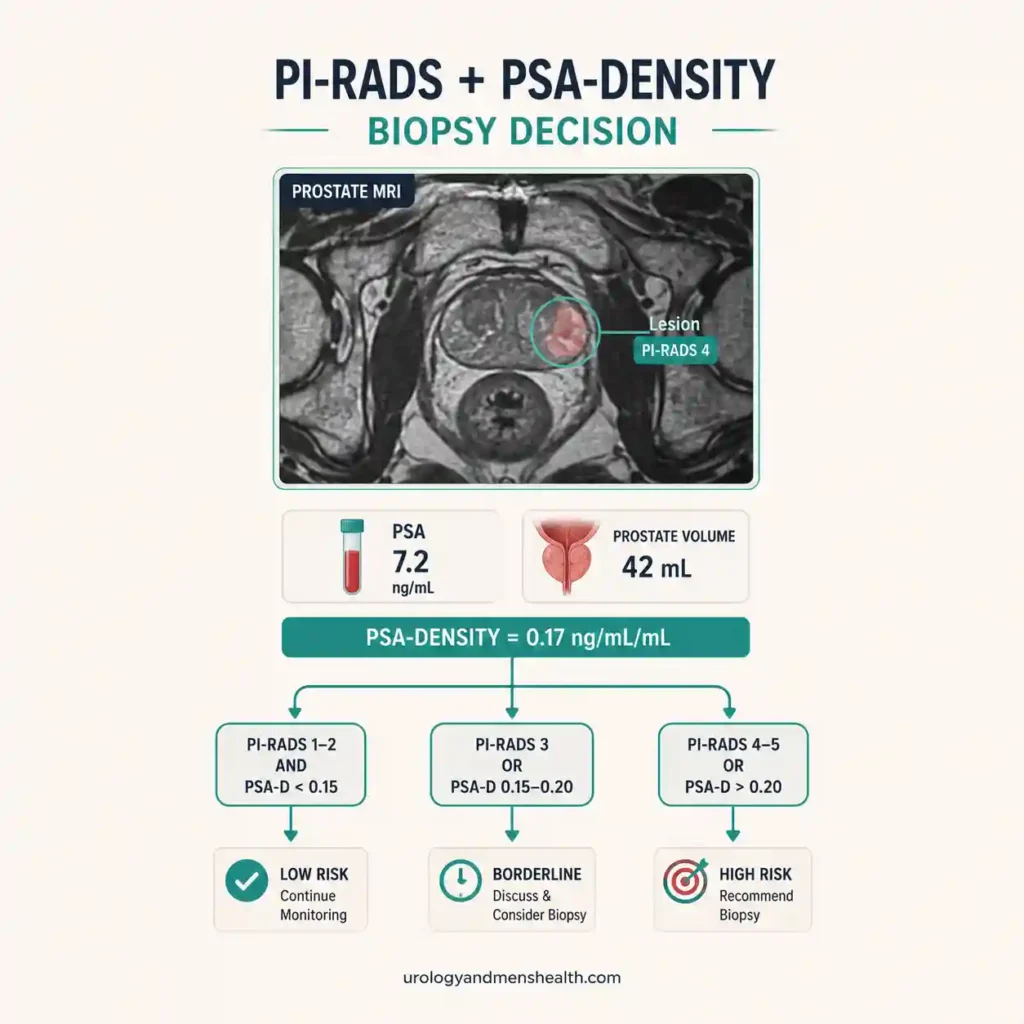
The Tool
Related Prostate Tools
Full Clinical Guide
In This Guide:
- Your MRI PI-RADS score and your PSA density together decide a biopsy far better than either number alone.
- PI-RADS 4 or 5 usually means a targeted biopsy; PI-RADS 1-2 with a low density can often be watched.
- PI-RADS 3 is the genuine fork – a PSA density above 0.15 ng/mL/cc pushes toward biopsy, below 0.10 pushes toward waiting.
- This is a framing aid, not a diagnosis – your family history, prior biopsies, and DRE still matter.
What This Tool Measures
This PI-RADS and PSA density biopsy decision tool combines the two strongest pre-biopsy predictors of clinically significant prostate cancer – meaning a Gleason 3+4 (Grade Group 2) tumor or higher, the kind worth finding. The first is your PI-RADS score, the 1-to-5 rating a radiologist assigns your multiparametric MRI. In pooled studies, significant cancer is found in roughly 4% of PI-RADS 1-2 men, 17% of PI-RADS 3, 46% of PI-RADS 4 and 75% of PI-RADS 5 [1]. The second is your PSA density – your PSA divided by your prostate volume. The tool maps your pair of values onto the biopsy pathways set out by the AUA/SUO [3] and the EAU [2]. If you are not sure what a PI-RADS 3 result means, read what a PI-RADS 3 score means.
The Physiology Behind Using Two Numbers
PSA on its own is a blunt instrument, because a large benign prostate produces more PSA without any cancer present. PSA density corrects for that: dividing the PSA by the prostate volume tells you how much PSA each cubic centimeter of gland is making. A man with a PSA of 6 and an 80 cc prostate (density 0.075) is in a very different position from a man with a PSA of 6 and a 30 cc prostate (density 0.20). The widely used cut-off is 0.15 ng/mL/cc. Below it, a negative MRI’s reassurance strengthens – its negative predictive value for significant cancer rises to around 90% [2]. Above it, even a clean-looking MRI carries a 27-40% chance of significant cancer, which is why density cannot be ignored [2]. The mechanics of the calculation are explained in prostate volume and PSA density, and you can compute your own with the PSA Density Calculator.
How to Interpret Your Result
The tool sorts you into one of four outcomes. Defer applies to a negative MRI with a low or intermediate density, or a PI-RADS 3 with a density under 0.10 – here significant cancer is uncommon and monitoring is the evidence-based path. Shared discussion applies to the true middle: a PI-RADS 3 with an intermediate density (roughly 0.10-0.15), or a negative MRI with a density above 0.15. Biopsy advised applies to PI-RADS 4 or 5, and to PI-RADS 3 with a density above 0.15, where a PSA density at or beyond 0.15 sharply enriches the share of men found to have significant cancer [4]. The fourth outcome, MRI first, appears when you have not had a scan yet – because the MRI reorganizes the entire decision and should come before any biopsy.
What to Do With Your Result
If your result was defer, agree a monitoring schedule with your doctor – typically a repeat PSA in 6 to 12 months, with the PSA density recalculated each time so a shrinking margin is caught early. If it was shared discussion, the next move is to complete any missing input (the MRI or the density) and then book a visit to weigh a targeted biopsy against watching, factoring in your family history and prior biopsies. If it was biopsy advised, the practical questions become the route – ideally an MRI-ultrasound fusion (targeted) biopsy – and the timing. And if a biopsy does find cancer, the grade it carries is what drives everything next; the Gleason Score Risk Interpreter explains what those numbers mean. If you are unsure about your result, the PDF report this tool generates gives you a ready-made framework to bring to your next appointment.
In My Practice
The result I spend the most time on is the negative MRI with a high PSA density. Men assume a clean scan ends the conversation, and I have to gently explain that a small, dense prostate can hide a significant cancer the MRI under-called – which is exactly why the guidelines still flag a density above 0.15 even when the scan reads clear.
A reassuring scan and a worrying density is the one combination where I push back against a man’s relief – because that is the pairing the evidence tells us not to dismiss.
References
- Park KJ, et al. Risk stratification of prostate cancer according to PI-RADS v2 category: systematic review and meta-analysis (13 studies, 4,265 men; significant-cancer detection 4% / 17% / 46% / 75% for categories 1-2 / 3 / 4 / 5). Journal of Urology, 2020.
- European Association of Urology. PSA density refines biopsy decisions; MRI negative predictive value rises to ~90% with PSA density <0.15, while negative MRI with density >0.15 still carries 27-40% risk of significant cancer. EAU Guidelines on Prostate Cancer – Diagnostic Evaluation.
- Wei JT, et al. Early Detection of Prostate Cancer: AUA/SUO Guideline, Part II – targeted biopsy for PI-RADS 3-5; PSA density >0.15 supports biopsy even after a negative MRI. Journal of Urology, 2023.
- PSA-density thresholds by PI-RADS category for biopsy decision-making (at density 0.15: significant-cancer probability ~3% / 15% / 52% / 77% across categories; PI-RADS 3 enriches above the 0.12-0.15 cut-off). European Radiology, 2026.
Frequently Asked Questions
Do I need both my PI-RADS score and my PSA density to use this?
No – the tool adapts. A PI-RADS 4 or 5 result points to a biopsy on the MRI alone, and if you have not had an MRI yet the tool tells you to get one first. PSA density only changes the answer for PI-RADS 1-2 and PI-RADS 3 results, where it does most of the work. If you have your MRI but not your density, you can get it from the PSA interpreter workflow and your prostate volume.
What exactly is a “clinically significant” prostate cancer?
It means a Gleason 3+4 (Grade Group 2) tumor or higher – cancer with enough aggressive pattern to warrant treatment or close surveillance. The opposite is Grade Group 1 (Gleason 6), which is so indolent that many urologists watch it rather than treat it. The whole point of combining MRI and PSA density is to find the significant cancers while sparing men a biopsy chasing the harmless ones.
Why is 0.15 the PSA density cut-off, and is it absolute?
0.15 ng/mL/cc is the threshold both major guideline bodies cite as the point where significant-cancer risk climbs enough to favor a biopsy. It is a guide, not a wall – some pathways act on 0.10 for an equivocal scan, and your family history, age, and PSA trend shift the line. Treat it as the center of a decision band rather than a pass/fail score, and let your overall risk picture inform it.
How accurate is this tool, and can I rely on it?
This tool maps your PI-RADS score and PSA density onto published AUA/SUO and EAU biopsy pathways, so its logic reflects current guidelines. But it cannot see your MRI images, your digital rectal exam, your prior biopsy results, or your genomic markers, all of which a urologist weighs. Use it to frame the decision and prepare your questions, then confirm the plan with your doctor using the MRI-first pathway as background.
How do I use this result at my doctor’s appointment?
Tap “Download My Report” to generate a two-page PDF with your PI-RADS score, PSA density, the recommended outcome, and a ready-made list of questions to ask. Bring it, along with your full MRI report and PSA history, to your urologist. It keeps the conversation focused on the actual decision – biopsy now, monitor, or complete a missing test – rather than starting from scratch.
Dr. Muhammad Khalid
MBBS · FCPS (Urology) · MCPS (General Surgery) · CHPE · CRSM · IMC #539472
Specialist urologist with 11+ years of clinical experience across tertiary teaching hospitals. Trained at Lady Reading Hospital and Khyber Teaching Hospital, Peshawar. Author or co-author of five peer-reviewed international publications, including in Cureus and the World Journal of Surgery. Procedural expertise: URS, PCNL, RIRS, TURP, TURBT, and major open urological surgery. Full profile →
This article is for educational purposes only and does not constitute medical advice. Always consult your physician or urologist for diagnosis and treatment decisions specific to your condition.