
Kidney Stone Surgery Selector: ESWL, URS or PCNL
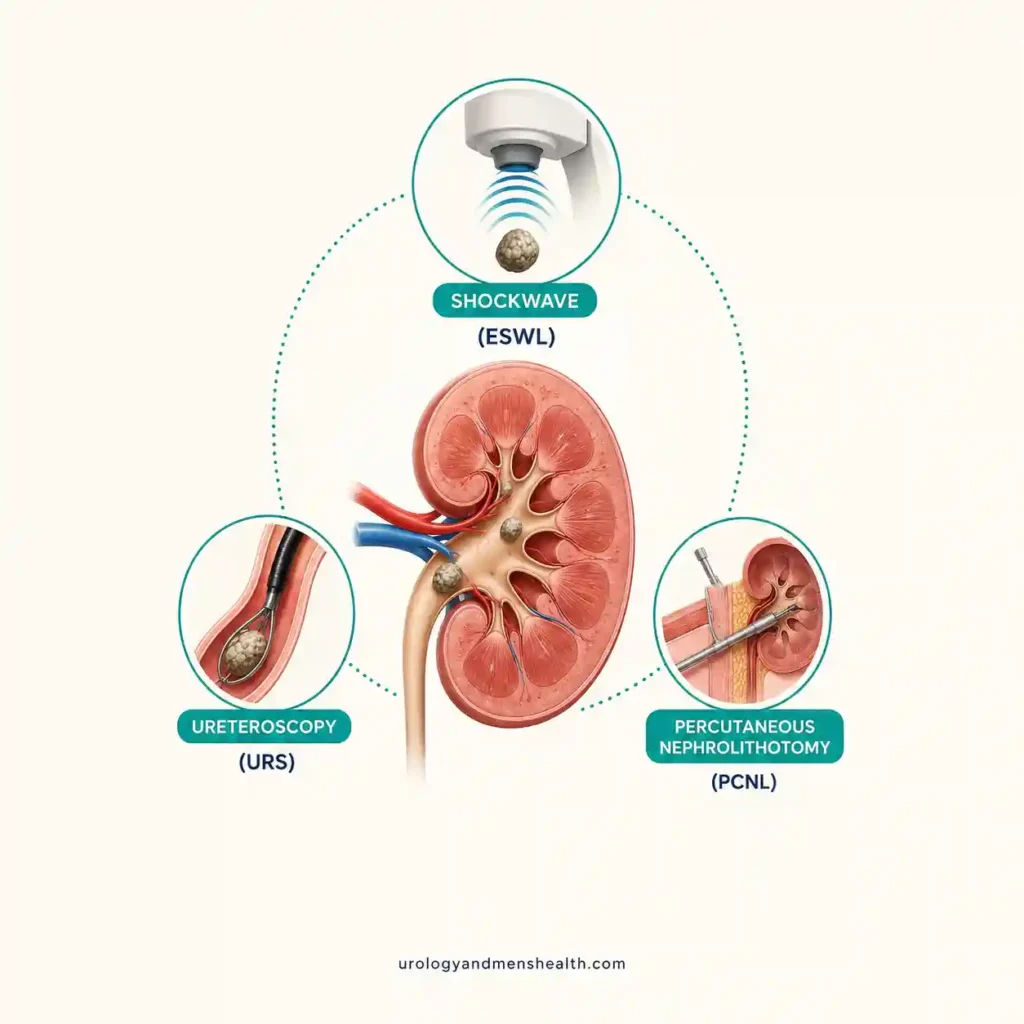
This kidney stone surgery selector helps you see which procedure - shockwave lithotripsy (ESWL), ureteroscopy (URS/RIRS), or percutaneous nephrolithotomy (PCNL) - usually fits a stone like yours, based on its size, location, and density. It is a planning aid, not a diagnosis, built to help you ask sharper questions before you decide. For the bigger picture, start at our kidney stones hub.

The Tool
Related Kidney Tools
Full Clinical Guide
In This Guide:
- Three numbers decide most of it: stone size in mm, location (ureter vs kidney, and which pole), and Hounsfield (HU) density on your CT.
- Shockwave (ESWL) suits small, favorable stones; ureteroscopy / RIRS is the workhorse for ureteral stones and dense or lower-pole kidney stones; PCNL is the standard once a stone passes about 20 mm.
- A blocked stone with fever is an emergency – the kidney is drained and treated for infection first, before any stone is removed.
- This is a planning aid, not a verdict – your urologist weighs anatomy, weight, and kidney function the tool cannot see.
What This Tool Measures
This kidney stone surgery selector maps your stone to the procedure urologists most often choose for it, following the American Urological Association (AUA) and European Association of Urology (EAU) guidelines on the surgical management of stones [1]. It is not a score and not a diagnosis. Instead it walks the same three-part logic a surgeon uses – is this an infection emergency, where is the stone, and how big and dense is it – and lands on the modality that fits: shockwave lithotripsy (ESWL), ureteroscopy (URS) and its flexible kidney form (RIRS), or percutaneous nephrolithotomy (PCNL). These three account for the large majority of stone operations; in the United States alone, more than 370,000 people had stone surgery in a single recent year, most of them ureteroscopy [1]. For a full plain-English breakdown of the procedures, see URS, PCNL and RIRS compared.
The Three Stone Surgeries, and How They Differ
Think of the three as increasing trade-offs between how invasive the procedure is and how reliably it clears the stone in one go. Shockwave lithotripsy (ESWL) sends focused sound waves through the skin to crack the stone – no incision, no scope, usually outpatient – but its one-pass clearance is the lowest, and it struggles with very dense stones (roughly above 1,000 Hounsfield units) and with stones in the lower pole of the kidney, where broken fragments tend to sit instead of draining [2][3]. Ureteroscopy (URS), and RIRS for kidney stones, threads a thin scope up the natural urinary tract and lasers the stone apart – because a holmium or thulium laser breaks any stone regardless of hardness, this is the dependable choice for ureteral stones and for the dense, cystine, or lower-pole kidney stones that defeat shockwave. PCNL removes the stone directly through a small incision in the back; it is the most involved but has the highest single-operation clearance, which is why it is reserved for the largest stones. Knowing your stone type sharpens this choice – the stone composition identifier can tell you whether you are likely dealing with a shockwave-resistant stone.
How to Read Your Result
The tool returns a verb-led recommendation and a confidence label rather than a number, because the choice is a match, not a measurement. A small upper-pole kidney stone with low density lands on shockwave – the gentlest route. A 12 mm lower-pole stone, a cystine stone, or any ureteral stone shifts to ureteroscopy or RIRS, because the laser does not care how hard the stone is, and lower-pole kidney stones clear far better with flexible ureteroscopy than with shockwave [4]. Anything past roughly 20 mm, or a branched staghorn stone, lands on PCNL as first-line, and the guidelines specifically advise against leading with shockwave for stones that large [1]. The one result that overrides all of this is the emergency path: a stone blocking the kidney alongside fever points to drainage and antibiotics first, with stone removal deferred until the infection settles. If shockwave is on the table for you, Read: Are you a good candidate for ESWL?
What to Do With Your Result
Bring two things to your appointment: your CT report (with the stone size in millimeters and its Hounsfield density) and the question of whether one procedure will clear the stone in a single session. If the tool pointed to shockwave, ask what happens if the stone does not fully break and whether a lower-pole or dense stone would do better with a scope. If it pointed to ureteroscopy or RIRS, ask about the stent – whether one is needed and for how long – since stent discomfort, not the stone, is what most people actually notice afterward. If it pointed to PCNL, ask about access tracts, bleeding risk, and the expected hospital stay. To see how the three procedures stack up on recovery and risk side by side, use the Read: Urology Surgery Comparison Tool. And if you are not yet sure surgery is even needed, the stone passage calculator estimates whether a smaller stone might clear on its own first. If you are unsure about your result, the PDF report this tool generates gives you a ready-made framework to bring to your next appointment.
In My Practice
The single most useful thing a patient can bring me is their CT report with the stone size in millimeters and its Hounsfield density. Those two numbers, plus where the stone sits, decide most of this conversation before we have even talked about preferences.
No surgery selector replaces that report or your urologist’s judgment – skin-to-stone distance, kidney anatomy, body weight, and whether you have a single working kidney all shift the choice. Use this tool to walk in informed and ask sharper questions, not to lock in an answer.
References
- Assimos D, et al. Surgical Management of Kidney and Ureteral Stones: AUA Guideline (2025/2026). American Urological Association. PCNL is first-line for renal stone burden over 20 mm; SWL is not recommended first-line at that size.
- EAU Guidelines on Urolithiasis (2025). European Association of Urology. SWL listed as a first-line option for renal stones up to 20 mm; endoscopic surgery preferred for lower-pole and ureteral stones.
- Wiener SV, et al. Role of Hounsfield Unit in predicting outcomes of shock wave lithotripsy for renal calculi: a systematic review. PMC (2023). SWL failure is strongly associated with stone density above 1,000 HU.
- Comparison of flexible ureterorenoscopy and SWL for lower-pole renal stones. NCBI PMC. Flexible ureteroscopy achieved a higher stone-free rate than SWL for 10-20 mm lower-pole stones.
Frequently Asked Questions
How is the right kidney stone surgery actually decided?
Does the hardness of my stone change which surgery I need?
Do I even need surgery, or could my stone pass on its own?
How accurate is this tool, and can I rely on it?
How do I use this result at my doctor’s appointment?
Dr. Muhammad Khalid
MBBS · FCPS (Urology) · MCPS (General Surgery) · CHPE · CRSM · IMC #539472
Specialist urologist with 11+ years of clinical experience across tertiary teaching hospitals. Trained at Lady Reading Hospital and Khyber Teaching Hospital, Peshawar. Author or co-author of five peer-reviewed international publications, including in Cureus and the World Journal of Surgery. Procedural expertise: URS, PCNL, RIRS, TURP, TURBT, and major open urological surgery. Full profile →
This article is for educational purposes only and does not constitute medical advice. Always consult your physician or urologist for diagnosis and treatment decisions specific to your condition.