
Calcium-Oxalate Meal Balancer: Pair Foods to Block Kidney Stones
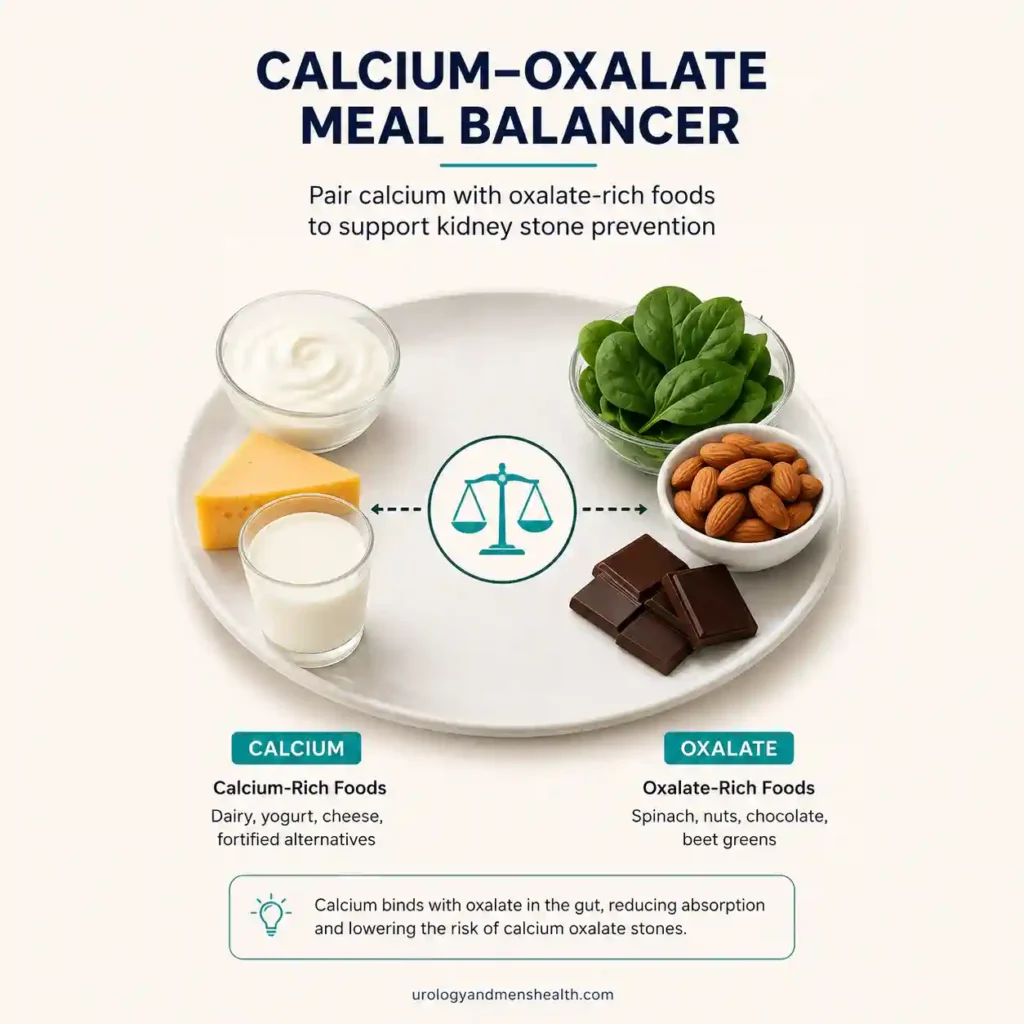
This calcium-oxalate meal balancer checks whether a single meal's oxalate is buffered by enough calcium to keep it out of your urine - the most evidence-based dietary defense against calcium oxalate kidney stones. Answer two or three quick questions about one meal and get a clear verdict plus your next step. For the full prevention picture, start at our kidney stones hub.

The Tool
Related Kidney Tools
Full Clinical Guide
In This Guide:
- Pairing beats avoiding. Eat a calcium food in the same meal as any high-oxalate food and most of the oxalate leaves in your stool, not your urine.
- Daily calcium of 1,000-1,200 mg is protective. Cutting out dairy is one of the most common stone-forming mistakes.
- A normal-calcium, low-sodium, low-animal-protein diet cut 5-year stone recurrence from 38% to 20% in a landmark trial.
- There is no “ratio” to hit. Consistent pairing and your daily totals do the real work, not any single meal’s math.
What This Tool Checks
The calcium-oxalate meal balancer is a fast decision aid: it looks at one meal and tells you whether its oxalate is being buffered by calcium, or whether it is heading into your urine where stones form. It deliberately does not give you a precise “calcium-to-oxalate ratio.” No validated dietary ratio target exists, and the one study that tested per-meal ratio and food sequence found they did not meaningfully change stone risk as long as daily calcium was adequate [3]. So instead of a false number, this tool checks the two things the evidence actually supports – did you pair calcium with the oxalate, and are you reaching your daily calcium target – and gives you a clear verdict. For the full dietary strategy behind it, read my kidney stone diet clinical protocol.
The Physiology: Why Pairing Beats Counting
Oxalate is a natural compound in many plant foods. What matters is where it ends up. When you eat calcium in the same meal, the two bind together in your intestine and the oxalate leaves your body in your stool – harmless. When you eat oxalate with little or no calcium, it is absorbed into your bloodstream and filtered out by your kidneys into your urine. There it can combine with the calcium already in your urine and crystallize into a stone. Roughly half of the oxalate in your urine comes from your diet [3], which is why this gut-level binding is such a direct lever. It also explains the most damaging myth in stone prevention – that cutting calcium helps. It does the opposite: less dietary calcium means more free oxalate absorbed and more in your urine. You can cross-check any food’s oxalate level with the oxalate food list.
How to Read Your Result
The tool returns one of three verdicts. Well buffered means the meal is either low in oxalate or paired with enough calcium to bind it – this is the pattern that keeps urinary oxalate down, and most calcium oxalate stones are preventable with it. Needs adjustment means there is a real, unbuffered oxalate load, usually because the calcium in the meal was too small or your daily calcium is short; the fix is to add calcium, not to cut the foods you enjoy. High-risk pairing means a heavy oxalate load with little calcium and a low daily total – the combination that drives the most oxalate into your urine, and the one most worth correcting first if you have ever passed a stone. None of these is a diagnosis; they tell you which habit to change. To see which foods most often cause trouble, read Foods That Cause Kidney Stones.
What to Do With Your Result
Whatever your verdict, two daily habits carry most of the protection. First, dietary calcium of 1,000-1,200 mg a day – about three servings of dairy or fortified alternatives, spread across meals – which both AUA and EAU guidelines recommend for calcium stone formers [1][2]. This is not optional protection: in a landmark trial, recurrent stone formers on a normal-calcium, low-sodium, low-animal-protein diet had a 5-year recurrence of 20%, versus 38% on a low-calcium diet [1]. Second, fluid – enough to keep your urine dilute, generally 2.5-3 liters (85-100 fl oz) a day; set your own target with the Hydration Calculator. If you have had more than one stone, the next concrete step is a 24-hour urine test, and confirming your stone type with the stone composition identifier tells you whether this oxalate strategy is even the right one for you. If you are unsure about your result, the PDF report this tool generates gives you a ready-made framework to bring to your next appointment.
In My Practice
One pattern I have learned to ask about directly is the “green smoothie” breakfast. A daily blend of raw spinach, almond butter, and berries can carry more oxalate than a stone former eats across the rest of the week combined – and it is almost never paired with calcium. Patients are genuinely surprised, because every ingredient feels healthy.
If there is one meal you eat most days, that is the one to run through this tool first. A small fix to a daily meal – adding yogurt, or swapping the spinach for a lower-oxalate green – outperforms perfect choices at meals you rarely repeat.
References
- Pearle MS, et al. Medical Management of Kidney Stones: AUA Guideline. Recommends 1,000-1,200 mg/day dietary calcium for calcium stone formers and reports the 20% vs 38% 5-year recurrence finding. American Urological Association.
- EAU Guidelines on Urolithiasis – Metabolic Evaluation and Recurrence Prevention. Recommends dietary calcium of 1,000-2,000 mg/day depending on oxalate, and pairing calcium with oxalate-rich foods. European Association of Urology.
- Lange JN, et al. The impact of dietary calcium and oxalate ratios on stone risk. Found that oxalate timing and the calcium-to-oxalate ratio did not significantly affect stone risk when recommended daily calcium was consumed; about 50% of urinary oxalate is dietary. PubMed.
- National Kidney Foundation. Kidney Stone Diet Plan and Prevention. Advises 1,000-1,200 mg/day calcium and eating calcium-rich and oxalate-rich foods together at meals. National Kidney Foundation.
Frequently Asked Questions
Why do I need calcium if I form calcium oxalate stones?
It feels backwards, but cutting calcium is the classic mistake. If little calcium is in the meal, the oxalate has nothing to bind to in your gut, so it is absorbed and dumped into your urine where it forms stones. Eating normal amounts of calcium with meals binds the oxalate so it leaves in your stool instead. See my kidney stone diet protocol for the full reasoning.
Which foods are highest in oxalate?
The heaviest hitters are spinach, rhubarb, almonds, beets, and Swiss chard – high enough that even good pairing may not fully buffer them for recurrent stone formers. Potatoes, sweet potatoes, berries, soy, chocolate, and strong tea are moderate and are usually fine when paired with calcium. Exact values vary between databases, so use categories rather than chasing numbers; the oxalate food list sorts them for you.
Is there a target calcium-to-oxalate ratio I should hit?
No, and that is deliberate. There is no validated dietary calcium-to-oxalate ratio, and the study that tested per-meal ratio and food sequence found neither significantly changed stone risk when daily calcium was adequate. So aim for the habits that are proven instead: pair calcium with high-oxalate foods, and reach 1,000-1,200 mg of calcium a day. If you want to know your actual stone type first, use the stone composition identifier.
How accurate is this tool, and can I rely on it?
It is a screening aid, not a diagnosis. Its logic follows AUA and EAU dietary guidance, but it works from your description of one meal, not from a measurement of your urine. The only way to know your true oxalate and calcium levels is a 24-hour urine test. Treat the result as a prompt to act and a conversation starter, and if you form stones repeatedly, see the recurrent stone metabolic workup.
How do I use this result at my doctor’s appointment?
Use the Download My Report button to generate a two-page PDF with your meal verdict, your next steps, and questions to ask your doctor. Bring it to your primary care doctor or urologist – it gives them a quick picture of your dietary pattern and saves appointment time. Pair it with the routine review in the stone prevention compliance tracker to show how consistent your habits are.
Dr. Muhammad Khalid
MBBS · FCPS (Urology) · MCPS (General Surgery) · CHPE · CRSM · IMC #539472
Specialist urologist with 11+ years of clinical experience across tertiary teaching hospitals. Trained at Lady Reading Hospital and Khyber Teaching Hospital, Peshawar. Author or co-author of five peer-reviewed international publications, including in Cureus and the World Journal of Surgery. Procedural expertise: URS, PCNL, RIRS, TURP, TURBT, and major open urological surgery. Full profile →
This article is for educational purposes only and does not constitute medical advice. Always consult your physician or urologist for diagnosis and treatment decisions specific to your condition.